
Overview
MINDS (MS, mid-to-high-end fully custom commercial printing) uses three blunt checkpoints before printing: first purpose, then hand feel, then finishing
・① Purpose: For jobs that need strong color, such as photos, illustrations, and food packaging, look at gloss film first
・② Hand feel: For brand cards, invitation cards, and higher-priced packaging that need a quieter, refined texture, look at matte film or soft-touch film first
・③ Finishing: For jobs with hot stamping, spot gloss, crease lines, or gluing, confirm film compatibility first. Do not judge only by a pretty sample
What Does Lamination Actually Protect?
Lamination means applying a thin film to the printed paper surface with heat and pressure. It improves resistance to water, dirt, scratches, and handling changes, while also changing gloss, reflection, and the tactile impression
When I look at lamination on the production floor, I usually do not start by asking "which one feels more premium." I ask how the printed piece will be used
・Flyers are usually flipped through quickly, so the dirt resistance and color performance of gloss film are very practical
・Catalogs are read while people sit down and spend time with them, so the lower glare of matte film is easier on the eyes
・Outer boxes are picked up, put down, opened, and closed. Anti-scratch film and crease handling matter more than simply looking good
・Gift boxes or higher-priced products are touched. That is where the value of soft-touch film shifts from visual to tactile
In finishing, lamination is a high-value process for the cost, but it is not an all-purpose shield. Once a sheet is laminated, folding, stamping, coating, and gluing all behave differently. That is where many jobs start to go wrong
How Should You Choose Common Film Types?
For the film types most often seen in Taiwan commercial printing, I usually start with 4 options: gloss film, matte film, soft-touch film, and anti-scratch film
・Gloss film: High gloss, good clarity, and color that appears more vivid. Best for food packaging, event posters, photography, and visuals that need to catch the eye right away
・Matte film: Low reflection and a quiet surface. Good for text-heavy catalogs, brand manuals, invitation cards, and premium-feel packaging
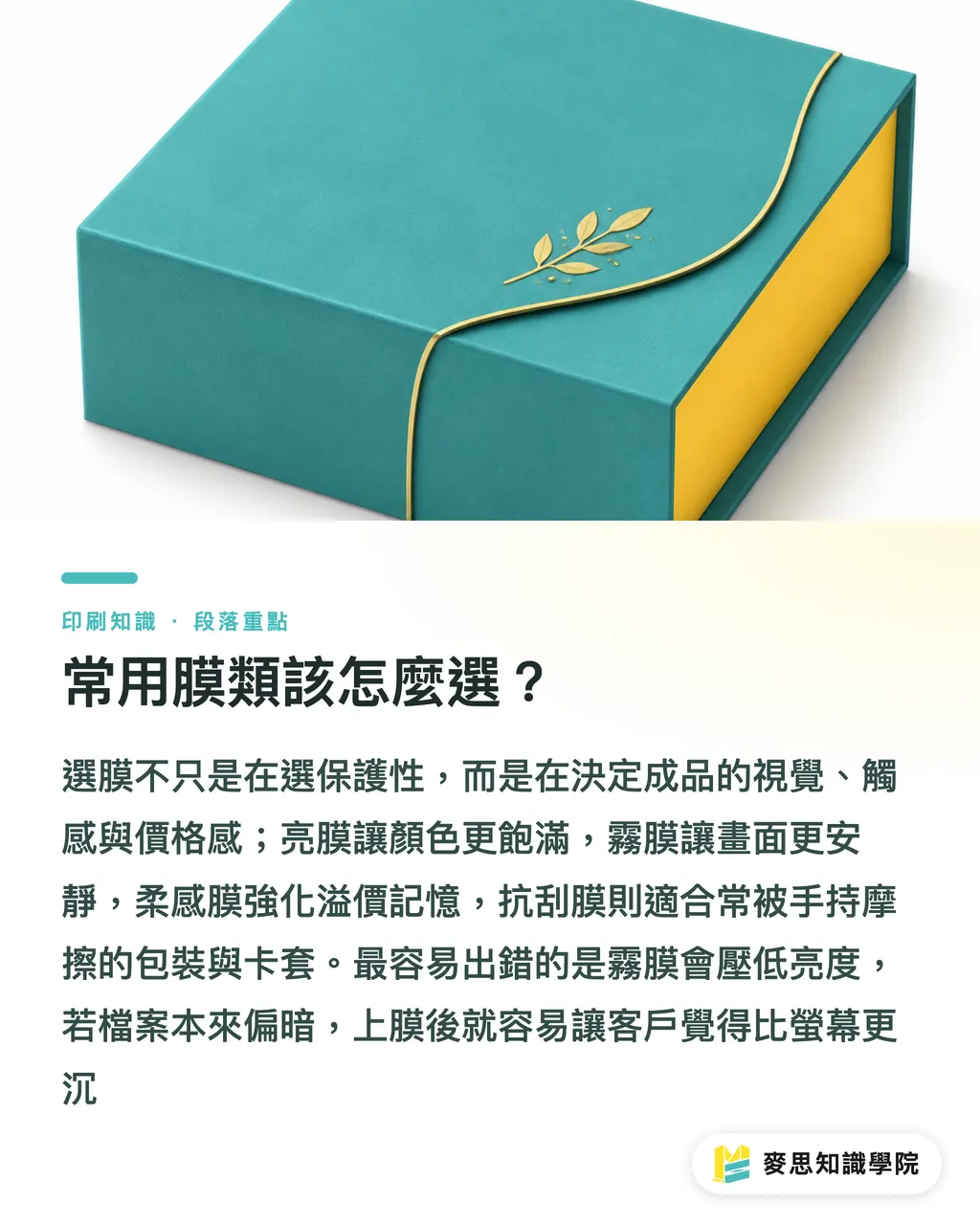
・Soft-touch film: A feel close to velvet, sometimes casually called a fabric-texture film. Common on higher-priced outer boxes, membership cards, and brand proposal materials. The sense of added value is clear
・Anti-scratch film: Wear-resistant, less likely to show fingerprints and scuff marks. Good for packaging, card sleeves, hang tags, and display samples that are handled often
Gloss film makes color look full more easily, but scratches and fingerprints also show more clearly on large dark areas. A black outer box makes this obvious as soon as someone picks it up
Matte film is a designer favorite because the image looks clean and does not compete with the text. But matte film slightly lowers perceived brightness. If the file is already dark, printing it and then adding matte film often makes the client ask why it looks heavier than it did on screen
I do not recommend treating soft-touch film as a general protective film. It is more like part of the packaging's price positioning. Whether that first touch leaves a memory directly affects how consumers imagine the product's price
What Is the Difference Between Water-Based and Solvent-Based Film?
In practice, the difference between water-based film and solvent-based film usually comes down to 2 things: environmental positioning and adhesion
・Water-based film: Easier to plan around degradability, low odor, and environmental claims. Suitable for printed materials where the brand cares about sustainability messaging
・Solvent-based film: Usually has stronger adhesion. It tends to be more stable for jobs with heavier ink coverage, full-bleed dark colors, or more complex finishing
Buyers often ask me, "Is water-based film always better?" My answer is usually cautious. Environmental performance depends on the actual film material, supplier specifications, and final use. Do not judge from the name alone
If a brand wants to include environmental messaging in its packaging communication, MINDS usually recommends confirming 3 things first
・Whether the film material comes with clear supplier specifications
・Whether later hot stamping, spot gloss, and gluing can be processed reliably
・Whether the client truly needs lamination, or whether paper choice, coating, or structural design could solve the issue instead
Sometimes using one less layer of film is cleaner than switching to another film. In sustainable packaging work, that sentence is very real
How Do Hot Stamping, Spot Gloss, and Crease Lines Affect Film Choice?
The biggest risk in choosing film is judging only from a single sample and leaving finishing out of the decision. The film surface affects hot-stamp adhesion, spot-gloss contrast, cracking along folds, and glue strength
・Hot stamping: In practice, gloss film is often recommended because the film surface makes it easier to get a clean metallic look. Still, the foil, temperature, pressure, and artwork detail all matter
・Spot gloss: Works best with matte film for contrast. A glossy pattern rising from a matte base makes the LOGO, lines, and selected graphics read more clearly
・Crease lines: Laminated paper pulls on the film layer more when folded. Thick paper, full-bleed dark color, and outer-box structures must be creased first
・Gluing: If the film surface is too slick or has low surface energy, the glue seam may be unstable. Do adhesion testing before mass production of paper boxes
I have seen plenty of beautiful packaging where the visual proof was almost fine, only for the job to get stuck on one crease line. The lid cracked after being opened twice. The client will not know at first glance that this is a finishing-sequence problem. They will just think the printing quality is poor
If the file already includes hot stamping, spot gloss, a die line, and crease lines, it is worth having the Mai Strategy Knowledge Academy consulting team review the finishing sequence before printing. This check does not take much time, but it often avoids problems that only show up after mass production
Three Common Failure Points and the Current State of Eco Paper-Based Film
Most lamination issues do not come from a single cause. Film material, temperature, pressure, humidity, paper, and ink layer usually act together. On the production floor, troubleshooting starts with the symptom and works backward through the process
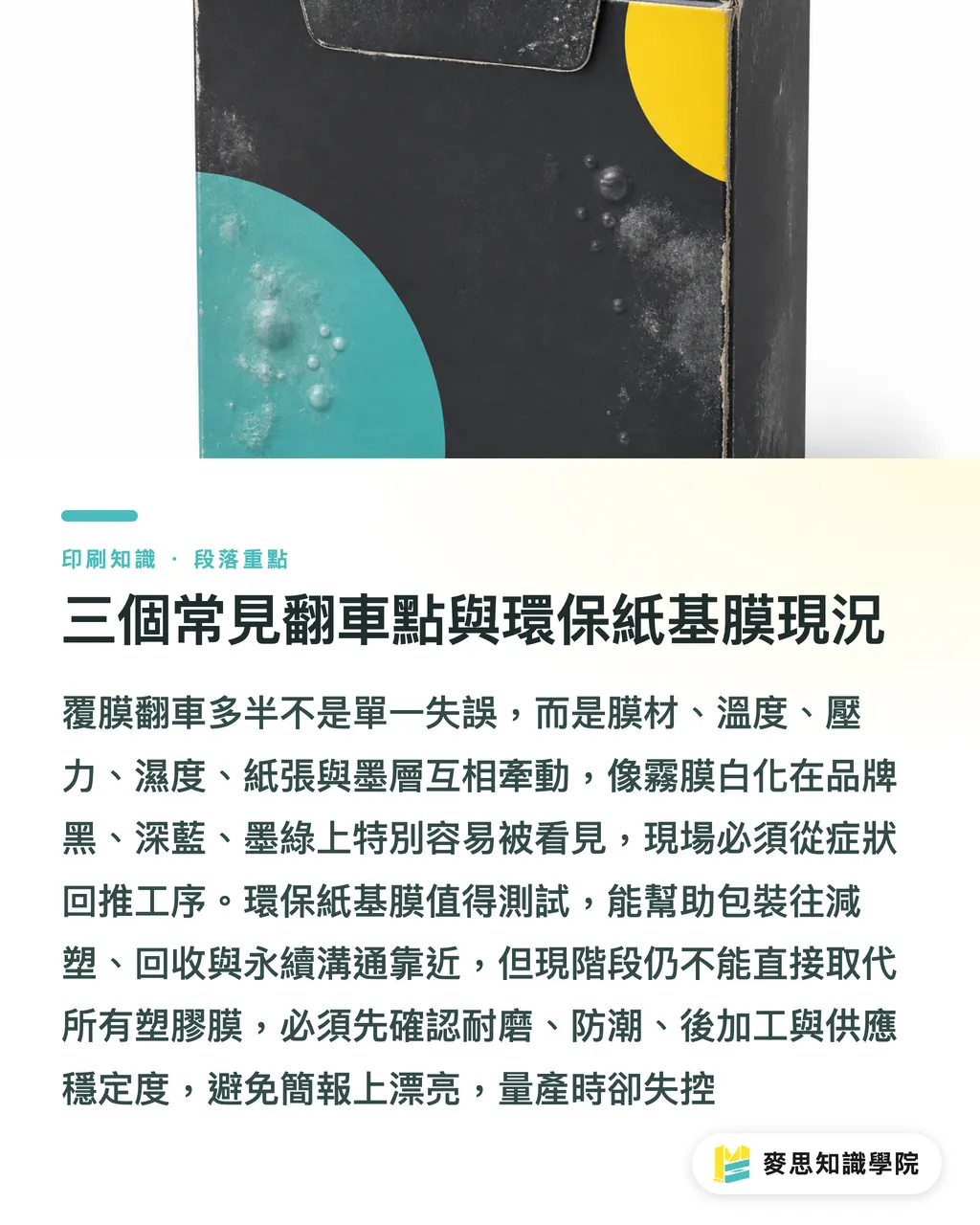
・Matte film whitening: Common causes include unstable humidity or temperature control. Once a matte surface turns pale, brand black, deep blue, and dark green are the colors that expose it fastest
・Gloss film bubbling: Common causes include insufficient lamination pressure, incorrect temperature, or ink that has not fully dried. Full-bleed dark color and large solid areas need extra attention
・Cracking after folding laminated sheets: A common cause is failing to crease first. Outer boxes, belly bands, thick cards, and full-bleed dark designs are where this happens most often
Eco paper-based film has been discussed more in recent years. My view is that it is worth testing, but it should not be treated as a direct replacement for every plastic film
The direction of paper-based film is clear: help packaging move closer to plastic reduction, recycling, and brand sustainability communication. At this stage, though, 4 limits still need to be checked
・Whether the wear resistance meets the needs of handheld packaging
・Whether the moisture resistance can handle shipping and storage
・Whether finishing can reliably connect with hot stamping, spot gloss, gluing, and crease lines
・Whether supply is stable enough to support long-term reprints for the same brand
The biggest risk with environmental materials is that they look good in the proposal deck, then fail to run steadily on the production line. A print consultant's job is to say the hard parts early, between good design, controlled cost, and workable finishing
Key Takeaways
・Gloss film is for color saturation. Matte film is for reading. Soft-touch film is for hand feel. Anti-scratch film is for durability
・Lamination is not a final decoration. It changes the result of hot stamping, spot gloss, crease lines, and gluing
・Matte film looks premium, but it darkens color. Set expectations early for dark artwork
・Soft-touch film is good for selling a price impression. It should not be thrown in as a general protective film
・Eco film materials need processing tests first. You cannot judge sustainability by the name alone
Further Thinking
Print manufacturing, design, AI applications, and SaaS all need to get film selection right together. The first step is not asking the client to choose a film name on a form. It is asking about purpose, touch frequency, finishing items, crease-line positions, and environmental requirements, then turning the MINDS (MS) three checkpoints into a preprint review process. For small and midsize businesses, if these 5 questions are answered before quoting, what gets reduced later is not communication cost. It is the risk of reprinting the whole batch
FAQ
- Which is better for catalogs, gloss film or matte film?
- For text-heavy catalogs that need to be read for longer periods, matte film is usually the better choice because it has low glare and is more comfortable to read. If the catalog is built around photos, dishes, or product color, gloss film will make the color look more vivid
- Is soft-touch film suitable for all premium packaging?
- Soft-touch film suits higher-priced packaging that needs a memorable tactile impression, but it is not right for jobs that only need basic protection. If the packaging will face frequent rubbing or a rough distribution environment, test wear resistance and fingerprint performance first
- Why do colors look darker after matte film is applied?
- The low-reflection surface of matte film makes the image feel quieter, and it may also reduce the perceived saturation and brightness. Full-bleed dark colors, low-contrast photos, and black-background designs should be checked during proofing
- Do printed pieces with hot stamping always need gloss film?
- Gloss film is often recommended for hot stamping because the film surface makes it easier to get a clean metallic look. If matte film or soft-touch film is used instead, test the foil, temperature, pressure, and fine-line adhesion first
- Can eco paper-based film fully replace regular lamination?
- Eco paper-based film has value for plastic reduction and sustainability messaging, but wear resistance, moisture resistance, finishing compatibility, and supply stability still need to be checked. Testing before mass production matters more than writing environmental claims in the copy
Related articles


The Print × AI weekly
The print and AI know-how designers, brands and enterprises can use before they commit — one email, every week
MINDS Free Tools
Spine width and imposition calculators — skip the manual math, free in your browser.
MINDS Group
Need actual printing or gifting services?
From premium printing to online ordering and festive gifts — the MINDS Group sister brands take it from here.