
How Should You Compare Green Printing Quotes?
Green printing quotes should be compared using the "MINDS Printing (MS, mid-to-high-end fully customized commercial printing) Green Print Quote Comparison Eight Fields." The total price is only the starting point. Procurement teams need to check paper sourcing, printing method, ink options, finishing, waste control, certification documents, proofing, and delivery terms at the same time to confirm that all 3 printers are quoting the same set of specifications
Green printing quote: a document in which a printer includes paper sourcing, printing method, ink, finishing, spoilage, certification documents, proofing, and delivery terms in the estimate, used to determine whether the environmental requirements and commercial costs both hold up
The mistake I see most often on-site is procurement comparing only the final line on 3 quotation sheets, without noticing that Printer A quoted standard white card, Printer B quoted FSC-certified paper, and Printer C priced coating and delivery separately. Comparing prices this way only distorts the decision
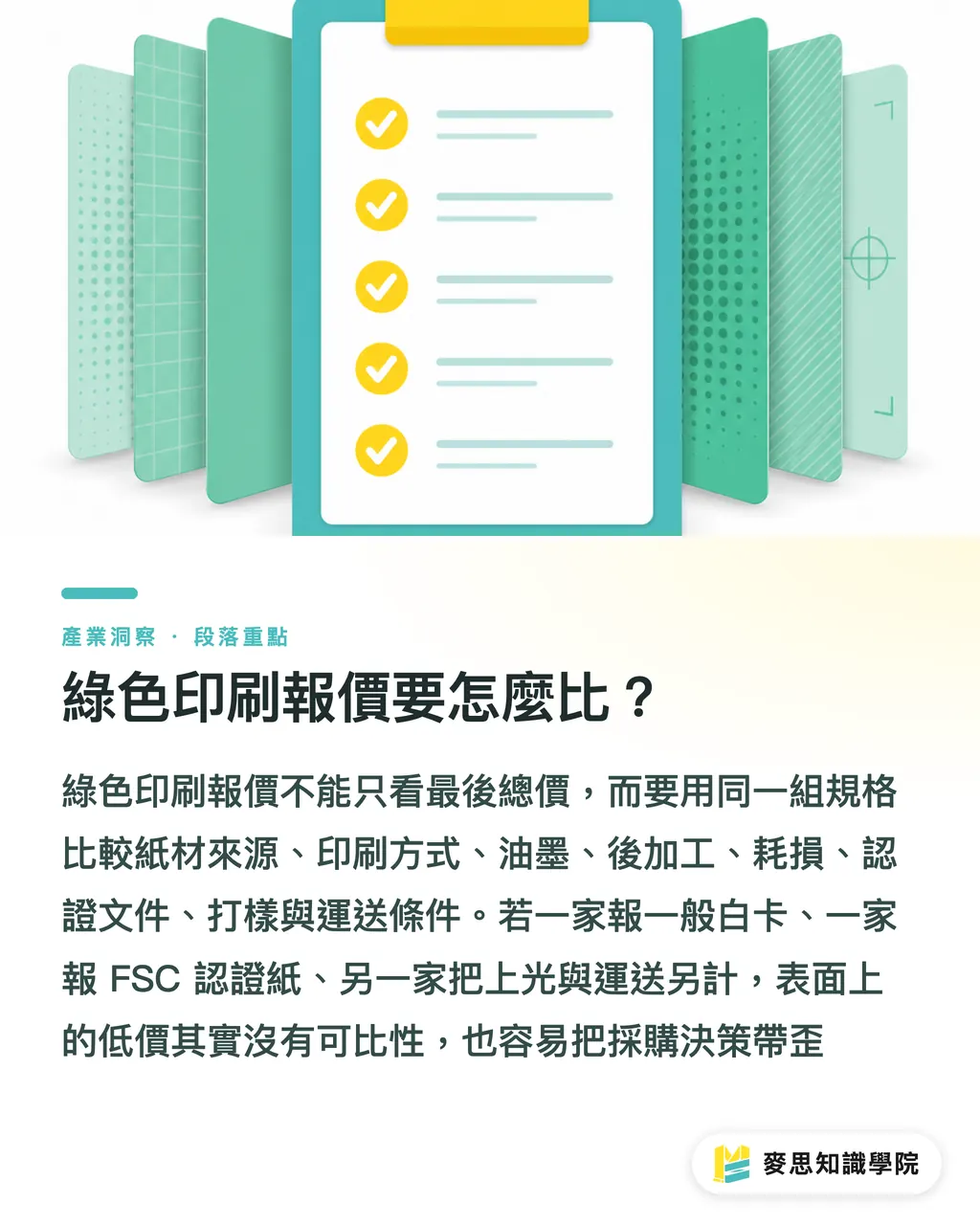
Why Can the Same Green Printing Job Vary So Much in Price?
Using the MINDS Printing (MS) Green Print Quote Comparison Eight Fields, price differences in green printing usually come from specification differences, not necessarily from one vendor being expensive or cheap. For the same 1,000 brand catalogs, digital printing, gang-run printing, and dedicated plate printing all differ in spoilage, color stability, and unit cost
Paper can also distort quotes very easily. The same line item of 250gsm white card may refer to standard paper, FSC-certified paper, recycled paper, or traceable batch-number paper, each with completely different supply conditions and lead times. If procurement only looks at gsm, two different papers may be treated as the same paper
Ink and finishing also need to be evaluated together. Vegetable oil-based ink paired with heavy lamination is not necessarily more eco-friendly than standard ink paired with a recyclable design. If a printer is willing to clearly state ink limitations, drying time, and coating method, that quote is often more worth reading carefully
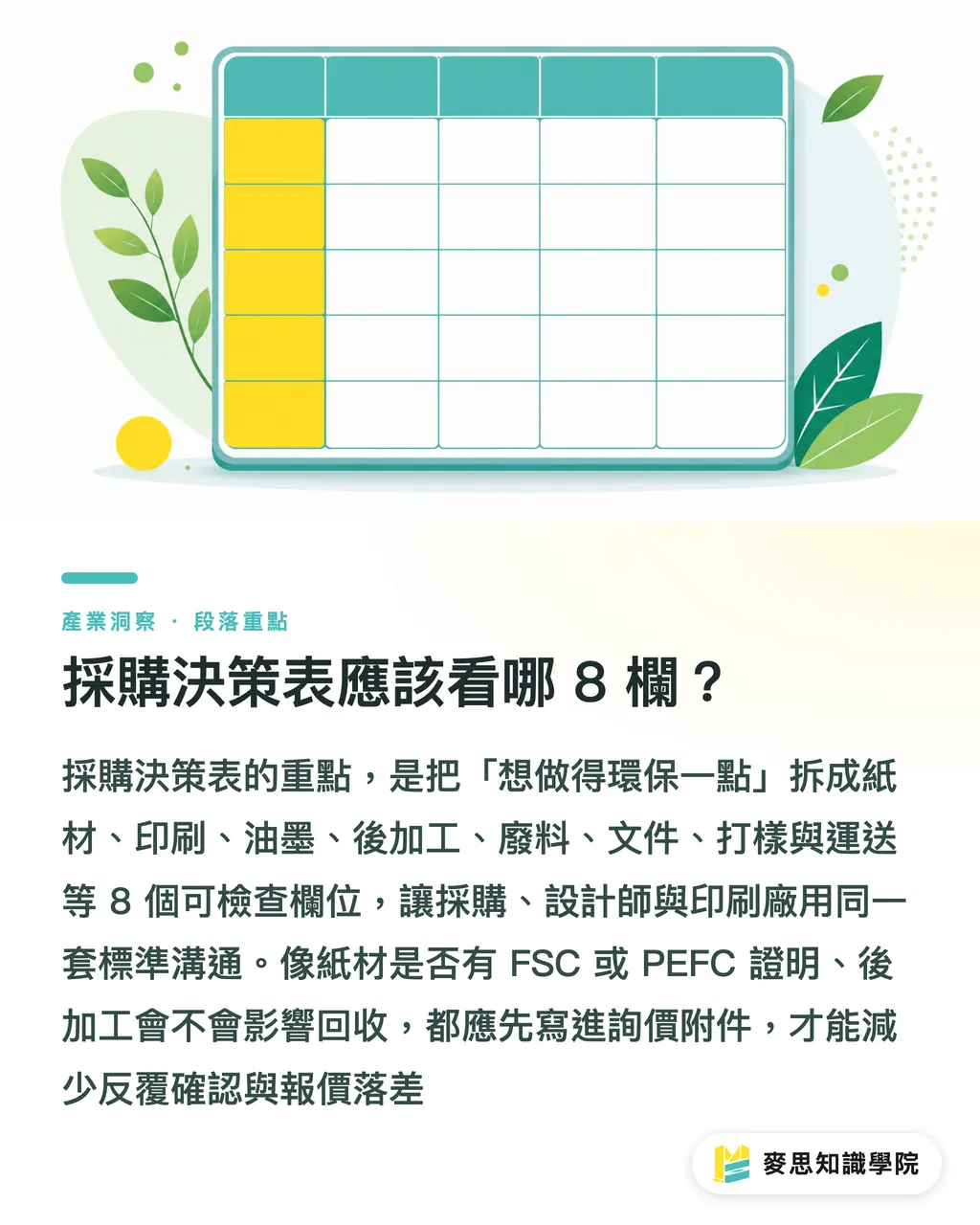
Which 8 Fields Should a Procurement Decision Table Include?
The purpose of the MINDS Printing (MS) Green Print Quote Comparison Eight Fields is to turn a vague request for "something more eco-friendly" into 8 checkable fields, so procurement, designers, and printers are discussing the same thing
・Paper sourcing: paper name, gsm, whether it is FSC or PEFC, whether it is recycled paper, and whether batch numbers or supplier documents can be provided
・Printing method: digital printing, offset printing, gang-run printing, or dedicated plate printing, with quantity ranges specified, because the approach may differ between 500 copies and 5,000 copies
・Ink options: standard ink, vegetable oil-based ink, or low-VOC options, with confirmation of color limitations and drying time
・Finishing: lamination, coating, foil stamping, embossing, die cutting, and binding, checked item by item for whether they affect recycling or disassembly
・Waste control: whether gang-run printing is used, whether proofing spoilage is included, and whether extra backup copies will be printed. The quote should clearly state whether spoilage is included or billed separately
・Certification documents: whether paper certificates, supplier documents, and CoC-related materials are provided, and whether document fees are included in the quote
・Proofing terms: PDF soft proof, digital proof, or 1:1 physical proof, with clear indication of which is included and which is charged separately
・Delivery terms: single-location delivery, staggered delivery, delivery to 3 addresses, packaging method, and rush fees should all be listed in the same table
If the project is a mid-to-high-end catalog, brand packaging, or corporate ESG use case, MINDS Printing usually recommends organizing these 8 fields into an inquiry attachment first, then asking printers to fill it in. This saves far more back-and-forth than simply writing "please quote eco-friendly materials."
Which Specifications Are Most Often Mixed Up During Comparison?
In the MINDS Printing (MS) Green Print Quote Comparison Eight Fields, paper is the most error-prone field, because procurement teams often treat "eco-friendly paper" as a single item. In practice, it should be separated into at least 4 conditions: standard paper, certified paper, recycled paper, and specialty paper. Once the paper changes, color, die cutting, fold lines, and lead time change with it
The second common source of error is finishing. On a designer's layout, something may simply look a little glossier, thicker, or more refined. On the production line, it may mean 4 separate processes: lamination, spot UV, foil stamping, and embossing. Each process changes the cost and may also change recyclability
The third source of error is proofing. Some quotes include PDF proofing, some include a digital proof, and some include a 1:1 physical proof. These 3 proof types serve different purposes: PDF checks layout, digital proof checks the general color feel, and physical proof is closest to the final material and finishing state
The fourth source of error is delivery. Delivering to 1 location and distributing to 3 locations are not the same cost. If rush handling, carton labels, and staggered warehouse receiving are also involved, the delivery field in a green printing quote cannot simply say "shipping included."
How Can Designers and Companies Make Their RFQs More Accurate?
Use the "MINDS Printing (MS) Three Gates for Green Print RFQs" when sending inquiries. The first gate is matching specifications, the second is checking proof, and the third is calculating the full cost. Only when these 3 things are done does a quote become meaningfully comparable
・① Matching specifications: use the same dieline, dimensions, page count, color count, paper, quantity, and finishing, so Printer A does not quote a simplified version while Printer B quotes the complete version
・② Checking proof: ask the printer to list paper certificates, certification documents, ink options, and the deliverables they can provide, rather than simply writing eco-friendly materials
・③ Calculating full cost: include proofing, artwork revisions, backup copies, waste handling, staggered delivery, and rush fees in the same decision table
Designers can also reduce costs at the file stage. For example, they can replace large full-bleed areas of dark color with a more stable color-block strategy, reduce unnecessary lamination, and make sure fold lines avoid heavy-ink areas. These actions may not lower the unit price, but they can reduce the likelihood of reprints and scrapping
For AI and SaaS teams building print quote comparison tools, I would recommend starting with field structure instead of only reading the total price inside a PDF. At minimum, the system should store 8 specification fields, 1 certification attachment list, and 1 version record. Otherwise, automated quote comparison can easily treat different specifications as the same job
Key Takeaways
・For green printing quote comparisons, align the specifications first, then discuss who is expensive or cheap
・A cheap quote without certification documents often just pushes the risk to right before delivery
・Paper, ink, and finishing must be evaluated together. Focusing on one green material in isolation can easily waste effort
・The more detailed the procurement decision table is, the more effectively printers can propose truly workable alternatives
Further Thinking
For print manufacturers, green printing quotes need to shift from "quoting a price" to "explaining a set of conditions." For designers, every layer of finishing in the file needs to be understood in terms of its production-line cost. For AI and SaaS teams, the most valuable work is not a polished total-price comparison, but breaking paper, ink, finishing, proof, and logistics into fields that can be checked, traced, and filled back in. For corporate procurement teams, the next step is simple: turn your most recent quote into an 8-field decision table, then take it to 3 printers
FAQ
- Can green printing quotes be compared by unit price alone?
- Not recommended. A green printing quote should at least compare paper sourcing, printing method, ink, finishing, certification documents, proofing, and delivery terms at the same time. If the unit price is low but the specifications differ, it has no real procurement decision value
- Can FSC-certified paper and standard paper be compared together?
- No. FSC-certified paper and standard paper have different supply conditions, documentation requirements, and cost bases. Procurement should compare them as two separate specifications, or require all printers to quote using the same paper
- Is green printing always more expensive?
- Not necessarily. Removing one unnecessary lamination process, switching to a more suitable printing method, or consolidating staggered deliveries may all reduce total cost. The key is to look at the full specification, not just one material
- What should designers prepare before comparing green printing quotes?
- Designers should first prepare dimensions, page count, color count, paper direction, finishing, quantity, proofing needs, and delivery method. The more complete these 8 types of information are, the less likely the printer's quote is to be distorted
Related articles



The Print × AI weekly
The print and AI know-how designers, brands and enterprises can use before they commit — one email, every week
MINDS Free Tools
AI background removal, a LINE sticker maker, spine & imposition calculators — all free, right in your browser, no upload.
MINDS Group
Need actual printing or gifting services?
From premium printing to online ordering and festive gifts — the MINDS Group sister brands take it from here.