
What Exactly Did DS Smith Do with the 'Birth Tree' Gift Box?
Let's first clarify the core framework of this project so the keyword 'sustainability' doesn't obscure the main point
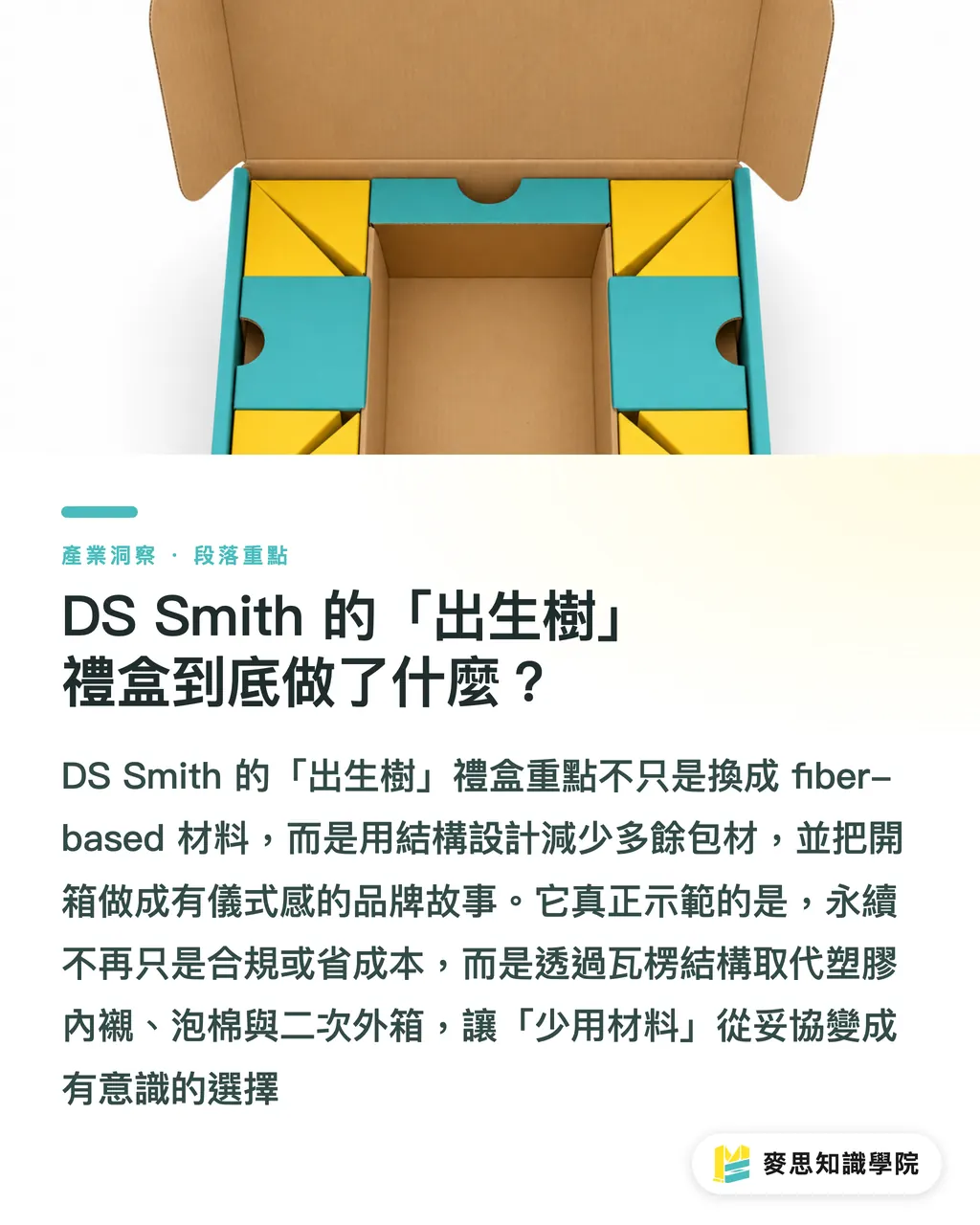
DS Smith designed a gift box for the 'Birth Tree' project. Using fiber-based materials as the primary substrate, they replaced excess packaging through clever structural design, turning the unboxing experience into a ritual. The key isn't how green the material is, but how they directly wove sustainability into the brand story, rather than just slapping an 'eco-friendly' sticker on the outer box
Looking at projects from US and European clients over the past year or two, this is the biggest shift I've noticed. Sustainability used to be the compliance department's headache; now, it's a selling point that marketing teams are fighting for. Take the same fiber-based paperbox: in the past, it was 'forced to use recycled materials to cut costs'; today, it is 'our deliberate choice of a minimalist material aesthetic.' The material hasn't changed, but the narrative has, shifting the consumer's perception from a 'compromise' to a 'conscious choice.'
Here is a technical detail that is easily overlooked: DS Smith is one of the few industry giants that markets 'structural design as a packaging replacement' as a core competency. Their logic is to use the load-bearing and cushioning properties of corrugated structures to eliminate plastic trays, foam inserts, and secondary outer cartons. One less material layer means lower costs, fewer recycling hassles, and one less flaw that could draw criticism for 'over-packaging' during the unboxing
Why Sustainable Packaging Has Shifted from a Cost Item to a Brand Asset
The key lies in who pays for it and how consumers interpret that 'restraint.'
Regulatory pressure in export markets is undeniably tightening. Legislation like California's SB 54, an Extended Producer Responsibility (EPR) law, places the responsibility for managing packaging waste squarely on the brand owners. In other words, over-packaging is no longer just a target for environmental group complaints; it will translate into actual financial liabilities. When 'reduction' shifts from an ethical plea to a financial reality, brands pay attention
However, the brilliance of DS Smith's project is that they didn't treat reduction as forced damage control; instead, they turned it into a design language. I often tell the technicians on the production line: the difference between material restraint and cutting corners lies entirely in whether it has been thoughtfully designed. A thin box without design feels cheap, but a thin box with calculated structure and elegant negative space is minimalist art
For brands, the benefits of this approach are highly practical:
・Cost aspect: Eliminating a layer of inserts and secondary packaging directly drives down unit packaging costs
・Compliance aspect: Monomaterial fiber-based packaging is highly recyclable, dodging the penalty risks that EPR regulations impose on multi-material formats
・Marketing aspect: The 'wow, this is so simple' reaction during unboxing is itself a shareable, photo-worthy touchpoint
Solving three problems with a single design decision, that is the true lesson of this case study
Is Unboxing Ritual Just a Gimmick, or Does It Actually Work?
It actually works, but only if you design it during the pre-press structural phase rather than trying to patch it up afterward
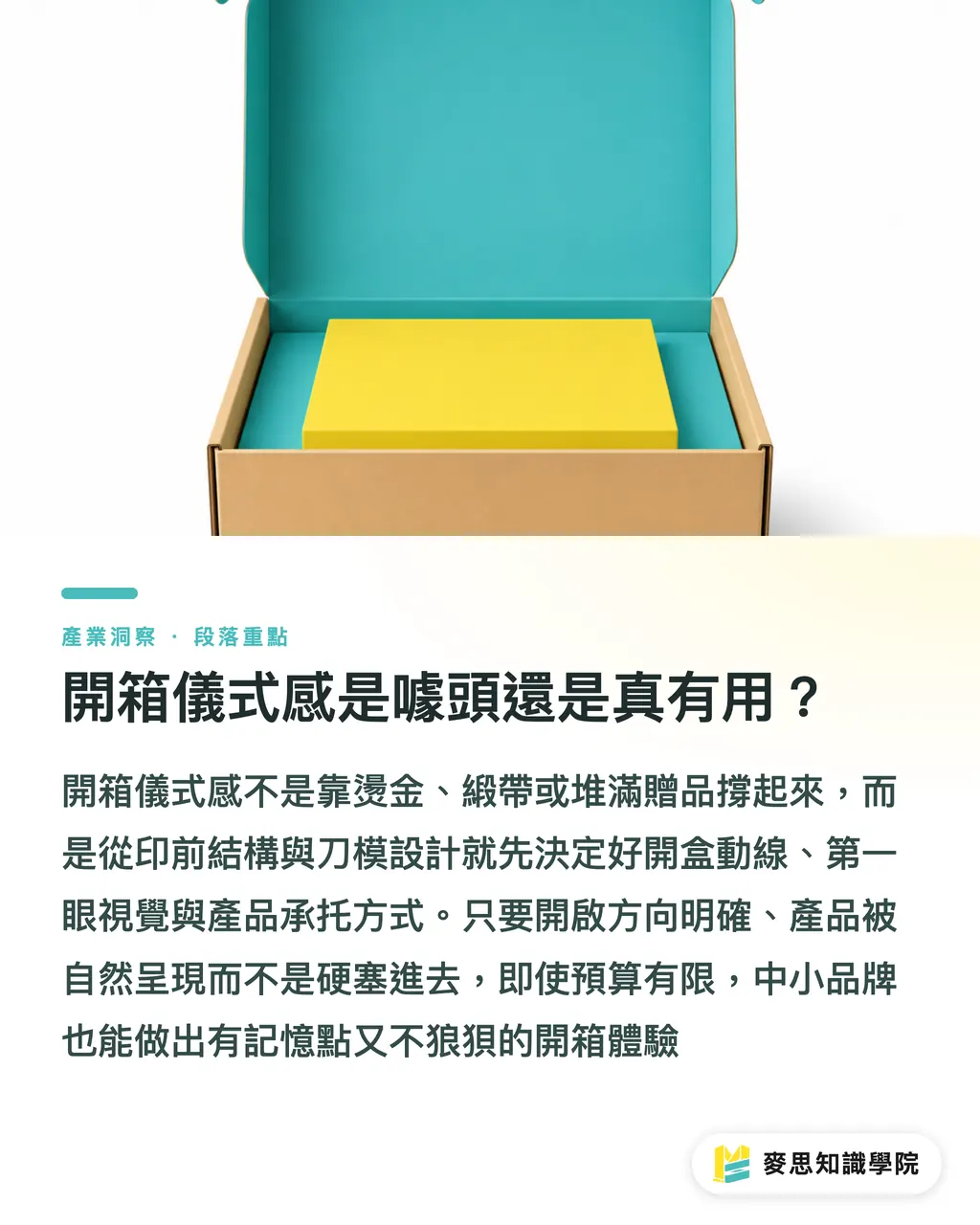
Many believe that creating a 'ritual' requires foil stamping, ribbons, or stuffing the box with tissue paper. In fact, it is the exact opposite. The ritual of the Birth Tree box comes from its structure: how it opens, what is seen first, and how the product is presented. These are all decided during the structural design phase
I have handled many returns for e-commerce clients, and 80% of the issues stemmed from poorly thought-out unboxing flows. Products shifting during transport, inserts getting stuck, or awkward opening angles, these are not material issues; they are failures of die-cuts and uncalculated structures. The opposite of ritual isn't simplicity; it's frustration
In practice, to turn unboxing into a memorable experience, you need to anchor the design around a few key points:
・A single, clear opening direction so consumers don't have to guess how to open it
・Leave white space in the first visual layer so information or freebies don't overwhelm the user all at once
・The structure should cradle the product, 'presenting' it rather than just 'stuffing' it inside
・Stick to a single material from start to finish, even avoiding plastic tapes for sealing, to ensure clean recycling
These are all variables controlled during pre-press preparation and die-line design. They have nothing to do with the number of print colors or foil stamping. In other words, small and medium-sized brands with limited budgets can achieve this too
How Should Taiwan's Small and Medium Printing Houses and Brand Clients Respond?
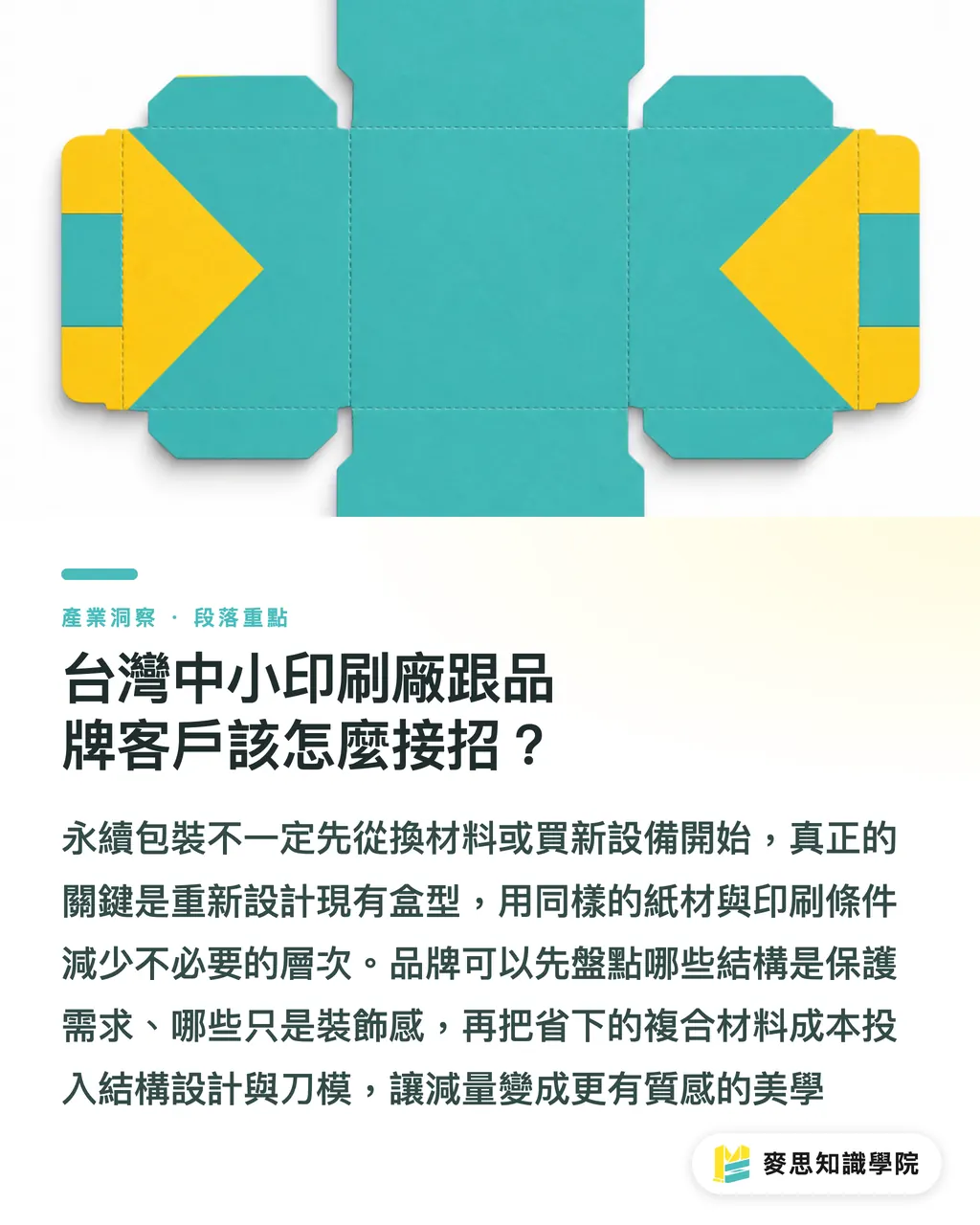
Don't rush to buy new equipment. Start by redesigning an existing box style
I see many small and medium-sized brands in Taiwan get stuck the moment they hear 'sustainable packaging,' assuming they need to swap out materials, switch supply chains, and watch costs skyrocket. In reality, the lesson from DS Smith is quite the opposite: design is the most valuable asset, not the material. Using the same paper stock and the same printing press, recalculating the structure can save a production step
Concrete next steps for brand clients:
・First, inventory how many layers of materials your current packaging has. Identify which ones exist solely for protection and which ones are there just to 'look premium.'
・List all removable multi-material components (such as plastic inserts, coatings, and excessive foil-stamped areas)—these are exactly where EPR regulations will penalize you in the future
・Allocate a portion of the savings from removing these layers toward structural design and die-lines, making the reduction look like a deliberate aesthetic choice
A reminder for fellow printing houses: Sustainable packaging is not a raw materials business; it is a design and structural engineering business. The supplier who can pitch a 'one-less-layer, yet better-looking' structural solution during quoting will win the business of export-focused brands. This is precisely what MINDS does, aligning pre-press structure, die-cuts, printing, and post-press finishing under one conversation, so clients don't have to piece together multiple vendors themselves
Anyone can buy the materials; only the vendors with design capabilities command pricing power
Key Takeaways
・The battle of sustainable packaging is won not by how green the material is, but by whether the narrative makes consumers feel it is a 'choice' rather than a 'compromise.'
・Only one thing separates material restraint from cutting corners: whether it has undergone structural design
・A clever reduction design can solve cost, compliance, and marketing challenges all at once
・The unboxing ritual comes from pre-press structure and die-lines, not from adding foil stamping and ribbons afterward
・For small and medium-sized shops, the most valuable move is not changing materials, but redesigning an existing box style
Further Reflections
The real signal this project sends is that the value of sustainable packaging is shifting from 'material sourcing' to 'design capability.' For the manufacturing side of printing, this means that pure price-competing OEM work will become increasingly difficult, and only vendors who can calculate structures, implement reductions, and maintain aesthetics during pre-press will command a premium. For designers, the next step is to treat 'removing a layer of material' as a creative prompt rather than a restriction. For those looking to integrate AI or SaaS, the opportunity lies in pre-press automation: repetitive yet experience-heavy processes like die-cut generation, structural validation, and unboxing flow simulation are prime targets for tools that amplify, rather than replace, the judgment of master craftsmen. A simple, actionable starting point is to select an existing high-volume box style, run a redesign that uses 'one less layer but has a stronger design language,' and calculate the cost savings and recycling benefits for the client. This is infinitely more powerful than reciting a hundred sustainability slogans
Further Reading
FAQ
- Is sustainable packaging necessarily more expensive?
- Not necessarily. Approaches like DS Smith's Birth Tree gift box, which replace redundant packaging with structural design, can actually reduce unit costs by eliminating plastic trays, foam inserts, and secondary outer cartons. What is expensive is swapping materials; what saves money is intelligent design
- What are the benefits of cellulose or fiber-based packaging?
- The biggest advantage of single-material packaging is its ease of recycling, which helps avoid penalty risks from Extended Producer Responsibility (EPR) regulations on multi-materials. Additionally, the clean aesthetic resulting from the reduction can itself become a visual selling point for the brand
- Does creating an unboxing ritual require spending a lot on post-press finishing?
- No. The ritual mainly comes from pre-press structural and die-line design, including the opening direction, first visual layer, and product cradle. It is not dependent on the number of print colors or foil stamping, making it achievable even with a tight budget
- What is the first step for small and medium Taiwan brands wanting to adopt sustainable packaging?
- Start by auditing the layers of materials in your current packaging. Identify which layers are there just to 'look premium' rather than actually protect the product. List the removable multi-material components, and then reallocate the saved costs to structural design
- Do EPR laws like California's SB 54 affect Taiwanese export brands?
- Yes. EPR shifts the responsibility for packaging waste disposal back to the brands. Taiwanese brands exporting to these markets will be required to reduce packaging volume and use the correct materials. In the future, over-packaging and multi-materials could translate into real financial costs
References
- DS Smith designs gift packaging for \"birth trees\" · packaginginsights.com
Related articles

The Print × AI weekly
The print and AI know-how designers, brands and enterprises can use before they commit — one email, every week
MINDS Free Tools
AI background removal, a LINE sticker maker, spine & imposition calculators — all free, right in your browser, no upload.
MINDS Group
Need actual printing or gifting services?
From premium printing to online ordering and festive gifts — the MINDS Group sister brands take it from here.