

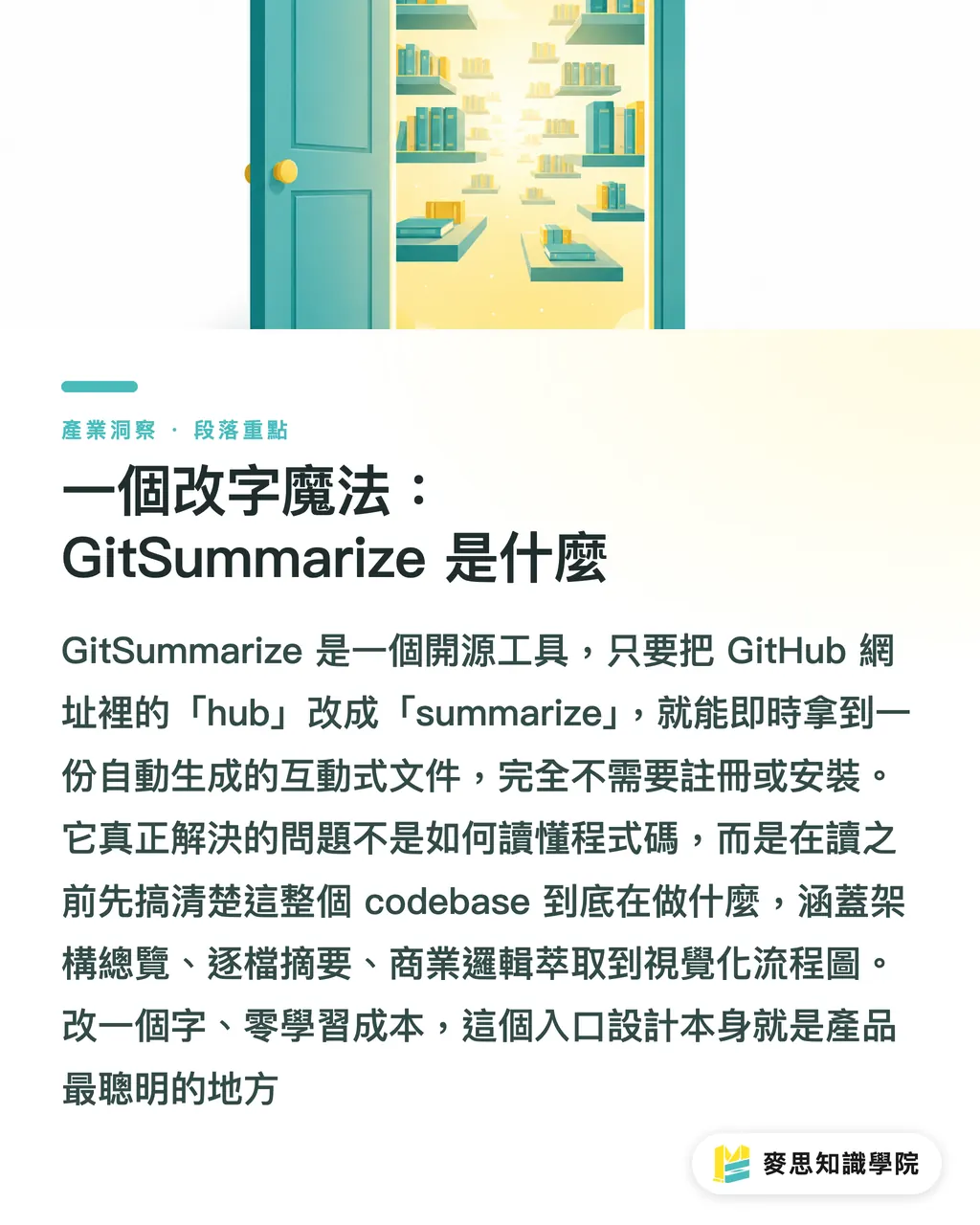
One Word Change: What GitSummarize Is
GitSummarize is an open-source tool (GitHub) with a simple premise: automatically generate a "world-class" interactive documentation hub for any GitHub repo
The entry point is the cleverest thing about the product. Swap hub for summarize in any GitHub URL, and you're done. github.com/xxx/yyy becomes gitsummarize.com/xxx/yyy, and you get an instantly generated document. Not a gimmick, it's a zero-learning-cost entry design: no signup, no install, no new URL patterns to memorize. Just change one word
The content it generates comes in five layers:
・System-level architecture overview, what the entire codebase does
・Per-directory, per-file summaries, the role of each folder and file
・Natural language descriptions, purpose, flow, and structure in plain English
・Business logic and rule extraction, pulling the logic buried in the code out into the open
・Architecture and flow diagrams, visual representations
In other words, it doesn't solve "reading code" — it solves "figuring out what this pile of code is even doing before you start reading it."
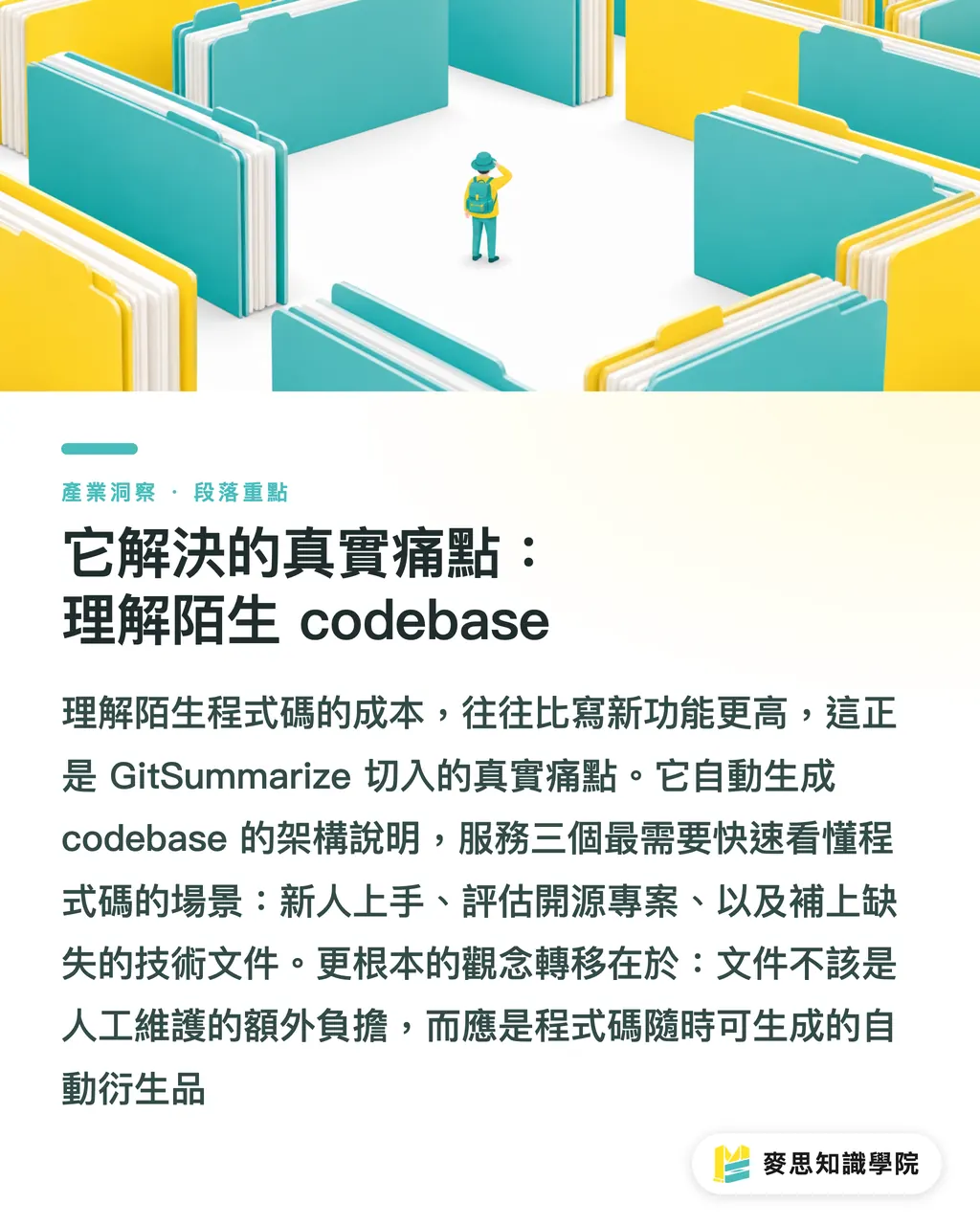
The Real Pain Point It Solves: Understanding Unfamiliar Codebases
The authors are upfront about their motivation: they wanted to contribute to open-source projects but found that understanding a large codebase was just too hard
This is a massively underrated cost. For engineers, reading someone else's code and making sense of the architecture often takes longer than building something new. What GitSummarize automates is exactly the hardest part: figuring out what the code does and how it's structured
It targets three high-value scenarios:
・Onboarding, when new members join a project, the first few weeks of staring at legacy code is the worst part
・Exploring an unfamiliar codebase, evaluating whether to use a library or fork a project
・Writing technical documentation, most projects have docs that are outdated or nonexistent, and AI fills that gap
There's a meaningful shift in thinking here: documentation shouldn't be an extra burden on top of coding, it should be an automatic byproduct of the code itself. GitSummarize turns docs from "something people have to carve out extra time to maintain" into "a snapshot you can generate whenever you need it."
How It Works: A Standard AI Application Blueprint
Its public tech stack reveals a fairly standard, and genuinely instructive, blueprint for "AI wrapper" tools:
The point isn't how impressive each component is. It's that this stack demonstrates a key formula: the value of an AI tool ≈ a capable LLM + a near-frictionless entry point + a clean presentation layer
GitSummarize is open about its inspirations: GitIngest (gitingest.com) (converts repos into LLM-friendly text) and GitDiagram (gitdiagram.com) (turns repos into architecture diagrams). This points to something bigger, a whole family of tools is growing up around "feeding GitHub repos to AI," each one taking a different angle on presentation: some output text, some output diagrams, some output docs

Its Limitations and Honest Caveats
GitSummarize doesn't pretend to do everything. That honesty actually works in its favor
・Rate limits: free hosting for now, but it explicitly says "this will likely change with Gemini's API policies." That's the shared vulnerability of every free tool wrapping an LLM API, your cost structure is in the hands of an upstream vendor
・Future steps are bare: the roadmap is just "add more documentation topics (Setup, Onboarding Guide)" and "add architecture diagrams." This is still an early-stage product
・Self-hosting is easy: git clone and npm run dev to run the frontend locally, a viable exit for teams that want control over their data, especially with private repos
Be realistic about what it is: a solid comprehension aid, not the final word on documentation. AI-generated summaries work well as a map, as a first impression, but for anything touching critical business logic or correctness, you still need a human to check

Key Takeaways
・The best entry design has zero learning cost. Swapping hub for summarize beats any tutorial
・Documentation shouldn't be extra work on top of coding, it should be an auto-generated snapshot of the code
・The AI tool value formula: capable model + near-zero friction entry + clean presentation layer. All three matter
・Free tools wrapping LLM APIs live and die by their upstream vendor's pricing decisions
・AI summaries are a map, not a destination. Good for building quick understanding; business logic still needs a human review
Further Thinking
GitSummarize offers three direct takeaways for teams like MINDS, where print manufacturing, SaaS, and AI adoption all intersect. First, the "one-word-change" entry philosophy is worth copying. Instead of asking customers to learn a new workflow, design AI features to slot into the habits they already have, for example, auto-generating print spec summaries when a customer uploads a file, or extracting key business rules from an order automatically. Second, bring the "documentation as automatic byproduct" concept to internal knowledge management: product specs, SOPs, the backstory behind custom projects, all of this can be turned into readable summaries from existing materials using an LLM, cutting both onboarding time and cross-team communication overhead. Third, watch the upstream dependency risk. Any feature that wraps a single AI vendor's API needs a fallback plan for when the model gets more expensive or the policy changes, exactly the vulnerability GitSummarize flags about itself. Suggested next step: feed an internal repo or a bloated product document into GitSummarize and evaluate how usable the AI summary actually is, then decide between using it directly or self-hosting for data control
Further Reading
FAQ
- How do you auto-generate documentation for a GitHub repo?
- GitSummarize swaps hub for summarize in the URL (e.g. gitsummarize.com/xxx/yyy) and instantly generates architecture overviews, file descriptions, business logic, and flow diagrams, no setup needed
- Is there a tool to help new team members understand an unfamiliar codebase fast?
- GitSummarize uses AI to automatically analyze a repo and generate five layers of summaries: system architecture, per-file responsibilities, plain-language descriptions, business logic, and visual diagrams, significantly cutting down onboarding time
- Can you trust AI-generated code summaries?
- AI summaries are best used as a quick-orientation map, not a source of truth. Anything touching business logic or technical correctness needs human review before you act on it
- How do you self-host GitSummarize to keep control of your data?
- GitSummarize is open-source and easy to self-host. git clone and npm run dev gets the frontend running locally, a solid option for teams that need control over private repo data
- What are the risks of using GitSummarize for free?
- GitSummarize is free to use, but its costs depend on Gemini's API terms. If the policy changes or prices go up, you'll feel it directly. It's worth evaluating self-hosting in advance
Related articles





The Print × AI weekly
The print and AI know-how designers, brands and enterprises can use before they commit — one email, every week
MINDS Free Tools
AI background removal, brand stamping, and a LINE sticker maker — free design tools, right in your browser, no upload.
MINDS Group
Need actual printing or gifting services?
From premium printing to online ordering and festive gifts — the MINDS Group sister brands take it from here.