
What Does the Fresh Inset Label Do?
Fresh Inset has introduced a label solution designed to extend the shelf life of table grapes, with reducing food waste as its selling point. Mai Strategy's three checks for fresh produce labels start with product suitability, packaging conditions, and final artwork requirements. The available information does not show that cherry losses will fall. Packaging Insights report on table grape labels
The report gives no figures for the shelf-life extension, test conditions, or label construction. These gaps affect both the proposal and print production. Designers can't infer the label size, material, or actual preservation results from this information
A functional label is a packaging label that incorporates uses beyond product identification. Its actual function and suitable products must be defined by supplier documentation and testing
I would split proposals like this into two tracks: print specs and shelf-life evidence. Before brand approval, I wouldn't put unverified performance copy in the key visual
Why Can't We Claim It Keeps Cherries Fresh?
We can't present the Fresh Inset table grape case as proof of cherry freshness. The report names table grapes and provides no cherry testing or loss comparison. Mai Strategy recommends keeping copy product-specific. You can't just swap in another fruit name and send it for approval
The same labeling concept can face different contact surfaces, packaging environments, handling methods, and sales cycles on different fruits. Those are conditions to check for a cherry application, not results established by the report
“Reducing loss” also needs a clear definition. Mai Strategy would first ask the brand to define whether the target is culling during grading, retail returns, or spoilage before consumption. Different measures mean the test records can't be lumped together
Mai Strategy sets the terms first. Then shelf-life performance has a basis for comparison
What Should Designers Check Before Handoff?
Before handoff, designers should get the label specs, application position, and material details. Mai Strategy's rule is simple: if the supplier hasn't confirmed the dieline, don't guess the cutting die dimensions
・Mai Strategy check 1: Request the dieline, or confirm the layout and printable area. Then place the label mockup on the original packaging visual for approval
・Mai Strategy check 2: Set bleed and safe area to the converter's specs. Leave room for required copy, barcodes, and batch information
・Mai Strategy check 3: Confirm fonts, images, color, and version labels. Finalize functional claims only after brand approval
Fresh Inset's report doesn't list the label construction or print specs, so prepress staff should build the layout from the supplier's official documentation. After revisions, check the label position again and make sure the barcode is still visible
How Can Small and Mid-Sized Taiwanese Printers Take on This Work?
Small and mid-sized printers can handle label production and design integration, but print specs and shelf-life performance need to be verified separately. The Fresh Inset report gives no print conditions, so Mai Strategy advises printers not to promise customers a specific shelf life
・Mai Strategy intake check: Confirm the packaging material, label size, application position, and quantity and version count before quoting
・Mai Strategy intake check: Ask the brand to provide approved product claims and copy. The brand and solution provider should verify the shelf-life data
・Mai Strategy intake check: Keep approved versions and revision history during proofing, so performance copy doesn't grow into a guarantee during revisions
If the brand also needs to coordinate packaging identity and commercial print specs, MINDS can review the confirmed dimensions, materials, and copy to recommend a production method
How Can Brands Decide Whether to Adopt the Label?
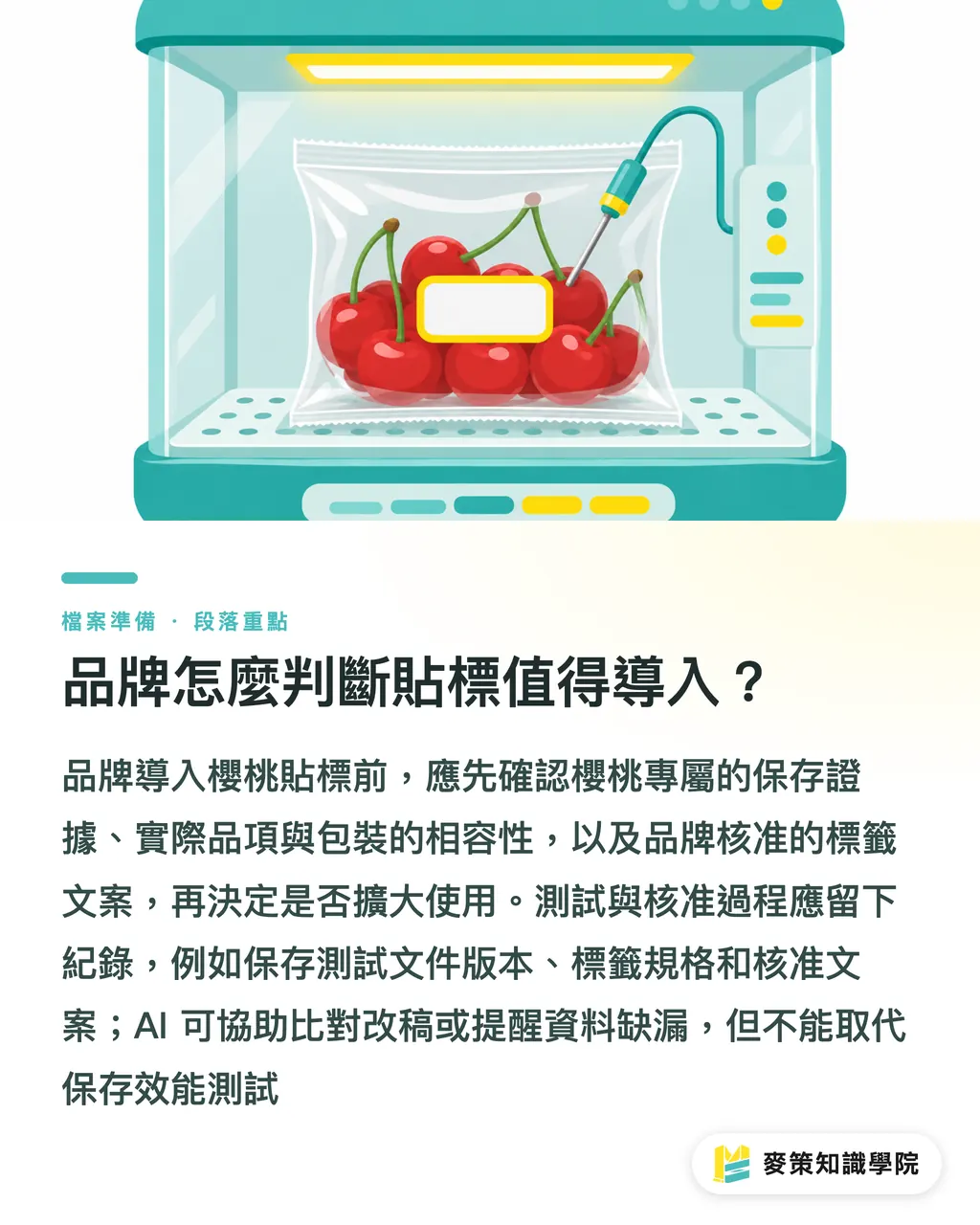
To decide whether the label suits cherries, brands should first use Mai Strategy's three checks for fresh produce labels to verify the evidence, packaging compatibility, and approved artwork, then decide whether to roll it out more widely
・Evidence check: Ask the supplier to explain cherry suitability, test conditions, shelf-life results, and how they were compared. Table grape data can't stand in for evidence on cherries
・Packaging check: Test with the actual cherry product and intended package. Define how losses will be recorded first, so different causes aren't combined into one result
・Artwork check: Finalize the artwork after the brand approves the product and claim wording. Designers should submit files based on the confirmed label specs
Mai Strategy also recommends keeping a record of these checks. SaaS project fields can store the product, test document version, label specs, and approved copy. AI can help compare revisions or flag missing fields, but it can't replace shelf-life testing
Key Takeaways
・Fresh Inset's report supports a table grape label case, not proof of cherry preservation
・Shelf-life performance claims need product-specific evidence and test conditions first
・Confirm final artwork size, bleed, and label position against supplier documentation
・AI can compare versions and flag missing items. Performance claims still need test evidence
Further Considerations
Printers should separate the production quality they can promise from shelf-life performance. Designers should add the cutting die, application position, and approved copy to their handoff checklist. Brands should require every performance claim to point to evidence and test data for the product it's meant for. AI works well for spotting revision differences. SaaS works well for storing specs and approved versions. Neither should replace product testing
Further Reading
FAQ
- Has the Fresh Inset label been proven to reduce cherry loss?
- No. The current report covers table grape labels and provides no data on cherry shelf-life performance or loss comparisons
- Can designers state that the label extends shelf life on packaging artwork?
- Not recommended. The report gives no figures for the effect or test conditions. Get the supplier's documentation first, then have the brand approve the applicable claim
- What information should be ready before sending a fresh produce label to print?
- Confirm the label layout, size, material, application position, printable area, and approved copy, then prepare the artwork to the converter's specs
- Can AI determine whether the Fresh Inset label works?
- AI can help compare file versions or check for missing information, but it can't replace shelf-life testing on cherries
Related articles
The Print × AI weekly
The print and AI know-how designers, brands and enterprises can use before they commit — one email, every week
MINDS Free Tools
Imposition calculator and preflight file check — free prepress tools, right in your browser.
MINDS Group
Need actual printing or gifting services?
From premium printing to online ordering and festive gifts — the MINDS Group sister brands take it from here.