

Why is this FESPA whitepaper worth your time?
During recent meetings with several long-term clients, everyone was asking how major brands currently audit ESG during the outsourcing process
This is no longer a matter of simply chanting slogans to get by
Looking back at the recent drupa 2024, although there were several sessions on recycled paper and waste reduction, frankly, they only scratched the surface
In contrast, FESPA's newly released event sustainability standards report has been hailed by the European industry as the 'gold standard.'
This is backed by significant financial investment. Not only have they achieved ISO 20121 certification for sustainable event management for two consecutive years, but they have also successfully reduced their carbon dioxide equivalent (CO₂e) emissions from 2024 to 2025
When exhibition organizers are spending heavily on consultants and meticulously calculating their carbon footprints,
how do you think the global brand buyers attending these shows will audit their own print suppliers back home?
This is why we must take FESPA's standards seriously, they directly foreshadow the audit specifications for export orders over the next couple of years
What exactly are brand clients looking for in ESG audits?
The core dimensions outlined in the whitepaper are essentially the exam papers that multinational brands are using to audit Taiwanese OEMs today
They no longer look solely at whether you use eco-friendly inks, but demand a complete carbon emission calculation and a decarbonization roadmap
Based on my experience helping factories conduct assessments over the past few months, the key focus areas are:
・Whether there are clear mechanisms for waste sorting and the reuse of exhibition materials and consumables
・Supplier audit criteria, minimizing the risk of upstream material sources failing to withstand scrutiny
・Whether the format of the carbon emissions report aligns with internationally recognized frameworks and whether it features third-party verification
With the Japanese printing plate giant Asahi Photoproducts securing an EcoVadis Silver medal in April 2026, this sends a strong industry signal
ESG ratings for consumables suppliers have officially become the ticket to entering global supply chains
These standards heavily overlap with FESPA's methodology. If you are still relying on intuition to talk about sustainability, your name might not be on the supplier list next quarter
How should small and medium-sized print shops respond and monetize sustainability?
Obtaining ISO 20121 or fully implementing EcoVadis immediately is indeed a heavy burden for small and medium-sized factories
However, you can start by adopting the practical approaches FESPA offers to its members: establishing shared carbon footprint calculation tools and actionable daily sustainability guidelines
Since we know what clients want, we need to translate environmental practices into quantifiable metrics:
・Audit high-energy-consuming equipment within the plant and list a clear carbon reduction timeline from prepress to post-press finishing
・Proactively offer clients paper options that meet FSC or PEFC certifications, accompanied by clear carbon label explanations
・Use digital tools to record consumables usage and waste ratios for every print job, serving as highlights in quarterly reports
Once you compile these quantitative data points,
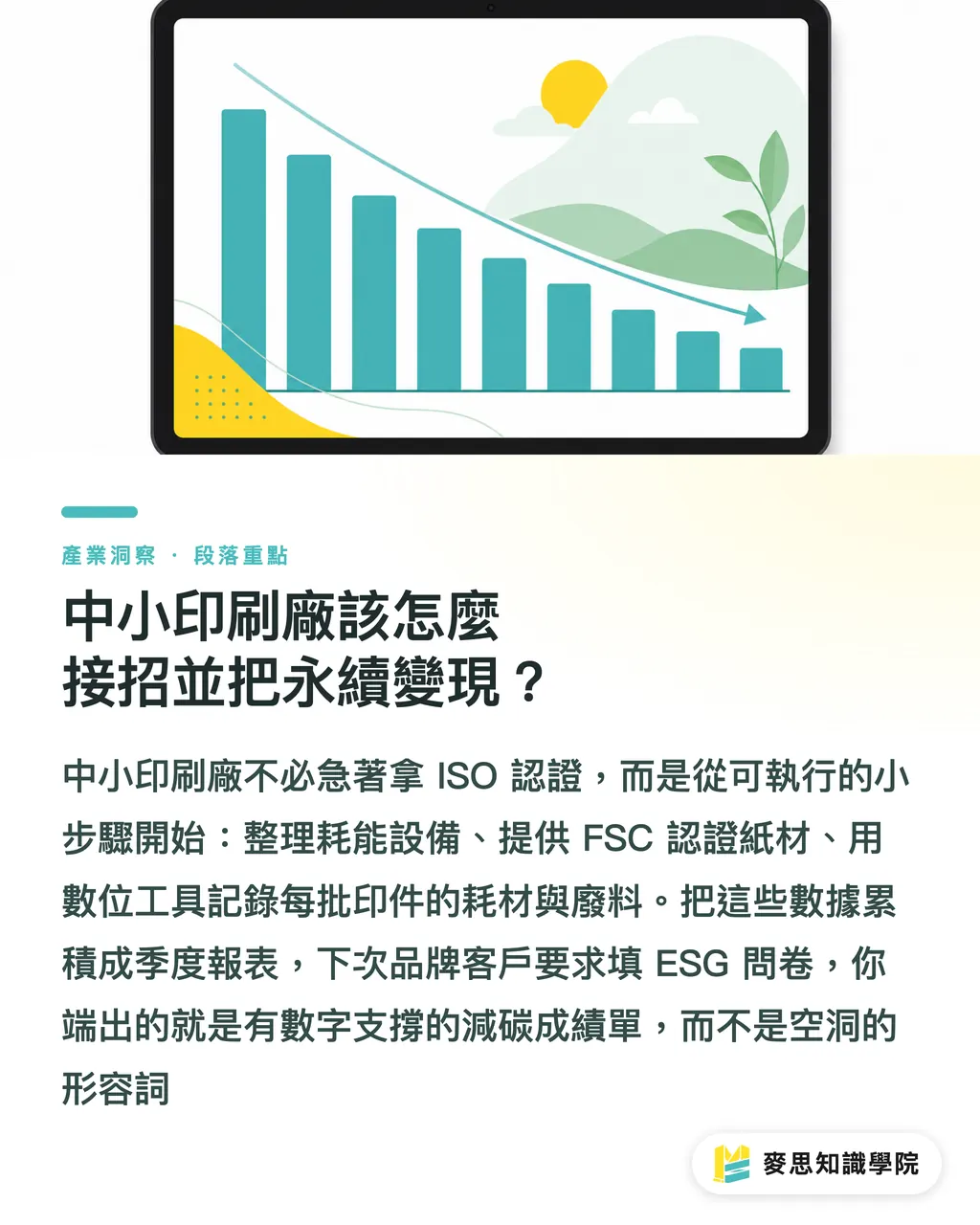
the next time a brand client requests an ESG questionnaire, you won't be submitting a bunch of empty adjectives,
but rather a concrete, data-backed carbon reduction report card
Key Takeaways
・Sustainability is no longer a PR slogan; winning contracts now requires hard metrics like third-party verification and quantified carbon emissions data
・FESPA's consecutive two-year ISO 20121 certification has established the industry's gold standard for carbon footprint and waste management
・ESG ratings for consumables suppliers have become standard, directly impacting the eligibility of Taiwanese print shops to secure orders from global brands
・Small and medium-sized factories should prioritize adopting carbon footprint calculation tools, translating daily material reduction and energy savings into reports visible to clients
Further Reflections
Sustainability transformation is not a solo effort; this is precisely where SaaS services have an excellent entry point
For a one-stop integration platform like MINDS, if carbon calculation, consumable source tracking, and waste output rates are directly built into every outsourcing and scheduling system, print shops can automatically generate ESG reports that meet international standards upon shipment
This directly addresses the pain point of print shops calculating carbon footprints, while offering brand clients clear visibility on the platform, lowering the barrier to green procurement through digital tools
Further Reading
FAQ
- What practical impact do FESPA's sustainability standards have on Taiwanese print shops?
- Multinational brands are gradually incorporating FESPA's carbon footprint and waste management standards into their ESG supplier checklist. Failing to pass could lead to losing export orders
- Our factory is small. How should we start responding to clients' ESG requirements?
- Start by adopting carbon footprint calculation tools and tracking daily consumable-to-waste ratios. Proactively offer material options with FSC certification or carbon labels to turn carbon reduction efforts into clear data
- Which is more urgent: an EcoVadis rating or an ISO certification?
- EcoVadis focuses more on overall corporate social responsibility and supply chain audits, whereas ISO 20121 is geared toward specific event management. It is highly recommended to start by inventorying plant carbon emissions and tracing material sources as a solid foundation
References
Related articles





The Print × AI weekly
The print and AI know-how designers, brands and enterprises can use before they commit — one email, every week
MINDS Free Tools
AI background removal, a LINE sticker maker, spine & imposition calculators — all free, right in your browser, no upload.
MINDS Group
Need actual printing or gifting services?
From premium printing to online ordering and festive gifts — the MINDS Group sister brands take it from here.