
Why is the FDA's Approval of Recycled Plastics This Time a Major Signal?
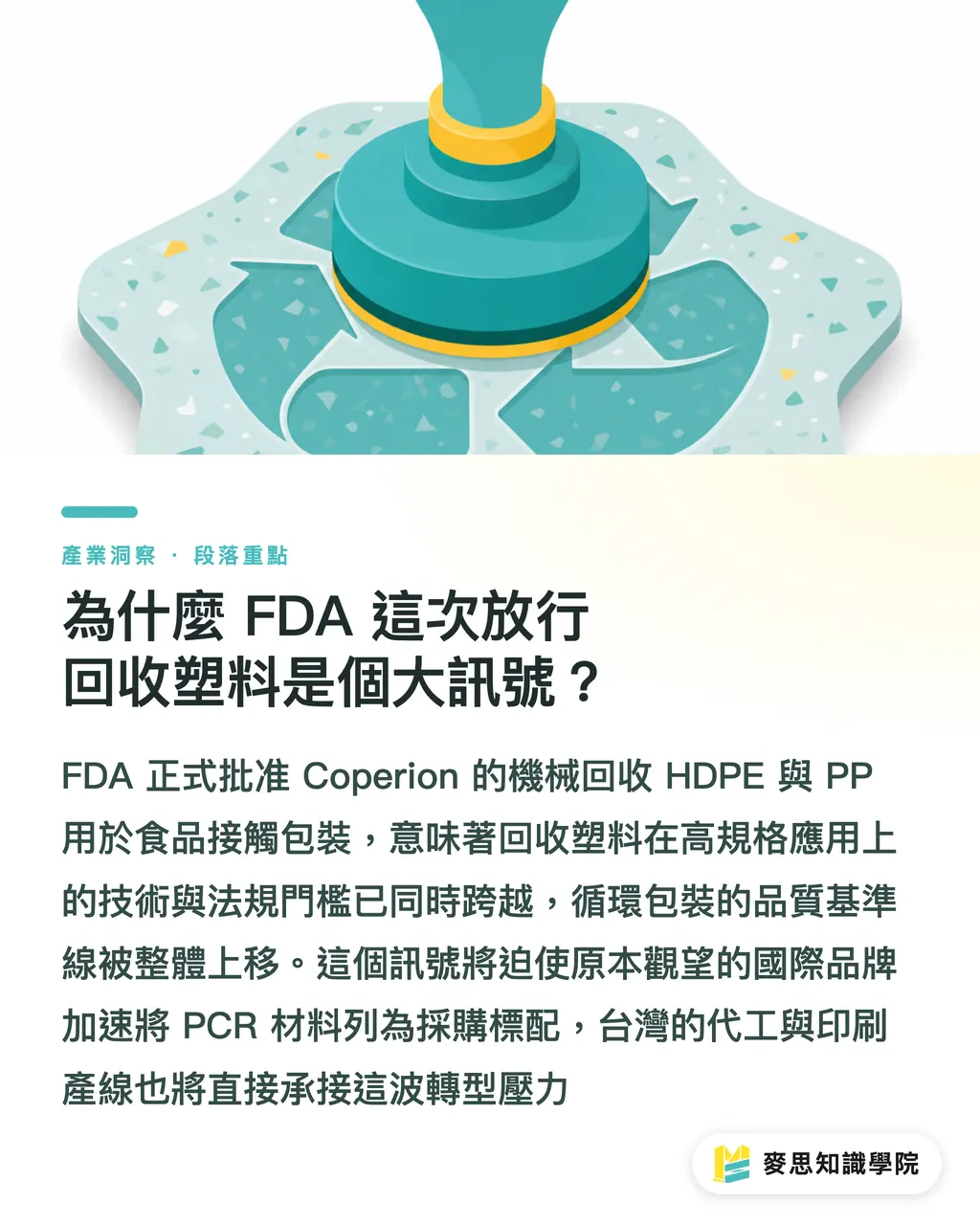
Having met with export clients over the past few months, I've clearly felt the pressure of chemical compliance in food packaging rising sharply. With the US Congress proposing the No Toxics in Food Packaging Act to target substances like PFAS, the FDA has now officially approved recycled HDPE (High-Density Polyethylene) and PP (Polypropylene) from equipment giant Coperion for use in food-contact packaging
In the past, the industry had persistent doubts about using mechanically recycled materials in food packaging, fearing residual impurities or odor anomalies. Coperion securing the highest level of US food safety approval signals to the market that mechanical recycling technology has crossed the mass-production threshold for high-end applications. This is not just a victory for a single manufacturer, but a step up for the standard baseline of the entire circular packaging supply chain
With regulatory pressure and material technology aligning, purchasing standards for major international brands are bound to shift. Brands that were previously waiting and seeing will now make PCR (Post-Consumer Recycled) formulations standard, and this ripple effect will quickly make its way to Taiwan's OEM and printing lines
Coperion's Decontamination Technology Work?
To enable mixed recycled plastics to meet FDA standards, the core lies in ultimate purification capabilities. The key to Coperion's approval is their use of twin-screw extrusion combined with devolatilization technology
・The twin-screw extruder is responsible for forcing the melting and compounding of recycled plastics in a high-temperature, high-shear environment
・The devolatilization technology then aggressively extracts residual volatile organic compounds (VOCs) and potential contaminants from the plastic under specific temperatures and vacuum levels
Through this physical mechanism, Coperion successfully reduced impurity concentrations below the detection limits required by the FDA. This shatters the historical myth that only chemical recycling could achieve food-grade purity, proving that high-end physical recycling processes can ensure food safety just as effectively
For packaging design, this means we have more low-carbon footprint material options to propose, without having to bet everything on costly specialized processes
Brands Are Switching to PCR Materials: How Should Taiwanese Printers Respond?
When materials change, the physical reactions on the production line are the most honest. When brand clients demand replacing virgin films with HDPE or PP containing high percentages of PCR, flexible packaging printers will immediately face a recalibration of technical parameters
・Surface tension variations: The surface energy of recycled materials is typically unstable, directly impacting ink leveling and wetting
・Ink adhesion retesting: The performance of existing flexographic and gravure ink systems on PCR substrates must be re-validated, as previous cross-hatch and tape peel test data may become completely obsolete
・Packaging structure changes: Heat-sealing temperatures and tensile strength of recycled materials will change, requiring a rediscovery of heat-pressing conditions during pouch-forming and molding
We need to audit our machinery limits right now and request test films with varying PCR content from ink suppliers for prototyping. Don't wait until clients show up with new specification sheets to discover that the ink won't adhere at all, that would mean losing an entire season of orders
What Preparations Are Needed in Advance for Audit Documentation and Structural Design?
Beyond production line hardware, compliance documentation on the administrative side is also a major focus. Recent trends, such as Portland's new mandate on takeout containers or film-free capsules, show that the entry barriers for export orders are undergoing a qualitative shift
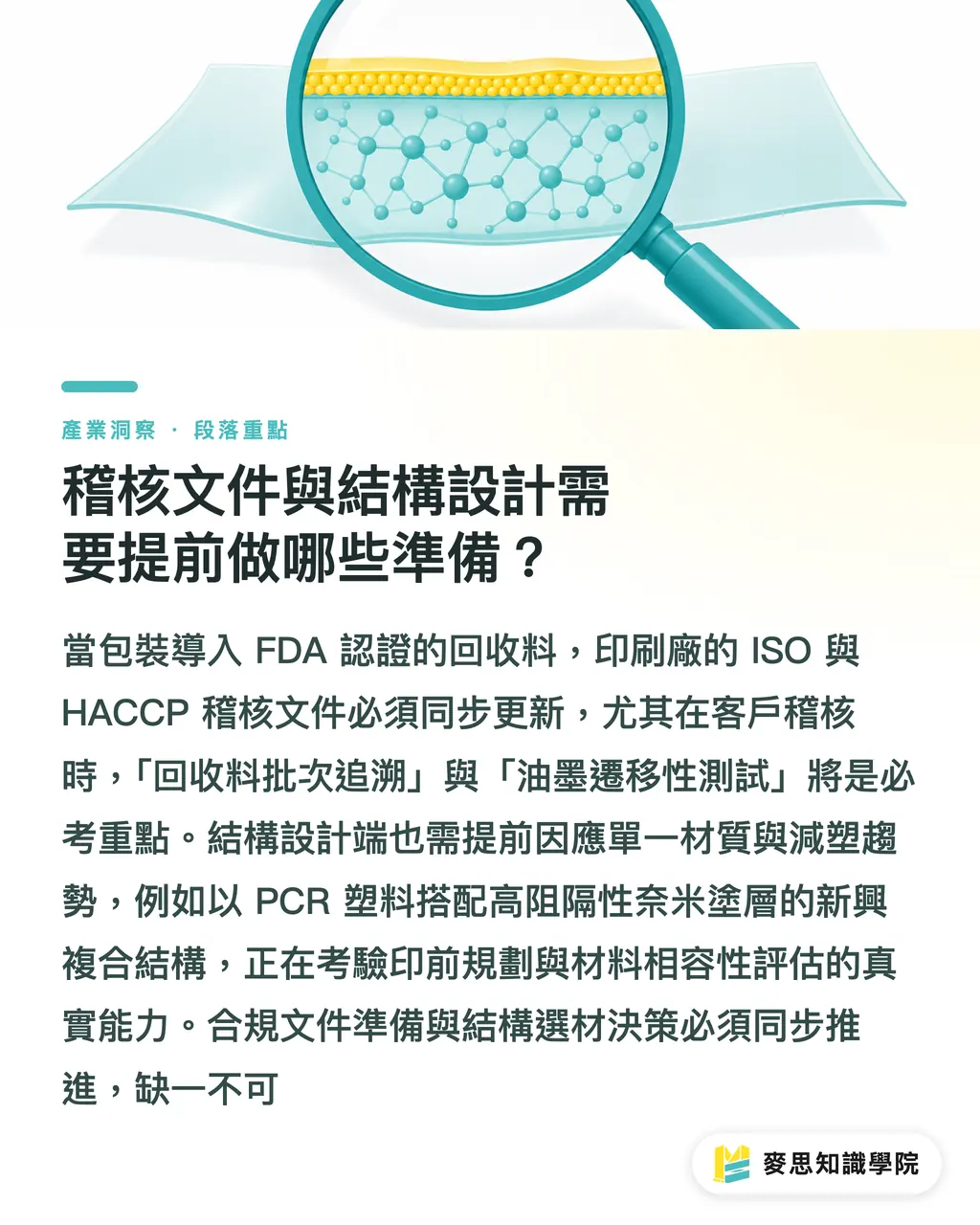
When FDA-certified recycled materials are introduced into the packaging structure, the printing plant's ISO, HACCP, and other relevant audit documents must be updated in tandem. During audits, clients will undoubtedly examine 'recycled material batch traceability' and 'ink migration testing' with extreme scrutiny
Regarding packaging structure, we must also consider alternatives due to the strong demand for mono-materials and plastic reduction. For instance, the graphene coating currently causing a buzz in the market addresses the barrier properties pain point of flexible films. In the future, if structures are built around FDA-approved PCR plastics paired with high-barrier nano-coatings, these emerging composite structures will directly test our true capabilities in pre-press planning and material compatibility assessment
Key Takeaways
・The FDA's approval of Coperion's recycled HDPE and PP marks the commercialization phase of mechanically recycled materials entering food packaging
・Brands accelerating their adoption of PCR formulations will directly impact the adhesion performance of existing flexographic and gravure inks on substrates
・Printing plants must proactively run prototyping tests with high-PCR films to redefine production line processing parameters and material compatibility
・For new material structures, internal food safety audit documentation and batch traceability systems must be upgraded for compliance in advance
Further Thoughts
The inspiration from this regulatory approval is clear: sustainable packaging has shifted from a brand PR topic to a hands-on battle over production line specs. For the MINDS team and the companies we advise, the most beneficial move at this stage is to build a material compatibility database, systematically recording color reproduction and adhesion data for different inks and coatings on substrates with various PCR ratios. Once a SaaS platform can directly retrieve these empirical parameters, we can offer clear processing limits during client pitches, turning compliance challenges for others into our own unique competitive advantage
Further Reading
FAQ
- Why is the FDA's approval of Coperion's technology a major industry milestone?
- Because it proves that mechanical recycling processes, such as twin-screw extrusion and devolatilization, can also reduce HDPE and PP contaminants below the detection limit, breaking the absolute reliance of food packaging on virgin materials
- What direct impact does switching packaging to PCR recycled materials have on printing plants?
- Changes in the surface properties of substrates will lead to decreased adhesion of original ink formulations or abnormal color reproduction, requiring new on-press prototyping and ink adaptability testing for both flexographic and gravure printing
- Beyond technical testing, what else do Taiwanese OEM factories need to prepare?
- They must update internal food safety and quality audit documentation in advance to ensure they can handle requests from international clients regarding batch traceability of recycled material sources and ink migration
References
- 再生塑料正式獲 FDA 食品級認證:循環包裝供應鏈的結構性轉折點 · packaginginsights.com
Related articles

The Print × AI weekly
The print and AI know-how designers, brands and enterprises can use before they commit — one email, every week
MINDS Free Tools
AI background removal, a LINE sticker maker, spine & imposition calculators — all free, right in your browser, no upload.
MINDS Group
Need actual printing or gifting services?
From premium printing to online ordering and festive gifts — the MINDS Group sister brands take it from here.