
What Is the EU PPWR, and Why Take Action Now?
The PPWR (Packaging and Packaging Waste Regulation) is a mandatory EU regulation that took effect on August 12, 2026, completely replacing the old directive. It regulates reduction, recyclability, and hazardous substance limits across all packaging materials. Non-compliant packaging cannot enter the EU market
From my years watching factory floors and client operations, many Taiwanese packaging and print shops still view EU rules through an outdated lens: 'encouraging recycling' or 'buying carbon offsets.'
With the PPWR now active, the rules of the game have flipped completely. The focus has shifted from passive recycling at the end of life to mandatory design reviews right at the start
Guidance released last week by compliance consultants like Valpak confirms this reality. The industry is caught between pushing for packaging innovation and shouldering a heavy burden of compliance proof
For Taiwanese OEMs and export manufacturers, this is no longer green PR for brand owners. It is a hard gate that directly decides whether your quotes and shipments clear customs
Germany has also rolled out its updated packaging law through VerpackDG, fully aligning with the strict PPWR standards
If you don't start tweaking your designs now, expect massive customs bottlenecks for the European holiday peak season this fall and regular exports next year
EU PPWR Timeline: Which Deadlines Should Taiwanese Suppliers Track?
The timeline is what gives supply chains the biggest headache under the PPWR. It is not a single deadline, but a regulatory grinder that tightens in phases based on risk levels and technical maturity
Looking at several European export projects I handled recently, the most common trap for clients is failing to grasp the grace periods and priority levels for each rule
・Phase 1: A total ban on PFAS ('forever chemicals'). This hits food contact packaging, fast-food paper boxes, and specialty materials with greaseproof or waterproof coatings hardest. If customs spots any residue during spot checks, goods get rejected or destroyed on the spot
・Phase 2: Mandatory packaging minimisation. The law requires cutting packaging weight and volume down to the absolute minimum needed for product safety and function. Bulky cosmetics boxes and luxury gift sets built purely for shelf appeal take the direct hit
・Phase 3: Full rollout of Design for Recycling (DfR) assessments. Packaging must hit grades A through C in recyclability. Fail this, and you face steep eco-modulation fees or, in the worst case, an outright sales ban across the EU
These three phases stack on top of each other. Every batch of folding cartons, plastic bags, or composite cans you order today must hold up against these checks in both physical structure and chemical makeup
How Should Taiwanese OEMs Respond? Mai Strategy's 3-Step Verification
Faced with this forced reset of technical specs, complaining about high European compliance costs gets you nowhere. Building defensive standards across your production line is the only way to protect your orders
For mid-to-high-end export packaging, I usually have our teams and clients apply Mai Strategy's 3-Step Verification to filter out hidden risks
・① Material traceability and chemical screening: Require suppliers to submit up-to-date PFAS-free declarations and heavy metal test reports before placing orders. Never pick papers and coatings based on gut feeling or past habits
・② Structural void-ratio calculation: Recalculate package volume using dieline software. Strip away unnecessary plastic trays, overly thick paperboard, and decorative empty space to prove with hard data that you met the minimisation rule
・③ Recyclability pre-grading: Make sure composite materials or lamination processes do not disrupt local European recycling lines. Keep the interference from industrial adhesives, heavy foil stamping, and UV inks to an absolute minimum
If your current packaging suppliers cannot provide this concrete data, now is the time to look for new partners
This is why more export brands are turning to MINDS for mid-to-high-end custom commercial printing with verified compliance. It lets them hand off the trickiest material-checking tasks to a team that knows the regulations inside and out
Why FSC Certification Can Still Get Your Packaging Stopped at EU Customs
This is the question I heard most while visiting clients over the past two weeks. Many companies that just finished switching packaging for California's SB laws assume an FSC certificate gives them a free pass into the EU
Under the PPWR framework, that assumption is a dangerous misconception that can lead to heavy losses
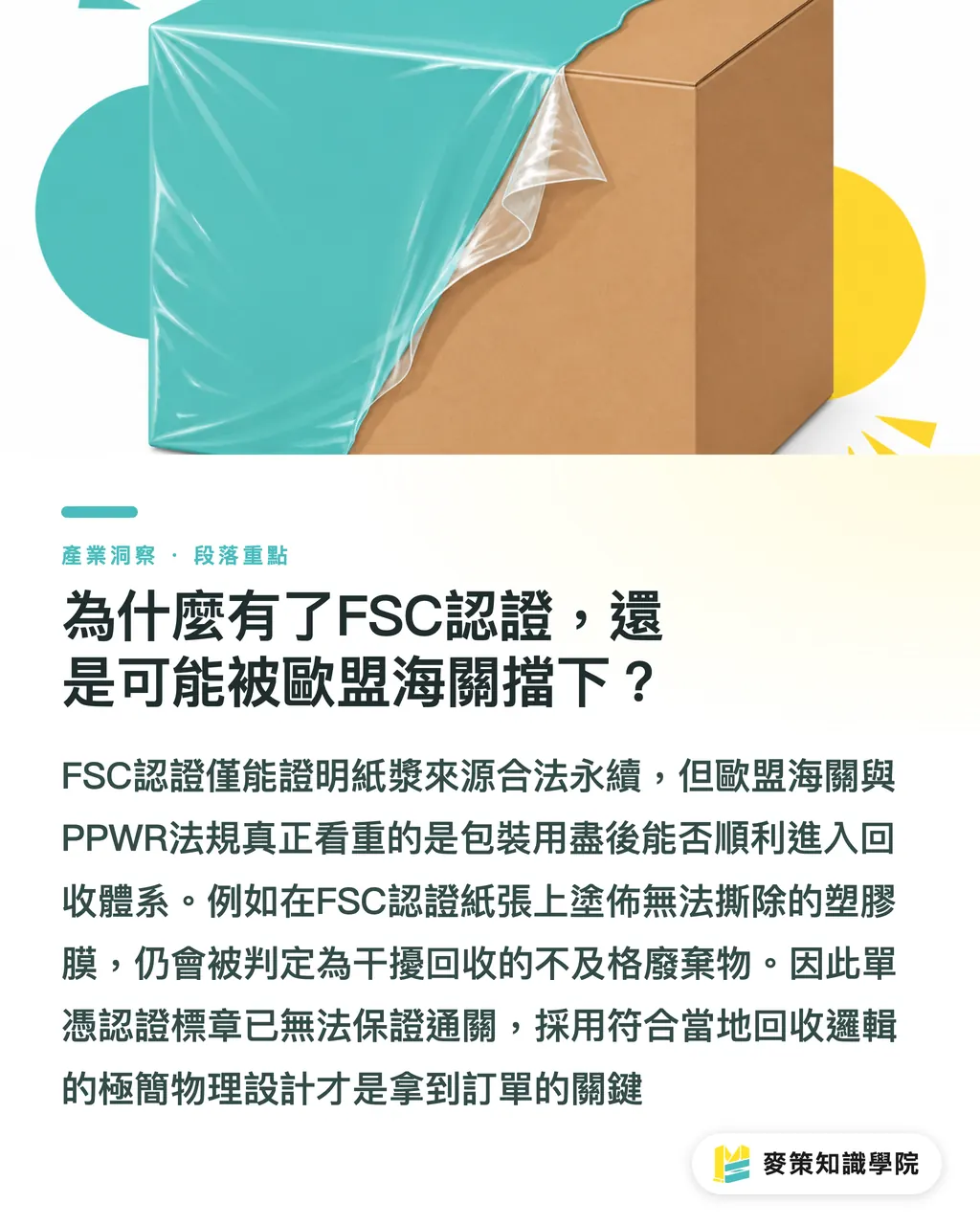
FSC certifies that your pulp comes from legal, well-managed, deforestation-free sources. It covers the birth of the packaging material
PPWR focuses on design and end-of-life: whether that package can enter the recycling stream smoothly and get reused after the consumer is done with it
If you use top-tier FSC-certified paper, but coat it in a thick non-separable plastic film or use specialty print finishes that disrupt de-inking, it still counts as failing waste under PPWR DfR rules
This shows how EU customs inspections have evolved. They moved past single green material certs to a full audit of physical and chemical packaging structures
A single certificate is no longer a get-out-of-jail-free card at customs. Building clean, minimalist physical designs that match how local recycling facilities actually work is what wins orders now
Key Takeaways
・The PPWR took effect on August 12, 2026. Packaging designs for EU export orders must cut out PFAS and begin volume reductions immediately
・FSC certification covers sourcing, not recyclability. Inseparable composite materials and over-packaging are prime targets for customs rejections
・Adopt the 3-Step Verification framework and write material specs, void ratios, and recyclability grades directly into your procurement contracts
Looking Ahead
For Taiwanese print manufacturers and SaaS builders, the arrival of the PPWR sends a clear signal: the data flow behind packaging is now just as important as the physical box
Packaging printers can no longer just focus on print quality. They must be able to generate compliant material data sheets and audit trails
This opens a prime opportunity for AI tools and compliance SaaS platforms
Whoever builds complex DfR standards into software so designers can generate instant compliance prediction reports right inside their layout tools will capture the next wave of packaging export growth
Further Reading
FAQ
- When does the EU PPWR officially take effect?
- The PPWR officially took effect on August 12, 2026, phasing in mandatory rules for PFAS restrictions, packaging minimisation, and recyclability grading
- Our folding cartons are already FSC-certified. Could we still run into issues exporting to Europe?
- Yes, absolutely. FSC only proves sustainable pulp sourcing. PPWR audits end-of-life recyclability and volume minimisation. Over-processed finishes or inseparable composite materials will still trigger non-compliance
- How should small and mid-sized businesses handle these new packaging rules?
- Start by auditing current inventory and phasing out any packaging containing PFAS. Next, bring structural calculations and material traceability into your procurement process. Partnering directly with a print shop that has proven compliance experience is the best way to safeguard your orders
Related articles


The Print × AI weekly
The print and AI know-how designers, brands and enterprises can use before they commit — one email, every week
MINDS Free Tools
AI background removal, a LINE sticker maker, spine & imposition calculators — all free, right in your browser, no upload.
MINDS Group
Need actual printing or gifting services?
From premium printing to online ordering and festive gifts — the MINDS Group sister brands take it from here.