
What Did Eisai Actually Buy with That £48 Million?
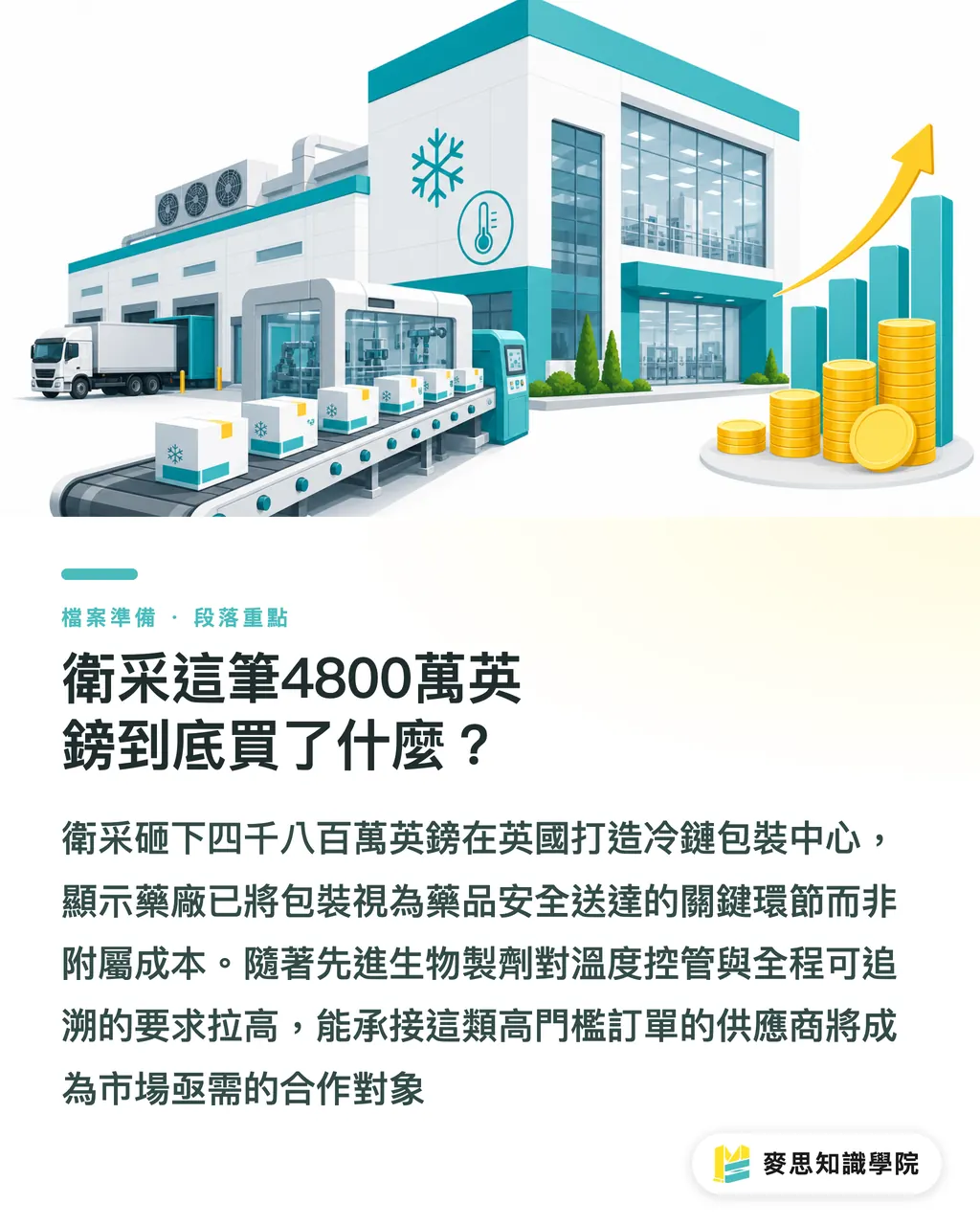
Major Japanese pharmaceutical company Eisai announced a £48 million investment to build a dedicated cold-chain pharma packaging center in the UK, specifically for handling highly temperature-sensitive advanced medicines
That number is worth stopping to think about. That £48 million isn't going into buying new drug formulas; it's being poured into packaging and logistics. When a drug manufacturer is willing to put that much money into packaging, it's telling the entire supply chain directly: packaging is no longer a secondary cost. It is a critical line of defense for whether efficacy makes it safely to the patient
From my observations dealing with clients over the past few years, procurement used to care most about cost and lead times when discussing medical packaging. But over the last year or two, the wind has clearly shifted. They ask if you can guarantee full temperature control and traceability first, and only then talk price. The 'advanced medicines' Eisai's center will handle are mostly high-value biologics that fear both heat and freezing, becoming worthless if left at the wrong temperature for just a few hours
For small and mid-sized printers in Taiwan, this isn't an irrelevant piece of international news. It's a demand roadmap. Drug companies are willing to pay a premium; what they lack are suppliers capable of getting this packaging right
Why Does a Surge in Biologics Trigger a Shortage in Cold-Chain Packaging?
The key lies in the physical properties of these drugs. Traditional small-molecule chemical drugs can survive at room temperature, but biologics are mostly protein structures that can lose potency outside a narrow 2-8°C window
This creates a chain of cause and effect. Follow the logic and you will understand why packaging plants suddenly have an opportunity:
・The pricier the drug, the scarier the spoilage: A single dose of a biologic often costs tens of thousands. If temperature control fails, the whole batch is ruined, and drug makers cannot afford that loss
・Fear of spoilage means proving it stayed safe every step of the way: From factory to patient, every leg needs proof that temperatures didn't cross the line
・The vehicle for that proof is the packaging: Temperature indicators, barrier structures, and trace labels all ride on this single packaging layer
Eisai's investment is the logical result of taking this chain to the extreme. When the value of the medicine reaches a certain level, drug companies would rather build their own dedicated facility to keep packaging quality in their own hands
The takeaway for small and mid-sized plants is direct. You are no longer taking orders to 'print a box.' You are taking orders to 'provide the final safety endorsement for a high-value medicine.' The pricing logic is completely different
What Are the Three Core Capabilities Printers Actually Need to Master?
Cold-chain medical packaging sounds high-end, but broken down to the print manufacturing level, the ticket in comes down to three specific technologies. Every single one is within reach for small and mid-sized plants
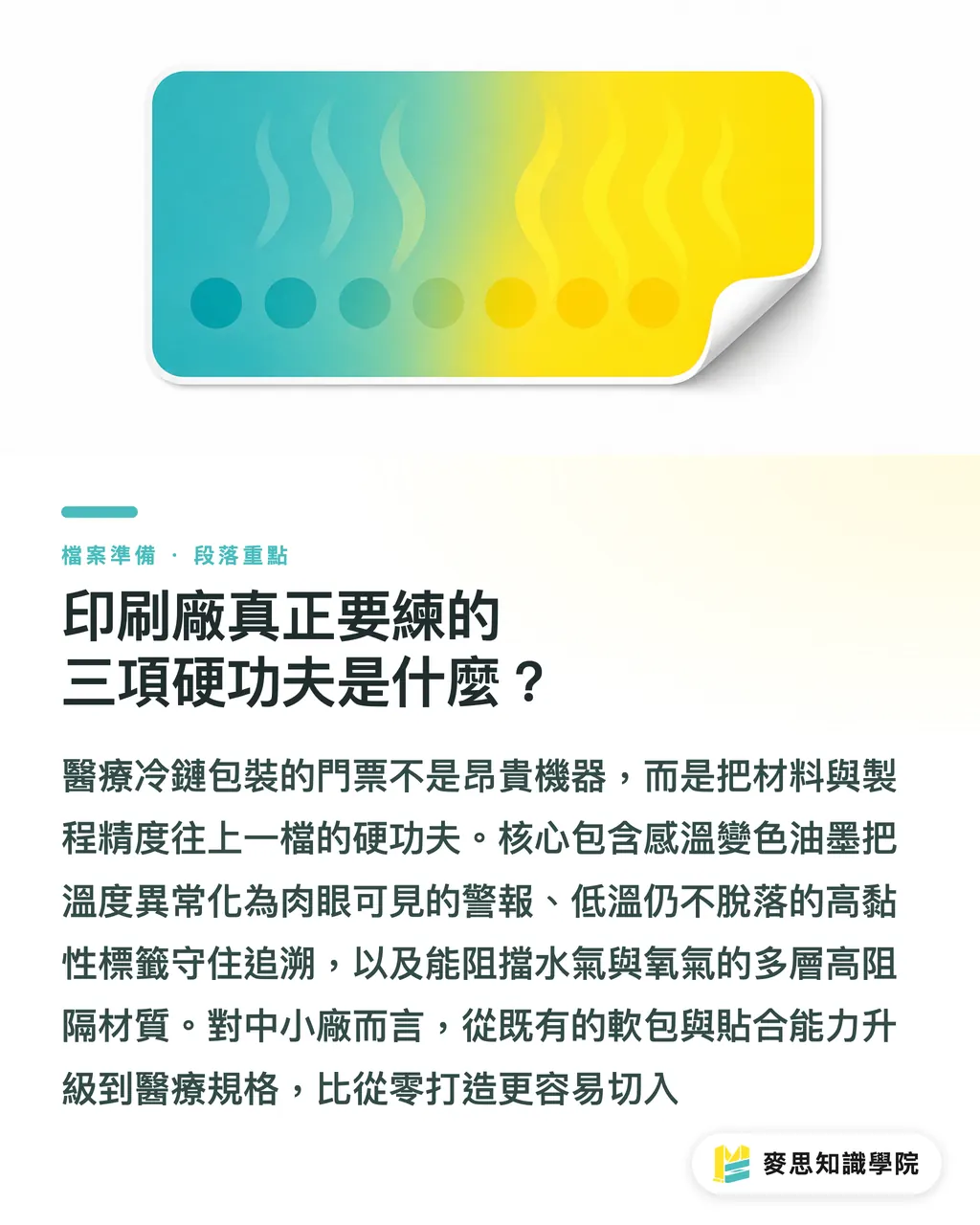
First, thermochromic ink
・What it is: A functional ink that changes color or reveals color when exposed to specific temperatures
・How it works: Printed on labels or boxes, if the drug exceeds the warning temperature, the color shift is irreversible, serving as a visual alarm that catches compromised products red-handed
・Why it matters: It translates abstract temperature data into a clear signal pharmacists can read at a glance, making it a key gatekeeper for the final mile of the cold chain
・How to apply it: Start by experimenting with reversible or irreversible inks for a single threshold, pairing them with the client's temperature specifications to set the color-change trigger
Second, high-tack labels that hold up in low temperatures
・The pain point is practical: Standard adhesives turn brittle, peel up, or fall off completely at 2-8°C or in frozen settings. When the label drops off, traceability breaks
・The solution combines material and adhesive choices: Select cold-temperature pressure-sensitive adhesives matched with face stocks that resist condensation
・This is a strictly functional benchmark. Delivering it grants entry; failing it means you don't even qualify to submit a quote
Third, high-barrier materials
・Function: Block moisture, oxygen, and light, all three of which accelerate the degradation of biologics
・Structure: Often multi-layer composite films where each layer plays a distinct role. This shares logic with general food packaging barrier design, but medical specs are far stricter
・The entry point for smaller plants: Upgrade existing flexible packaging and lamination capabilities to medical standards, rather than starting from scratch
Looking at all three together, the barrier to entry for medical cold-chain packaging isn't about buying a million-dollar machine. It's about raising the precision of your materials, inks, and lamination up a notch
How Can Small and Mid-Sized Taiwanese Printers Tap into This High-Margin Line?
Don't let 'pharma-grade' scare you off. The strengths of small and mid-sized Taiwanese plants happen to fit this market's appetite perfectly
New medical drugs mostly involve small batches, high variety, and fast-shifting specs. That is work big plants dislike and smaller plants excel at. From my long-term observations on factory floors and with clients, plants that deliver stable consistency in small batches actually command better pricing power than those competing on high-volume, low-cost orders
Here is a practical path forward:
・Establish a foothold with one technology first: You don't need to master all three skills at once. Pick either thermochromic ink or cold-resistant labels and reach delivery standard. That gives you the standing to open conversations with clients
・Turn 'validation capability' into your selling point: Medical clients want more than finished products. They want your data on material testing and cold-adhesion testing. That verifiable proof is itself a source of premium value
・Target the integration needs of brand clients: Biotech, medical device, and health supplement brands often lack internal packaging engineering teams. They need a partner who can manage the entire pipeline from prepress specs and material selection to post-press finishing
This is precisely what MINDS (mid-to-high-end fully customized commercial printing) has been doing: connecting prepress, materials, specialty printing, and finishing into a seamless service line so brand clients don't have to piece together multiple suppliers. Especially in medical fields where a single wrong spec ruins the whole job, a partner who can integrate and guide decisions is far rarer than a factory that simply prints
Ultimately, Eisai's £48 million bought certainty. Whoever can build that certainty into every label and every layer of film holds the key to this high-margin business
Key Takeaways
・A pharma company spending £48 million on packaging signals that cold-chain packaging has moved from a cost line item to a strategic defense line for drug efficacy safety
・Biologics fear heat and freezing; a single failure ruins the whole batch, driving rigid demand for temperature-controlled, traceable packaging
・The entry ticket for medical cold-chain packaging consists of three specific technologies: thermochromic ink, cold-resistant high-tack labels, and high-barrier materials
・The barrier isn't buying expensive machinery; it's raising the precision of your materials, inks, and lamination up a notch
・Small batches and high variety are home turf for small and mid-sized Taiwanese plants. Turning verifiable validation capabilities into your selling point drives premium margins
Further Thoughts
The first step isn't rushing to buy equipment. It's evaluating how far your current flexible packaging, label, and lamination capabilities are from medical standards. Pick the skill closest to your current setup, run a test batch for cold adhesion or temperature color change, and compile the test data into a report for clients. That report will carry far more weight than your price quote. Designers can start treating temperature-control visual indicators as a standard module in label design, ensuring warning details are both compliant and easy to read. For AI and SaaS, the entry point is traceability: saving batch numbers for materials, inks, and temperature test results in a structured log. When integrating with pharma electronic record systems in the future, you will arrive at the negotiation table well ahead of competitors who only deliver finished goods
Further Reading
FAQ
- Why is cold-chain medical packaging a high-margin market?
- Because high-value medicines like biologics can lose potency outside 2-8°C, and a control failure ruins the entire batch. Pharma companies are willing to pay a premium for packaging that ensures safe delivery, and that premium creates high profit margins for printers
- What technologies do small and mid-sized printers need to break into medical cold-chain packaging?
- There are three core technologies: thermochromic ink (which shifts color to signal temperature breaches), high-tack labels that won't fall off in low temperatures, and high-barrier materials that block moisture, oxygen, and light. Mastering just one grants you entry
- How does thermochromic ink work?
- It is a functional ink that reveals or changes color when exposed to specific temperatures. Printed on labels or boxes, if a drug exceeds warning temperatures, it leaves an irreversible color change so pharmacists can visually confirm if the medicine remains safe
- If small and mid-sized Taiwanese plants can't outcompete large ones, why can they win these orders?
- New medical drugs mostly involve small batches, high variety, and rapidly changing specs, work large plants avoid and smaller plants excel at. Delivering stable consistency in small batches gives smaller plants far better pricing power than competing on high-volume low prices
- What does Eisai's investment mean for Taiwan's printing industry?
- It proves the global market for high-value biologics is expanding rapidly, pulling up demand for specialized temperature-controlled packaging. It serves as a demand roadmap, showing smaller plants that pharma companies will pay a premium for suppliers who know how to get the packaging right
References
- 衛采投入4800萬英鎊建置英國冷鏈醫藥包裝中心 · packaginginsights.com
Related articles
The Print × AI weekly
The print and AI know-how designers, brands and enterprises can use before they commit — one email, every week
MINDS Free Tools
AI background removal, a LINE sticker maker, spine & imposition calculators — all free, right in your browser, no upload.
MINDS Group
Need actual printing or gifting services?
From premium printing to online ordering and festive gifts — the MINDS Group sister brands take it from here.