

Why Digital Product Passports (DPP) Are Becoming a Key Metric for Export Orders
Recently, several clients exporting to the US and Europe have been asking, on top of rushing to comply with California's packaging laws, just how strict the upcoming EU regulations will be
Looking at the evolution of the EU's Packaging and Packaging Waste Regulation (PPWR), the regulatory focus has long shifted from passive recycling to mandatory design reviews
This means compliance must be baked into the packaging design from the very beginning, with the Digital Product Passport (DPP) serving as the entry ticket for this system
According to EU plans, DPPs will be mandated in phases starting in 2027 for batteries, textiles, and electronics. This represents an immediate and very real trade barrier
If Taiwanese manufacturers and brands continue to treat labels as mere printouts or stickers, their products will likely be blocked directly at European customs

Dissecting Smart Labeling Solutions: Real-World Cases from Securikett and Markem-Imaje
To pack an entire product lifecycle's worth of data into a tiny label, traditional prepress typesetting is simply not enough
We can see where the industry is heading from Securikett's latest technology showcases, where they integrate NFC and QR Codes directly into anti-counterfeiting labels
This means the hardware must not only be scratch-resistant and durable, but it must also feature tamper-proof physical anti-counterfeiting mechanisms to ensure the credibility of the data carrier itself
On the software side, Markem-Imaje's CoLOS Smart Labeling system serves as a great point of reference
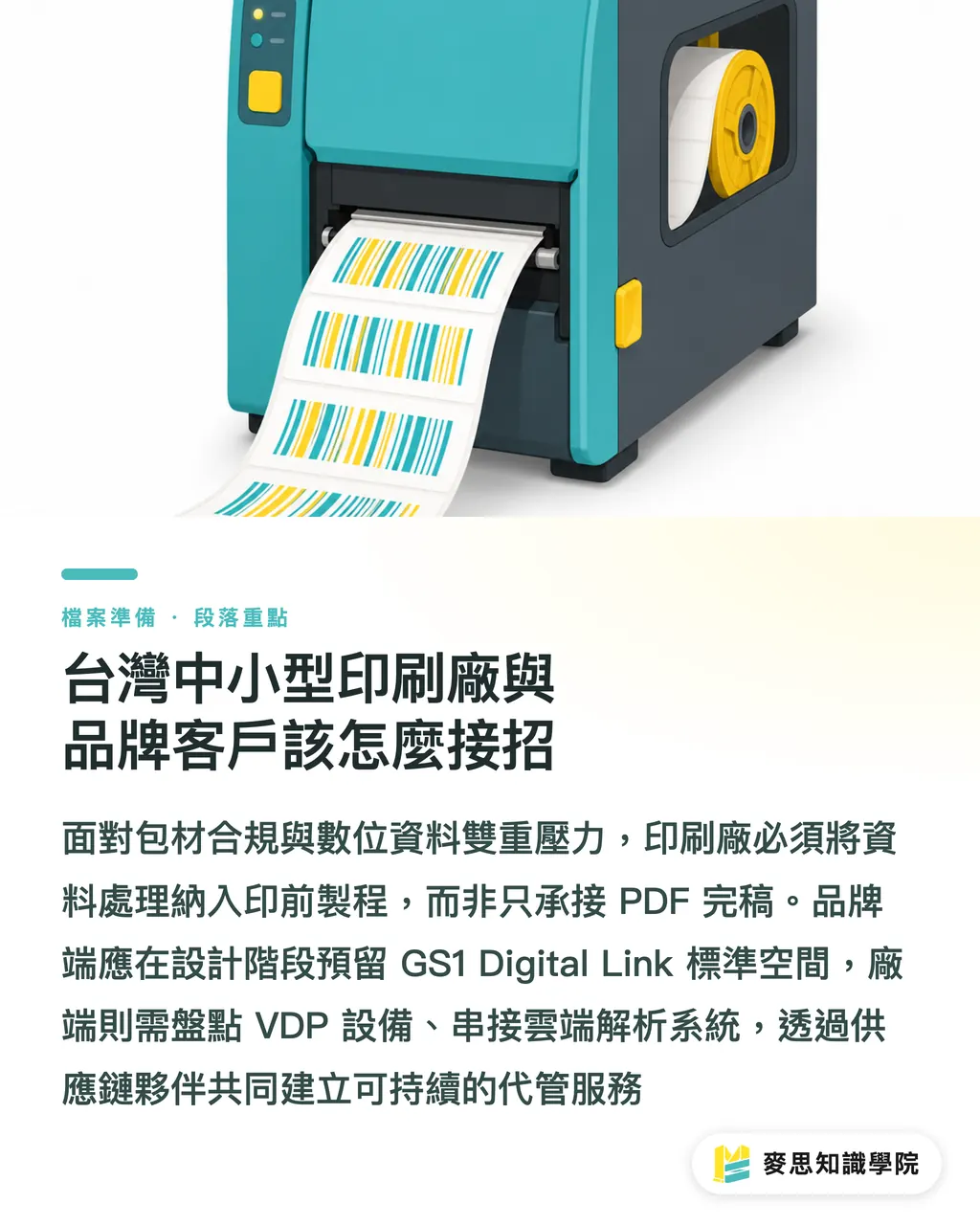
The system supports the GS1 Digital Link standard, allowing URLs on a single label to be dynamically resolved
For consumers scanning the code and customs officials conducting audits, the same QR Code can direct users to either a marketing web page or various regulatory data endpoints, completely solving the challenges of limited layout space and dynamic data updates
How Small and Medium-Sized Taiwanese Printers and Brands Should Respond
Faced with this double squeeze, spanning physical materials all the way to cloud data, going at it alone is simply too costly
Based on my long-term observations on the production line and client side, coupled with mounting chemical compliance pressures such as the recent bans on PFAS in food packaging, data links will only become more complex
Printers must treat data processing as an integral part of the prepress process, rather than just receiving finished PDF files from clients
・Audit in-house Variable Data Printing (VDP) equipment to ensure it can reliably produce dynamic barcodes with high yield rates
・Advise brand clients to reserve standard marking space for the GS1 Digital Link during the packaging design phase
・Seek supply chain partners who can bridge labeling hardware with cloud resolution software to offer systematic managed services
Key Takeaways
・With the EU mandating DPPs starting in 2027, labels have evolved from mere packaging into customs clearances for trade compliance
・The integration of Securikett's anti-counterfeiting hardware and GS1 Digital Link software resolution points the way forward for smart label standards
・SME printers must incorporate dynamic data processing capabilities into their core prepress workflows, transforming into compliance data carrier providers
Further Reflections
For the MINDS team and SaaS practitioners, this reveals a massive service gap
Most small and medium enterprises in Taiwan lack the technical capability to transform ERP data into compliant DPP endpoints
Developing a lightweight middleware system that links factory production data and automatically generates GS1-compliant dynamic URLs for prepress production lines
...would be a key entry point to break away from the razor-thin margins of traditional printing and lock in high-value clients
Further Reading
FAQ
- What is the EU Digital Product Passport (DPP)?
- It is a mandatory digital ID required by the EU for specific products (such as batteries, textiles, and electronics). Scanning it reveals details about product composition, origin, and recycling information, serving as a basis for import/export compliance reviews
- Why can't traditional QR Code labels meet DPP requirements?
- Traditional QR codes can only point to a single static URL. In contrast, the GS1 Digital Link required by the DPP allows the same barcode to dynamically direct users to different levels of data endpoints depending on who is scanning it
- What preparations can Taiwanese printers make at this stage?
- Prioritize upgrading prepress workflows to ensure capability in generating and verifying high-volume, high-precision variable data (VDP), and begin familiarizing themselves with GS1 standards and regulations
References
- 數位產品護照來了:包裝標籤業者如何在合規浪潮中搶先布局 · packaginginsights.com
Related articles

The Print × AI weekly
The print and AI know-how designers, brands and enterprises can use before they commit — one email, every week
MINDS Free Tools
AI background removal, a LINE sticker maker, spine & imposition calculators — all free, right in your browser, no upload.
MINDS Group
Need actual printing or gifting services?
From premium printing to online ordering and festive gifts — the MINDS Group sister brands take it from here.