

Overview
Before you quote a custom die‑cut, you need at least finished size, die line, bleed, corner radius, paper thickness, layout, crease position, hole position, and forming method. I run everything through MINDS Printing's (MS, mid‑to‑high‑end fully custom commercial printing) three‑gate intake—(1) size, (2) die, (3) post‑processing, because the price gap almost always comes from finishing risk, not the area of paper on the sheet
What Is a Custom Die‑Cut, and Why Won't a Simple Outline Get You a Real Quote?
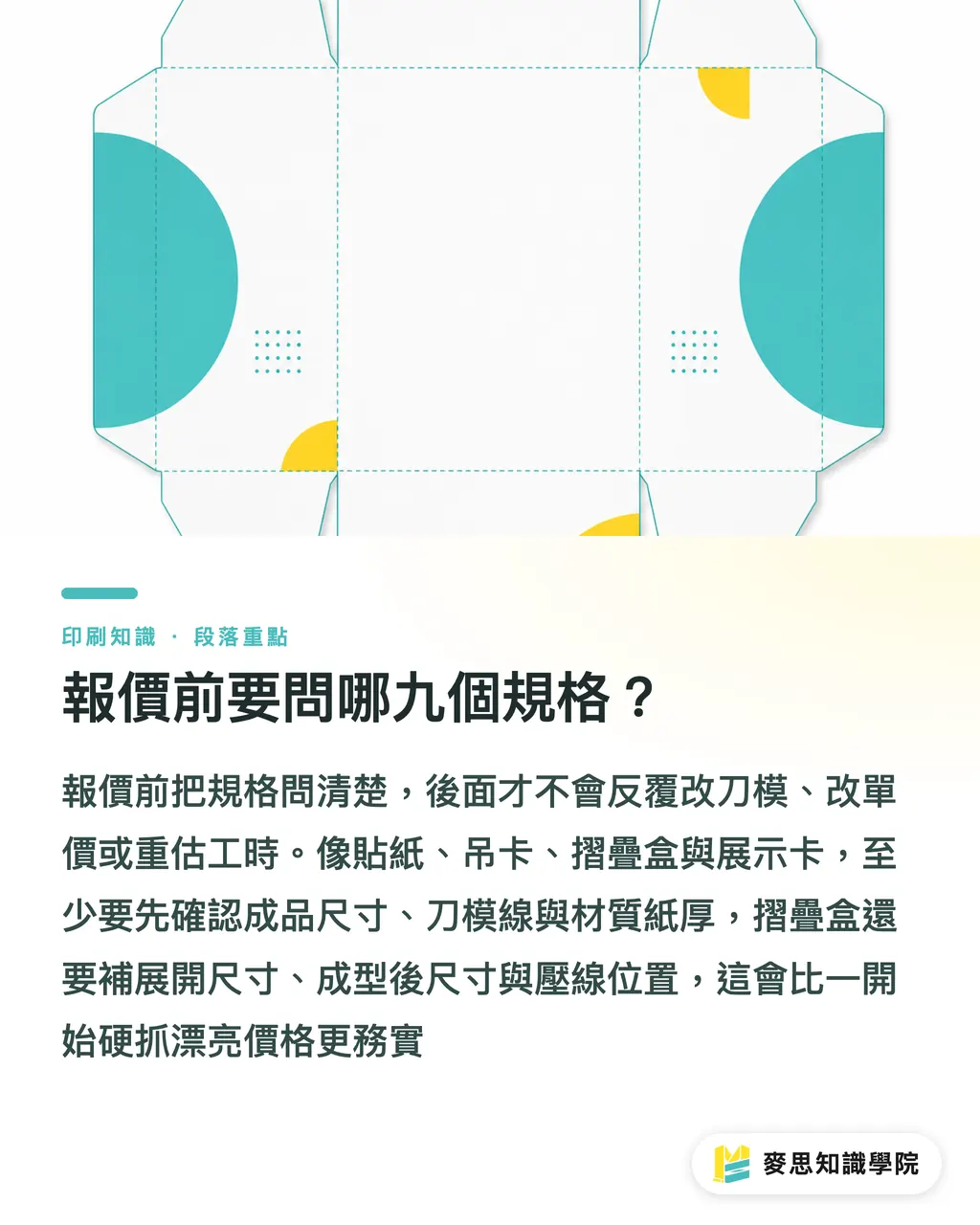
In MINDS Printing's pre‑quote intake, a custom die‑cut is when a die presses the printed sheet into a non‑straight shape. You'll see it on stickers, hang tags, folding cartons, and display cards. The die line carries the cut, crease, hole, and forming logic
The most common headache I see on the floor is this: the design side sends a pretty outline, but doesn't say which line cuts, which line creases, which hole punches through, and which edge folds later. On a folding carton, a crease line off by 1 mm can twist the whole box. On a hang tag, a hole shifted a millimeter sits crooked on the shelf
MINDS Printing's three‑gate intake separates the question cleanly:
・(1) Size gate: keep finished size, flat size, and folded size straight
・(2) Die gate: cut lines, crease lines, holes, and bleed need to read clearly to the printer and the die‑cutter
・(3) Post‑processing gate: strip waste, fold the box, insert the card, glue, thread the string, price it and schedule it from the start
What Are the Nine Specs to Lock Down Before You Quote?
The more you pin down before the quote, the fewer dies you reopen later. When MINDS estimates stickers, hang tags, folding cartons, and display cards, I usually get these 9 specs filled in first, then we talk unit price
・Finished size: give the trimmed length and width. For folding cartons, add the flat size and the folded size
・Die line: cut and crease should sit on separate layers or in separate colors, ideally as vector paths. A low‑res preview isn't enough
・Bleed: 3 mm is the usual starting point, but for full‑bleed backgrounds, specialty stocks, or stickers with colored edges, follow the printer's template
・Corner radius: small radii usually run more cleanly than sharp corners. Too small and you basically get a sharp corner, plus waste gets harder to strip
・Paper thickness: 300 gsm card, laminated stickers, heavy display cards all want different die pressure and die settings. Paper thickness can't wait until the proof
・Layout: one‑up, multi‑up, or shared edges between left/right pieces all change die cost, paper waste, and how stable the cut runs
・Crease position: on folding cartons, mark the crease, counter‑crease, and fold direction clearly. Creases too close to artwork make the print look crooked
・Hole positions: hang tag holes, mounting holes, round holes, and slot holes need diameter, center point, and distance from the edge
・Forming method: interlocking tabs, glued boxes, hand folds, display card standing angle, each one changes the die design and the hand time
If you only have a draft on hand, send MINDS the finished size, expected substrate, quantity, and end use for a first estimate. Lock the die line, then the unit price. That beats chasing a pretty number on day one
Which Die Designs Most Often Blow Up the Quote?
I usually split die‑cut red flags into three buckets: spikes too thin, cut lines too dense, content too close to the edge. They all look great on screen and turn into fraying, tearing, drift, and hand patching on the press
・Spikes too thin: starbursts, zig‑zags, skinny tails. The paper frays, and sticker waste can snap off at the tip. The die‑cutter can run it, but the yield won't be pretty
・Cut lines too dense: wavy edges, tiny cutouts, clusters of small inner holes. The die itself gets harder to make, and stripping waste slows down
・Content too close to the edge: text, logo, QR code hugging the die line. Even a 0.5 mm shift shows, and dark backgrounds with white text give it away fastest
Generative AI can spark shape ideas for designers, but the outlines from an AI image usually have no cut lines, creases, bleed, paper grain, or stripping order. I'd treat the AI outline as a concept sketch and redraw a production‑ready die line in Illustrator
Stickers, Hang Tags, Folding Cartons, Display Cards: What Do You Ask for Each?
They're all called custom die‑cuts, but the risk profile is completely different across stickers, hang tags, folding cartons, and display cards. MINDS Printing's three‑gate intake shifts its checklist depending on the product
・Stickers: ask for the size of each piece, the die outline, full‑kiss or half‑kiss cut, and whether waste needs to be stripped. Corners and sharp tips hit strip speed directly
・Hang tags: ask for hole diameter, distance from the hole center to the edge, hang direction, and paper thickness. Confirm at least one hole can actually hold weight on a real shelf
・Folding cartons: ask for the flat layout, crease positions, fold direction, interlocking tabs, and glue flap. Two or more folds means you need to spell out the forming sequence
・Display cards: ask how it stands, slot width, back panel angle, and what it holds. Cutting the shape is the easy part, if it won't stand on the shelf, it goes back to the drawing board
I've watched plenty of jobs stall at "the artwork looks great, but it doesn't work once it's formed." Display cards show this the most. The face has to catch the eye, the structure has to hold up. Before you quote, have a Mai Strategy Knowledge Academy consultant eyeball the structure. It often saves a proof round
What Happens to the Quote When Hand Stripping or Assembly Follows the Die‑Cut?
Die‑cut cost often hides after the press stops. Stickers need hand stripping, hang tags need stringing, folding cartons need hand folding, display cards need assembly. All of that moves the unit price and the lead time, so quantity alone won't tell you the story
When I quote, I ask two specific questions: can the waste be stripped cleanly, and does the finished piece need hand assembly. 500 sheets of complex handwork can easily outrun 2,000 sheets of simple square cards, because hand time isn't priced by sheet area
For buyers, the practical move is to break the job into five steps and ask about each one: print, die‑cut, strip, assemble, pack into bags. For designers, dropping one small spike or one row of dense inner holes can save half a day across the whole run

Key Takeaways
・Lock down the 9 specs before asking for a die quote. Skip one and you'll likely pay for it in a second proof or a re‑cut die
・Finalize finished size, die line, and paper thickness first. The die‑cutter needs them to choose the rule and set the pressure
・Sharp corners, dense cut lines, and text hugging the edge look fine on screen and run unstably on the press
・Build hand stripping and assembly into the lead time. Cheap quotes often get made up before shipment
Where to Go From Here
On the production side, these 9 fields can become required fields in the estimation form. On the design side, die line, bleed, and hole positions can become a pre‑press checklist. AI can handle shape ideation and version sorting, but the final piece has to be a vector die that the die‑cutter can actually run. If SaaS wants to serve print buyers, the real value isn't pricing paper, the value is helping the user get size, substrate, die, forming, and hand operations right in one pass before they ever ask for a quote
FAQ
- Do I need to send the die line before asking for a custom die‑cut quote?
- Ideally yes. At minimum, send the finished size, an outline sketch, and the end use. Without a die line, any quote is rough. Once the cut, crease, and hole positions are confirmed, the price gets a lot closer to actual production cost
- Why does the price of a custom‑shaped sticker change so much with the outline?
- Sticker price moves with die complexity, kiss‑cut vs. through‑cut, stripping difficulty, and layout. More sharp tips, more inner holes, denser cut lines, each one adds die cost and hand‑stripping time
- What's the easiest thing to forget when quoting a folding carton?
- Crease positions, fold direction, interlocking tabs, and the glue flap. The front face size alone isn't enough, you also need the flat layout and the forming method
- Can I send an AI image or a JPG of the die outline straight to the printer?
- An AI image or JPG works as a concept reference, but not as a finished die file. The printer needs an editable vector die line with cut, crease, bleed, and hole positions clearly marked
- Does hand stripping or assembly affect the lead time?
- Yes. Hand stripping, stringing, hand folding, assembly, and bagging all extend handling time. Get those steps spelled out before the quote, or the price and the schedule get rewritten right before shipment
Related articles



The Print × AI weekly
The print and AI know-how designers, brands and enterprises can use before they commit — one email, every week
MINDS Free Tools
Spine width and imposition calculators — skip the manual math, free in your browser.
MINDS Group
Need actual printing or gifting services?
From premium printing to online ordering and festive gifts — the MINDS Group sister brands take it from here.