

Should Course Handouts Be Split into Modular Booklets or Bound as a Single Volume?
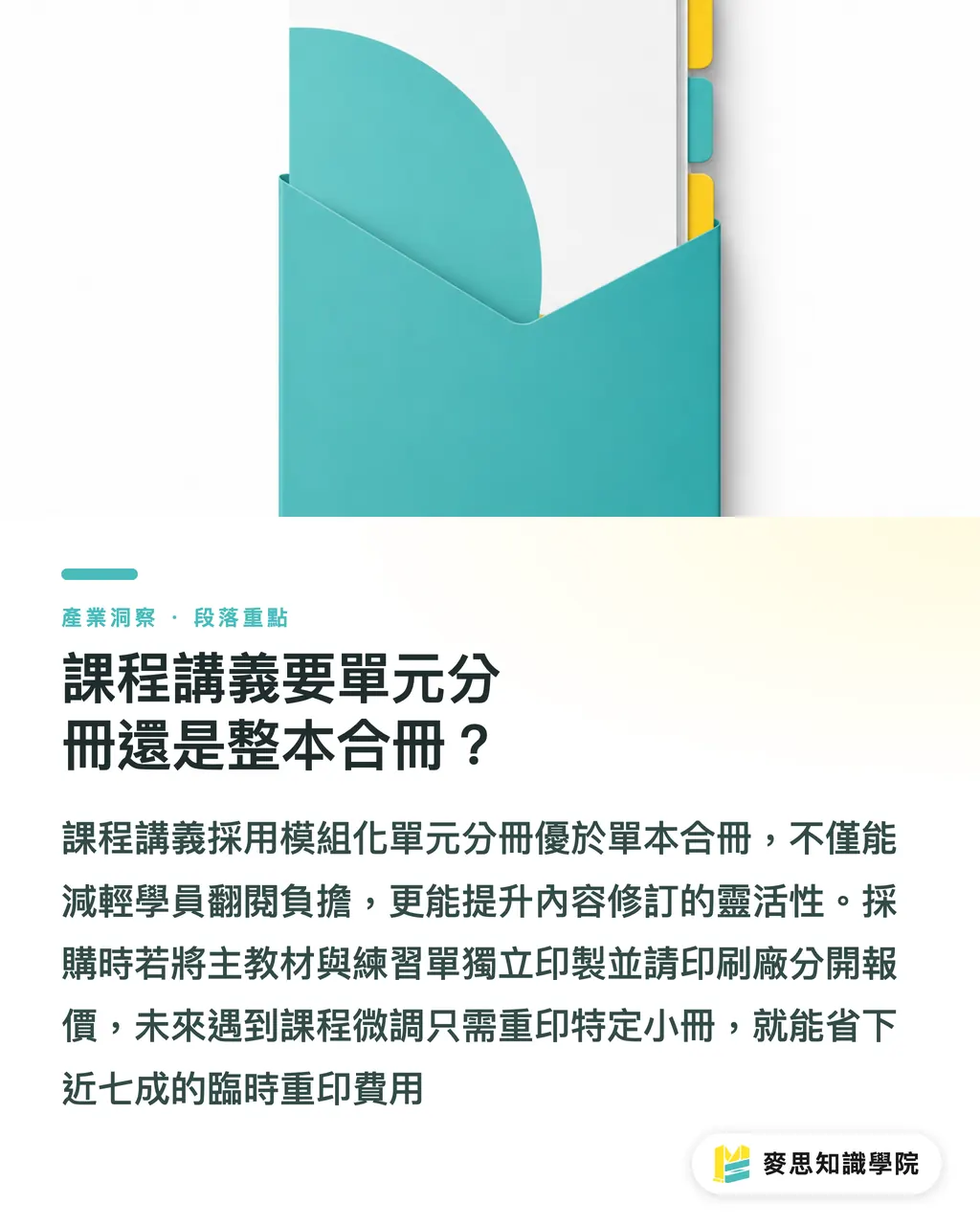
Using modular unit booklets for handout packs beats binding everything into a single volume. It solves two major pain points: participants carrying heavy materials and instructors making last-minute content changes
Corporate training and workshops often include components like main handouts, exercise worksheets, certificates, name badges, sign-in sheets, and takeaway folders. Binding them all into one thick volume makes flipping through pages on-site clumsy. Even worse, if just one page changes, you have to scrap and reprint the entire book
From my years of observing print production lines and procurement jobs, combining booklets into kit sets yields the highest ROI. When drafting specifications, procurement teams can use the following principles to balance choices and compare quotes:
・Main courseware handout: Print as a bound booklet of 60 to 100 pages to present core concepts completely
・Hands-on exercise sheets: Print as standalone sheets or unit booklets. This makes it easy for participants to pull them out anytime for writing and group discussions
・Post-class reference materials: Use single-page modules stored in a folder so participants can easily take them home and file them
・Completion certificates and name badges: Print separately on heavy paper of 250gsm or higher to preserve quality and professionalism
Hold on a second
When getting quotes, procurement buyers shouldn't just compare the total price per bound book. Make sure to ask the print vendor for separate line items on unit booklets and the outer pocket folder. That way, if a module needs minor tweaks later, you only reprint a specific 4-page or 8-page booklet. This saves nearly 70% in emergency reprinting costs
How Should You Specify Handout Paper and Binding for Easy Writing?
Handout paper should prioritize uncoated offset or woodfree paper, paired with a binding style that opens completely flat
Woodfree Paper refers to printing paper free of chemical wood pulp residues, with uniform fibers and no glossy surface coating. It offers good ink absorption and opacity, making it ideal for writing on-site with pencils, ballpoint pens, and rollerball pens. It is the primary material choice for course handouts and exercise sheets
Many buyers pick coated art paper to get vivid, photo-like colors. As a result, when participants take notes, the ink takes forever to dry. A quick swipe of a hand leaves the whole page smeared black, creating an awful experience in the classroom
For setting specifications on handouts and exercise sheets, procurement should consider the following layout when requesting quotes:
・Inner pages: 80gsm to 100gsm white woodfree or soft woodfree paper. This balances double-sided print opacity with a smooth writing feel
・Cover paper: 200gsm to 250gsm C1S or C2S art card, paired with single-sided matte lamination to boost wear resistance and water repellent qualities
・Saddle stitching: Best for thin booklets under 64 pages. The advantage is low cost and pages that lay relatively flat when opened
・Twin-loop wire binding: Ideal for thick manuals or workshop workbooks over 80 pages. It folds 360 degrees and lays completely flat on a desk
・Perfect binding: Suitable for standard coursebooks over 100 pages. The clean spine looks good and stores neatly on bookshelves
If you have doubts about the writing feel or opacity of specialty paper, reach out directly to MINDS for physical paper samples and proofing to guarantee quality before committing to high-volume printing
How to Stop Last-Minute Edits by Instructors from Forcing a Full Reprint?
Establishing standardized version page numbering and on-site page swapping procedures is your strongest defense against last-minute reprint risks
The most common emergency in classroom training is an instructor asking to change two slide charts 24 hours before class. If the full batch of handouts is already printed, buyers get trapped in a dilemma: reprint everything or live with the flaws
The key to solving this is building error-proofing mechanisms right at the design stage. You can ask designers and print shops to follow this workflow:
・1. Unit-based page numbering: Use format like "A- 01, A-02" or "Module 1-1" instead of traditional continuous book numbering. This prevents page count shifts across the entire book when adding or deleting pages in a single module
2. Reserve insert sheets before class: Plan volatile data charts or case studies as independent insert pages and place them loose inside the handout folder
3. Stamp version timestamps in footers: Print tiny text like "V20260801" in page corners so on-site staff can quickly verify the latest version
4. Prepare digital reprint backup files: Agree on an emergency print workflow with your digital printing partner. If specific pages need reprinting on-site, black-and-white digital fast printing can deliver within 2 hours
It's simple
By decoupling high-variability content from fixed layouts, you keep losses from instructor edits to a minimum

How Corporate Procurement Enforces Inspection and On-Site Backups
Handout pack inspection should focus on trim margins, binding durability, and paper color variation, while mandating a 5% on-site backup allowance
When receiving course handout packs from the printer, buyers must never sign off and pay based solely on outer box labels. Randomly sample 3% to 5% of the total order on-site for physical inspection
Quality inspection should strictly execute the following three checkpoints:
・Trim and bleed check: Confirm inner page body text and page numbers are not too close to trim lines. Keep a safety margin of at least 5 to 8 mm from edges
・Binding and saddle stitch check: Flip through pages to check if spine staples align properly. Pull inner pages firmly to confirm there are no loose pages or glue failures
・Paper and ink color check: Cross-reference against ISO 12647 international color printing standards to ensure uniform ink density across all pages without noticeable color shifts or streak lines
Beyond quality inspection, quantity and backup planning form an integral part of procurement decisions
Classrooms often face last-minute walk-ins, VIP attendees, or participants accidentally spilling water on their handouts. When setting print quantities, buyers must add a 5% to 10% backup quota on top of expected headcounts
Prepare an extra blank sample pack containing name badges, certificates, and exercise sheets, and hand it to the on-site teaching assistant. This guarantees the entire training session runs without a hitch

Key Takeaways
Using modular booklets for handouts guards against instructor revision risks and cuts reprinting costs
Specify 80 to 100gsm woodfree paper for writable pages, avoiding glossy coated art paper that causes ink smudging
Adopting independent unit page numbering and printing version timestamps boosts emergency swapping and reprinting efficiency
Choose binding based strictly on page count: use saddle stitching under 64 pages, and wire binding for thicker books
Reserve a 5% to 10% backup allowance during print procurement to handle attendance changes and unexpected incidents on-site
Further Considerations
As shown by handout pack planning, modern print procurement is no longer just about competing on unit price. It tests error-proofing design and flexible response capabilities across the entire learning environment
Looking ahead, when companies plan large-scale internal training or SaaS hybrid online/offline courses, combining AI layout design with short-run digital printing creates an agile handout printing workflow
By building a standard spec library and version control system early, procurement leads ensure smooth classroom experiences while striking the optimal balance between budget and quality
FAQ
- Should handout printing use digital printing or traditional offset printing?
- It depends on print volume. For small runs under 300 copies or personalized badges and certificates, digital printing is recommended to shorten lead times. If volume exceeds 500 copies with fixed content, traditional offset printing significantly lowers cost per unit
- Why is varnish coating or lamination discouraged for inner pages of handouts?
- Lamination or varnish closes the pores of paper fibers. Water-based inks and ballpoint pens cannot adhere to it, leaving participants unable to write notes or complete exercises smoothly
- How can you ensure handout binding will not fall apart when flipped through on-site?
- For under 64 pages, saddle stitching is the most secure option. For thicker books requiring perfect binding, explicitly instruct the printer to use PUR reactive hot melt glue. Its adhesion and durability far exceed standard EVA hot melt glue
- Does a handout cover need lamination?
- Single-sided gloss or matte lamination on the cover is strongly recommended. It enhances visual appeal while preventing color transfer and dirt smudges during transport and handling
Related articles





The Print × AI weekly
The print and AI know-how designers, brands and enterprises can use before they commit — one email, every week
MINDS Free Tools
Spine width and imposition calculators — skip the manual math, free in your browser.
MINDS Group
Need actual printing or gifting services?
From premium printing to online ordering and festive gifts — the MINDS Group sister brands take it from here.