

How Should You Retain Samples During Print Delivery Inspection?
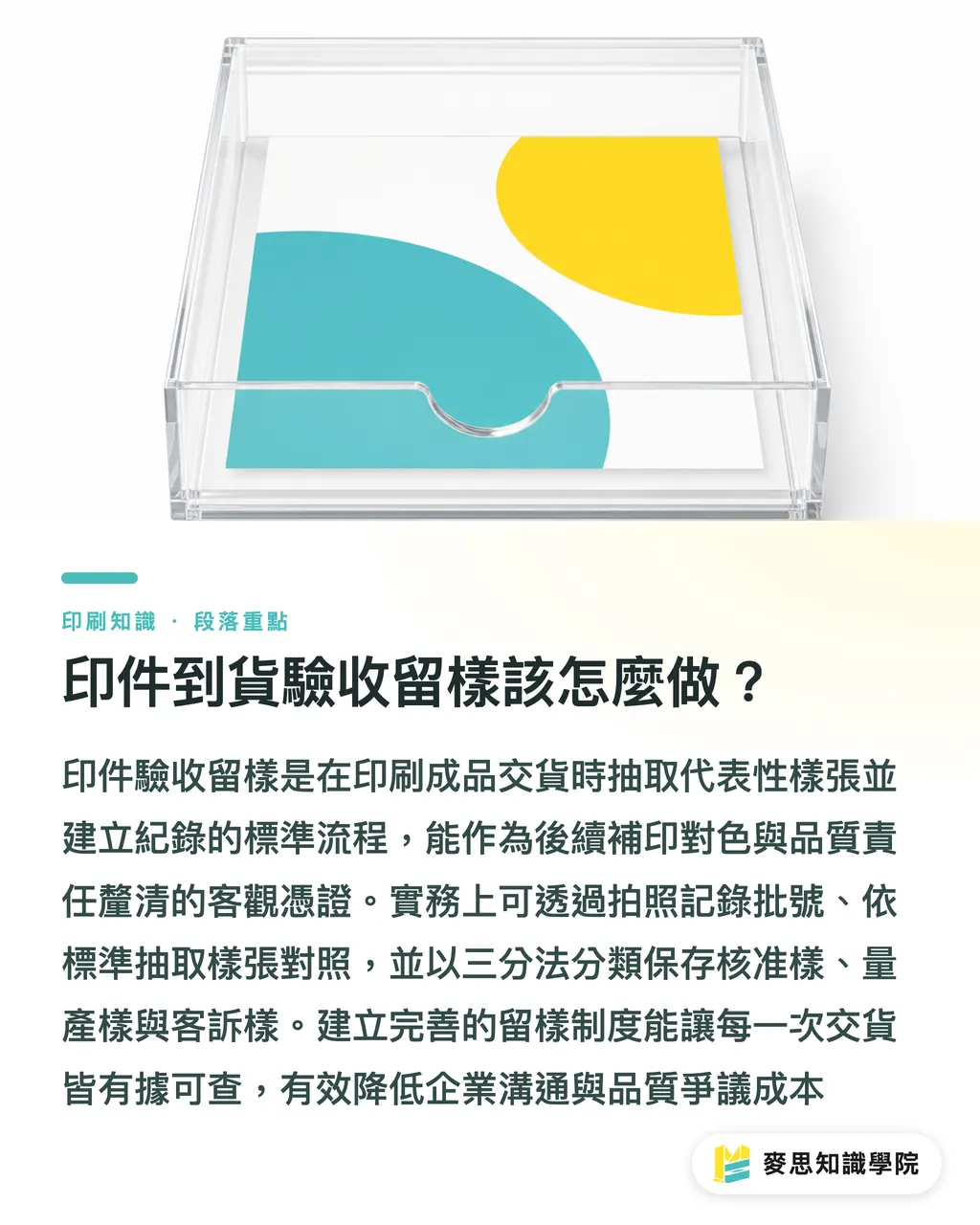
Retaining inspection samples is the standard procedure for companies to classify, store, and record approved files, random delivery samples, and defective samples after bulk print delivery. The goal is to establish an objective baseline and reduce communication costs during reprints or quality disputes. Put this into action directly using the 'MINDS (MS) Retained Sample Three-Step Method': 1. Take photos of outer boxes and batch numbers for archiving. 2. Sample 3% to 5% according to ANSI/ASQ Z1.4 standards and compare them against the approved proof. 3. Apply the three-way retention method to store approved proofs, mass production samples, and complaint samples
Retaining print inspection samples means procurement or QA staff draw representative finished products from the bulk delivery upon arrival, mark them with batch numbers, delivery dates, and color proofing conditions, and store them properly. These serve as physical and digital evidence for future color matching during reprints, quality returns, and liability clarification
A common nightmare on site happens six months later when you need a reprint of 2,000 copies. The factory asks which press printed the original job and which paper batch was used, but no one can find a single sample from the production run. Everyone ends up staring at an old poster and printing by pure guesswork. Setting up a proper sample retention system ensures every delivery leaves a clear paper trail
Why Can't Print Inspection Rely Only on Photos and Visual Impressions?
Many company inspection records consist of nothing more than two smartphone photos dropped into a chat group with a comment like 'the color seems dark' or 'the paper feels soft.' Descriptions lacking a clear baseline carry zero weight in legal or supplier communications, as screen color temperatures vary and photos cannot show paper thickness or finishing textures
To give retained samples true legal and commercial traceability, manage samples using the three-way system:
・ Approved Sample: Digital proof or press proof signed off by both sides before printing. This is the ultimate legal benchmark for quality
・ Mass Production Sample: Actual finished items sampled from different outer cartons upon delivery, representing the average quality of that batch
・ Complaint Sample: Defective samples preserved specifically when issues like misaligned trimming, scratches, or flaking foil stamping occur, used to hold vendors accountable and request reprints
Don't rush to unpack and store all bulk goods immediately. If quality concerns arise, place these three sample types side by side under standard lighting. You will instantly see whether the issue was in the original proof, a production error, or damage from transport
If your print projects involve complex structures, special substrates, or fully custom commercial printing, reach out to the Mai Strategy Knowledge Academy Consulting Team to build a custom quality sign-off and sample retention SOP
What Items Must Be Documented to Keep Inspection Records Valid?
A working document that holds up under review must record more than just pass or fail. Procurement teams must link physical samples with digital data during inspection
A complete inspection worksheet should cover the following key details:
・ Outer Box Labels and Batch Numbers: Photograph the production batch number, box number, and delivery date printed on the outer carton. This is your only trace back to plate versions and paper batches
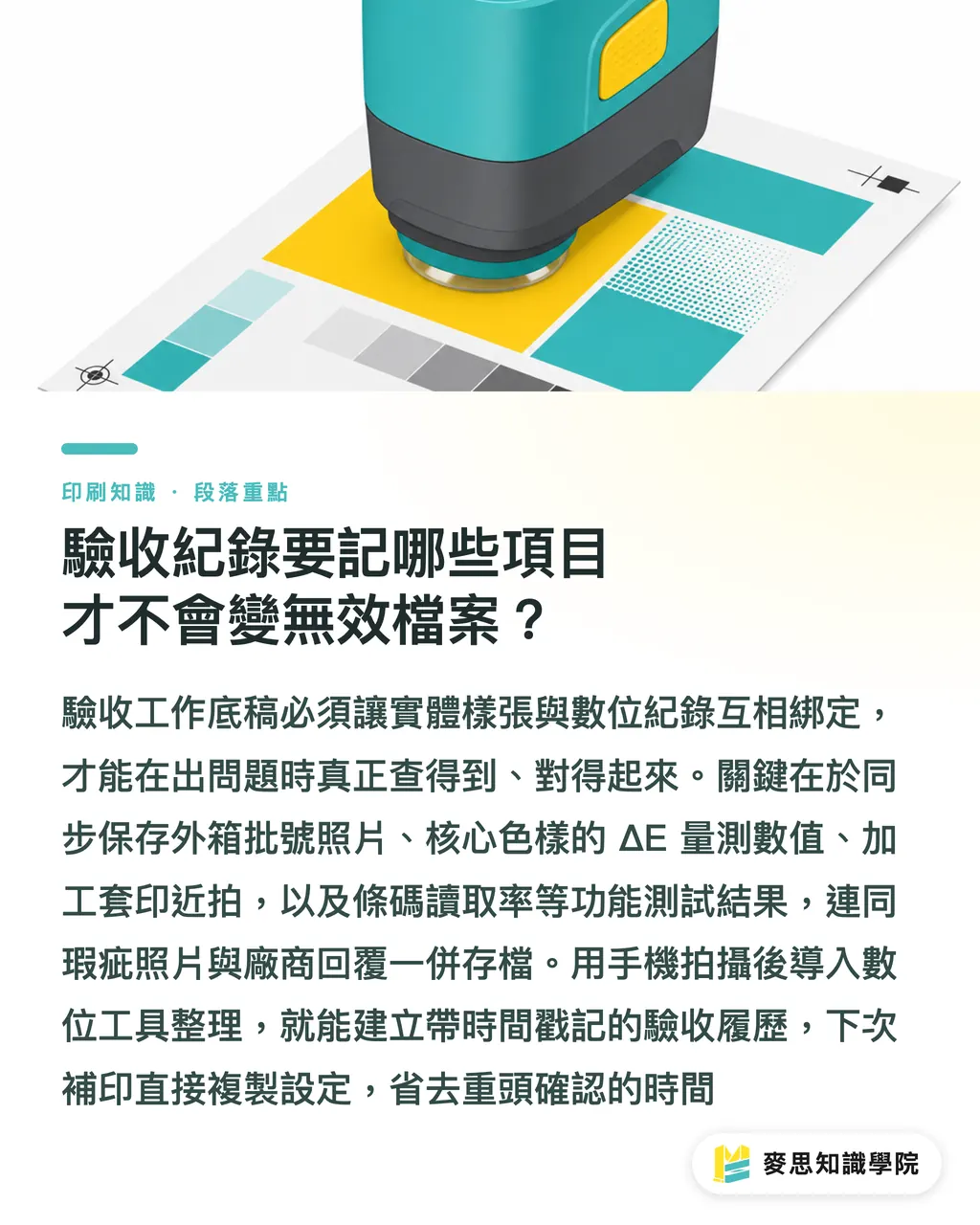
・ Core Color Samples and Measurements: Keep key solid color blocks or Pantone spot color areas. If a spectrophotometer is available, record ΔE color difference values
・ Finishing Positions and Gripper Edge Records: Take close-up shots of folding, spot UV, foil stamping, or creasing positions to confirm registration tolerances remain within 0.5 mm
・ Sustainable Packaging and Functional Test Records: For eco-friendly paper materials, test glued edge pull strength, verify barcode scan readability reaches Grade A, and check automated packing line performance
・ Defect Descriptions and Supplier Responses: Archive photos of defective items alongside written notes, vendor corrective action reports, and reprint commitments
That's all it takes. Snap photos with a smartphone and import them into digital tools to build a timestamped online inspection history. When reprinting next time, duplicate the configuration profile
How Do Retained Sample Standards Differ for Short-Run Trials, Proofing, and Mass Production?
Print procurement moves from screen sign-off, digital proofing, and short-run trial prints to mass production. Each stage has completely different retention priorities and cost considerations
Here are the principles for balancing sample retention and inspection across production volumes:
・ On-Screen Review and Digital Proofing: Suited for text proofreading and layout verification. Digital proofs work as basic color samples, but cannot serve as the final reference for ink absorption on specialty papers
・ Short-Run Digital Trial Prints: For print runs between 50 and 200 copies, use trial samples directly as the mass production standard and retain 2 to 3 copies
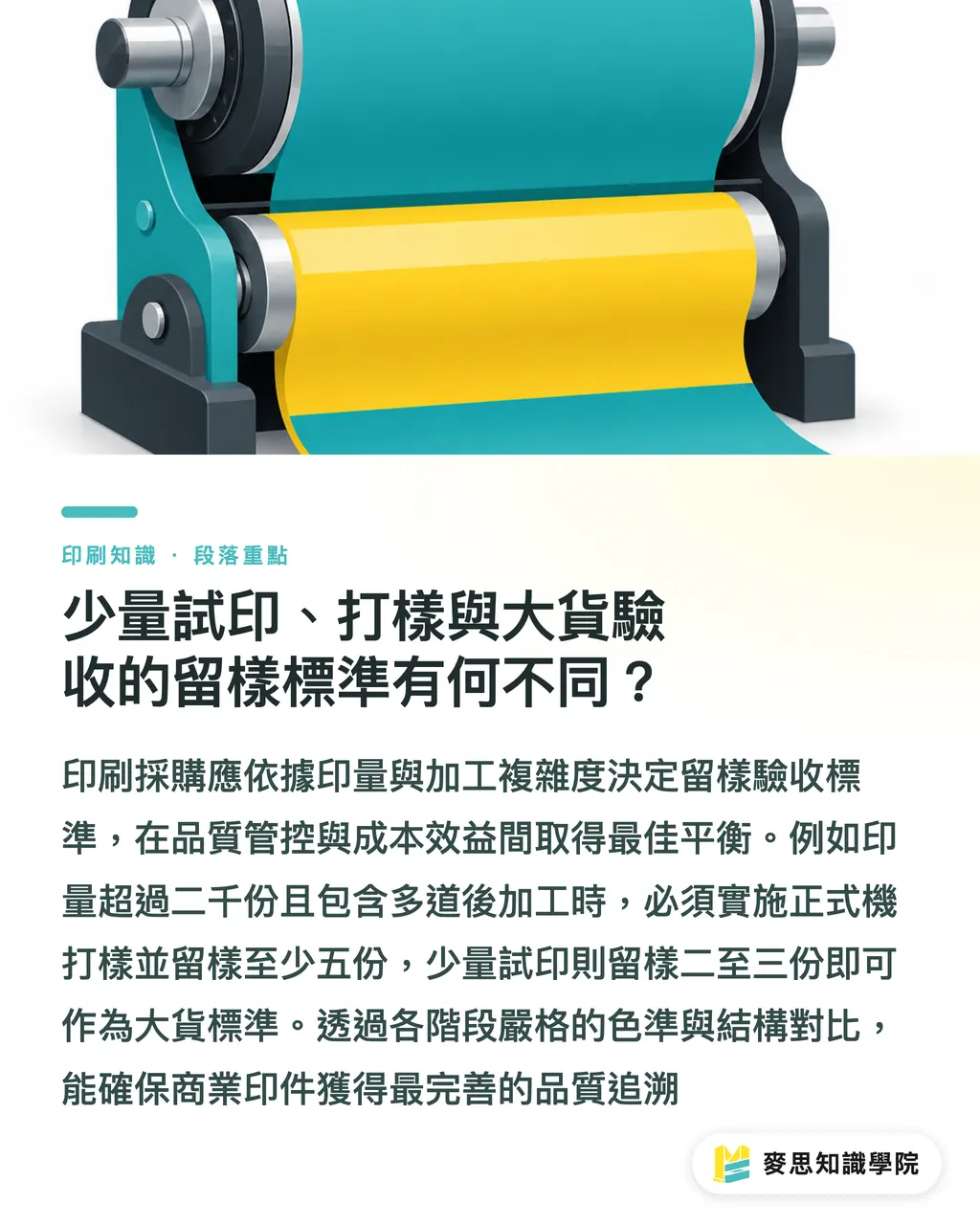
・ Press Proofs and Mass Production: When runs exceed 2,000 copies and include multiple finishing steps, execute a formal press proof, sign off physical samples, and retain at least 5 copies upon delivery
High-spec commercial printing demands strict color accuracy and structural control from proofing to final inspection. For mid-to-high-end custom commercial printing, MINDS provides complete print services from proof sign-off to production quality traceability
Key Takeaways
・ Inspection sample retention must follow the three-way storage rule, filing approved samples, mass production samples, and complaint samples separately
・ Outer box labels and production batch numbers provide essential clues for tracking paper and plate versions. Always photograph them upon delivery
・ Inspection records must cover finishing tolerances, barcode readability, and packaging structure tests rather than focusing only on color performance
・ Short-run digital trial prints can directly serve as mass production standards, while large volume runs require retaining at least 5 physical samples as a benchmark
Further Considerations
Sample retention seems like downstream quality control, but it forms the core of risk management in upfront design and procurement. As AI tools and digital sign-offs gain ground, companies should pair physical samples with digital history profiles, converting subjective color impressions into data-driven and visual worksheets. This cuts communication overhead during reprints while helping vendors drive continuous quality improvement
Further Reading
FAQ
- How many samples should be drawn upon print delivery for retention?
- For general commercial printing, randomly select 3 to 5 samples from different outer cartons for mass production retention. For larger volumes, follow the ANSI/ASQ Z1.4 standard to sample 3% to 5%
- How long should approved samples, mass production samples, and complaint samples be kept?
- Store samples for regular reprint items for 1 to 2 years. Keep samples for seasonal or one-off marketing campaigns for at least 6 months after the event ends, stored in a dry environment away from light
- Without a formal press proof, what should be used as the comparison benchmark during delivery inspection?
- If no formal press proof was made, rely on the digitally approved proof or annotated screen file signed off by both parties. Upon initial delivery, select the finished item closest to specification to serve as the baseline sample for future reprints
Related articles




The Print × AI weekly
The print and AI know-how designers, brands and enterprises can use before they commit — one email, every week
Tool Library
RGB↔CMYK conversion, ΔE color difference and brand color print analysis — free color management tools, computed right in your browser.
MINDS Group
Need actual printing or gifting services?
From premium printing to online ordering and festive gifts — the MINDS Group sister brands take it from here.