
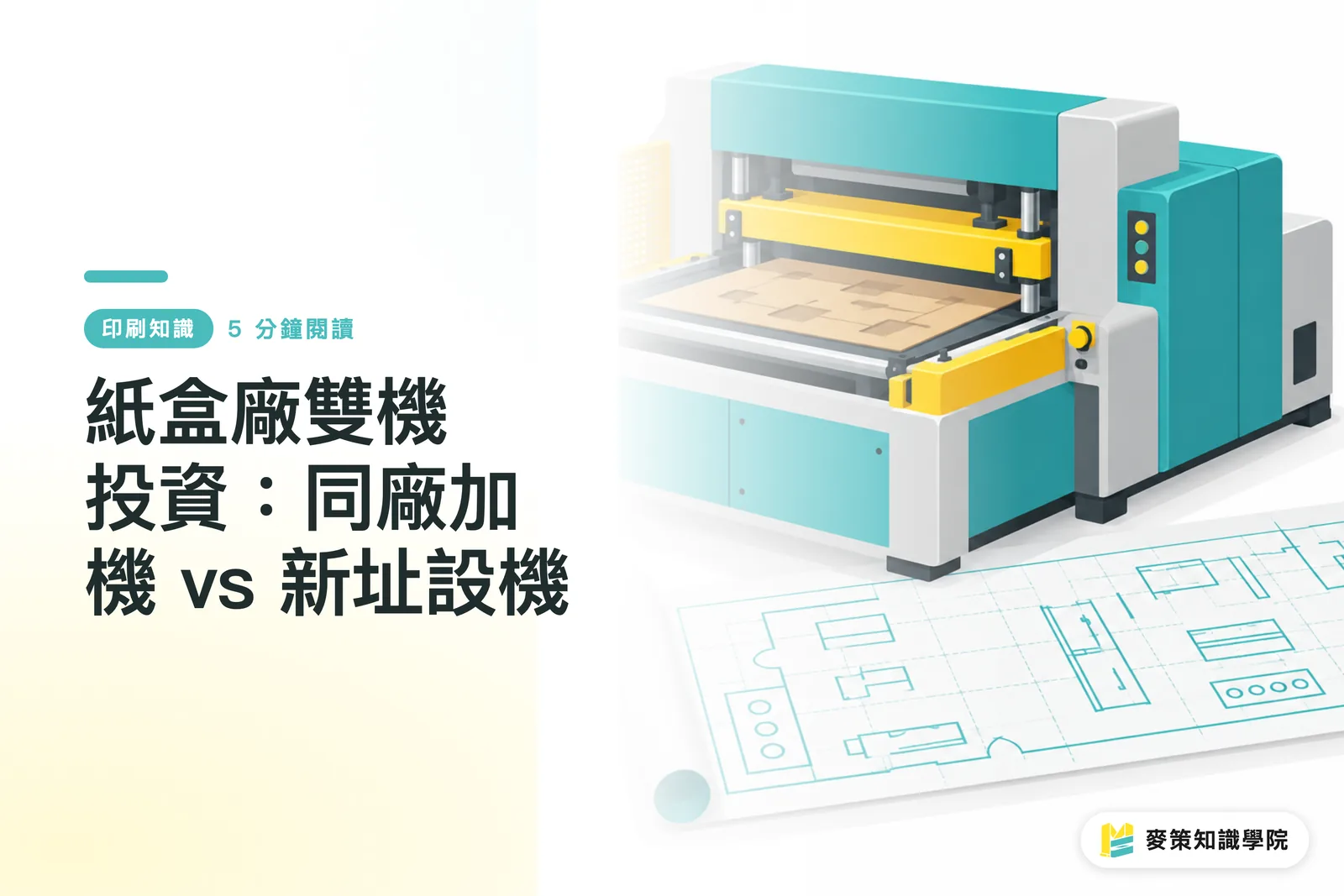
Which expansion paths did Galoppin and IVE take?
Galoppin Papier expanded its BOBST die-cutting capacity at its existing site, while IVE installed a BOBST NOVACUT at its new facility in Kemps Creek. The two cases show different paths: adding equipment at an existing plant and setting up a production line at a new site. BOBST, a post-press equipment brand, announced the investment on May 13, 2026. Galoppin's purchases included a VISIONCUT 106 LER Autoplaten. Founded in 1937, the family-run company is now in its fourth generation. It has 50 employees, around 30 machines and its own prepress department, and its folding carton business has grown in recent years. A die-cutting machine uses a custom die to cut printed board into carton blanks and crease fold lines, helping ensure consistent shapes and folds. My three-question framework for dual-machine investments starts by asking whether the new equipment can remove a production bottleneck, rather than simply looking at the number of machines. BOBST announcement: Galoppin Papier expands folding carton capabilities and invests in die-cutting equipment

What's the difference between adding a machine at the existing site and setting one up at a new site?
Adding a machine at the existing site uses the current factory, while setting one up at a new site means building a production operation at another location. Galoppin and IVE offer an example of each. Galoppin already had a BOBST SP 1080, which had been running reliably for around 60 years. The available information on IVE says it installed a NOVACUT at its new Kemps Creek facility. The machine model alone doesn't tell us its production volume or payback period. Apply the three-question framework and work through the site requirements one by one:
・Adding a machine at the existing site: Check whether it can share the current prepress team, technicians and material routes. Also make sure the extra equipment won't crowd the schedule, storage space or material handling
・Setting up at a new site: Include staffing, quality control, material transfers and customer lead times at the new location in the cost calculation. Don't count only the machine and the building
The distance from the existing plant and how orders are split between sites will both affect the management workload. Before buying equipment, map the board's route from receiving through die-cutting
How can a folding carton plant tell whether investing in a second machine makes sense?
A second machine makes sense if it can turn a bottleneck into conforming carton blanks delivered on time. The three-question framework breaks down the case for buying into three checks:
・Where is the bottleneck? Record die-cutting queues, downtime and orders with delayed delivery. Confirm that die-cutting is actually the cause
・Are there suitable jobs? Review the carton styles, order sizes and changeover frequency you handle regularly. Make sure there are enough orders to keep the added capacity busy
・Can the shop floor handle it? Factor in operators, training, maintenance, space and financing
Do the sums first. Galoppin's old die-cutter from another manufacturer was nearing the end of its useful life, and breakdowns were disrupting production. In that situation, replacing the machine can also reduce scheduling chaos caused by downtime. If the real problem is too few orders, buying equipment won't automatically bring in more revenue
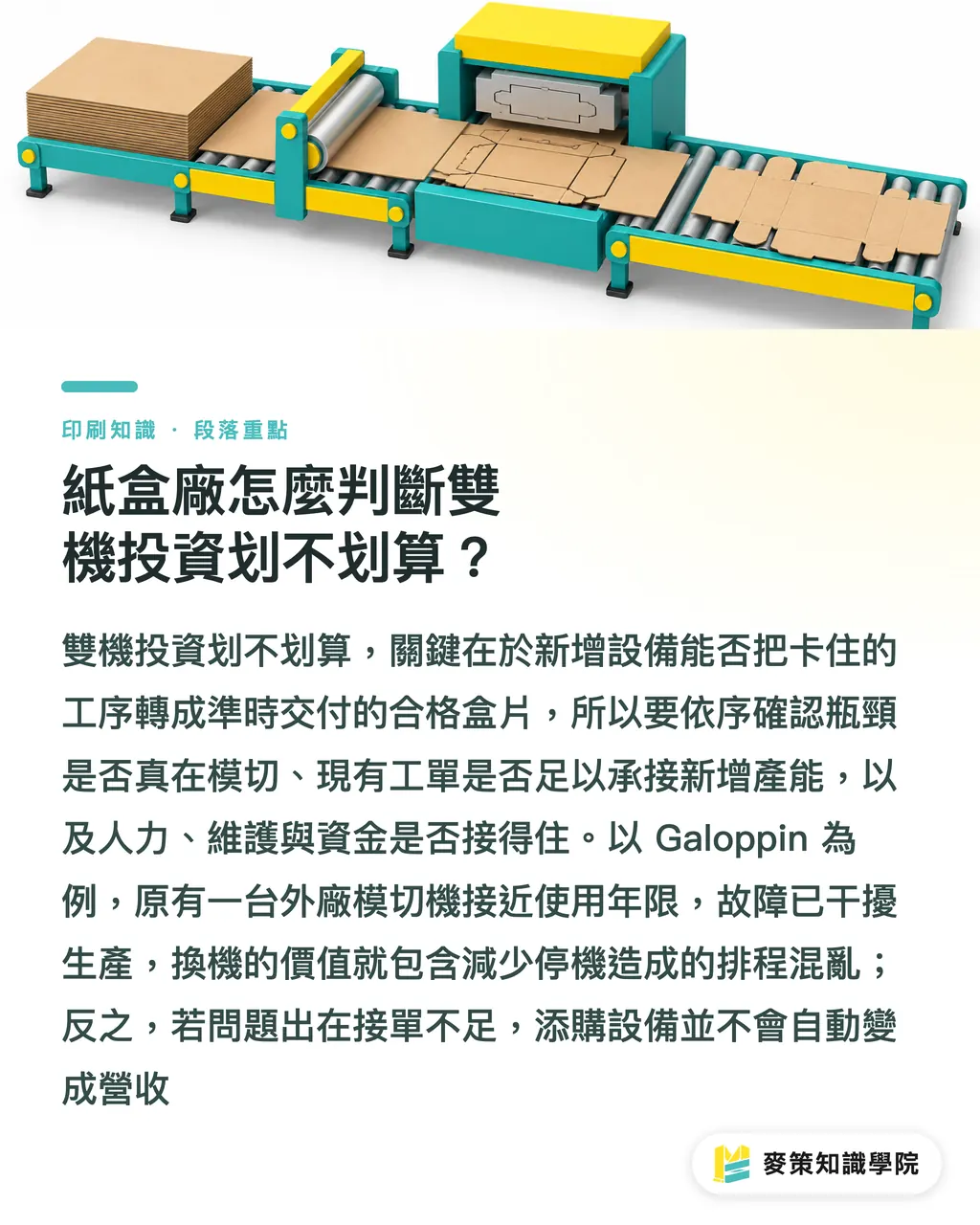
Why does changeover capability affect equipment choice?
Changeover capability affects how many different jobs each machine can handle in a day. After seeing a demonstration at the BOBST Competence Centre, Galoppin was particularly impressed by how easily the VISIONCUT 106 LER could be changed over. Skilled operators are also still hard to find and train. The three-question framework therefore includes how long a changeover takes, who can operate the machine and how quality is checked afterward. Don't compare machines by their advertised top speed alone
Faster changeovers. For orders with many product variations and short runs, changeover time cuts into the hours available for production. Even a fast new machine can leave the schedule stuck at handoffs and first-off checks if setup is complicated and current staff need a long time to train. Galoppin's long-running SP 1080 also offers a durability benchmark for evaluating how a new machine performs on the shop floor
What can Taiwan's smaller plants and brand customers do first?
Smaller plants in Taiwan can start by reviewing die-cutting queues, downtime and changeovers, then decide whether to add a machine at the existing factory or open another site. Using the three-question framework, brand customers evaluating a supplier's expansion can also ask which carton styles the new equipment will handle, how changeovers will be scheduled and whether promised lead times match the actual production schedule
・Printers: Gather recent records of delays and downtime. Work out whether the problem comes from die-cutting, earlier printing stages or staff scheduling
・Design teams: Provide dielines, board specifications and carton requirements for evaluation to reduce back-and-forth during prototyping
・Brand procurement teams: Include estimated quantities and delivery dates when requesting a quote, and confirm how the supplier will schedule sampling and production
If you're planning custom paper cartons, organize the carton style, board, quantity and delivery requirements, then ask MINDS for a quote. The clearer the specifications, the easier it is to match equipment capabilities to actual delivery needs
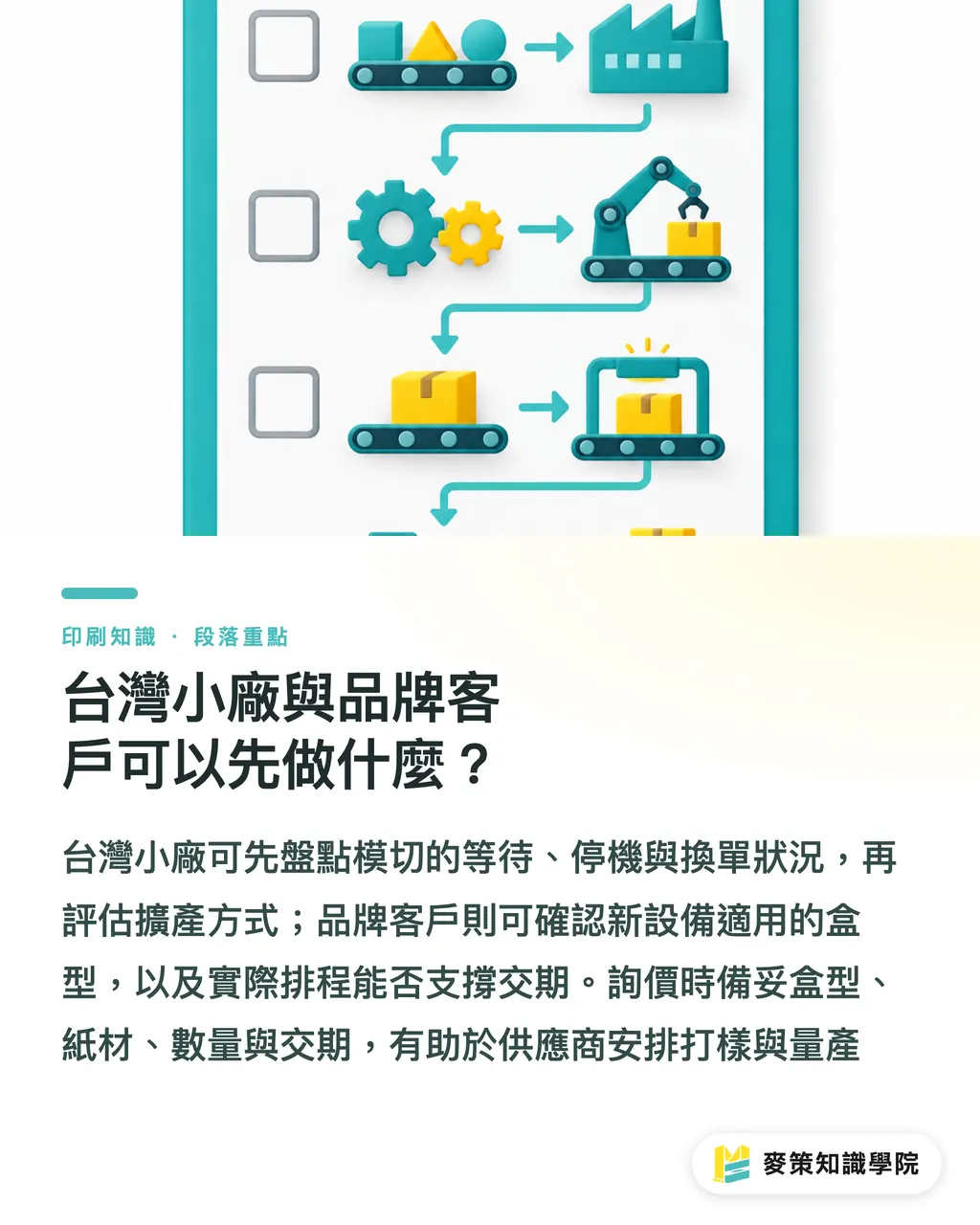
Key takeaways
・For a second-machine investment, find the die-cutting bottleneck first, then choose the equipment and site
・Adding a machine at the existing site means checking material routes and scheduling. A new site also requires a review of staffing and management
・Changeover ease and training demands affect how much of a machine's capacity can actually be used
・Machine speed isn't the same as saleable capacity. Assess jobs and delivery dates together
Further considerations
Print manufacturers and design teams can start by recording job details, changeover times, downtime causes and first-off inspection results in a consistent way. If AI or SaaS is used to help with scheduling, start with data that is clearly defined on the shop floor, then assess which orders could be delivered faster after the equipment investment
Further reading
FAQ
- When does a folding carton plant need a second die-cutting machine?
- A second die-cutter has a clear business case when queues or downtime at die-cutting are delaying deliveries and there are enough jobs to keep the added capacity busy
- How should a plant choose between adding a machine at its existing site and setting one up at a new site?
- For an existing site, start by checking available space, staff and material routes. A new site also requires calculations for staffing, quality control and material transfers
- Should I compare die-cutting machines by their top speed?
- Top speed is only one measure. A folding carton plant should also check changeover time, operator training, maintenance arrangements and first-off quality
- What equipment did IVE install in Kemps Creek?
- IVE installed a BOBST NOVACUT die-cutter at its new Kemps Creek facility, showing one path to expansion through setting up equipment at a new site
Related articles

The Print × AI weekly
The print and AI know-how designers, brands and enterprises can use before they commit — one email, every week
MINDS Free Tools
Spine width and imposition calculators — skip the manual math, free in your browser.
MINDS Group
Need actual printing or gifting services?
From premium printing to online ordering and festive gifts — the MINDS Group sister brands take it from here.