
Why is Saica adding another rotary die-cutter at Ashbourne?
Saica Group has installed a new machine at its Ashbourne plant in Ireland. The immediate goal is to increase corrugated packaging output and available capacity in response to changing customer demand and the production demands created by the growing number of automated packaging lines
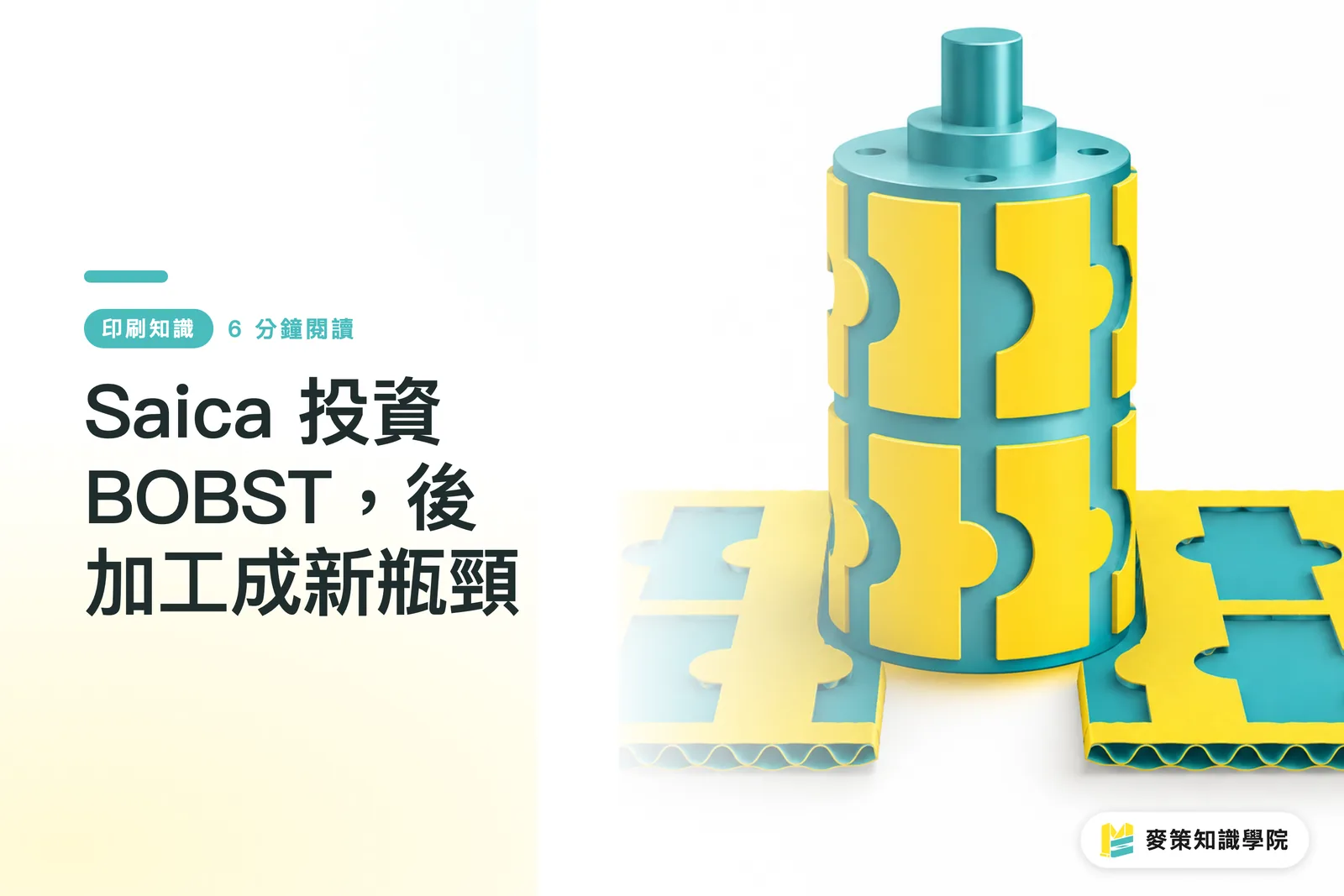
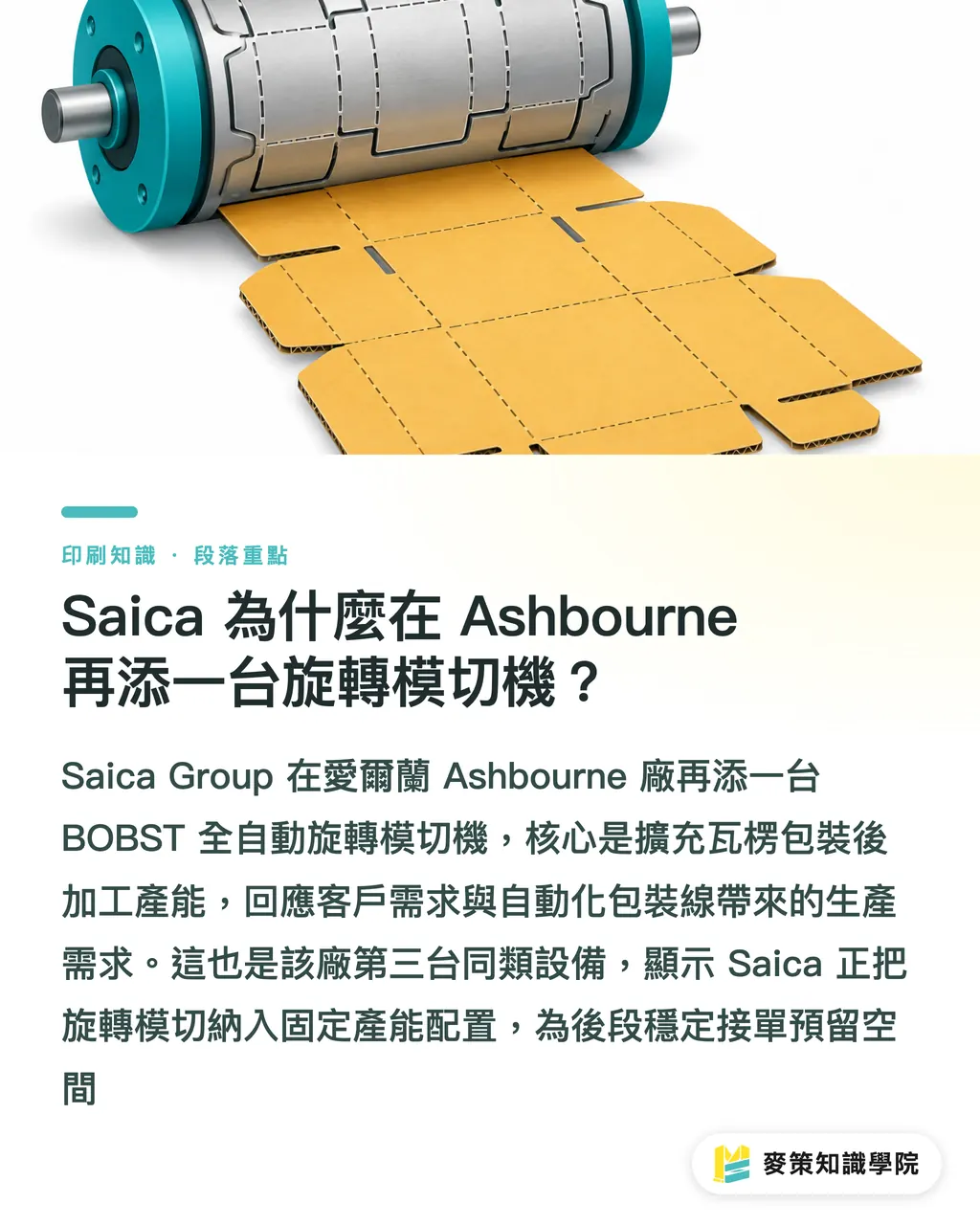
Postpress covers the cutting, creasing, folding and gluing, and forming preparation that follow printing. It determines whether a flat sheet of board can become usable packaging. A rotary die-cutter uses a cylindrical die to continuously cut and crease corrugated board, turning a case blank into a shape that can be folded and assembled
This installation is a fully automated rotary die-cutter from BOBST, the Swiss packaging equipment manufacturer, and it is the third fully automated machine of its kind at the Ashbourne plant. A report on Saica Group's installation of a BOBST rotary die-cutter at Ashbourne, published on September 22, 2026, said the new machine is expected to start production soon and will be included in Saica's wider investment plan in Ireland
I see the "third machine" as more informative than the brand name. Saica has made rotary die-cutting part of its standing capacity plan, and the capital spending points to room for steady order flow in postpress
What exactly does a rotary die-cutter improve?
It improves the cutting, creasing, and changeover rhythm between printing and the packaging line, helping corrugated board become case blanks ready for folding and assembly faster
A box is not finished when printing ends
The board must be cut according to the die into its outer shape, tabs, and openings, then creased along the fold lines. It may then move to folding and gluing, stacking, or packing. A rotary die-cutter runs continuously, making it well suited to handling repeat work through postpress with consistent results. Full automation helps with feeding, registration, and changeovers, reducing the time spent figuring out every new order
When I evaluate equipment, I ask two questions first: where exactly does the changeover get stuck, and can finished-product accuracy be maintained once the changeover is complete? A machine can run very fast, but if boxes still need rework downstream, the line is still slow
Saica's third fully automated machine at Ashbourne shows at least that postpress needs to be viewed as part of total capacity, not treated as an accessory beside the printing press
Why is postpress becoming the competitive battleground for corrugated plants?
Postpress is becoming a competitive battleground because brands want boxes that fit the product dimensions, packaging speed, and delivery rhythm. Getting the print color right completes only half the job
Ciaran Rodgers, regional manager at Saica Pack Ireland, attributed the growth in demand to the implementation of the EU Packaging and Packaging Waste Regulation (PPWR) and the growth of automated packaging lines. When boxes go straight into a customer's equipment, fit and compatibility go beyond appearance
Manual packing still allows an operator to adjust the box by hand. An automated packaging line will not position a poorly fitting box for you. If the die, crease lines, or stack dimensions are inconsistent, the issue may only surface when the customer's line stops, and the blame then lands on delivery quality
In my view, plants that can handle short runs, rush orders, and high-precision requirements have more pricing power. Plants that do not adjust their equipment and processes are likely to remain stuck in low-price competition for long runs. The Ashbourne investment lays that dividing line bare
How should small and midsize corrugated plants in Taiwan respond?
Taiwanese small and midsize corrugated plants should first identify the actual postpress bottleneck, then decide whether to buy equipment, outsource the work, or reorganize production. Do not start with a machine comparison chart
The new machine at Ashbourne is expected to enter production soon. Taiwanese plants should check "machine installed" and "actually able to take orders" separately. This is what I call MINDS' three-gate print-to-production check
・1. Specifications gate: confirm the board, box style, flat dimensions, die, crease lines, and end use. Do not send only a flat PDF
・2. Converting gate: confirm die-cutting capacity, die preparation, changeovers, proofing, and the path from sampling to mass production. If the customer has an automatic case-packing line, include it in the specifications
・3. Delivery gate: put printing, die-cutting, folding and gluing, stacking, and shipping on the same schedule. Do not look only at press availability
When order volume is unstable, find a reliable postpress partner first. Once similar orders become steady, use changeover frequency, labor-shortage risk, and delivery lead times to work backward into an investment decision. If a brand team is handling both commercial printing and packaging visuals, it can bring the finished-product requirements to MINDS for discussion, so print decisions start from the finished product
What habit should brand clients and designers change first?
Brand clients and designers should expand acceptance criteria from "Are the printed colors right?" to "Can the box reliably move through the next packaging process?"
Start with the finished product
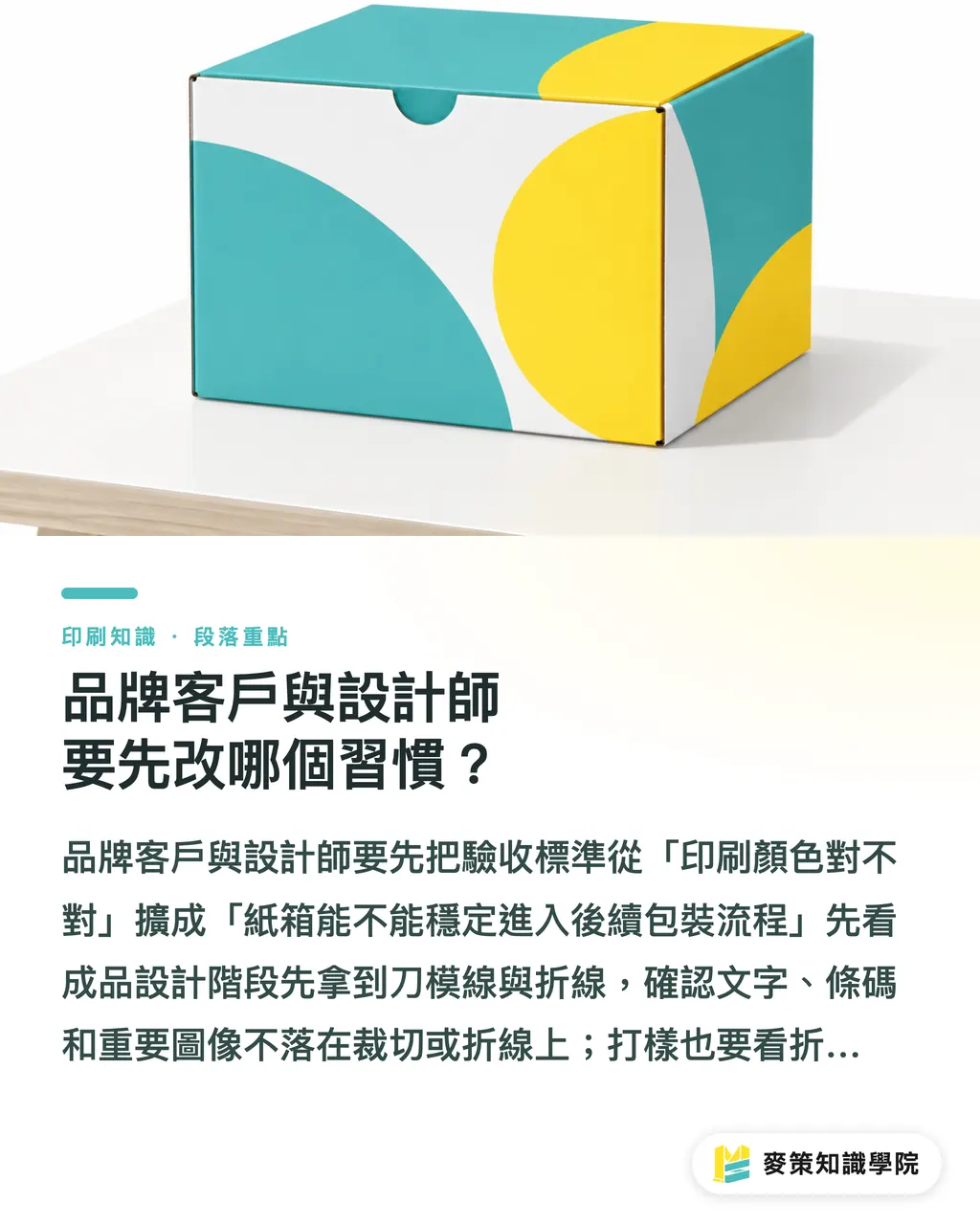
During design, get the die line and crease lines first, then make sure text, barcodes, and important graphics do not fall on a cut or crease. A proof should also be checked after folding, including the box's appearance, glue position, and case-packing motion. Do not look only at the flat board
The third fully automated machine at Saica's Ashbourne plant is also a reminder to AI (artificial intelligence) and SaaS (software as a service) teams that quoting and scheduling fields cannot record only board, number of ink colors, and press speed. They also need to include the die number, postpress stage, changeover conditions, and delivery status. Otherwise, automation will only spread optimistic estimates from the printing stage faster
The source does not disclose this machine's speed, changeover time, or payback figures, so procurement teams cannot treat "fully automated" as a guarantee of payback. Testing the bottleneck against real orders before deciding on equipment specifications is usually more reliable than chasing catalog numbers
Key takeaways
・Saica has installed a third fully automated BOBST rotary die-cutter at Ashbourne, increasing postpress output and available capacity
・For corrugated packaging, delivery bottlenecks often show up in cutting, creasing, and changeovers, not necessarily at the printing press
・Small and midsize plants should audit their operations through the three gates of specifications, converting, and delivery before deciding whether to buy equipment or outsource
・Brand acceptance checks should ask whether the box can enter the packaging line reliably, not just whether the flat print looks right
・Before introducing AI and SaaS, organize the postpress fields so quoting and scheduling stay connected to the shop floor
Further thought
I suggest that a plant start with one recent order that was most likely to get held up at die-cutting, folding and gluing, or delivery. Map the actual handoffs between printing, die-cutting, folding and gluing, stacking, and shipping, then divide the gaps into equipment, specification, and scheduling issues. This process map is usually closer to the investment answer than a machine catalog. If you want to turn the findings into purchasing specifications, quoting fields, and design handoff rules, discuss them with the Mai Strategy Knowledge Academy consulting team. Get the shop-floor language straight first, then talk automation
Further reading
FAQ
- What equipment is Saica installing this time?
- Saica Group is installing a third fully automated BOBST rotary die-cutter at its Ashbourne plant in Ireland. It is expected to start production soon, with the aim of increasing corrugated packaging output and available capacity
- What is the difference between a rotary die-cutter and ordinary cutting?
- A rotary die-cutter uses a cylindrical die to continuously cut and crease corrugated board. It suits a continuous, repeatable postpress workflow, so case blanks can move on to forming and packing
- Why is PPWR drawing more attention to postpress?
- The source says Saica links the rise in demand to the implementation of the EU PPWR and the growth of automated packaging lines. As a result, corrugated boxes need to fit both their intended use and the equipment's operating rhythm more consistently
- Do Taiwanese small and midsize corrugated plants have to buy fully automated equipment?
- Not necessarily. Use MINDS' three-gate print-to-production check to review specifications, postpress capacity, and delivery first, then decide between buying and outsourcing based on order stability, changeover frequency, and labor-shortage risk
- What should designers confirm before sending corrugated packaging artwork?
- Confirm the die line, crease lines, board specifications, and finished-product use first. Then use a proof to check cutting, folding, gluing, and packing. Do not judge it only by the flat print
Related articles
The Print × AI weekly
The print and AI know-how designers, brands and enterprises can use before they commit — one email, every week
MINDS Free Tools
Spine width and imposition calculators — skip the manual math, free in your browser.
MINDS Group
Need actual printing or gifting services?
From premium printing to online ordering and festive gifts — the MINDS Group sister brands take it from here.