
Overview
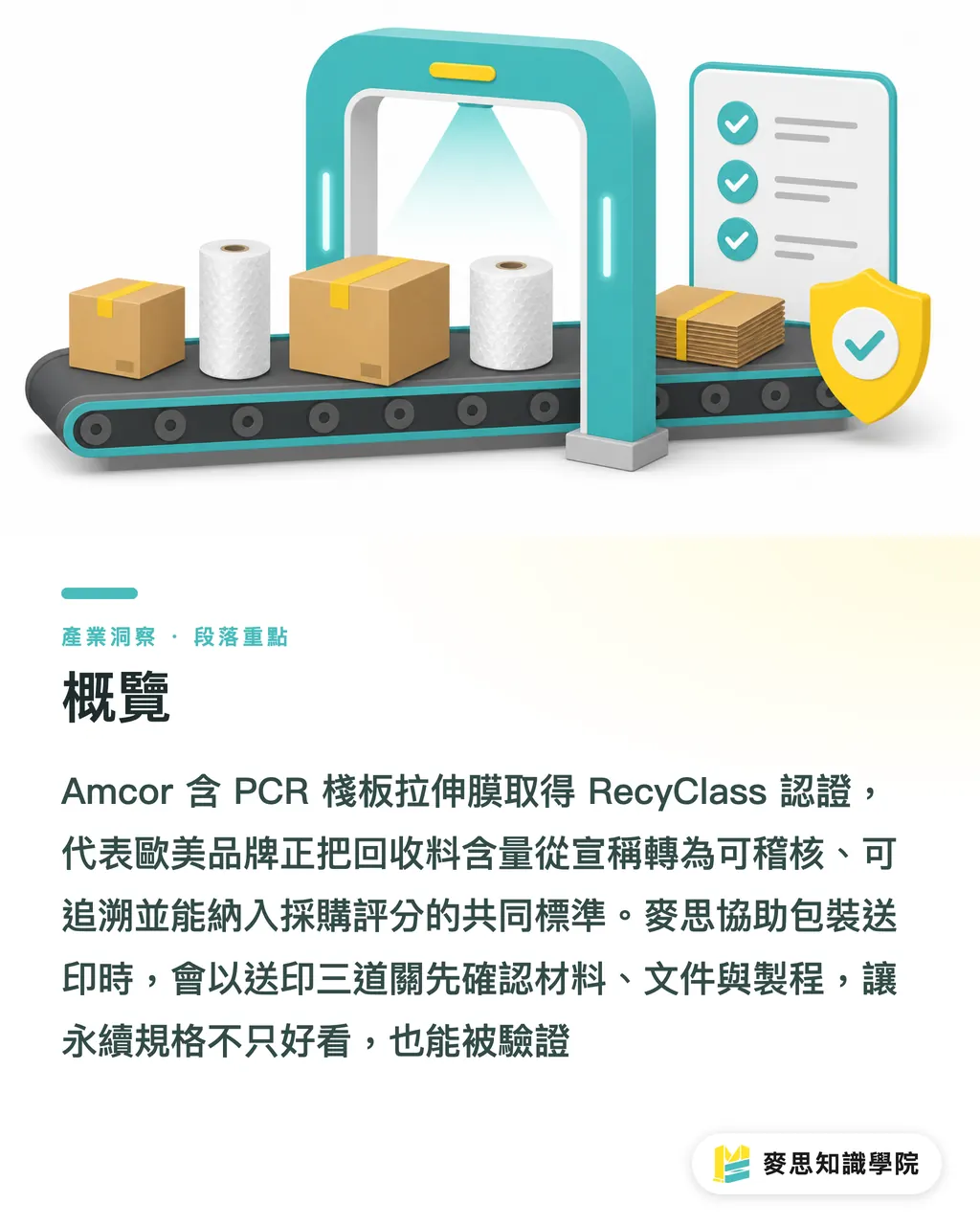
Amcor landed RecyClass certification for PCR-containing pallet stretch film. The signal is plain: Western brands are turning "recycled content" into a shared language that can be audited, traced and dropped into a sourcing scorecard. At MINDS (MS, mid-to-high-end fully custom commercial printing), when I'm helping a packaging job get to press, I run it through "MINDS (MS) Three Checks for Press Delivery" — materials, paperwork, and process, three things to verify up front
What certification did Amcor actually pick up?
What Amcor just certified under RecyClass is its pallet stretch film that contains PCR. The source at Amcor secures RecyClass PCR certification for stretch film points to industrial and logistics packaging, pallet stretch film, the wrap that locks loads onto a pallet
I read this in three layers: the product is stretch film, the material carries post-consumer recycled content, and the certification uses RecyClass to prove that the recycled material's source and content claims can actually be checked
For a print shop, pallet stretch film feels a long way from folding cartons, labels and stickers. But the supply-chain language is the same. Brands have stopped asking "can you run an eco material" and started asking "can the PCR paperwork for this SKU be shown to a European buyer"
Hold on
This isn't just big-corp news. A case like Amcor's filters down into purchase orders, design briefs, prepress sign-off and supplier scorecards. Sooner or later a Taiwan mid-sized print shop will see RecyClass, ISCC PLUS or UL ECVP show up in the attachment column of an export customer's email
How does RecyClass make recycled content legible?
PCR (Post-Consumer Recycled content): plastic that's been recovered after the consumer used it and gone through recycling, already out of the original production flow. It's usually a stronger backbone for a brand's recycled-content claim than PIR
RecyClass: a European certification scheme for plastic packaging recyclability and recycled-content traceability. It audits material origin, process and content accounting so a buyer can cross-check the recycled claim printed on the pack
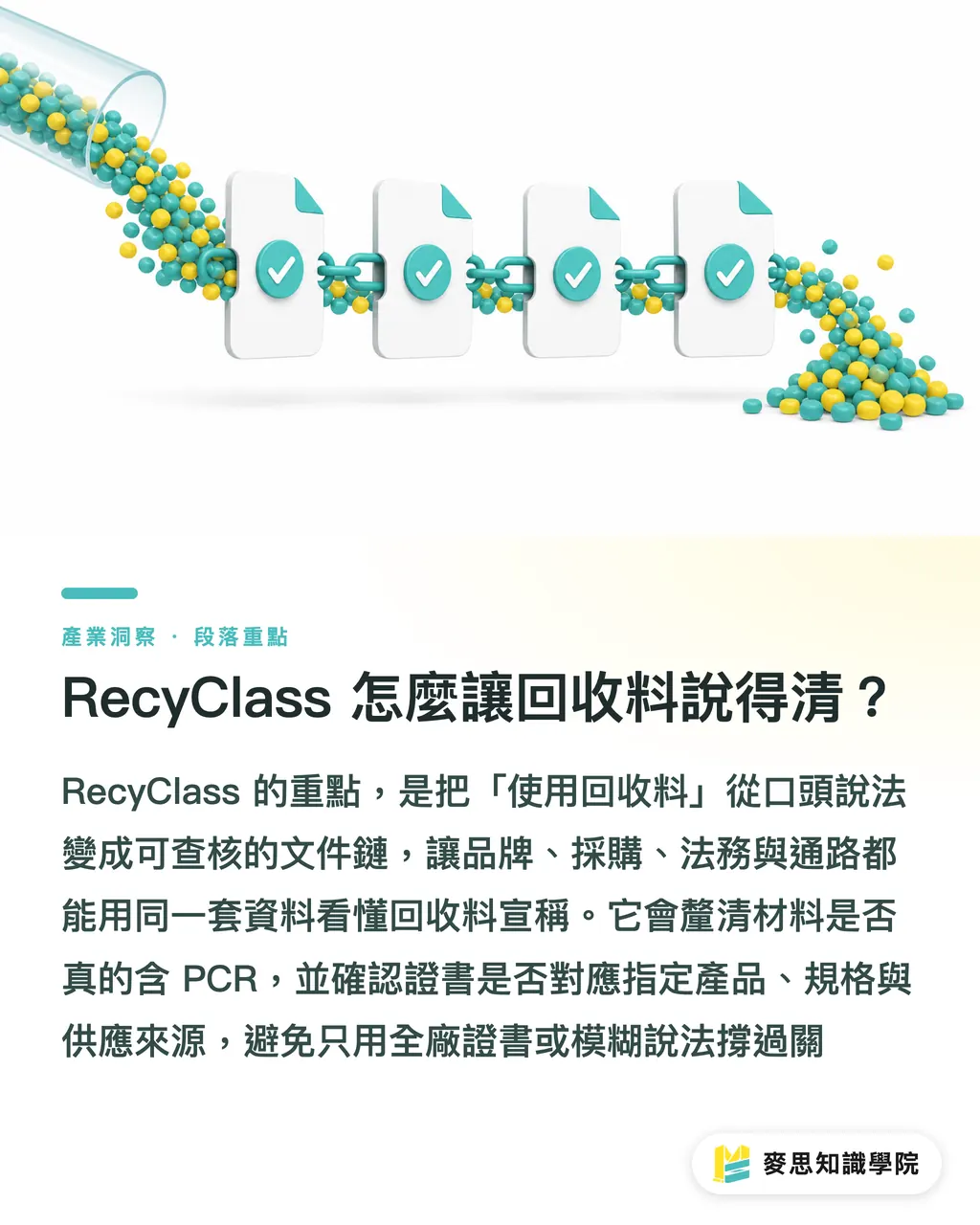
What RecyClass actually does is turn spoken promises into a paper trail. Print shops and brand clients need to line up at least three things
・Whether the material really contains PCR, rather than blending in-house scrap or post-industrial recycled content under one fuzzy label
・Whether the certificate is tied to a specific product, a specific spec and a specific source, not a vendor-wide certificate that papers over everything
・Whether the recycled-content claim on the artwork can be read the same way by procurement, legal, retail and audit
The most common mistake on the print floor: the design file says "made with recycled plastic" in nice type, but procurement can't produce a batch number, a certificate scope or a material declaration. Rushing to patch paperwork the week before shipment is messier than redoing the artwork
Why does a print shop need to understand PCR certification?
Looking at recent packaging reissue jobs, fewer clients are asking about FSC share and a lot more are asking about PCR, PPWR and PFAS. Export brands care about whether the pack clears Western supply-chain review, not whether the print shop believes it used a green material
RecyClass, ISCC PLUS and UL ECVP get name-dropped in the same sourcing meeting, but they do different things. A print shop that mixes them up loses credibility on the spot
・RecyClass: leans toward plastic packaging recyclability and recycled-content traceability. The fit when the conversation is PCR content, recycled-material accounting and European supply-chain documentation
・ISCC PLUS: shows up in bio-based, circular and mass balance supply-chain claims. The fit for cross-border material chains that include chemical recycling or mixed sources
・UL ECVP: leans toward third-party verification of specific environmental claims. The fit when "how much recycled content is in here" needs to become a checkable statement
Taiwan mid-sized print shops don't need to pretend to be a certification body. They do need to understand which kind of proof the client is actually asking for. If a shop can flag risks around material, ink, lamination, finishing and on-pack wording at the quote stage, the client treats you as a supply-chain advisor, not just the cheapest bidder
How should brand clients write certification into procurement?
When a brand client wants RecyClass-style certification baked into sourcing specs, the first move isn't to drop the words "eco packaging" into the brief. It's to split SKU, material, ratio, certificate and claim wording into deliverables that can actually be handed over
I'd suggest brands and print shops open the spec through "MINDS (MS) Three Checks for Press Delivery" — it fits teams that are putting PCR, RecyClass or any recycled-content certification into a packaging job for the first time
・MINDS (MS) Three Checks for Press Delivery ①: Materials. Confirm that the film, paperboard, label or laminate structure actually supports the PCR claim on file
・MINDS (MS) Three Checks for Press Delivery ②: Paperwork. Put the certificate scope, product spec, supplier declaration and the PO SKU in one folder
・MINDS (MS) Three Checks for Press Delivery ③: Process. Check whether printing, coating, foil stamping, lamination and diecutting will hit recyclability, label compliance or the client's claim
If a brand wants the recycled-content claim printed on the pack, I'd suggest getting MINDS to check the artwork wording and press-readiness first. "Contains PCR" isn't a tagline the designer can swap in and run. Material evidence and post-press finishing have to be looked at together
Where can a Taiwan mid-sized shop start?
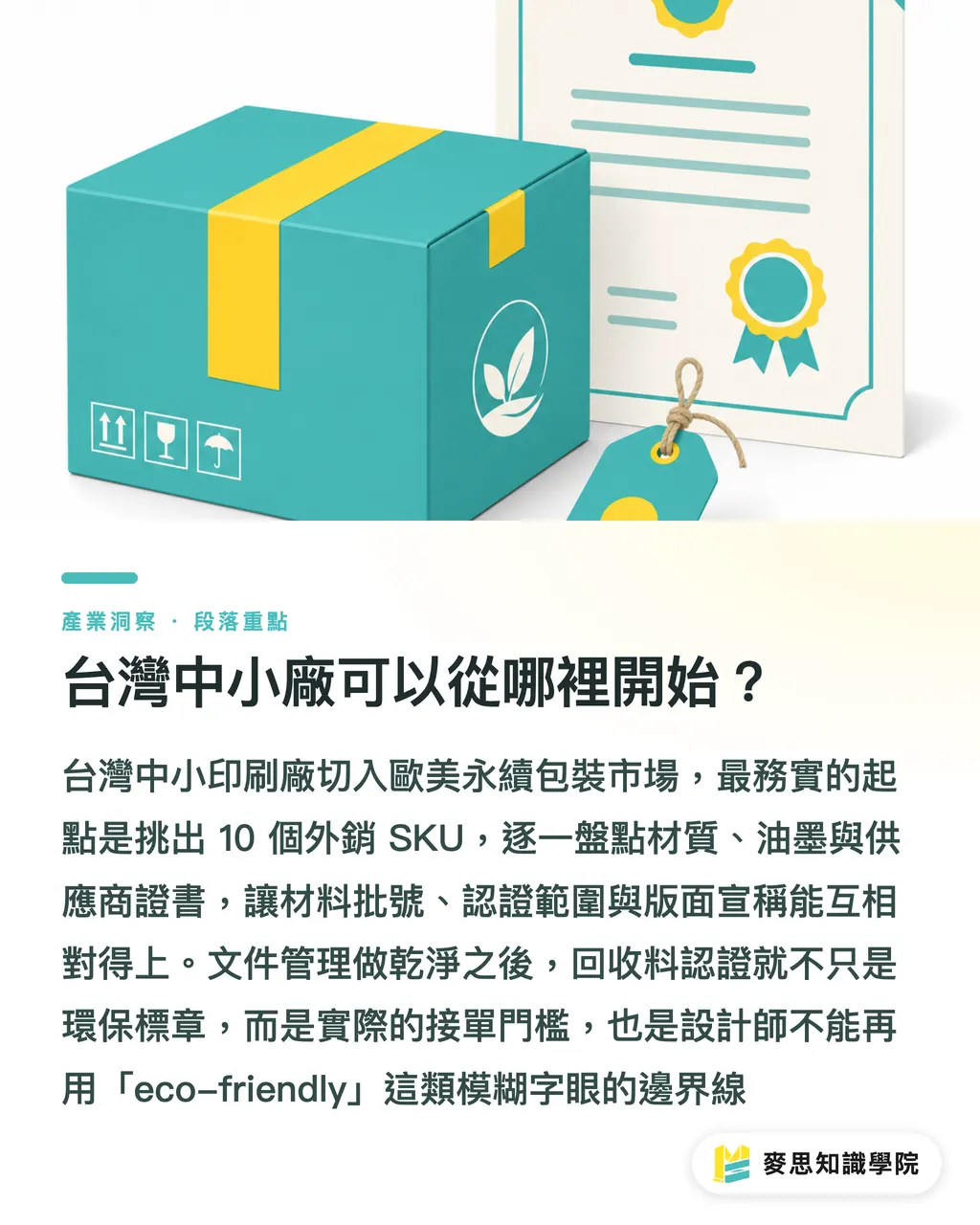
For a Taiwan mid-sized print shop trying to land Western sustainable packaging work, the starting point can be unglamorous and concrete: pick 10 export or near-export SKUs, then audit the material, ink, coating, lamination, label, pack claim and supplier certificates
Keep it simple
Mid-sized shops don't need to buy every certification at once. They do need clean document control. Same client, same pack, same material batch, certificate name, valid scope, batch number and the artwork claim all need to match each other
For brands, recycled-content certification is becoming a sourcing language. For print shops, it's becoming a gate to take the order. For designers, it sets the boundary for what the copy can say — "green" and "eco-friendly" can't be used as soft packaging for vague claims
Key takeaways
・RecyClass pulls PCR claims from slogan to paperwork, procurement can check it, retail dares to use it
・When a print shop knows the differences between certifications, export clients will hand compliance risk to you instead of keeping it in-house
・PCR, PIR and mass balance can't be talked about as the same thing. Get the source of the material wrong and that's a greenwashing risk
・Brands should pin down the SKU and certificate first, then let the artwork carry the recycled-content claim
Further thinking
For teams in print manufacturing, design, AI applications and SaaS, cases like RecyClass are a reminder: the systems worth building next aren't the ones that only handle quotes or work orders. They're the ones that tie material certificates, artwork claims, sourcing specs, shipment batch numbers and client audit questions into searchable fields. If your team is mapping an export packaging workflow, get the Mai Strategy Knowledge Academy consulting team to run a documentation and process audit first, don't wait until the client's audit form lands in your inbox and you're digging through supplier email threads
Further reading
FAQ
- What is RecyClass PCR certification?
- RecyClass PCR certification is a common European mechanism for tracing and verifying recycled plastic content. Its job is to confirm that the source, process and content claim for the post-consumer recycled content in a product can actually be checked
- Does Amcor's RecyClass certification have anything to do with a Taiwan print shop?
- Yes. Cases like Amcor's shift the language brand buyers use, so Taiwan print shops taking export packaging work will get asked more often to spell out the PCR, the certificate scope and the artwork claim clearly
- How are RecyClass, ISCC PLUS and UL ECVP different?
- RecyClass leans toward plastic recyclability and recycled-content traceability. ISCC PLUS is common for circular material and mass balance supply chains. UL ECVP leans toward third-party verification of specific environmental claims
- Can a brand just write "contains PCR" on the pack?
- Brands can write it, but only after the material certificate, product spec, PCR ratio and claim wording are all aligned. A recycled-content claim without paperwork behind it becomes a greenwashing risk
- What's the first step for a mid-sized print shop?
- Pick 10 export SKUs, audit the material, post-press processing, supplier certificates and pack claims, then clean up the document chain where it's most likely to break
Related articles

The Print × AI weekly
The print and AI know-how designers, brands and enterprises can use before they commit — one email, every week
MINDS Free Tools
AI background removal, a LINE sticker maker, spine & imposition calculators — all free, right in your browser, no upload.
MINDS Group
Need actual printing or gifting services?
From premium printing to online ordering and festive gifts — the MINDS Group sister brands take it from here.