
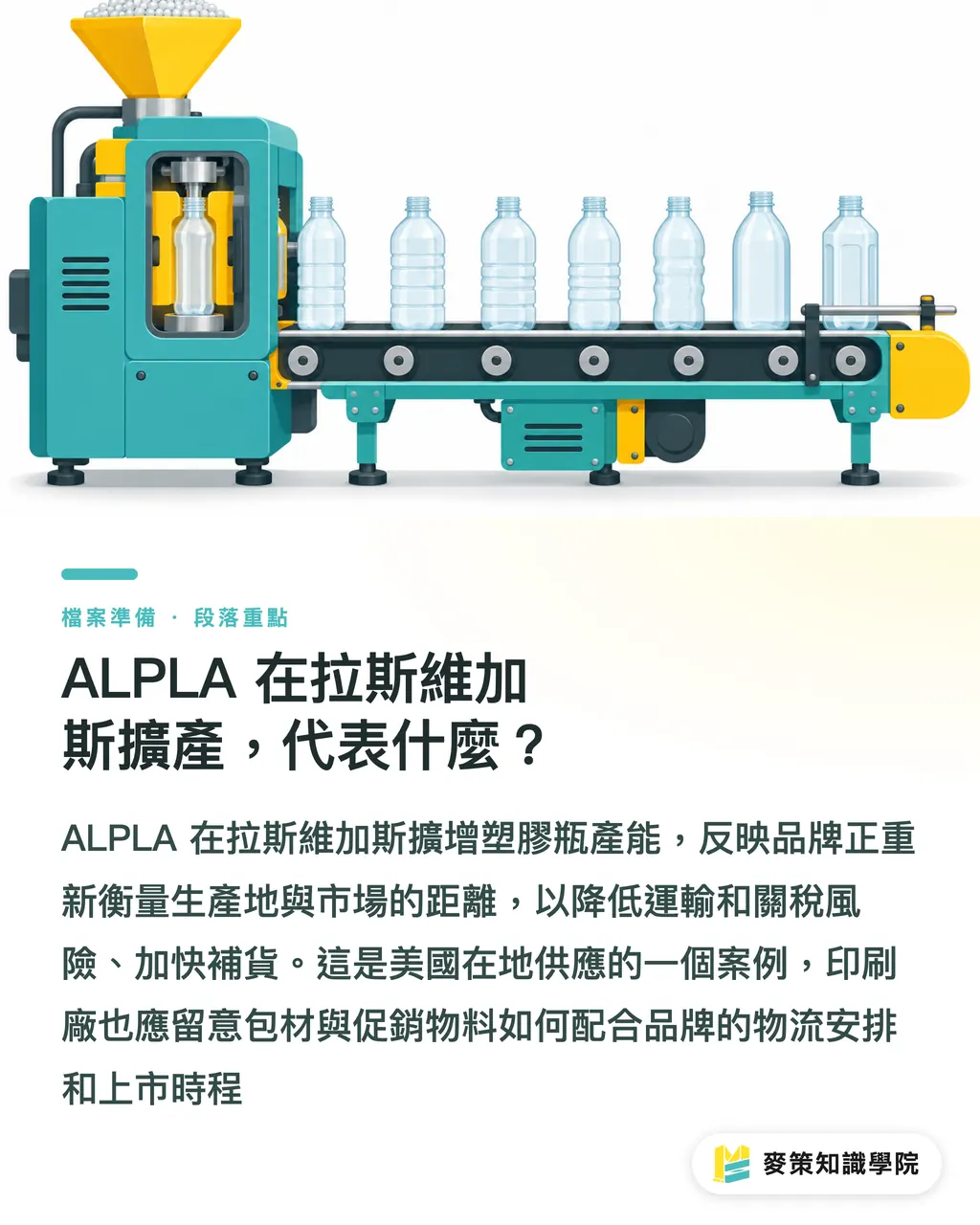
What does ALPLA's Las Vegas expansion mean?
ALPLA has announced an expansion of its plastic bottle capacity in Las Vegas, Nevada, targeting North American demand while reducing reliance on ocean freight and tariffs. MINDS (MS) sees this as a concrete example of buyers reassessing how close their suppliers need to be
Nearshoring means locating production close to a main sales market to shorten cross-border shipping and supply coordination. For packaging buyers, production location affects replenishment plans, lead-time buffers, and supplier choices
ALPLA's Las Vegas expansion shows that the company is adding bottle capacity in the U.S. One case isn't enough to conclude that bottle and container production is returning across the globe. Print shops should watch how brands recalculate logistics, tariffs, and replenishment risks, since bottles, labels, cartons, and promotional materials often need to be ready for the same launch window
What impact will Taiwanese export printers feel first?
ALPLA's announcement concerns plastic bottle capacity in Las Vegas. It doesn't say that Taiwanese print orders have already moved. MINDS (MS) expects that if a brand switches to a North American bottle supplier, labels, cartons, instruction cards, and promotional materials will need a fresh review of sourcing locations, replenishment cadence, and print schedules
Long-run orders make it easier to compare landed costs after freight and tariffs. For short-run, multi-version materials that change often, customers also look at proofing speed, version control, and communication across suppliers. I'd expect changes to show up first in quotes for new projects and repeat batches. I wouldn't read one capacity expansion announcement as proof that existing orders are moving
Quotes can break out proofing, revisions, rush jobs, and additional print runs, so customers can see the time and cost involved for each version. If you quote only one bulk price, it's hard for a print shop to explain what it can still save the customer when the production location changes
How should small and midsize print shops adjust their order intake?
ALPLA's decision to add plastic bottle capacity in Las Vegas is a reminder for Taiwanese export shops to check customers' sourcing plans before deciding on equipment investments. MINDS (MS) recommends building "local flexibility" into order intake and quoting
Don't rush to buy equipment
・1. Separate customer markets and SKUs. Record the label, carton, and document versions for the U.S. and Asia, so files with the same name don't get mixed up
・2. Put minimum quantities and lead times for short-run proofs and revision add-ons in your quotes. Don't use bulk-order cost assumptions to promise small replenishment runs
・3. Grade orders against your current finishing and logistics capabilities. If you don't have a delivery route into North America, clearly state your Taiwan shipping terms and don't promise local supply you can't provide
This information also helps sales teams tell whether a customer wants a low unit price, fast replenishment, or small runs across multiple versions. The clearer the order terms, the better the basis for deciding whether to adjust equipment
What should designers confirm before handing off files?
ALPLA's announcement doesn't specify how the bottles will be decorated. If a brand changes bottle suppliers, designers should first get the new bottle shape and label specifications. MINDS (MS) has turned this check into three packaging handoff checks to prevent old die lines from being reused as-is
・1. Decoration method: Confirm whether the bottle will be printed directly, labeled, or decorated with a sleeve. Ask the supplier for the printable area and seam limitations
・2. Structural version: Get the latest bottle shape and label die line, then recheck bleed and safety margins. Bleed is the image area extending beyond the trim line to prevent white edges on the finished piece
・3. Color conditions: Confirm the substrate, surface finish, and color reference. If using clear material or white ink, ask how the layers will be printed, then proof on the actual material
After revisions, recheck the file name, version, and die-line date, and keep the approved proof on file. Screen color can't replace a color proof on the actual material, especially when a new supplier uses a different substrate or finishing process
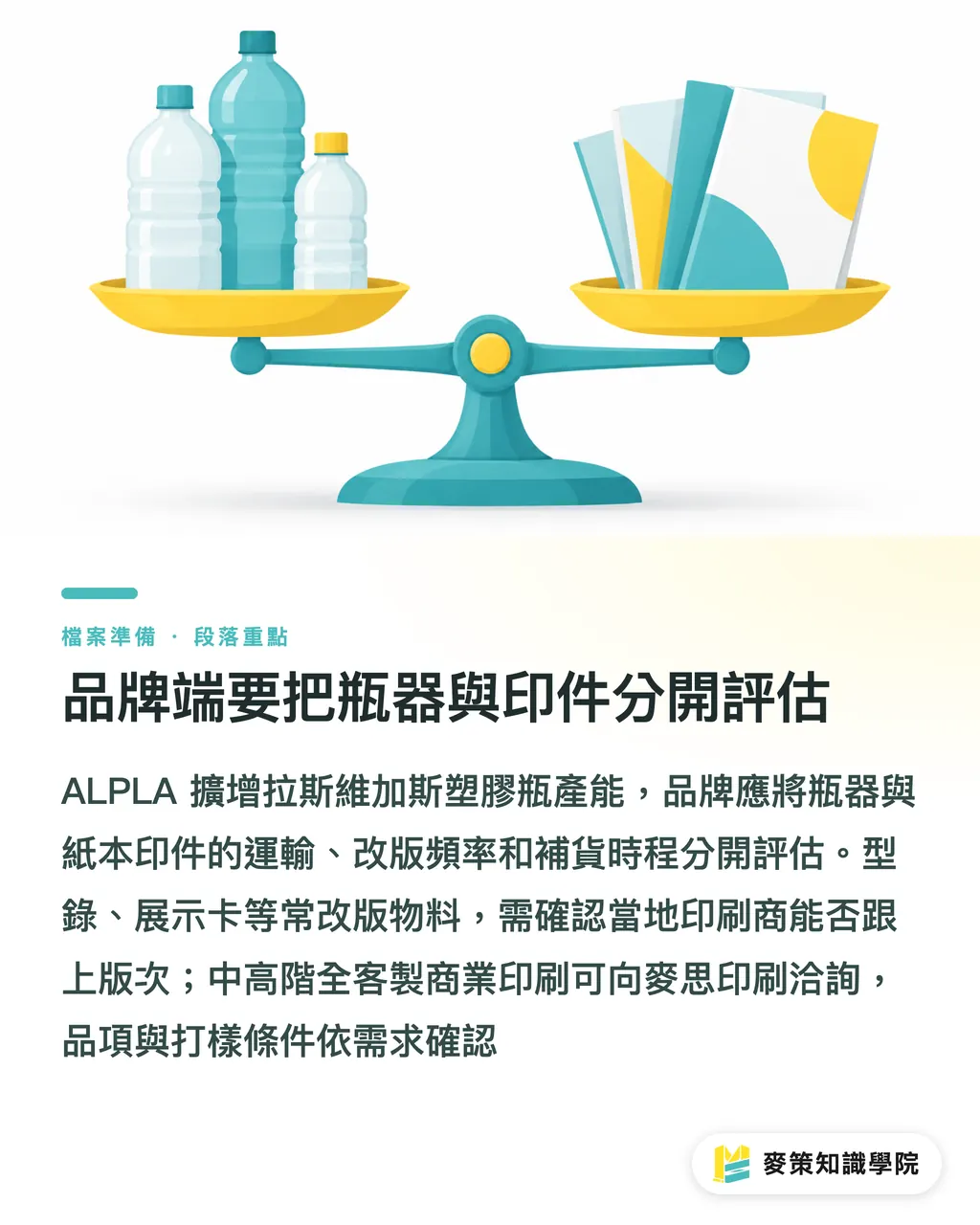
Brands should assess bottles and printed materials separately
ALPLA is expanding plastic bottle capacity in Las Vegas to serve North American demand. Brands don't need to assume every printed item must move along with bottle production. Compare shipping, revision frequency, and replenishment schedules for bottles and paper materials separately
For products with stable print volumes, lead times can be planned alongside the bottle supplier's schedule. For frequently revised catalogs, in-store display cards, or launch kits, check whether local suppliers can keep pace with design versions. If the Taiwan team is updating these paper materials, put the print version and packaging master file on the same specification list. MINDS can be contacted about mid- to high-end fully custom commercial printing. Specific products and proofing terms can be confirmed based on requirements
Key takeaways
・ALPLA's Las Vegas expansion is an example of nearshoring. One announcement doesn't mean bottle and container production is returning across the globe
・Taiwanese print shops should review customers' markets, revision frequency, and replenishment needs before considering production-line investments
・Designers should get the new bottle shape, die line, printing method, and color requirements. Old files can't be reused as-is
・Brands should calculate bottle and paper print costs separately, then plan supply around lead times, logistics, and versions
Further thoughts
Print manufacturers can start by sorting order lists by customer market and order type. Designers can add die lines, materials, color requirements, and proof approval to their handoff checklists. AI can help compare text differences and missing fields across old and new PDFs. SaaS tools should keep file versions, approval records, and supplier specifications in order. Prepress staff still need to check the actual color proof
Further reading
FAQ
- What does ALPLA's U.S. expansion mean?
- ALPLA is expanding plastic bottle capacity in Las Vegas to serve North American demand and reduce reliance on ocean freight and tariffs. It reflects the purchasing value brands place on producing close to their markets
- Will Taiwanese print shops lose U.S. orders?
- ALPLA's announcement doesn't say that Taiwanese print orders have moved. Taiwan-based shops should first review customers' sourcing locations, short-run revision needs, and replenishment requirements, then adjust their quotes and order mix
- How should designers revise packaging files?
- Ask the new supplier for the bottle shape, label die line, decoration method, materials, and color requirements. Then confirm bleed, safety margins, and proofing. Don't reuse the previous supplier's specifications
- What is nearshoring?
- Nearshoring means locating production close to a main sales market to shorten cross-border shipping and supply coordination. One company's expansion doesn't prove that an entire industry is moving production
Related articles
The Print × AI weekly
The print and AI know-how designers, brands and enterprises can use before they commit — one email, every week
MINDS Free Tools
Imposition calculator and preflight file check — free prepress tools, right in your browser.
MINDS Group
Need actual printing or gifting services?
From premium printing to online ordering and festive gifts — the MINDS Group sister brands take it from here.