

What capabilities did Heidelberg bring together at Shift?
At Shift, Heidelberg discussed AI and robotics as part of the same print workflow, with a focus on coordinating software automation and shop-floor equipment to manage production. The two-day international summit, hosted by Heidelberg in 2026, drew around 300 people from the print industry and focused on:
・AI-assisted production planning and autonomous workflows, using data and target values to help schedule jobs
・The Jetfire 50 industrial digital printing system and robotics as part of a hybrid production workflow
An autonomous workflow uses predefined data and target values to move production steps forward automatically, reducing the need to plan each job from scratch. During the summit, Heidelberg also sold the first Jetfire 50 to a print company in Phoenix, Arizona. That signals buyer interest, but it does not prove a return on investment. The report gives no robot model, cycle time, or labor savings figures. Applying this signal to Mai Strategy's three checks, the first question is which job-related pain point the equipment is meant to solve (Print21: Heidelberg focuses on AI and robotics at Shift)

Why look at job value first in hybrid printing?
Hybrid printing brings digital and offset printing into the same schedule, choosing a production route based on each job's requirements so each press handles the work it suits best. Swiss printer Schmid-Fehr AG shared that its average job value fell from around €2,800 in 2015 to around €800 today (Print21's Schmid-Fehr case study)
Start with job value
This is one company's job value, not an average for the Taiwanese market. But it shows why shrinking order values make it harder to protect margins when staff have to coordinate every job by hand. The company brought two systems into the same production plan:
・Jetfire 50: an industrial digital printing system
・Speedmaster XL 75: an offset press used alongside it
Through Mai Strategy's three checks, the case is a reminder for print shop managers to check whether job costs and delivery deadlines should determine the production route. Press speed alone is not enough
How does Prinect Touch Free use AI?
Prinect Touch Free automates production planning and manufacturing workflows using clearly defined data and target values. It is Heidelberg's AI-powered production workflow, helping schedule and combine jobs and choose the more cost-effective route for hybrid printing. AI-assisted production planning uses job data and target values to set the sequence of processes and production routes, making the basis for scheduling decisions traceable
Heidelberg described several applications:
・An AI chatbot on the Heidelberg Portal that answers workflow questions
・Automatically combining jobs so each order does not need to be scheduled on its own
・Choosing the more cost-effective production route in a hybrid printing environment
For print shops, these features address recurring workflow questions for customer service, jobs waiting to be grouped into batches, and routing decisions between digital and offset orders. Mai Strategy's three checks start by asking whether quote, file, prepress, and production fields are consistent. When data is missing, automation only sends errors downstream faster

How should Taiwanese small and midsize print shops plan automation investments?
Taiwanese small and midsize print shops should first map their job workflows and production bottlenecks, then decide whether to bring in workflow software, robots, or new equipment. When I talk about automation on the shop floor, people often start by asking which machine to buy. The discussion only gets specific when I ask which jobs are getting stuck
Hold off for a moment
Mai Strategy's three automation checks can start with recent jobs. There's no need to wait for an equipment replacement cycle:
・① Job data: Can quotes, customer files, prepress specifications, finishing details, and deadlines all carry through to the job ticket?
・② Production bottlenecks: Do orders usually get held up waiting for files, materials, press time, or a finishing handoff?
・③ Cost of exceptions: How much staff time goes into checking rush changes, missing data, and custom finishing?
Once you have that picture, choose a small group of repetitive jobs with complete data for a trial. Then compare whether scheduling delays and manual work have gone down. Changes on your own shop floor will tell you more about the investment than a robot video at a trade show
What kind of order-taking model should print automation support?
Automation needs to support an order-taking model that can make money. At Shift, Heidelberg outlined three directions: platform provider, niche specialist, and local service provider. Print shops can assess them against their existing customers and job mix:
・Platform provider: Take orders with stable specifications that are suited to high-volume online processing
・Niche specialist: Turn a particular printing or packaging need into a repeatable workflow
・Local service provider: Serve nearby customers through fast responses, reliable delivery dates, and hands-on coordination
These are business models. Buying equipment will not make them happen on its own. The final check in Mai Strategy's three-part framework is whether automation will reduce wait times or rework for your existing customers. If job, prepress, equipment, and finishing data are still scattered, talk to the Mai Strategy Knowledge Academy consulting team to map the handoff gaps before setting specifications or estimating returns. Consider robots for procurement only after repetitive handling or handoff bottlenecks are clear
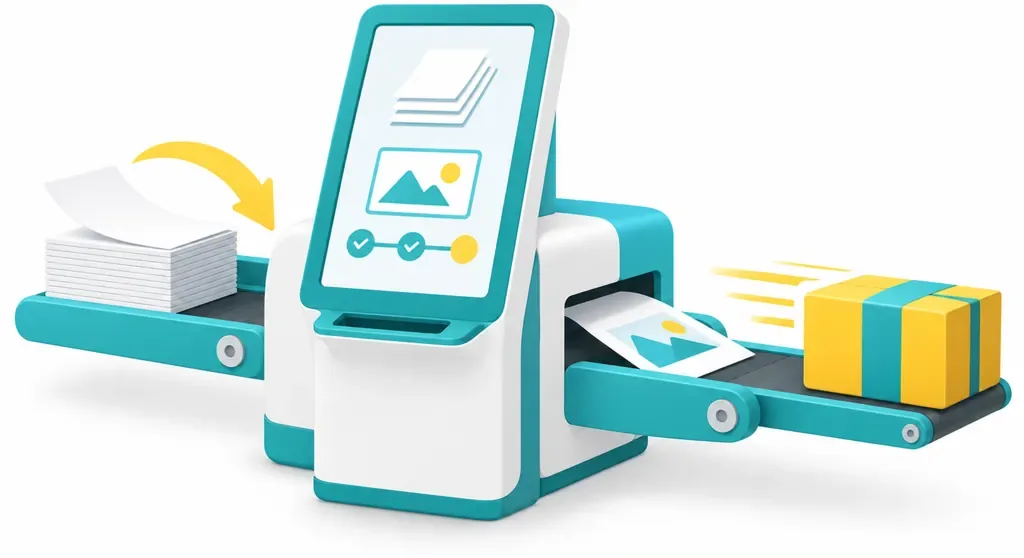
Key takeaways
・Heidelberg's Shift points to automation across the production workflow. The benefits of robotics still need to be verified on the shop floor
・Schmid-Fehr AG's job value example is a reminder to factor price pressure into production route decisions
・Prinect Touch Free is used for scheduling, combining jobs, and choosing routes for hybrid printing
・Mai Strategy's three checks start with mapping jobs, finding bottlenecks, and calculating the cost of exceptions before deciding on equipment investments
Further thoughts
A print shop can start with one common job type, map how data passes from quoting through finishing, and record where orders wait and where staff spend time rescheduling by hand. Designers can provide consistent artwork and version details, while SaaS providers can connect those fields through an interoperable workflow. Once there's a baseline, it becomes possible to see whether automation improves order intake, scheduling, and delivery times
Further reading
FAQ
- Should a print shop buy robots or scheduling software first?
- The material Heidelberg presented at Shift gives no figures on the benefits of robotics. Start with Mai Strategy's three checks to map job workflows and production exceptions, then decide whether software or physical equipment should come first
- What does Prinect Touch Free do?
- Prinect Touch Free is Heidelberg's AI-powered production workflow. It can automate production planning, combine jobs, and choose a more cost-effective route for hybrid printing
- Is hybrid printing a good fit for small and midsize print shops in Taiwan?
- If a print shop has both digital and offset work, and enough job data to compare different routes, hybrid printing is worth assessing. Start by reviewing actual job costs and delivery times, then estimate the investment in equipment and workflow changes
- What robotics benefits did Heidelberg announce at Shift?
- Print21 reported that Heidelberg focused on robotics, but gave no specific model, cycle time, or labor savings figures. Print shops cannot calculate a return on investment from that report alone
Related articles
The Print × AI weekly
The print and AI know-how designers, brands and enterprises can use before they commit — one email, every week
MINDS Free Tools
AI background removal, brand stamping, and a LINE sticker maker — free design tools, right in your browser, no upload.
MINDS Group
Need actual printing or gifting services?
From premium printing to online ordering and festive gifts — the MINDS Group sister brands take it from here.