

Why Are Ink Giants Betting Big on Packaging?
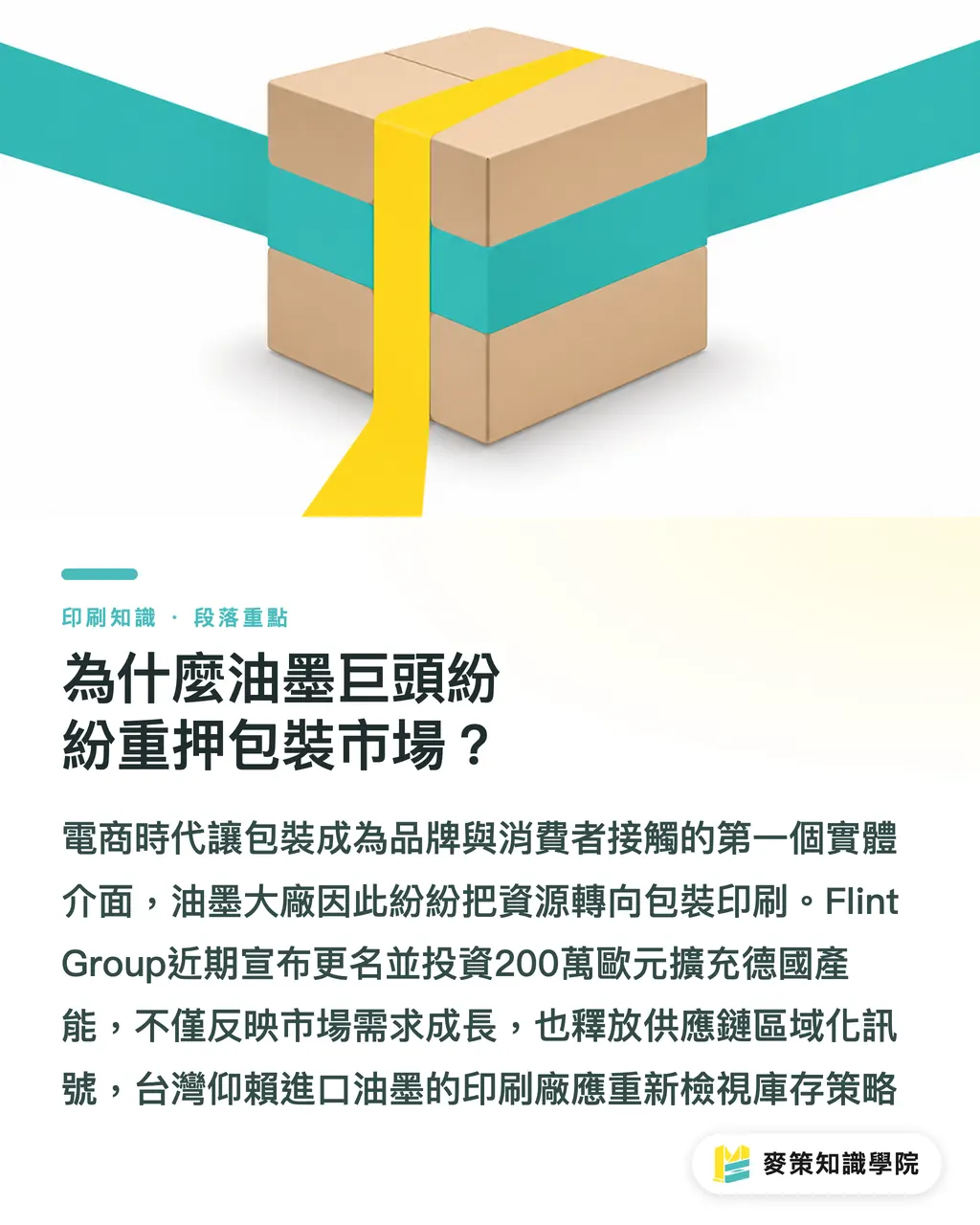
Because e-commerce has turned packaging into the true frontline of brand marketing. Global ink and consumables giant Flint Group announced a rebrand and recently poured 2 million euros into expanding its German production capacity, pivoting fully toward packaging print. That shows big players are focusing their resources where both profit margins and demand are growing
From what I have seen over more than a decade on the production floor and working with clients, this is not just about scaling up capacity. It is a clear sign of supply chain regionalization. As global suppliers pull logistics closer to home in Europe, small and mid-sized print shops in Taiwan that rely heavily on imported inks need to rethink their inventory strategies. Packaging is no longer just a protective shell for products leaving the factory. It is the very first physical touchpoint between a brand and its customers
How Should Budget-Constrained Small Brands Respond?
Skip the war of attrition over specialty paper against major corporations. Put your resources squarely into the visual and tactile unboxing experience instead. Most small businesses cannot order 100,000 custom boxes from a paper mill, but by getting creative with standard finishing techniques on existing equipment, you can still produce packaging that customers will not want to throw away
We usually recommend that new clients follow the Mai Strategy Three-Step Print Check to keep quality under control:
1. Lock in the budget before finalizing visuals: Decide which finishing methods you want early in the design process and set that budget aside
2. Pick a single focal point: Do not try to foil-stamp everything. Pick the logo or key illustration and focus all the impact there. That is plenty
3. Proof physical samples to check textures: Always run a physical proof with spot finishing to make sure the paper texture and the finish bond properly
3 Practical Post-Press Strategies for Added Value
Turning bold visuals into premium packaging only requires a few proven finishing techniques. Everyone talks about sustainability lately, and switching to recycled paper can sometimes make boxes look dull or gray. That is where finishing techniques come in, lifting the overall feel without adding any extra plastic
・Foil Stamping: A traditional technique using heated metal dies and pressure to transfer metallic foil onto paper, producing a genuine metallic reflection that regular ink cannot match. Principle: Transfers metallic foil using heat and pressure. Pros: Real metallic shine, premium finish. Limits: Requires die-making setup costs, and fine lines can break
・Spot UV: Principle: Applies clear gloss resin to specific surface areas. Pros: Low processing cost, sharp contrast between gloss and matte. Limits: Works best on matte-laminated bases, unsuitable for hairline details
・Embossing: Principle: Uses male and female dies to press paper from behind and raise the surface. Pros: Creates distinctive tactile depth and dimensional relief. Limits: Leaves indentations on the reverse side, and paper cannot be too thin or it will tear
Why Do Trendy Designs Often Crash on the Production Line?
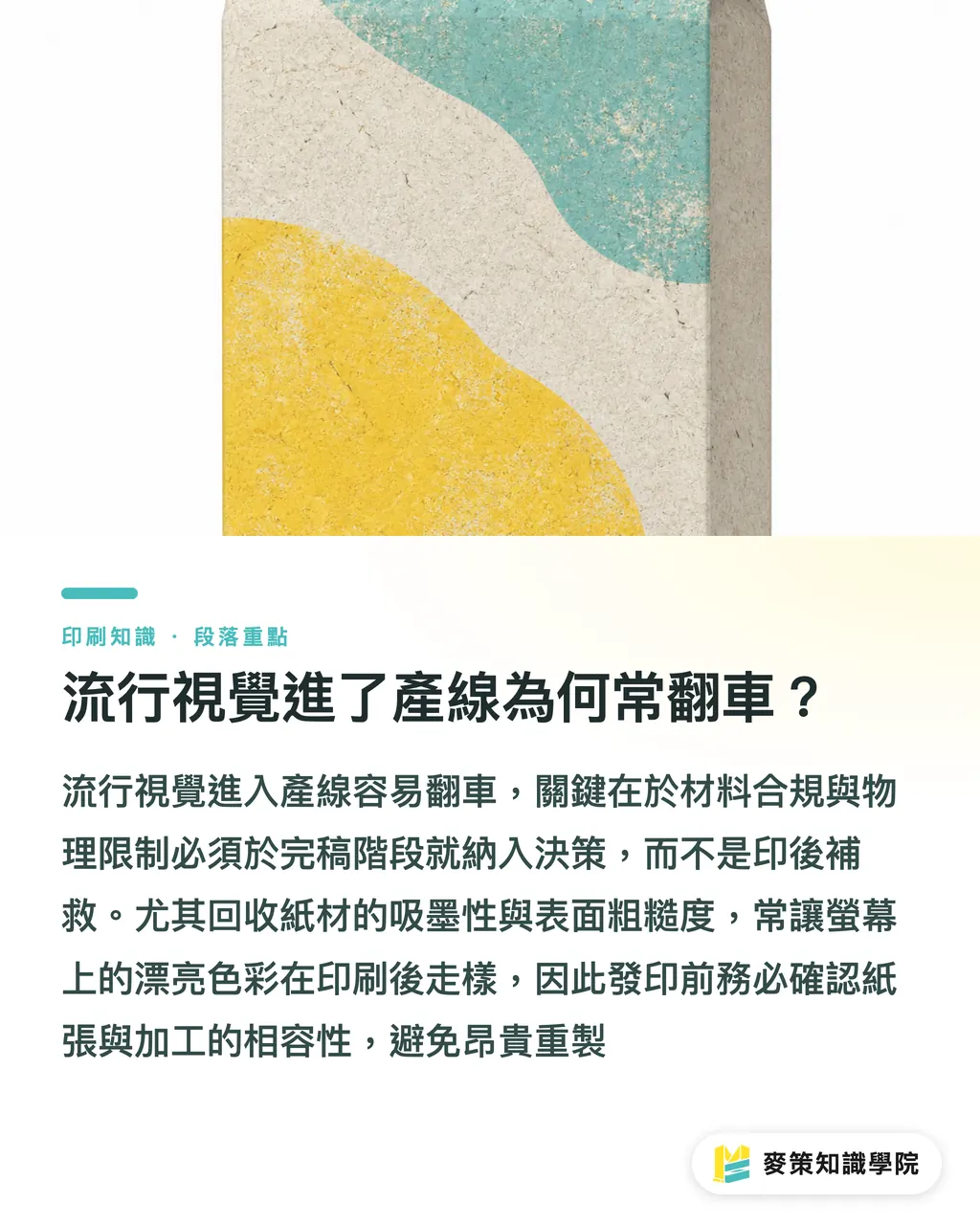
Because many people overlook the fact that material compliance and physical constraints have become front-end design choices. Over the past few months, I have noticed that food contact safety, sustainability claims, and recyclable design cannot be fixed after printing. They have to be settled right in the final art stage
Designs look great on screen. On the production line, it is a whole different story. If designers only adjust colors on a glowing monitor without considering the ink absorption and rough texture of recycled stock, the print run will be a disaster. Talk to print production specialists who know the machinery, or consult the Mai Strategy Knowledge Academy consulting team to help iron out the process. Do not rush. Verifying compatibility between your paper and finishes before going to press will save you a fortune in reprints
Key Takeaways
・Global ink manufacturers are pivoting to packaging, and smaller brands should focus resources on the unboxing experience to create premium value
・Skip sprawling, overly complex prints. Targeted applications of foil stamping, embossing, and spot UV are the most cost-effective ways to make an impact
・If eco-friendly paper makes packaging look flat, high-contrast post-press finishes can restore visual punch
・For trendy designs to work in mass production, material properties and process limits must be factored in during the final file preparation stage
Further Thoughts
When industry giants all invest in packaging, it proves that physical touchpoints are regaining value. For print professionals and designers in Taiwan, the challenge is no longer just getting artwork onto paper. It is about balancing environmental regulations, material limits, and client budgets to create the most refined finish combination possible. By putting proven post-press techniques to work, small brands can easily build packaging presence that rivals major players
Further Reading
FAQ
- Why does packaging look dull and grayish after switching to eco-friendly paper?
- Most recycled paper has shorter fibers and no coating, making it highly absorbent. That dramatically reduces ink gloss. Pairing it with spot UV or foil stamping adds the visual highlights you need
- Can foil stamping and spot UV be applied to the exact same spot?
- We do not recommend it in practice. The two treatments have different bonding requirements. Overlapping them often causes peeling or registration issues. Separating them in your design delivers a much cleaner, sharper result
- Can short-run print jobs also use these premium finishing techniques?
- Yes. Many digital press setups now support short-run digital foiling and digital spot UV. While the unit cost runs slightly higher, you avoid the expensive upfront die and plate fees of traditional methods
Related articles



The Print × AI weekly
The print and AI know-how designers, brands and enterprises can use before they commit — one email, every week
MINDS Free Tools
Spine width and imposition calculators — skip the manual math, free in your browser.
MINDS Group
Need actual printing or gifting services?
From premium printing to online ordering and festive gifts — the MINDS Group sister brands take it from here.