

Why should printers care about a news story on 18 million specimens?
The California Academy of Sciences is home to one of the world's largest insect collections, with about 18 million insect specimens stored across 35,000 wooden drawers. Recently, it did something worth pausing over in the printing world: using an Epson ColorWorks CW-C6000A on-demand color label printer together with BarTender label design software, it replaced its old geography-based color-coding system with printed color labels based on biogeographic regions
This is not a marketing story. It is a real operational pain point. Chris Grinter, the academy's insect collection manager, pointed straight at the problem with the old system: the geography-based color code was flawed at its roots, neither inclusive nor friendly to color-blind researchers. In other words, a label standard that had run for decades was ultimately replaced by a desktop color label printer
For small and midsize label printers in Taiwan, the signal is clear: label printing customers are not limited to the industries you already know
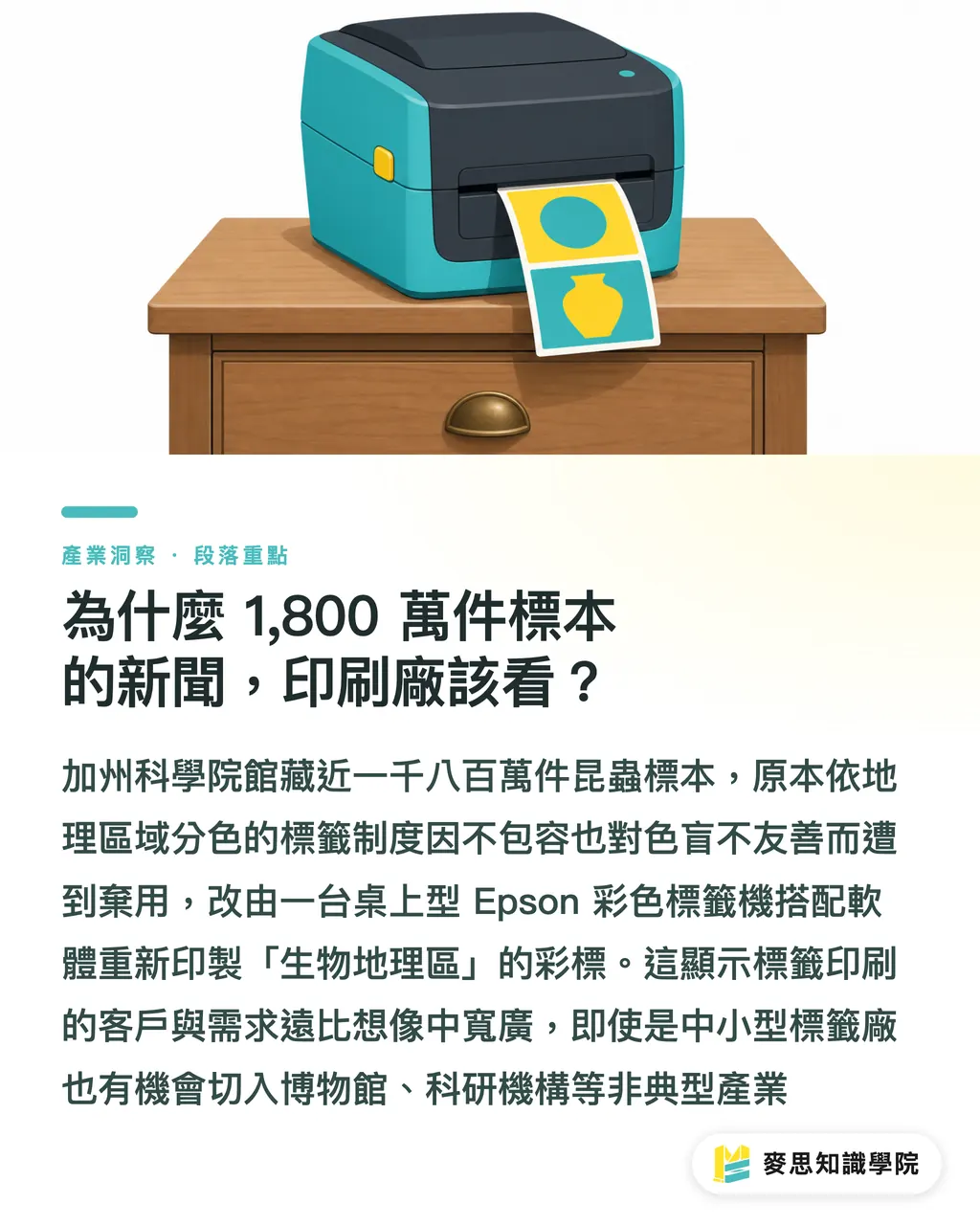
How are scientific labels different from retail labels?
The biggest differences are these three things. Do not get the order wrong
・The object is different by nature: retail labels go on products, and the goal is to sell. Scientific labels go on specimens, and the goal is identification and traceability. The label itself is a data carrier. Not a single one can be printed wrong
・The update frequency is extreme: DNA analysis keeps changing species classification, and scientific names often change every year or two. That means customers are buying reprint capability, not just a good-looking first print
・The decision maker is not procurement: in this case, the collection manager and Elisha Karan from the system integrator Kenco Label decided the specs together. This is not a price contest or a lead-time contest. It is a contest over who understands the workflow
To put it more bluntly: scientific customers see labels as system components, not printed goods. They need labels tied into databases, barcodes, and lifecycle management. That is why this case ended with a ColorWorks plus BarTender setup, not a traditional flatbed label press
Why do the words "on-demand color" matter so much?
On-demand is the lifeline of this business model. The California Academy of Sciences prints dozens or hundreds of labels at a time. It almost never prints tens of thousands of the exact same thing in one run. This rigid need for low-volume, high-variety production used to mean preprinted label inventory, then manual matching against forms and hand application. The error rate and labor time were both ugly
What Epson ColorWorks inkjet color label printers really sell is not resolution. They sell the ability to change labels on site, print immediately, and sync label output automatically when the database changes. Grinter said it plainly: "ColorWorks let us carry out this relabeling at scale."
This is actually the same industry path as the short-run color label fight. The setting has simply moved from the store floor to the lab and the storage room

Can Taiwan printers get in? Answer these three questions first
Do not get excited just because the case looks attractive. First, compare it against where you are now
・Can you accept that "one label is also an order": scientific jobs usually do not have high unit prices, but the customization runs deep, and the profit structure is completely different from retail labels
・Do you have a partner who understands databases: scientific institutions will not study label specs on their own. They want an integrator. That is exactly the role Kenco Label played in this case. Without a partner who understands BarTender or similar software, you will not even get into the proposal conversation
・Can your after-sales support handle the customer site: an on-demand label printer is not something you install and forget. Ink, printheads, cleaning, and software connections are daily matters. If nobody at the customer site understands them, they all come back to you
If your answer to two of the three questions is "no," forcing your way in will only hurt you
What procurement needs to understand before buying this kind of job
For corporate procurement teams, this case gives an even more practical lesson. The buying logic for scientific labels is very different from retail labels, so the acceptance criteria need to change
・The spec sheet must define durability clearly: specimen labels may sit for 10 or 20 years. Ink resistance to light and moisture, as well as material resistance to yellowing, all need to be written into the contract
・Software integration is the subject of the purchase, not an accessory: what the customer wants is the ability to output labels directly from a database. That means procurement needs to include software licenses, version updates, and technical support in the total cost of ownership
・Ask one more question during quotation: "How does the reprint process work?" This question will immediately filter out vendors who only know how to quote the first print run
If procurement compares only on price, it is treating scientific labels like ordinary sticker labels. Acceptance and maintenance will almost certainly go wrong later. For mid- to high-end fully customized commercial printing services such as MINDS Printing (MS), the core of this kind of project is not how beautiful the print is. It is how cleanly the integration works
If you are a printer or a procurement contact and want to evaluate this path seriously, the next step is to bring your current customer list and review it once with the Mai Strategy Knowledge Academy consulting team, then identify which customer profiles have entry potential
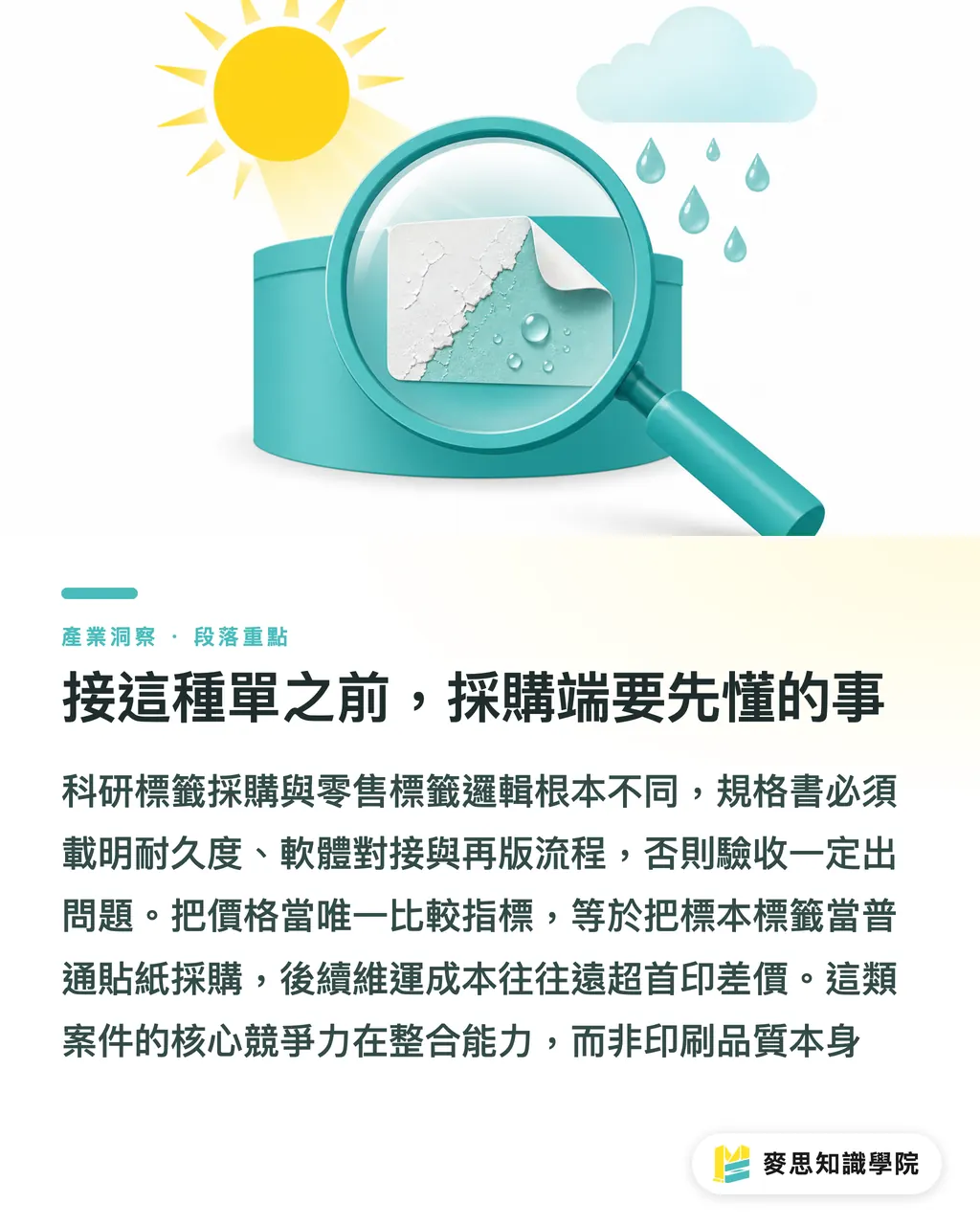
Key Takeaways
・Scientific labels are data carriers, not printed goods. What customers buy is accuracy and reprint capability
・The value of on-demand color label printers is in changing and printing on site, not in resolution or speed
・Before entering this market, confirm whether you can handle single-label orders, whether you have database integration partners, and whether your on-site after-sales support can hold up
・Procurement teams need to include durability, software integration, and reprint workflows in their evaluation. They cannot compare only the first print price
・The entry ticket to nontraditional vertical markets is understanding the customer's workflow, not equipment specs
Further Thinking
The real lesson for Taiwan printers is not "I should sell scientific labels too." It is "Can I move my existing retail and logistics customers into other vertical scenarios?" Museums, university labs, botanical gardens, seed companies, and hospital medical record rooms all share the same demand structure: small quantity, high customization, data-driven output, and decision makers outside procurement. From the equipment side, the entry barrier for on-demand color label printers is lower than for flatbed label presses. The real barrier is back-end integration and after-sales capacity. For SaaS and AI application companies, this case also points to a line worth entering: label design software, automatic database output, and version control. These three layers currently have no dominant local solution, which means there is room to build. Taiwan's small and midsize printers should start with one or two existing customers as scenario experiments, prove that they can sell labels as a system, then decide whether to write this line into the annual strategy
Further Reading
FAQ
- How are scientific institutions' label needs different from ordinary retail labels?
- They differ in three ways. The target is a data carrier, not a product. Updates are extremely frequent because species classifications often change. The decision maker is a researcher or system integrator, not procurement. So these labels are system components by nature, not printed goods
- What kind of printer is a good fit for Epson ColorWorks and similar on-demand label printers?
- They are a good fit for vendors whose customer base is built around small batches and heavy customization, and who can also provide software integration and on-site after-sales support. If your customers are still mainly asking for tens of thousands of identical labels in one run, forcing this equipment into the business will only waste equipment cost
- What is the barrier for Taiwan printers entering the scientific label market?
- It is not the equipment. It is three capabilities: a quoting and production structure that can handle single-label orders, an integration partner who understands databases and label software, and after-sales operations that can support the customer site. If two of the three are missing, entering the market is not recommended
- How should procurement teams accept scientific-grade labels?
- They should look at three non-price indicators: the durability of the ink and material, including resistance to light, moisture, and yellowing, the software licensing and update mechanism for database integration, and whether the reprint workflow is documented. Price still matters, but it cannot be the only standard
Related articles




The Print × AI weekly
The print and AI know-how designers, brands and enterprises can use before they commit — one email, every week
MINDS Free Tools
AI background removal, a LINE sticker maker, spine & imposition calculators — all free, right in your browser, no upload.
MINDS Group
Need actual printing or gifting services?
From premium printing to online ordering and festive gifts — the MINDS Group sister brands take it from here.