
What should you check first before running a bio-based substrate on press?
Before a bio-based substrate goes on press, first check whether the material will accept ink, whether it can tolerate heat, and whether it can run with the existing inks and finishing process
Bio-based substrate: packaging material made from plant fiber or renewable polymers. Once the material source changes, the surface, thermal behavior, and recycling conditions change with it
In Bio-Based Packaging Becomes an International Mainstream, published by the Chinese Association of Graphic Science and Technology on 2026/07/10, the article notes that plant-fiber packaging and bio-renewable inks have moved from trial runs into mainstream packaging applications. What I usually see on the shop floor is that the trouble is not the concept. It is finding out during the first production batch that the old settings cannot simply be copied over
Hold on first
When designers receive this kind of project, do not only ask, "Can it be printed?" Ask whether the printer is receiving fiber-based packaging material, PLA (polylactic acid) film, or starch-based film. Ink absorption, stretch, and heat response vary a lot across these materials
Why do surface energy and ink absorption usually fail first?
Surface energy and ink absorption usually fail first because they decide whether ink spreads out, penetrates properly, or scratches off after drying
Surface energy: the material surface's ability to let ink spread and adhere. When the energy is too low, ink can form pinholes, leave white spots, feather at the edges, or fail to bond firmly
Bio-based films are not as easy to judge from old experience as conventional petrochemical films. Fiber-based packaging materials can also change their ink behavior because of coatings, moisture barriers, or oil-resistant treatments. The source article mentions that new coatings and treatments can help fiber packaging resist moisture and grease. That helps food packaging, but for printing, it adds another set of variables
・For large dark solid areas, first check whether the ink film shows pinholes, mottling, or obvious color shift after drying
・For small reversed-out type, first check whether the edges are eaten away by ink absorption
・For full-bleed gradients, first check whether the base shows through after drying or whether color blocks look uneven
・For barcodes and QR Code, check scan rates first. Do not rely only on the screen preview
Does switching to bio-based ink automatically make printing easier?
No. A higher renewable content in the ink does not mean it can automatically handle the original drying, adhesion, and abrasion requirements
The source article says some bio-based inks can contain up to 90% renewable content under certain conditions, but it also states clearly that the choice still depends on the printing process, product safety requirements, and recycling method. That line is very practical. Good-looking ink is one thing. Whether the package still looks right after sealing, stacking, and shipping is where the customer will make the final call
Simple as that
If the design includes brand colors, large full-bleed solids, metallic ink, matte lamination, or spot varnish, the final artwork notes should clearly state the intended substrate and intended ink system. That lets the printer and ink supplier confirm adhesion, drying, and abrasion testing in advance. High-value, fully custom commercial printing projects are also good candidates for discussing proofing conditions early with MINDS Printing
How should heat resistance and finishing be checked?
Heat resistance and finishing need to be checked before quoting, because bio-based films and fiber-based packaging can deform or undergo surface changes earlier than conventional materials during varnishing, lamination, heat sealing, embossing, or similar steps
I would split the pre-order assessment into 5 compatibility checkpoints. Designers and production artwork teams can use them directly when speaking with in-house teams or outsourced partners
・Substrate checkpoint: confirm the material name, thickness, batch stability, and whether it has any moisture-barrier or oil-resistant coating
・Surface checkpoint: confirm surface energy, ink absorption, and whether corona treatment or primer is needed
・Ink checkpoint: confirm ink type, drying method, adhesion, and abrasion-resistance requirements
・Thermal processing checkpoint: confirm deformation risks during foil stamping, heat sealing, lamination, embossing, and cutting
・Recycling checkpoint: confirm whether the final package goes to recycling, reuse, or disposal, so decorative processes do not damage the customer's sustainability specs
How should designers write specs before handoff?
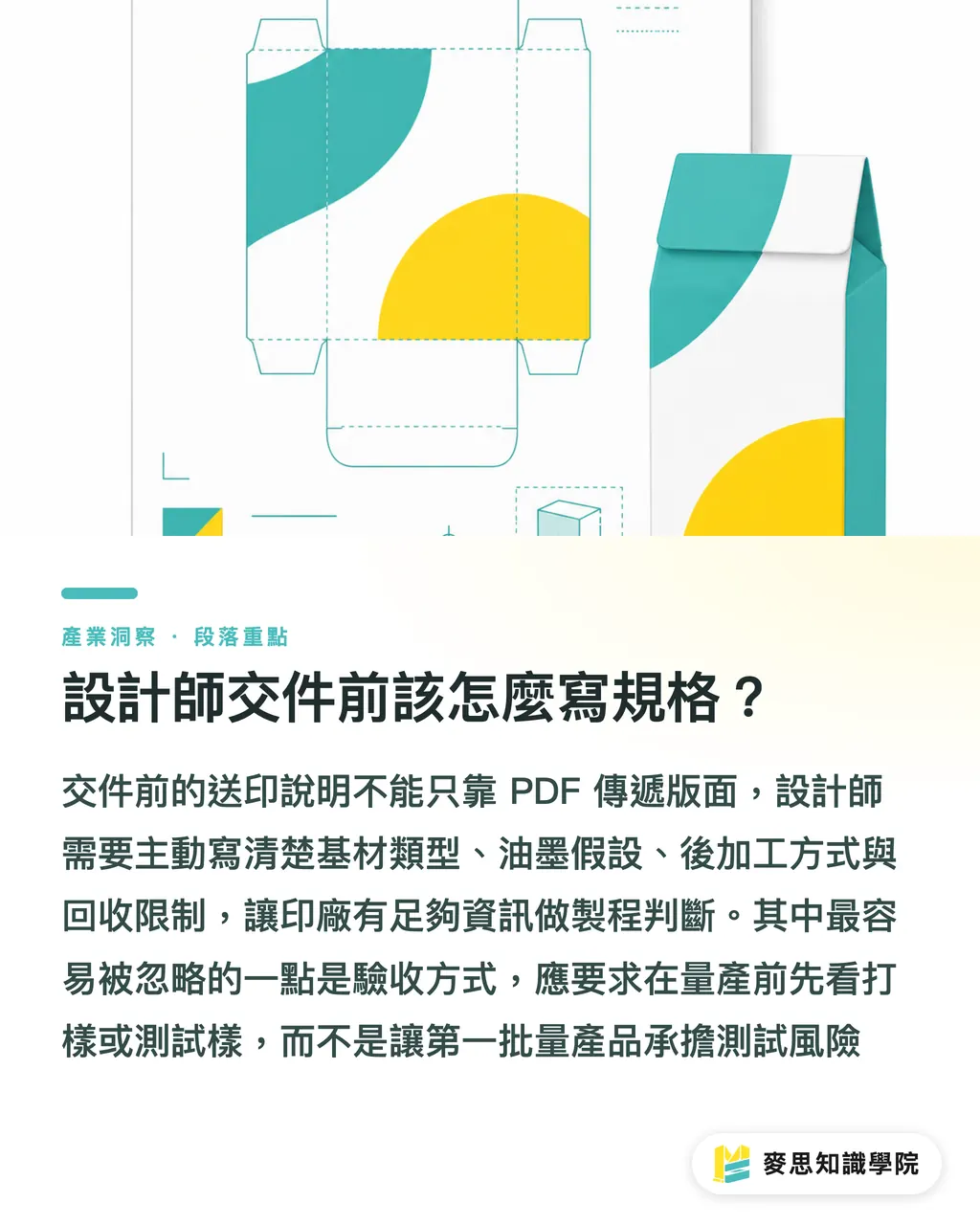
Before handoff, designers should write the substrate, ink assumptions, color tolerance, finishing, and recycling limits into the print instructions. Do not just send a PDF
PDF (portable document format) can preserve layout, but it cannot preserve process judgment. Bleed is the same. Bleed is the image or text area extended beyond the trim line. Its job is to prevent white edges after cutting, not to vouch for material deformation
A pre-handoff self-check can be written like this
・End use: clearly separate food, retail, and delivery packaging. The source article also lists these 3 as common applications for plant-fiber packaging
・Substrate information: state whether it is PLA, fiber-based packaging material, starch-based film, or another bio-based material
・Printing risks: mark the positions of large full-bleed areas, fine type, reversed-out type, barcodes, and brand colors
・Finishing information: state the varnishing, lamination, heat sealing, embossing, cutting, and packing method
・Acceptance method: require a proof or test sample first. Do not let the first production batch become the real test
Key Takeaways
・For bio-based substrates, check press conditions first, then talk about the sustainability story
・If surface energy is not confirmed, color management is only damage control
・If heat resistance fails, finishing will magnify every problem from the earlier stages
・When designers clearly state the substrate in the handoff file, they save the printer one round of trial and error
・When customers ask for eco-friendly packaging, the printer should answer with a process compatibility checklist
Further Thinking
For print manufacturers, bio-based substrates need to be built into the order-intake questionnaire and proofing workflow. For design teams, final artwork notes need to move from "the file is correct" to "the material is printable." For AI (artificial intelligence, technology that helps systems compare specs and flag risks) and SaaS (software as a service, software delivered through the cloud) teams, the most valuable feature is not generating a few more templates. It is turning substrate, ink, finishing, and recycling limits into selectable risk cards. This kind of SOP can also be organized into internal training and order-intake specs with help from the Mai Strategy Knowledge Academy consulting team
Further Reading
FAQ
- Can bio-based substrates go on press with the original print settings?
- Not recommended. The ink absorption, surface energy, and heat resistance of bio-based substrates may differ from traditional plastic or paperboard, so material, ink, and finishing compatibility should be confirmed before press setup
- Which bio-based packaging spec do designers most often miss?
- The substrate name and finishing conditions are the most commonly missed. Size, color, and bleed are not enough. The printer also needs to know whether there are coatings, heat sealing, lamination, or recycling limits
- If a bio-based ink contains renewable content, is it automatically suitable for all packaging?
- Not necessarily. The source article mentions that some bio-based inks can contain up to 90% renewable content, but the choice still depends on the printing process, product safety requirements, and packaging recycling method
- What should be tested before running PLA or starch-based film on press?
- Before PLA or starch-based film goes on press, test surface adhesion, drying speed, abrasion resistance, tension, and heat resistance. This matters even more when foil stamping, lamination, or heat sealing is involved
- What should small and midsize printers prepare first before taking bio-based packaging jobs?
- Small and midsize printers should first prepare a pre-order assessment checklist, with fixed fields for substrate, surface treatment, ink system, thermal processing, and recycling requirements, then decide how to quote and proof the job
Related articles


The Print × AI weekly
The print and AI know-how designers, brands and enterprises can use before they commit — one email, every week
MINDS Free Tools
Spine width and imposition calculators — skip the manual math, free in your browser.
MINDS Group
Need actual printing or gifting services?
From premium printing to online ordering and festive gifts — the MINDS Group sister brands take it from here.