

What Kind of Print Orders Will AI Agents Take Over First?
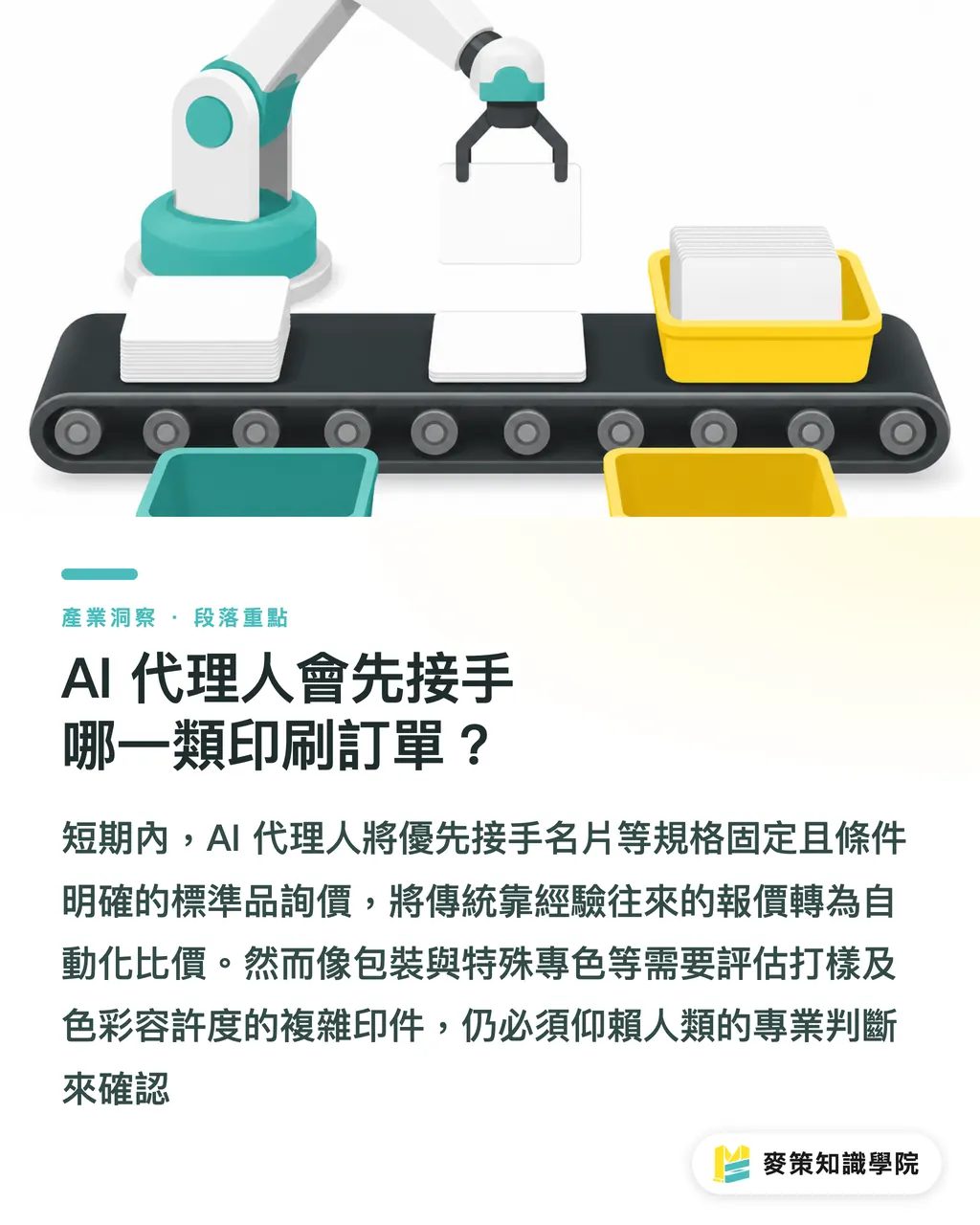
In the short term, AI agents will first take over inquiries with fixed specifications and clearly stated conditions. Special print jobs still need human confirmation. An AI agent is software that organizes information, compares options, and carries out the next step on a person's behalf based on a goal. In print procurement, it can read specifications, send quote requests, and organize replies
The shift drawing attention in North America's printing industry is that companies are handing quote requests and price comparisons to AI agents and automation tools. Processes once maintained through sales relationships, experience-based judgment, and custom quotes are starting to become field-by-field comparisons. This discussion appears in AI Agents Outsourcing Your Print Jobs? The Impact of Automated Procurement and How to Respond FAQ
Based on my experience working with clients, standard products such as business cards, one-page flyers, and fixed-layout products are more likely to enter automated quoting first. Packaging, specialty paper, spot colors (specified ink colors), and rush jobs are hard to decide from a single total price. Two jobs may both be labeled "one print run," yet the underlying proofing method, color tolerance, and responsibility for meeting the deadline may be completely different
How Does Automated Price Comparison Change Print Quotes?
Automated price comparison starts by comparing fields that software can read. The more a quote is written like a product specification, the more easily it can move through the procurement workflow. Automated procurement means handing requirements, quote requests, comparisons, and ordering conditions to software to process according to fixed rules, while people handle exceptions and give final approval
I would first break one quote into three sets of data
・Specifications: Clearly state the finished size, quantity, stock, printing method, imposition (how multiple pages or panels are arranged on one large sheet), and whether finishing is included
・Delivery: Put the point from which lead time is counted, shipping method, packaging, and delivery responsibility in the same set of terms
・Quality: Clearly label the proof format, color reference, file checks, and acceptable variation (the permitted difference between the finished product and the agreed proof)
If any one set is missing, the quote looks simpler on the surface but actually pushes manual confirmation, requests for missing information, and rework to later. The biggest weakness in traditional custom quoting is that what the salesperson knows is not written into the specifications, leaving the buyer no fair basis for comparison. Tools can only treat blanks as having no cost
Why Doesn't the Lowest Unit Price Equal the Lowest Print Cost?
The lowest unit price often does not equal the lowest total cost, because print production still involves proofing, color confirmation, file corrections, lead times, and exception handling
For example, in a packaging job using the same brand color, quote differences may come from whether proofing, spot-color confirmation, file checks, or split delivery are included. If these conditions are not spelled out, the buyer sees only a number and discovers after printing that the two sides were not actually buying the same thing
Not so fast
Based on my long experience reviewing quotes, at a minimum, separate three types of cost before comparing prices
・Direct costs: Stock, printing, finishing, packaging, and shipping
・Rework costs: Back-and-forth file revisions, new proofs, reprints, and scrap
・Deadline costs: Delayed launch, missed events, or having to find a new supplier at the last minute
AI is well suited to organizing these fields into a comparable checklist, but it cannot decide how much variation in a brand color is acceptable, nor can it make the print shop take responsibility for a batch printed incorrectly

How Can Print Shops Make AI Understand the Value of Their Services?
To deal with automated procurement, the first step for a print shop is to turn a quote from a single total price into a set of verifiable terms, so specifications, risks, and services are all visible
I would use the "Mai Strategy Three-Gate Print Submission Process" to organize the shop's internal quoting and customer-service workflow
・1. Specifications gate: Break size, stock, quantity, imposition, finishing, and lead time into fixed fields to reduce back-and-forth questions
・2. Risk gate: Put the color reference, proofing method, file checks, and acceptable variation in the quote so the expertise does not remain only in the salesperson's head
・3. Service gate: State response times, how missing files or information should be supplied, exception handling, and responsibility for reprints, so conditions beyond price can also be compared
These three gates keep human confirmation for specialty paper, packaging, and rush jobs, while putting everything that can be stated clearly into the workflow first. When the quote page shows only a total price, the buyer's AI can compare only totals. If the shop can return the full set of terms, proofing, lead time, and customer service have a chance to be seen
If you want to restructure an existing quote sheet in this format, start by auditing your print-submission workflow with the Mai Strategy Knowledge Academy consulting team
How Can Buyers Work With AI Without Letting the Lowest Price Drive the Decision?
Buyers should keep AI focused on organizing data and initial screening. Do not let it independently approve print quality, color, or responsibility for meeting deadlines
I recommend a three-step approach
・1. First, organize requirements into a standardized specification, letting AI produce an initial price range and a list of items to confirm
・2. Then ask every print shop to quote against the same fields, especially checking stock, finishing, proofing, lead time, and exception handling
・3. When brand colors, specialty paper, packaging structures, rush jobs, or major reprint costs are involved, have a person confirm the proof and responsibility terms
It's simple
AI can cut down the back-and-forth in emails and spreadsheets, but it cannot take responsibility for printing a batch incorrectly. If a SaaS team is building print-procurement features, the quote API should not return only the `price` field. It should also return specifications, delivery terms, and quality terms. Otherwise, automation merely sends incomplete data faster

Key Takeaways
・AI agents take over standardized inquiries first, while special printing still needs human judgment
・If a quote cannot express the specifications, the print shop's service value cannot be compared fairly
・The lowest unit price does not equal the lowest total cost. Proofing, color, and lead time belong on the same quote
・Print shops should organize their data first, and buyers should standardize the terms first. That is how human-machine division of labor avoids turning into blind price comparison
Further Thoughts
Print shops can start by auditing the fields in an existing quote sheet, adding stock, imposition, finishing, proofing, color reference, lead time, and exception handling. When designers deliver files, they also need to spell out brand colors, final-art checks, and acceptable variation. Teams bringing in AI should start with data formats instead of rushing into fully automated ordering. SaaS teams should have quote APIs return price and responsibility terms together, so buyers compare the same job rather than a few numbers that only look attractive
Further Reading
FAQ
- Can an AI agent place a print order for me directly now?
- For now, it is best suited to handling inquiries with fixed specifications, organizing information, and conducting preliminary price comparisons. People should still confirm color, proofing, specialty finishing, and delivery responsibility before placing the order
- How can a print shop make its service value visible to automated procurement?
- Break size, stock, quantity, finishing, proofing, color reference, lead time, and exception handling into verifiable fields. Do not return only a total price
- Will AI price comparison always choose the cheapest print shop?
- Not necessarily. If quote terms are inconsistent, the lowest unit price may not include proofing, file checks, reprints, or responsibility for meeting the deadline. Buyers should standardize specifications before comparing
- Which print jobs are best suited for introducing AI procurement first?
- Standard products whose size, stock, finishing, and lead time can all be described consistently are the best fit. Specialty paper, spot colors, packaging structures, and rush jobs should retain human review
Related articles





The Print × AI weekly
The print and AI know-how designers, brands and enterprises can use before they commit — one email, every week
MINDS Free Tools
AI background removal, brand stamping, and a LINE sticker maker — free design tools, right in your browser, no upload.
MINDS Group
Need actual printing or gifting services?
From premium printing to online ordering and festive gifts — the MINDS Group sister brands take it from here.