
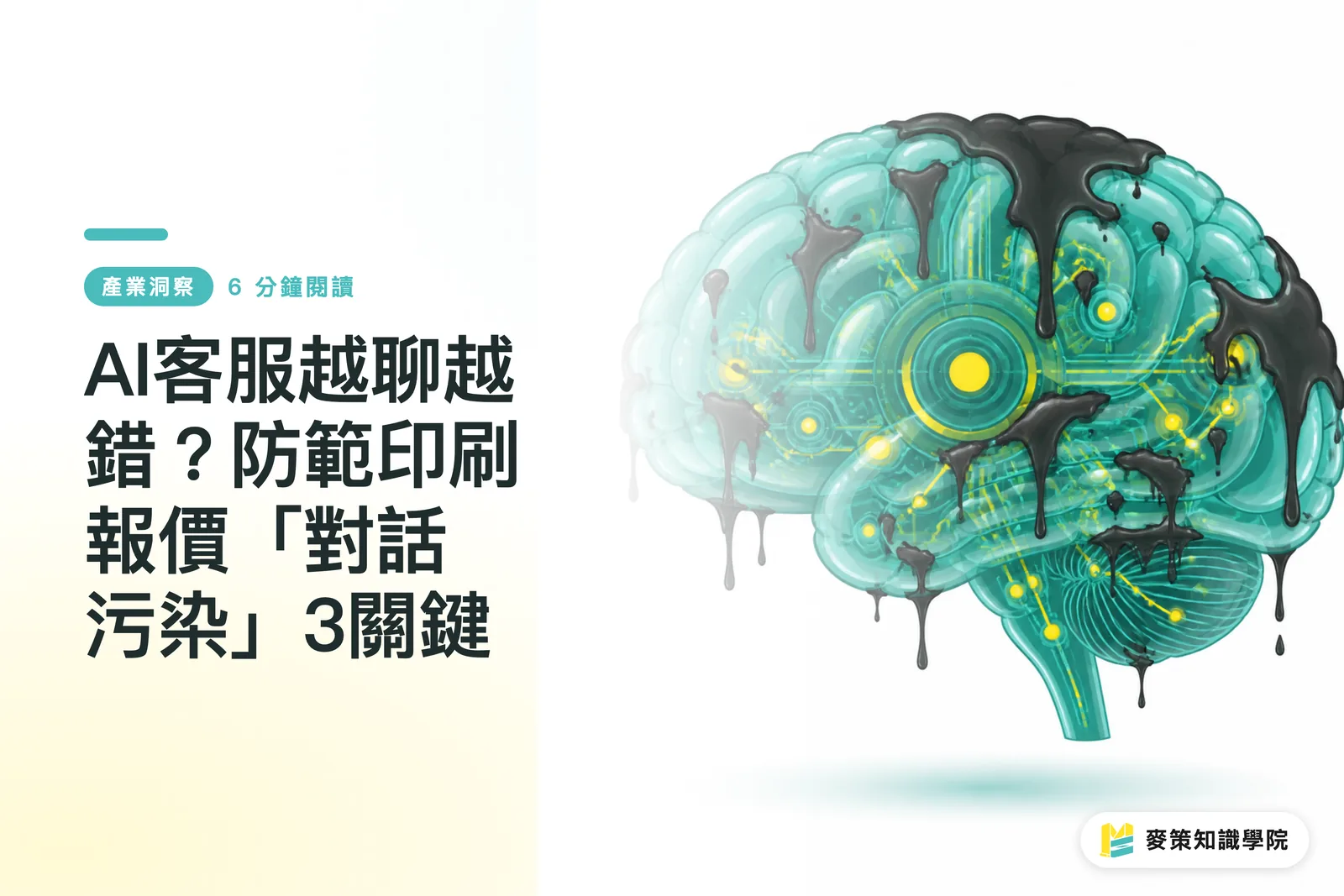
Why AI Chatbots Make More Quoting Errors the Longer They Talk
Lately, many in the industry hooked AI up to LINE to handle quoting, only to discover that after a customer revises their specs a few times, the AI stubbornly clings to the original outdated details
In tech circles, this is known as Context Poisoning. When incorrect concepts get repeated throughout a long conversation, their attention weight becomes high enough to drown out the correct information
When a customer first asks about 150 gsm coated art card, finds it too expensive, and switches to 100 gsm woodfree paper, the AI might reply, 'Sure, updated.' But inside its underlying attention mechanism, the 150 gsm coated card discussed across several earlier turns actually gained heavier weight
As a result, even though the AI acknowledges the change, the final calculated quote still reflects the heavier stock
This isn't a software bug. It is an unavoidable side effect of how long conversations accumulate context
What Happens When Wrong Specs Slip All the Way to Production
On a printing production line, a single misunderstanding about paper thickness can wreck the entire imposition and binding schedule
Discussions about context poisoning on Reddit have recently sent a clear warning to the tech community
An AI that can understand customer messages should never have direct permission to send out official quotes or push work orders into the ERP
I have talked with several plant managers who rushed into automation, thinking that dumping a customer's entire email thread or chat history into the system would eliminate customer support overhead
Printing relies heavily on precision verification. Being off by a single millimeter or swapping paper grain changes the cost structure entirely
Once context poisoning happens and the AI takes an abandoned A5 size as the final decision to generate a work order, the entire print run will end up in the scrap bin
How Print Shops Should Build Defense Mechanisms for Order Intake
The most practical approach is to abandon the fantasy of fully conversational quoting. Instead, use structured forms paired with breakpoint resets to block memory contamination
Stopping error accumulation cannot rely on prompting the AI to 'forget earlier messages.' You have to enforce hard resets at the system architecture level
You can look at Mai Strategy's three verification checkpoints to clean up your intake workflow:
・Form-based specs: After discussing requirements, have the system generate a clickable confirmation checklist instead of letting the AI write freeform quote text
・Forced memory disconnection: When entering the quote generation stage, feed only the finalized spec form to the AI and discard the entire back-and-forth chat history
・Lock down dispatch permissions: Generated quotes and work order drafts must stop in a human review queue, requiring a sales rep to click the final confirm button before anything is sent
If your company is planning to upgrade its LINE Official Account or wants to audit the risks in your current order intake system, we recommend having the Mai Strategy Knowledge Academy consulting team review your permissions and workflows before making changes
Key Takeaways
・Long conversations accumulate incorrect weights, making AI support increasingly prone to hallucinating specs the longer a chat goes on
・The only reliable way to stop context poisoning is a hard memory reset, rather than expecting the AI to self-correct
・Automated quoting must lock down dispatch permissions, keeping the final confirmation button in the hands of human sales reps
Further Thoughts
Everyone is competing over how smart their models are. But from my years observing production floors and customer interactions, whether AI succeeds in practice comes down to having brakes in place when it makes a mistake
Instead of spending huge budgets trying to train a super-chatbot that claims to understand printing completely, invest those resources into basic spec confirmation interfaces and permission controls
Accepting that AI will suffer from context poisoning and designing fault-tolerant workflows is what small and medium print shops should focus on right now
For complex structural packaging or high-end bespoke projects, skipping AI and working directly with human specialists at MINDS remains the safest route
Further Reading
FAQ
- Why does the AI still quote the wrong price even after the customer corrects it?
- Because the earlier incorrect specs were mentioned repeatedly throughout the chat, building up heavy attention weight that overpowers later correction prompts. In technical terms, this is known as context poisoning
- Do we need to scrap our shop's LINE bot and start from scratch?
- No need to scrap it. You just need to insert a breakpoint between the chat and quote generation, extracting only the finalized spec fields to calculate prices while isolating the earlier chat history
- What is AI customer service actually good for right now?
- It works well for answering standard material properties, sharing dieline download links, or handling basic inquiries. But whenever custom quotes involve pricing and lead times, handing them off to human staff is always the safest choice
Related articles

The Print × AI weekly
The print and AI know-how designers, brands and enterprises can use before they commit — one email, every week
MINDS Free Tools
AI background removal, brand stamping, and a LINE sticker maker — free design tools, right in your browser, no upload.
MINDS Group
Need actual printing or gifting services?
From premium printing to online ordering and festive gifts — the MINDS Group sister brands take it from here.