
Why is everyone adopting AI customer service? What tasks can it actually handle?
In the past six months, eight out of ten clients I've encountered have been asking about AI Q&A systems embedded in official LINE accounts or websites
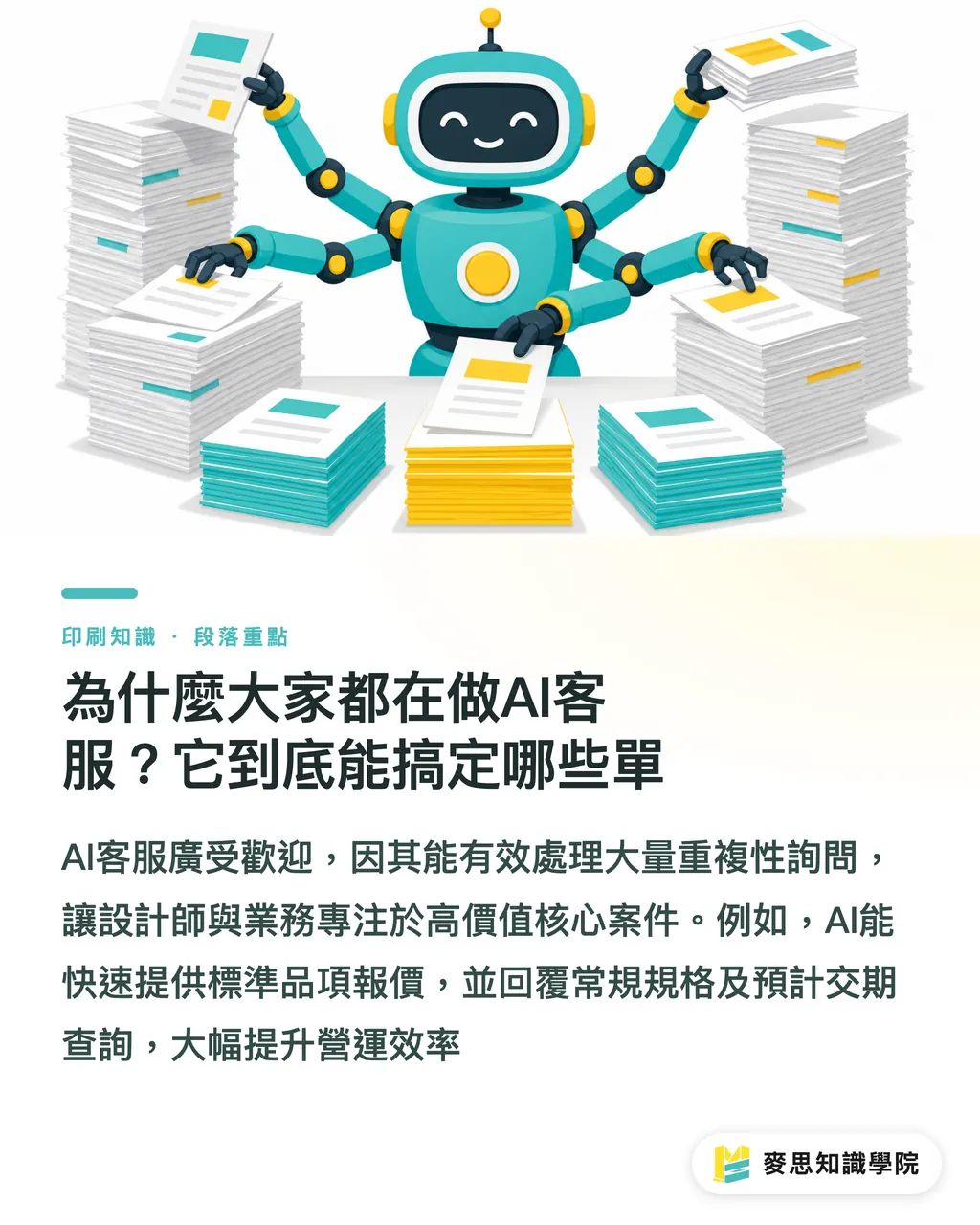
From the daily operations perspective of a printing plant, frontline customer service staff deal with a massive volume of highly repetitive inquiries every day
At this stage, AI acts like a tireless assistant, capable of quickly digesting the most trivial communication costs
Under the current technical architecture, AI bots can reliably handle these basic tasks:
・Providing quick quotes for standard items, such as the public pricing for 500 boxes of 250g premium cardstock printed double-sided
・Handling routine specification inquiries, such as bleed size settings and common resolution requirements
・Answering estimated delivery inquiries, turning delivery forecasts from gut feelings into science-based scheduling calculations
By offloading these chores to the system, designers and sales teams gain the capacity to focus on high-value, core projects
Why does AI fail when faced with complex processes and color disputes?
Many purchasers rely entirely on AI for price comparisons just to save effort, only to pay high hidden costs later on
As soon as a case deviates from standard specifications, the current judgment capability of AI is highly prone to errors
Printing is an industry that demands high physical precision; bots cannot touch paper, nor can they be held accountable for subjective visual quality
If you let the system take orders autonomously, you are almost guaranteed to trigger complaints in the following situations:
・Special material confirmation: AI cannot provide precise advice on the ink absorption and tactile feel of different fine papers
・Color consistency commitments: When a client demands a color match based on an RGB screen swatch, the AI does not know when to hit the brakes and refuse
・Multi-process quote combinations: Combining hot stamping, embossing, and special die-cutting requires an experienced craftsman to consider physical processing constraints; the prices calculated by AI are often disconnected from reality
This proves that what AI procurement saves is not money, but the massive cost of judgment errors; when these problems arise, humans must take over immediately
How can printing plants nurture AI to become smarter?
Many printing plants just connect the AI auto-quoting system and let it run, only to find six months later that it is just better at making the same mistakes
This is just like training a new hire; if you don't provide sufficient standard answers and corrections, it will just spin in circles with faulty logic
To build a truly functional prepress knowledge base, the key is not how much marketing copy you feed it, but the boundary conditions
Before going live, you must equip the system with these core data points:
・Accumulated real FAQ documents, mapping client layman terms to professional terminology
・Clearly structured quoting logic, including the calculation basis for base size units, minimum print quantities, and post-processing loss rates
・A compilation of common rejection reasons, enabling the AI to identify files with insufficient resolution or copyright concerns and proactively decline them
This is what I often say on-site: the key reason AI quoting assistants go off-track is the lack of feedback and correction mechanisms
Should you choose SaaS or build your own? What to do when clients get stuck?
The ultimate goal of introducing tools is to serve people, not to drive them away
When a client goes in circles with the system on LINE more than three times, they will immediately turn to your competitors
Therefore, in workflow planning, a seamless transition mechanism to human staff is the life insurance of the entire AI customer service setup
As for how to purchase the system, it depends on your plant's volume and engineering resources:
・SaaS solutions: Paying a monthly subscription fee of a few thousand NTD is suitable for most small and medium-sized enterprises to quickly test the waters and market acceptance
・Self-built solutions: Initial investments often start in the hundreds of thousands; only large factories with specific integration requirements and internal teams can afford this
Regardless of the approach, shifting the focus from a race to the bottom price to maximum complete value, combined with one-stop integration service experiences like MINDS, is the only way to make digital transformation truly effective
Key Takeaways
・AI is an excellent filter for standard specifications and public pricing, not a replacement for experienced print production specialists
・Without continuously feeding it common rejection reasons and correction logic, AI customer service will only produce erroneous quotes with high efficiency
・When planning any automated response system, a seamless and instantly interruptible transition to human staff is the key to retaining clients
・Small and medium-sized printing plants should prioritize evaluating SaaS solutions to verify the fit between production lines and clients with minimum trial-and-error costs
Extended Reflections
Introducing automated quoting is not for laying off customer service staff, but for liberating experts from endless specification confirmations
When a bot blocks 80% of canned questions, your team can invest their time in handling high-margin special processes and managing client relationships
The next step should be auditing the top 20 standard items most frequently inquired about in your plant, and letting the AI perfect its handling of these basics first
FAQ
- Our plant has many special imported paper stocks; is it suitable to let AI provide quotes directly to the public?
- It is highly discouraged. The texture and ink absorption response of special papers require physical, empirical judgment. This portion should be set to 'AI cannot answer' and automatically transferred to human handling
- What data should we prepare at the beginning to train a functional AI customer service bot for printing?
- You must first organize a standard item pricing logic table, past customer Q&A compilations, and, most importantly, the history of rejection and order refusal reasons
- Is the price calculated by AI accurate when encountering complex post-processing combinations?
- Usually inaccurate. Multi-stage processing, such as hot stamping overlaid with spot UV, involves positioning and loss rate considerations; this type of multi-process quoting currently still requires an experienced print production specialist to intervene and evaluate
Related articles




The Print × AI weekly
The print and AI know-how designers, brands and enterprises can use before they commit — one email, every week
MINDS Free Tools
AI background removal, brand stamping, and a LINE sticker maker — free design tools, right in your browser, no upload.
MINDS Group
Need actual printing or gifting services?
From premium printing to online ordering and festive gifts — the MINDS Group sister brands take it from here.