
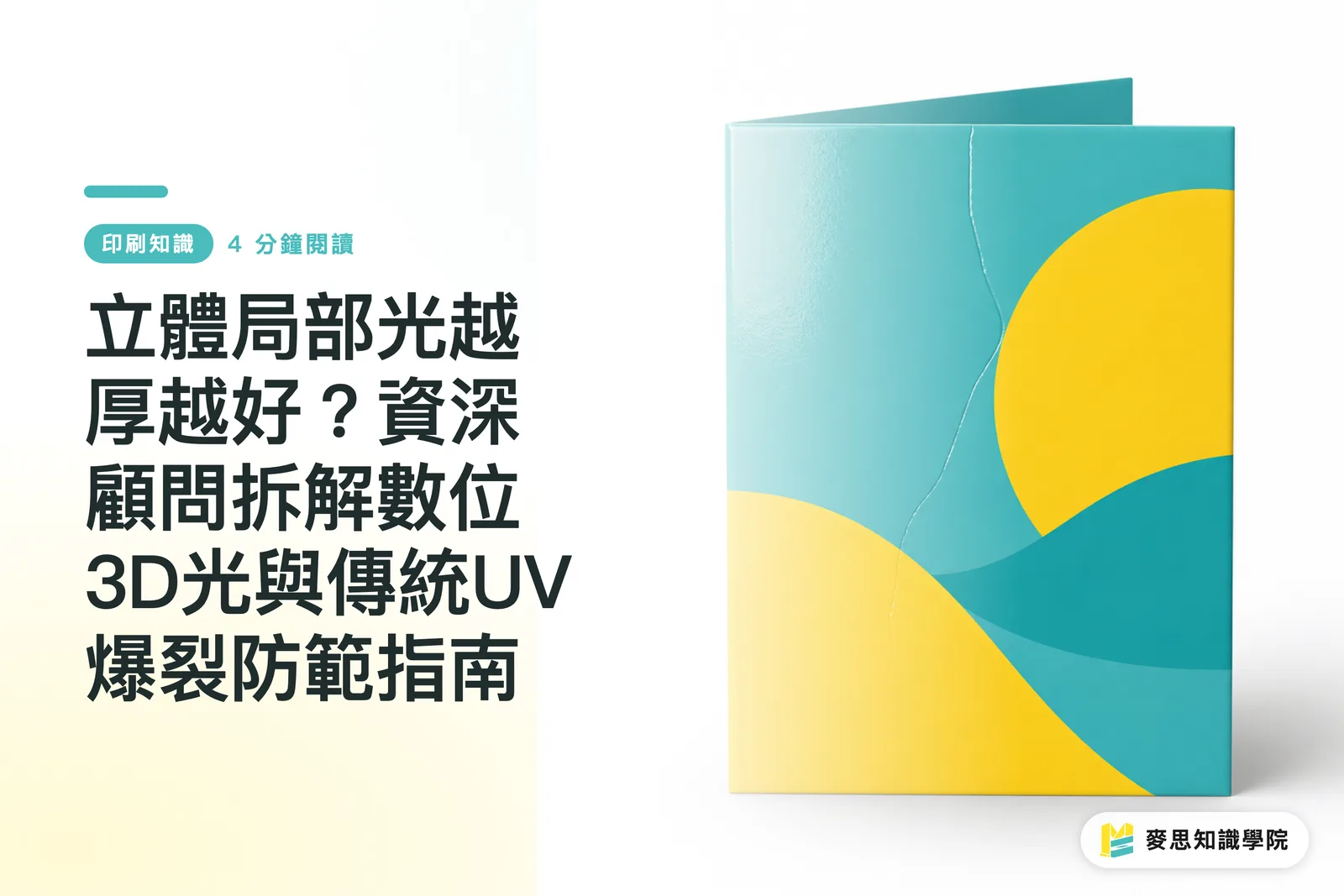
Is raised spot UV really better when it is thicker?
Do not rush to max out the varnish thickness. The answer is clearly no. When the varnish is too thick, the resin loses toughness, causing severe cracking and delamination at creases and folds. Based on the firsthand production experience of our MINDS Printing (MS, mid- to high-end fully custom commercial printing) consulting team, controlling the build height and following the crack-prevention logic of the "MINDS Printing (MS) three print-ready checks" is the right way to balance a raised tactile feel with durability
Raised spot UV is a finishing process that builds varnish resin onto selected graphics through digital inkjet printing or traditional screen coating. The varnish cures quickly under light, forming a raised contrast structure on the paper surface with both height and visual gloss
From a process standpoint, digital 3D spot UV and traditional screen spot UV are fundamentally different:
・Digital 3D raised spot UV: Piezoelectric printheads jet UV varnish precisely onto the printed piece. The build height can be adjusted from micron-level relief to 80 microns or even higher. No screen plate is needed, and it can produce gradients and refined edge transitions
・Traditional screen spot UV: A mesh screen or squeegee applies high-viscosity varnish through the screen. The coating thickness usually falls between 15 and 25 microns. The varnish layer is even and flat, making it suitable for large gloss areas and basic texture enhancement

Why does raised spot UV crack and delaminate across crease lines?
In real production, once the varnish build exceeds 50 microns, the cured resin usually has an elongation rate below 3%. Paper fibers still have some elastic room to stretch when folded at 90 degrees or 180 degrees, but the hardened varnish layer cannot withstand the tension. This is why many packaging boxes and folded cards show peeling gaps along the fold line
From what I have seen in factories over the past few years, the main causes of cracking and peeling usually come down to three points:
・No clearance around the crease: The varnish sits directly on the crease line. Once the creasing blade presses down, brittle cracks in the varnish spread immediately along the fold
・Poor adhesion between the base film and the varnish: If high-build 3D spot UV is applied directly over water-based matte lamination or low-quality film, surface tension mismatch can easily cause the whole area to delaminate
・The paper base is too soft: Thin paper or soft cardstock lacks load-bearing strength. When folded, it deforms too much and pulls the cured ink layer until it breaks
How should designers set black-plate gradients and crease clearances?
The answer is simple. To create a premium raised effect that does not crack, prepress preparation and layer rules are the key. Designers and purchasers can reduce the risk of reprints by following the file-preparation steps summarized by the Mai Strategy Knowledge Academy consulting team:
・① Leave a clear zone on both sides of crease lines: Whenever a crease line, fold line, or die-cut line appears, the spot UV black plate must be pulled back by at least 1.5 mm to keep the varnish from crossing the fold
・② Make good use of grayscale gradients in digital 3D spot UV black plates: Traditional screen spot UV only supports 100% black and white, but digital 3D spot UV supports K-value gradient settings. By adjusting the K value from 20% to 100%, the varnish thickness can transition smoothly at the edges, greatly reducing edge tension
・③ Choose the right base film: Give priority to high-adhesion digital matte film or scratch-resistant matte film to make sure the varnish bonds firmly with the underlying paper
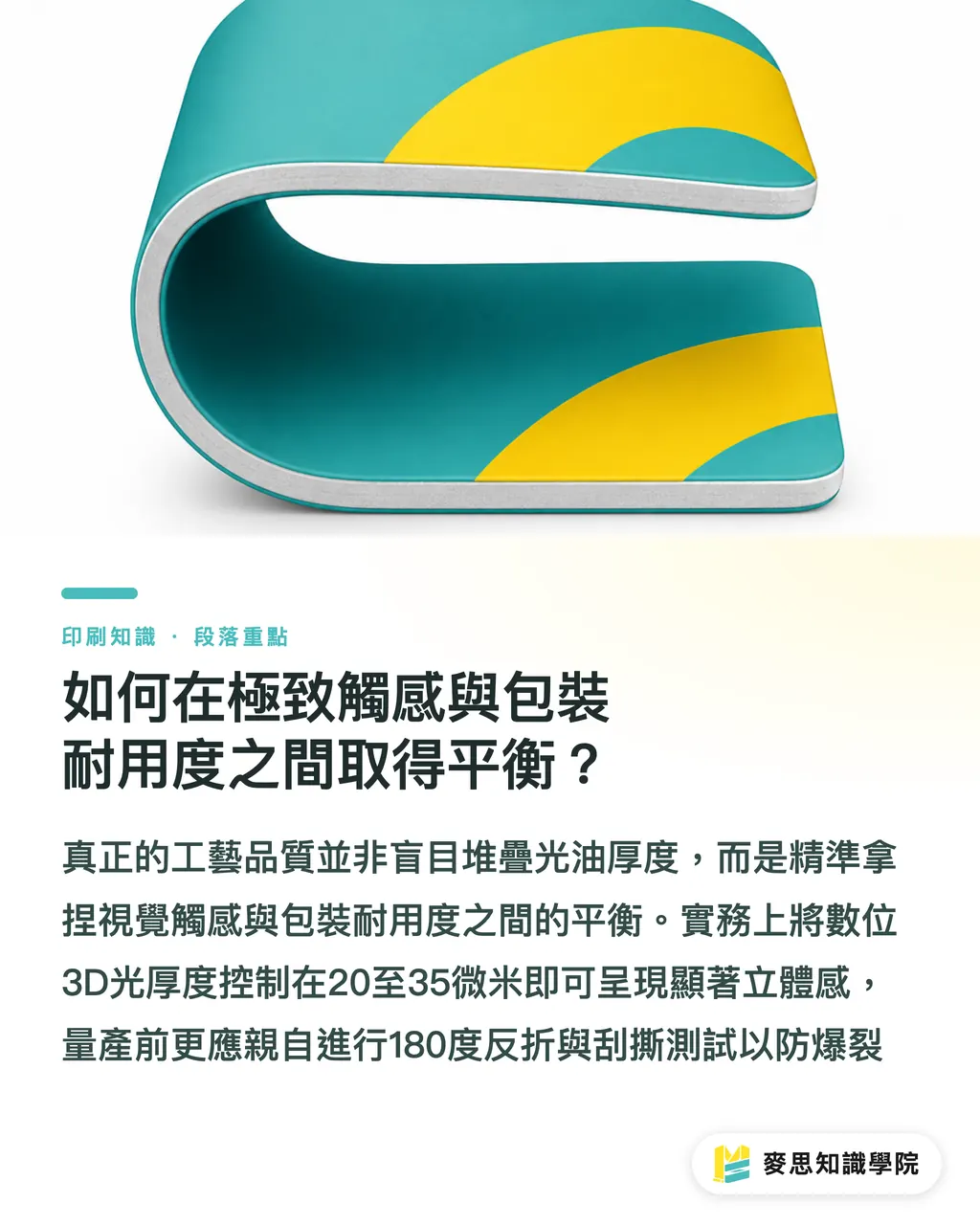
How do you balance extreme tactility with packaging durability?
In several recent projects I have handled, clients often wanted to build the varnish as high as possible. But once the finished pieces went into shipping cartons and faced friction and impact, the edges started falling apart. Real finishing quality is not about chasing thickness blindly. It is about balancing visual contrast with durability
In practical production, the following three points can help control risk:
・Control the build height: For standard business cards and card boxes, keeping digital 3D spot UV between 20 and 35 microns already creates a clear raised tactile feel. There is no need to force it above 60 microns
・Adjust according to graphic size: Fine lines and text can use higher-micron raised gloss to bring out detail. Large solid areas should use lower thickness to avoid overall hardening and brittleness
・Make a physical proof before mass production: Before batch production, always make a proof and personally run a 180-degree reverse-fold test and a scratch-peel test. Place the order only after confirming there is no cracking
Key Takeaways
・When varnish thickness exceeds 50 microns, cured elongation is extremely low, and varnish cracking can easily occur along folds
・Digital 3D spot UV supports K-value grayscale gradients, allowing smooth edge-thickness transitions and reducing edge tension
・The spot UV black plate must be pulled back by at least 1.5 mm from crease lines and fold areas to prevent the creasing blade from cutting and cracking the varnish
・For commercial card boxes, a 3D spot UV thickness of 20 to 35 microns is recommended to balance visual impact and durability
Further Thoughts
For professionals in print manufacturing and graphic design, digital 3D raised spot UV offers the advantage of gradient-friendly coating without screen making, but it also places stricter physical limits on prepress preparation. Design teams should build process-clearance logic into the early design stage and work closely with print shops that have equipment calibration experience, turning digital finishing into a stable, commercially polished result
FAQ
- What is the difference between digital 3D raised spot UV and traditional spot UV?
- Digital 3D spot UV jets UV varnish directly through piezoelectric printheads and supports grayscale gradients and multi-level thickness adjustments. Traditional spot UV is produced through screen printing, with a uniform fixed thickness and no gradient effect
- Why does spot UV chip or peel at folds?
- High-build UV varnish becomes brittle after curing and lacks the stretch and elongation of paper. If it directly covers a crease or fold line, bending will cause cracking and delamination
- How should a spot UV black plate avoid crease lines?
- When preparing the prepress black plate, leave a recessed clear zone of at least 1.5 mm on each side of crease lines, fold lines, and die-cut lines to keep the spot UV from covering the bending point
Related articles



The Print × AI weekly
The print and AI know-how designers, brands and enterprises can use before they commit — one email, every week
MINDS Free Tools
Spine width and imposition calculators — skip the manual math, free in your browser.
MINDS Group
Need actual printing or gifting services?
From premium printing to online ordering and festive gifts — the MINDS Group sister brands take it from here.