

What Exactly Goes into a Premium Finishing Quote?
Premium finishing quotes usually have four line items: plate costs, labor costs, material costs, and minimum-run charges. When these are lumped together as a single "finishing fee," it becomes hard for designers to tell where the price difference comes from
Foil stamping uses a heated die to transfer metallic or colored foil onto the paper surface. Embossing and debossing use dies to change the height of the paper surface. Spot UV applies UV varnish only to designated graphics and text to create a glossy finish. Laser engraving is priced by engraving area, time, and consumables. Specialty films depend on the film stock, lamination, and subsequent finishing
・Plate costs: Making and setting up foil-stamping plates, spot UV plates, or embossing/debossing dies. A revision may require them to be remade
・Labor costs: Press setup, pressure adjustment, registration, cleaning, and plate changes. Registration means aligning the printing and finishing layers
・Material costs: Foil, UV varnish, specialty film, laser-engraving consumables, and paper stock, all of which vary with coverage and paper compatibility
・Minimum run: Even for a small quantity, the press still has to be set up and adjusted, so printers calculate a minimum batch or minimum charge
When I review quotes on the production line and on the vendor-sourcing side, the first thing I look for is whether these four items have been separated. That is the first gate of Mai Strategy's three-gate print submission process

Which 4 Variables Drive the Unit Price Up?
Four variables move the unit price most easily: quantity, paper stock, finishing coverage, and complexity. The second gate of Mai Strategy's three-gate print submission process puts all four back on the same specification sheet
・Quantity: Fixed plate and setup costs can be spread across more pieces, while small runs hit the minimum charge first. With 200 business cards, fixed costs usually make up a more noticeable share
・Paper stock: Different textures, dark colors, coatings, and absorbency can affect foil adhesion, embossing formation, and how the UV coating forms
・Finishing coverage: A small logo and a large-area gloss coating use different amounts of foil, UV varnish, and film, and require different amounts of processing time
・Complexity: Fine type, reversed-out type, dense lines, multiple foil colors, or overlapping foil stamping and spot UV all make registration and press setup more demanding
The process order must also appear in the quote. Applying spot UV after foil stamping is different from embossing first and then foil stamping in terms of surface finish, adhesion, and registration requirements. The design team cannot simply hand over one merged PDF
Why Doesn't the Finishing Cost Get Cut in Half When the Quantity Doubles?
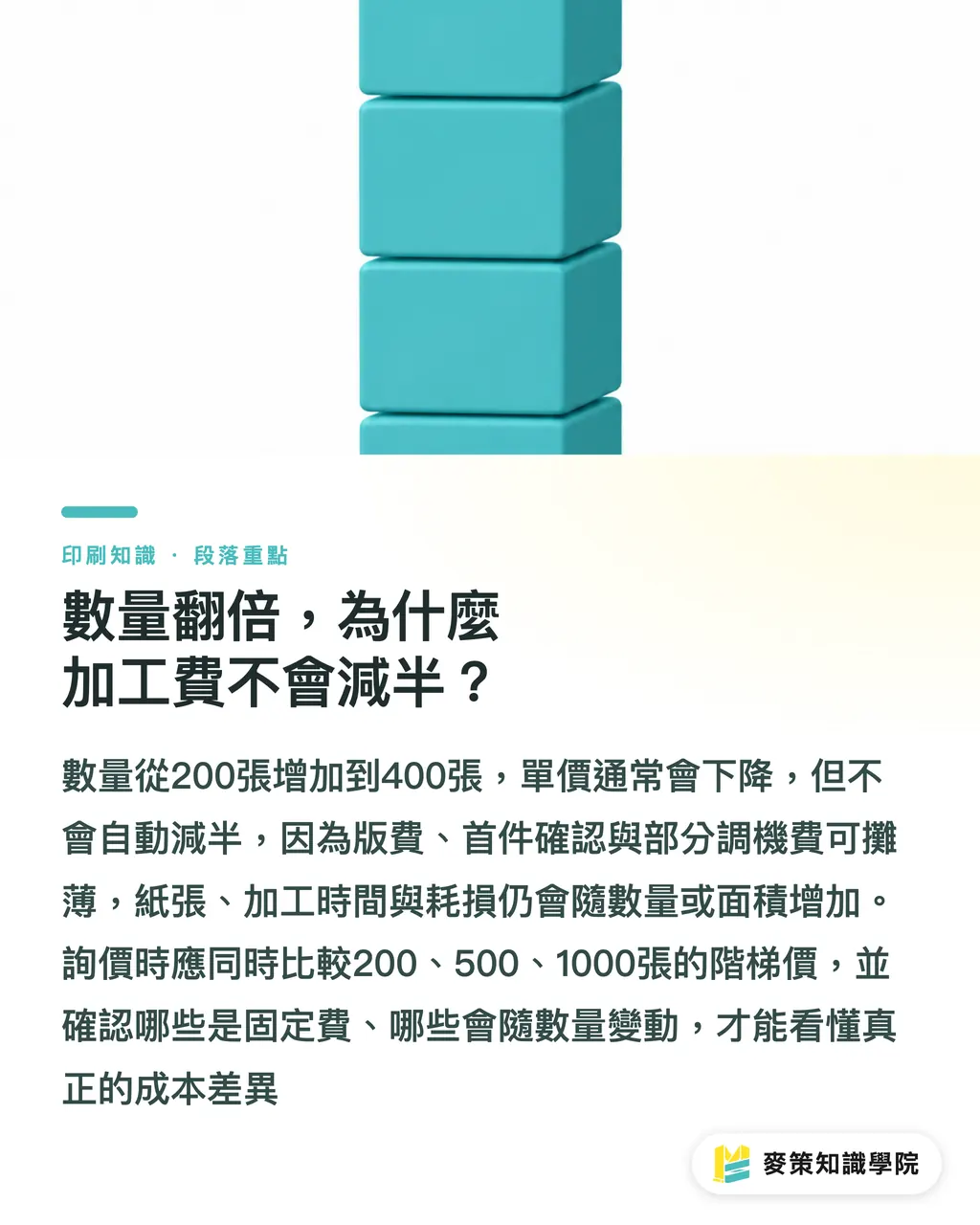
When the quantity goes from 200 to 400 pieces, the unit price usually drops, but it does not automatically get cut in half. Fixed preparation costs are spread only once, while materials, processing time, and waste still increase with the batch size
Total price = fixed preparation costs (plate costs + press setup) + batch labor costs + materials and waste
Unit price = total price ÷ quantity
・Plate costs, first-piece approval, and some setup costs can be spread across the run, so the amount allocated to each piece gets smaller as quantity increases
・Paper, foil, UV varnish, specialty film, and actual processing time still increase with quantity or coverage
・When a batch exceeds the machine or labor capacity, another batch must be run, bringing back new setup and waste costs
When requesting a quote, ask for tiered pricing at the same time for 200, 500, and 1000 pieces, and ask them to state which costs are fixed and which vary with quantity. Simply asking, "Is it cheaper if we order more?" is not enough
How Can 3 Common Job Types Be Estimated?
For all three job types, calculate the total as "fixed costs + batch labor costs + materials and waste," then divide by the quantity. The examples below show the method only and do not represent market rates
・Premium business cards, 200 pieces: For foil stamping plus embossing, list the two types of plate/die costs first, then add one batch of labor, paper stock, and waste. An illustrative calculation would be "(fixed plate/die costs + one batch of labor + 200 × paper and waste per piece) ÷ 200."
・Wine labels, 500 pieces: First confirm whether they are supplied as individual sheets or roll stock, and whether the paper surface is coated. Then break out foil-stamping coverage, spot UV coverage, cutting, and waste. The illustrative calculation is "(fixed costs + one batch of labor + 500 × materials and waste per piece) ÷ 500."
・Calendars, 1000 copies: First confirm the number of pages per copy and which pages receive finishing, then calculate materials and batch labor for specialty film, spot UV, or laser engraving. 1000 copies does not mean every page shares the same unit price
I write each job type in two lines: "total price ÷ quantity" and "fixed-cost share." That makes it possible to see, when specifications change, whether a process was actually removed or the cost was merely shifted elsewhere
Which 4 Questions Should You Ask the Printer to Keep the Quote from Being Misleading?
Ask at least four questions when requesting a quote, and write the answers back into the specification sheet. The third gate of Mai Strategy's three-gate print submission process makes sure the designer, buyer, and printer are discussing the same set of conditions
・1. Are plate, labor, material, and minimum-run costs listed separately? How are artwork revisions and remade plates or dies calculated?
・2. How many press setups, registration checks, proofs, and waste allowances are included in the quote? When foil stamping, embossing, and spot UV are layered, how is the process order handled?
・3. How are the tiered prices for 200, 500, and 1000 pieces calculated? Which costs do not decrease with quantity?
・4. How will fine type, registration, gloss, pressure marks, and film-surface defects be inspected and accepted? Where is the reprint responsibility specified?
Before handing over the files, run these three checks
・Keep the printing and finishing layers separate, and clearly label the spot colors for foil stamping, embossing, and spot UV
・Check bleed, fine type, reversed-out type, finishing order, and the safe area after trimming
・Put the paper stock, quantity, finishing coverage, finishing order, and deadline on the same one-page specification sheet
When you need to verify the paper stock, files, and finishing order together, you can request an itemized quote from MINDS

Key Takeaways
・Premium finishing quotes should first separate plate, labor, material, and minimum-run costs, so the total price has a basis for comparison
・For small runs, look at fixed costs first. Increasing the quantity only spreads the portion that can be shared
・Paper stock, finishing coverage, and process order all affect adhesion, registration, and waste at the same time
・When requesting a quote, spell out the 200, 500, and 1000-piece tiered prices and acceptance criteria, so changing the design does not mean guessing the cost all over again
Further Thoughts
If printing manufacturers separate plate, labor, material, and minimum-run costs into individual fields, SaaS quoting tools can have traceable fields. On the design side, the printing, foil stamping, embossing, spot UV layers, and bleed rules can be fixed in a file-submission template. AI is well suited to checking file layers, spot-color naming, and quote-field matching first, but it cannot replace judgment based on physical paper tests and proofs. The next step is to turn 200 business cards, 500 wine labels, and 1000 calendars into your team's own quote-request templates. Each revision then changes only the variables instead of rewriting the entire quote sheet
Further Reading
・MINDS official website
FAQ
- Is foil stamping always more expensive than spot UV?
- Not necessarily. The quote depends on finishing coverage, paper stock, plate costs, and process order. Foil stamping over a small area may be easier to keep within budget than spot UV over a large area
- With only 200 premium business cards, is it still suitable to use foil stamping, embossing, and spot UV?
- Yes, but three finishing processes add plate/die, press setup, registration, and waste line items at the same time. Ask for an itemized quote first, then decide which process to remove
- Why doesn't the unit price get cut in half when the quantity increases from 200 to 400 pieces?
- Plate and setup costs can be spread across more pieces, but paper stock, foil, coating, processing time, and waste still increase. If the batch triggers a second run, fixed costs may appear again
- What should a designer check most carefully before sending files?
- Keep the printing and finishing layers separate, check bleed, fine type, reversed-out type, registration order, and safe areas, and provide the printer with the paper stock, quantity, coverage, and delivery conditions together
Related articles





The Print × AI weekly
The print and AI know-how designers, brands and enterprises can use before they commit — one email, every week
MINDS Free Tools
Spine width and imposition calculators — skip the manual math, free in your browser.
MINDS Group
Need actual printing or gifting services?
From premium printing to online ordering and festive gifts — the MINDS Group sister brands take it from here.