

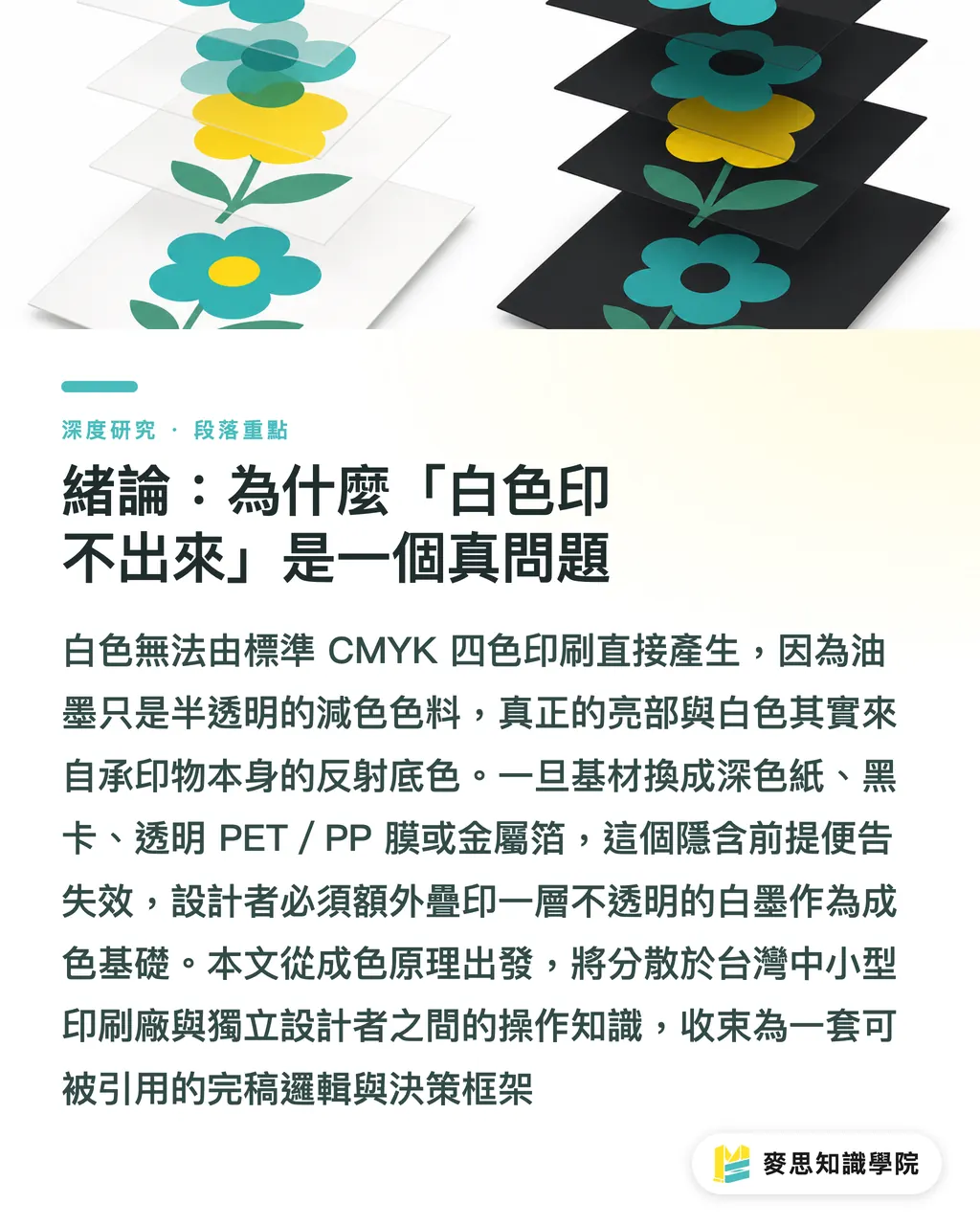
Introduction: Why "White Won't Print" Is a Real Problem
The fact that white cannot be produced directly through standard four-color printing is one of the most common yet least systematically explained problems designers encounter when moving into specialty substrate printing. This article first defines the technical root of the issue, then reviews the distribution and gaps in existing discussions, before breaking down the color-forming mechanism of white ink and the corresponding artwork specifications layer by layer
The core of the problem lies in the principle of color formation. CMYK is a subtractive system. Inks are essentially semi-transparent colorants that absorb specific wavelengths and reflect the remaining wavelengths through layered overprinting. The final highlights and "white" actually come from the reflective base color of the substrate itself. This analysis argues that this is precisely why designers almost never need to think about where white comes from when printing on white paper: white is supplied by the paper, not generated by ink
However, when the printing substrate itself is dark paper, black card stock, transparent PET/PP film, or metallic foil, this implicit assumption no longer holds. The substrate no longer provides a reflective white base. Any design element that needs to appear white or maintain color saturation must rely on an additional layer of opaque white ink as the foundation for color formation
For Taiwan's industry, the importance of this issue is increasing. Cultural and creative stickers, premium packaging, beverage labels, 3C accessories, and membership cards all make heavy use of transparent and dark substrates, and many of these orders fall to small and medium-sized printing shops and independent designers. The contribution of this article is to consolidate scattered operational knowledge into a citable logic for artwork preparation and decision-making, filling the systemic gap in existing discussions that emphasize "how to do it" but rarely explain "why it should be set up this way."
Literature and Current Practice Review: From Artistic Question to Technical Gap
Serious existing discussions of "white" are concentrated mainly in art and cultural fields rather than print engineering. This is the gap this article aims to address
Within visual culture and art history, "white" has long been treated as a charged subject. Research in photography and image history on creators such as Margaret Bourke-White reflects a tradition of closely examining white as a visual language [1]. More directly, "white on white" has itself been treated as an independent perceptual and aesthetic issue, highlighting how white is identified and how visual depth is produced against a same-color background [2]. This article argues that although these discussions are not print technology literature, they reveal a key fact: the visibility of white is never self-evident; it depends on contrast with the base color. Logically, this aligns with the physical premise that makes white ink necessary in printing
By contrast, industry-side discussions of white ink take on a different form: highly operational, fragmented, and often presented as "how-to guides" for a single material. Common lines of discussion include white ink underprinting for transparent materials, color difference control on pearlescent substrates, and setting pitfalls related to rich black and overprint. These discussions share one consensus: the gap between what appears on screen and what comes out in print is rooted in misunderstandings of the substrate and ink overprinting behavior. Their differences lie in the point of entry. Some begin with material properties, while others begin with software settings. Few integrate the two into a single logic for artwork preparation
In summary, existing discussions show a pattern in which the art side has depth and the technical side has breadth, but there is little mediation between them. Art literature explains why white is a problem [1][2], and operational guides explain how to handle individual scenarios. What is missing is a systematic layer that connects color-forming principles, white ink types, and artwork specifications. This article positions itself in that gap and attempts to provide an actionable and verifiable framework by breaking down the mechanisms involved
Core Analysis 1: The Two Main Technical Routes for White Ink and Their Boundaries
White ink is not a single technology. Based on its color-forming mechanism, it falls into two main routes, with a clear trade-off between opacity and fineness. Understanding this trade-off is the prerequisite for selecting the right process
The first route is conventional screen printing white ink. Its principle is to press a high-concentration, high-opacity white ink thickly onto the substrate through a screen. This article argues that the core advantage of screen-printed white ink lies in its controllable ink film thickness and strong opacity. It is especially suitable for large solid areas that need to completely block out a dark base, such as a full white base on black card stock or a full-coverage white layer on a glass bottle. The trade-off is plate-making cost and minimum production quantity, making it economically more suitable for medium to large orders
The second route is UV inkjet white. It uses digital printheads to jet ink point by point and cures it immediately with UV light. Its biggest advantage is the ability to handle fine graphics, gradients, and variable data without plate-making, making it suitable for short runs, personalization, and proofing. This article argues that its limitation is that a single ink layer is usually thinner than screen printing. On very dark substrates, multi-pass printing is often needed to make up for insufficient opacity, which directly affects production speed and cost
The choice between the two routes is essentially a trade-off between area and fineness. For large areas, simple color blocks, high opacity requirements, and unit-cost efficiency, conventional screen printing has the advantage. For small batches, complex graphics, fast turnaround, or variable content, UV digital printing is more suitable. This article argues that in practice the two are not mutually exclusive. Many production lines use screen printing for a full-base white layer, then overprint color using other processes, forming a hybrid workflow
It is worth emphasizing that no matter which route is used, the opacity of white ink is not unlimited. On dark and transparent substrates, the thickness of the white ink layer directly determines the saturation and accuracy of the colors printed above it. This is the physical basis for the later discussion of artwork preparation and overprint order

Core Analysis 2: The Three Decisive Variables in Artwork Preparation
The success or failure of white ink artwork depends on three variables that must be clearly defined: the white plate layer, the overprint order, and mirrored artwork. Any omission among the three can be enough to cause an entire batch to be reprinted
The first variable is the independent creation of the white plate layer. The key principle is this: white must be created as an independent layer and labeled "White" or "white plate," using a spot color name the print provider can recognize, rather than expressed as CMYK(0,0,0,0). This article argues that this principle is often overlooked because in the mental model of screen viewing and ordinary white-paper printing, "no ink" is equivalent to "white." In a white ink workflow, however, white is an ink that must be explicitly specified. It needs corresponding plate data, otherwise the RIP, or raster image processor, cannot generate white ink output
The second variable is overprint order: whether white ink serves as the bottom layer, printed before color, or the top layer, printed after color. This article argues that this order is determined by which side the finished product will be viewed from, not by arbitrary choice. On opaque dark paper, white ink is almost always the bottom layer, lifting the color performance of the subsequent color inks. On transparent materials, the order depends on whether the graphic is viewed from the front, with white ink serving as a backing after the color layer, or viewed through the reverse side of the film, in which case the overprint relationship is reversed. An incorrect order can cause color to be covered by white ink, or cause the white to show the base color and appear dirty
The third variable is the mirror requirement specific to transparent materials. When the design is viewed through the opposite side of a transparent film, the artwork must provide a mirrored reading reference to ensure that text and graphics appear correctly oriented from the final viewing side. This article argues that the mirror issue is essentially caused by the separation of the printing side and the viewing side. This is precisely where transparent substrates differ from ordinary paper and where errors most easily occur, because paper does not have this kind of viewing ambiguity between its two sides
Together, these three variables form the minimum specification set for white ink artwork. This article argues that confirming these three points with the print provider before file opening, white plate naming, overprint order, and viewing side with mirroring, can eliminate the vast majority of rework caused by communication gaps
Core Analysis 3: White Ink Quality Failure Modes and Their Causes
Common quality problems with white ink are not random. They can be traced to specific material and process mechanisms. Only by understanding the causes can the right remedies be applied. This section breaks down three typical failure modes
The first is yellowing. When white ink turns yellow after curing or long-term use, the cause is usually related to ink formulation, curing conditions, or interaction with the substrate. This article argues that for designers and project owners, yellowing is mostly a process- and consumables-level issue that is difficult to solve at the artwork stage. Choosing a stable supplier and requiring proof verification are more effective than trying to fix the problem afterward
The second is unevenness, seen as inconsistent white base density, clouding, or streaking. In digital processes, this is often related to insufficient ink passes or printhead condition. In screen printing, it is related to squeegee pressure and mesh count. This article argues that dark substrates require particular attention, because any unevenness in the white base will be amplified by the color printed above it into visible color differences
The third is show-through, meaning the white ink lacks sufficient opacity and allows the dark substrate to show through, causing the color printed above it to become darker and muddier. This article argues that this is the most fundamental quality indicator in white ink processing, directly echoing the earlier physical fact that white ink opacity is limited. Practical responses include increasing the white ink layer thickness or number of passes, and adjusting the coverage area of the white plate. However, all of these increase cost and production time, so the balance between substrate darkness and budget must be evaluated at the design stage
Across these three types of failure, the common point is that the problem often occurs on the production side, but cost and decision-making trace back to the artwork and project briefing stage. This article argues that this reinforces one point: white ink is not a printing "post-process," but a color-forming variable that must be incorporated from the beginning of design and artwork preparation
Implications for Taiwan's Design and Printing Industry
The value of white ink technology ultimately lies in how it changes the actual workflows and cost structures of small and medium-sized printing companies, designers, and brand owners. This section explains the implications by stakeholder group
For small and medium-sized printing companies, white ink capability is a service dimension that differentiates them from competitors. This article argues that actionable practices include clearly publishing the supported white ink processes, such as screen printing or UV digital, along with applicable substrates, minimum order quantities, and pass options; establishing a standard white plate file specification document for customers to download; and making "proof verification of white base opacity" a standard step for dark and transparent substrate orders to reduce reprint losses caused by yellowing, unevenness, and show-through. On the cost side, reflecting white ink pass count and area in the pricing structure can prevent underestimated opacity requirements from eroding margins
For designers, the implication is to incorporate white ink into the standard mental model of artwork preparation. Specific practices include creating a white plate as an independent spot color layer with correct naming from the beginning of file setup, confirming overprint order and viewing side with the print provider before project release, and proactively providing mirrored references for transparent material projects. This article argues that these steps add almost no design time, yet can eliminate the highest proportion of rework risk. In effect, process discipline is exchanged for stability in delivery time and cost
For brand owners, white ink relates to cost expectations and schedule management. This article argues that finished products using dark and transparent substrates require an additional white ink process, so their pricing and lead time should naturally be higher than ordinary paper printing. Communicating this expectation early can prevent misunderstandings on the procurement side. At the same time, requiring suppliers to provide physical proofs rather than approving only screen mockups is the single most effective way to control the final presentation quality
Across all three parties, the shared lesson of white ink is this: the decisive points for cost and quality are highly front-loaded into the artwork and project briefing stages, not the moment of printing. Establishing shared white plate specifications and proofing discipline is the key to reducing total cost across the value chain

Conclusion and Limitations
The research question addressed in this article is why dark and transparent substrates cannot produce white using standard four-color printing, and how white ink technology and artwork preparation should be handled systematically. The study shows that in subtractive printing, white is originally supplied by the substrate. When the substrate loses its white base, opaque white ink must be used to compensate. White ink forms a trade-off between area and fineness through two routes, screen printing and UV digital printing. The success of artwork preparation depends on three variables: the white plate layer, overprint order, and mirroring. Quality failures mostly arise from opacity and curing mechanisms on the process side
This study has clear limitations:
・First, most citable existing literature belongs to artistic and cultural discussions of "white" [1][2]. Technical claims at the print engineering level are presented mainly as industry rules of thumb and analysis in this article. There is a lack of directly citable quantitative sources, so readers should treat specific values, such as ink pass count and opacity thresholds, as engineering parameters that must be verified through case-by-case proofing rather than as final conclusions
・Second, this article does not include measured comparisons of specific branded ink formulations, curing equipment parameters, or environmental variables
As for future research, this article argues that building measured comparative data for common local substrates in Taiwan, such as dark fine paper, PET/PP film, and pearlescent paper, alongside white ink processes, and quantifying opacity and color difference under different pass counts, would advance today's largely experience-based white ink knowledge into searchable and comparable engineering benchmarks
Key Takeaways
・CMYK is a subtractive system and inks are semi-transparent. White is originally supplied by the substrate; dark and transparent substrates lack a white base, so opaque white ink is needed for color formation
・White ink falls into screen printing, which has strong opacity, suits large areas, and requires higher minimum quantities, and UV digital printing, which is fine, supports short runs and variable data, and often needs multiple passes on dark substrates. The core trade-off is area versus fineness
・The three artwork variables are: the white plate must be an independent spot color layer named "White/white plate," not CMYK all 0; the overprint order, bottom layer or top layer, must be confirmed; and mirrored artwork must be provided for transparent materials
・Yellowing, unevenness, and show-through mostly originate on the process side, but cost decisions trace back to artwork preparation and project briefing. White ink should be treated as a color-forming variable from the early design stage
・The decisive points for cost and quality are highly front-loaded. Shared white plate specifications and physical proofing discipline are the key for small and medium-sized printers, designers, and brand owners to reduce total cost together
Further Reflection
For print manufacturing, white ink capability is a monetizable service differentiator. It is worth institutionalizing implicit know-how through standardized white plate specifications and proofing workflows. For designers, adding the white plate layer, overprint order, and mirroring to the default artwork checklist is a low-cost, high-return investment in discipline. The opportunity for AI and SaaS lies in using software at the preflight stage to automatically detect high-frequency errors, such as white mistakenly set as CMYK(0,0,0,0), missing white plates, and transparent materials that have not been mirrored, while recommending white ink pass counts based on substrate darkness. This would turn a process now dependent on manual communication into rule-based automated validation. The unresolved issue is the lack of quantitative opacity and color-difference benchmarks for Taiwan's local substrates and white ink processes. This is both a research gap and the data foundation that anyone building a prepress automation product must first establish
References
[1] Glenn C. (2003). [Bourke-White [White], Margaret](). Oxford Art Online. DOI: 10.1093/gao/9781884446054.article.t010623
[2] Part I: White on White. White on White/Black on Black. DOI: 10.5771/9780742568730-15
[3] White J., Canada., White J. (1919). Conservation in 1918 / by James White.. DOI: 10.5962/bhl.title.20783
[4] WHITE AGAINST WHITE. Busing and Backlash. DOI: 10.2307/jj.7968101.9
[5] White A., White A. (1906). Autobiography of Andrew Dickson White. DOI: 10.5962/bhl.title.17508
FAQ
- Why can't CMYK four-color printing print white?
- CMYK is a subtractive system. Inks are semi-transparent colorants that create color by absorbing light through overprinting, while highlights and white actually come from the reflective base color of the substrate. When the substrate itself is dark or transparent and cannot provide a white base, an additional layer of opaque white ink is required to produce white
- How should the white plate layer be set up in artwork preparation?
- White should be created as an independent layer and labeled with a spot color name the print provider can recognize, such as "White" or "white plate." It should not be expressed as CMYK(0,0,0,0), otherwise the RIP cannot output white ink. The print provider should also confirm in advance whether the white ink will be used as the bottom layer or the top layer
- How should I choose between conventional screen-printed white ink and UV digital white ink?
- Choose conventional screen printing for large solid areas, strong opacity, unit-cost efficiency, and medium to large orders. Choose UV digital for fine graphics, gradients, variable data, short runs, or fast proofing. When digital white ink is used on dark substrates, multiple passes are often needed to make up for opacity
- Why does transparent material printing require mirrored artwork?
- Because the printing side and viewing side may be separate. When the design is viewed through the opposite side of a transparent film, a mirrored reference is needed to ensure that text and graphics appear correctly oriented from the final viewing side, avoiding reversed text in the finished print
- What should be done if white ink shows through and makes the colors darker?
- Show-through is caused by insufficient white ink opacity, allowing the dark substrate to show through. The response is to increase the white ink layer or number of passes, or adjust the coverage area of the white plate. However, this increases cost and production time, so it is best to evaluate substrate darkness and budget at the design stage and require physical proof verification
References
- 印刷白墨視覺遮蓋度的量測標準(Graphic technology. Visual opacity of printed white ink) · BSI British Standards白墨遮蓋度可被標準化量測
- 工業噴墨印刷中的 UV 固化墨水及其應用(UV-Curable Inkjet Inks and Their Applications in Industrial Inkjet Printing) · Wiley, Handbook of Industrial Inkjet PrintingUV 數位白墨的固化與墨層機制
Related articles





The Print × AI weekly
The print and AI know-how designers, brands and enterprises can use before they commit — one email, every week
MINDS Free Tools
Imposition calculator and preflight file check — free prepress tools, right in your browser.
MINDS Group
Need actual printing or gifting services?
From premium printing to online ordering and festive gifts — the MINDS Group sister brands take it from here.