

Introduction: Why Receipt Recognition Is a Tough Nut to Crack in Print Digitization
Production workflows across the printing industry lean heavily on paper slips. From job tickets issued by sales reps, to factory return slips (delivery receipts, shipping manifests, process sign-offs sent back from the shop floor), to proof-of-delivery vouchers from logistics partners, these documents carry essential details on specs, quantities, deadlines, and operational handoffs. When print shops try to digitize scheduling, capacity, and billing, receipt recognition is usually the very first hurdle, and the one most likely to fail. The challenge is not just "reading the characters." Rather, these slips lack fixed layouts, come in countless vendor formats, feature frequent handwritten notes and scribbled corrections, and arrive as phone photos with wildly uneven scan quality [1]
With generative AI and multimodal models maturing in recent years, claims that "OCR is a solved problem" have become commonplace. Yet running a Vision Language Model (VLM) directly in real production is totally different from scoring high marks on a clean dataset. A study evaluating a dataset built from mobile phone photos of Japanese receipts pointed out that even with specialized fine-tuning for structured receipt extraction, model performance remains tightly tied to dataset representativeness and layout diversity [2]. In other words, benchmark numbers cannot simply be assumed to work on arbitrary document formats from any given factory
This study focuses on three questions:
・First, what generations of evolution has receipt recognition tech gone through, and where are the practical boundaries for each?
・Second, why is the "latest model" not always the "right solution to adopt," and what factors actually drive technology choices?
・Third, for resource-constrained small and medium Taiwanese print shops, what architectural principles and routing logic should guide a workable receipt recognition setup? Grounded in a first-hand deployment report by a Taiwanese engineer [1], this article synthesizes insights from receipt OCR and AI governance literature
The contribution here lies in reframing receipt recognition not as a simple model selection pick, but as a system engineering effort across three coordinated layers: recognition, structuring, and review, along with actionable routing principles. For print shops currently evaluating digital job ticket workflows, this article offers a rare, ground-level local perspective

Literature and Current State: The Shift from Model-Centric to System-Centric Thinking
Existing discussions around document recognition fall into three clusters based on their core priorities, with clear tensions between their stances
The first cluster centers on model capability. This line of research focuses on pushing a single model to score higher on receipt extraction tasks. The aforementioned Japanese mobile receipt study fits here: it built an annotated dataset of about 1.3K samples and fine-tuned a VLM to output structured receipt fields, demonstrating that dataset quality paired with targeted fine-tuning significantly improves structured extraction accuracy [2][4]. The value of this work lies in offering reproducible methodologies and quantitative benchmarks. Its hidden premise, however, is a relatively consistent data distribution. When hit with the long-tail distribution typical of print shops, where every client uses a different template and new layouts appear constantly, maintaining a single fine-tuned model becomes costly and generalization degrades
The second cluster focuses on tools and engineering practice. With AI coding agents becoming widespread, developers can wire up OCR, LLMs, and backend logic at far lower costs. Practical literature documents collaboration patterns and limits of AI coding agents in real-world engineering, noting that while they speed up boilerplate code generation and tool chaining, domain-specific decisions still require human intervention [5]. Package implementations integrating AI coding agents into specific analysis environments (like RStudio) also show that agent-assisted data pipelines have become a viable engineering paradigm [3]. This cluster shifts the spotlight from "how capable the model is" to "how the system is assembled," complementing rather than replacing the first cluster
The third cluster centers on AI governance. Stepping back from technical details, this perspective explores how organizations can manage AI wisely. Relevant research stresses that the success of an AI system depends not only on algorithmic accuracy, but on how responsibilities are divided between humans and systems, as well as how uncertainty is handled through institutional rules [6]. This point is especially relevant for receipt recognition. When a model cannot reliably decipher a poor-quality photo, system designers must decide in advance who handles that failure and what fallback workflow takes over, rather than counting on an impossible 100% accuracy rate from the model
Looking across all three clusters reveals a clear shift in thinking: early discussions favored a model-centric view, assuming a stronger model would fix everything, while recent discussions have shifted toward a system and governance focus, recognizing that models have ceilings and that real deployment success hinges on preprocessing, routing, and human review. Yet existing literature mostly stays siloed within each cluster. Model research rarely addresses production edge cases or fallback design, engineering write-ups seldom measure quantitative accuracy limits, and governance studies tend to stay abstract without concrete deployment mechanics. This article argues that the intersection of these three domains is the exact gap in receipt OCR discussions, and a thorough local deployment report fills it directly [1]

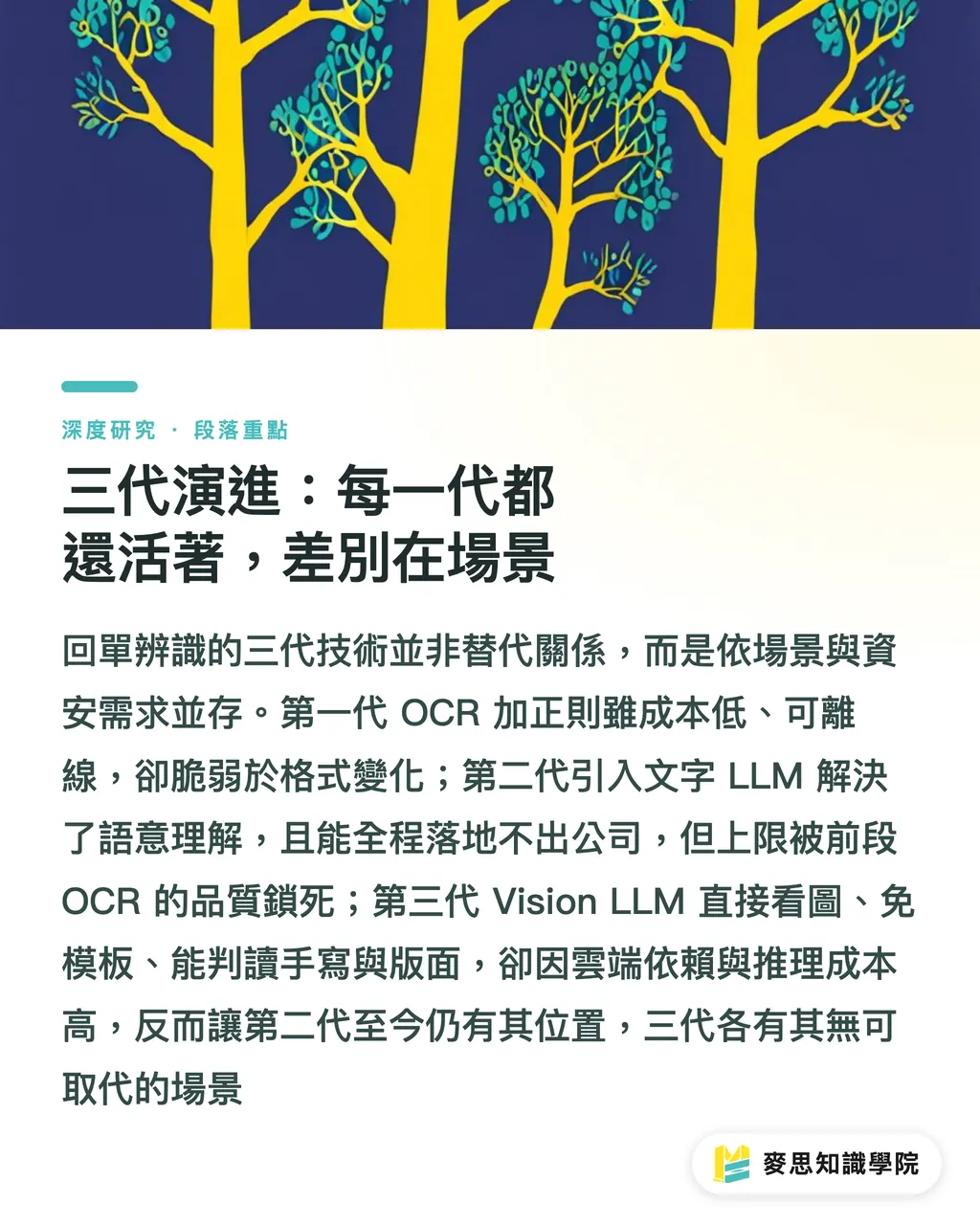
Three Generations of Evolution: Each Still Alive, Differentiated by Use Case
The evolution of receipt recognition tech spans three generations. The key is understanding that this is not a clean, linear replacement story. Instead, each generation survives and coexists based on specific workflow needs and security constraints [1]
The first generation is the OCR plus regex route. This approach runs traditional OCR engines (such as Tesseract or Google Document AI) to convert images to text, then uses Python regular expressions to extract fields line by line: finding the order number, matching date patterns, and checking addresses against rules [1]. The upsides are obvious: low cost, offline capability, and high speed. When layouts are fixed, it runs predictably, stays stable, and is easy to debug, requiring zero LLMs and zero token spend [1]. But its weaknesses are just as stark: any layout tweak breaks the parser, forcing engineers to rewrite regex rules for every new slip format. If the OCR engine misreads or drops a single character, the entire regex match fails. As client counts grow and formats multiply, regex scripts become brittle, bloated, and painful to maintain. The fundamental limit of generation one is that it lacks semantic understanding entirely and relies solely on rigid string matching, making it incapable of handling the long tail of print industry forms
The second generation is the OCR plus text LLM route. It still starts by using OCR to turn images into text, but skips hard-coded regex. Instead, the raw OCR text is passed to a text-based LLM to interpret context, pull out fields, and fill in missing pieces [1]. According to first-hand field reports, this setup delivered an immediate jump in accuracy for four reasons: layout changes no longer require regex rewrites since the LLM understands context directly, the model can recover dropped characters from surrounding text, it recognizes synonymous field labels (mapping both "Order #" and "Waybill #" correctly), and development moves quickly with lower maintenance overhead [1]. Even better, both OCR and text LLMs offer mature on-premises options, keeping data strictly inside company walls. This is a decisive advantage for customer privacy and sensitive business records [1], aligning closely with data sovereignty and accountability boundaries highlighted in AI governance literature [6]
Even so, generation two hits a hard ceiling locked in by upstream OCR quality. If OCR misreads something early on, the LLM receives bad text, leading straight to "garbage in, garbage out." The OCR conversion also strips away layout and color data: red and blue pen marks, table structures, and hand-drawn divider lines vanish, leaving the LLM with no visual context. Handwritten notes, signatures, and crossed-out edits that make sense only when viewed visually lose their meaning once flattened into text [1]. Generation two's strength and weakness are two sides of the same coin: it wipes out regex pain and runs fully on-premises, but the ceiling of the entire pipeline is constrained by upstream OCR accuracy
The third generation is direct Vision LLM inference. The newest approach bypasses standalone OCR altogether, feeding receipt images directly into multimodal models (like GPT-4o or Claude) to look at the image and interpret semantics in a single step, spitting out structured fields [1]. Its value lies in tackling most pain points from the previous two generations: it understands layout, tables, color, and hand-drawn markings; it reads handwriting, crossed-out text, checkboxes, signatures, and colored ink; it uses context and logic to distinguish visually similar characters (like 1 vs. l, or O vs. 0); and it operates without templates or regex across new formats [1]. This matches findings from studies on fine-tuned VLMs for structured receipt extraction, which confirm the edge multimodal models hold when parsing visually complex, real-world documents [2]
Yet generation three brings tradeoffs of its own. Inference runs slower, as image ingestion and visual processing add noticeable latency compared to text-only pipelines. Vision tokens are expensive, adding up fast at scale. Leading vision models remain primarily cloud-hosted, making fully on-premises deployment without external data transfer difficult today. That reality is why generation two remains so valuable. On top of that, vision models still cannot achieve 100% accuracy. Water-damaged papers or blurry, off-angle phone photos miss key information from the start, and no model can salvage what was never captured [1]. These limits confirm the central thesis of governance literature: model uncertainty is structural and must be managed through institutional processes rather than expected to disappear on its own [6]
Toolbox and Selection Logic: The Trilemma of Cost, On-Premises Deployment, and Accuracy
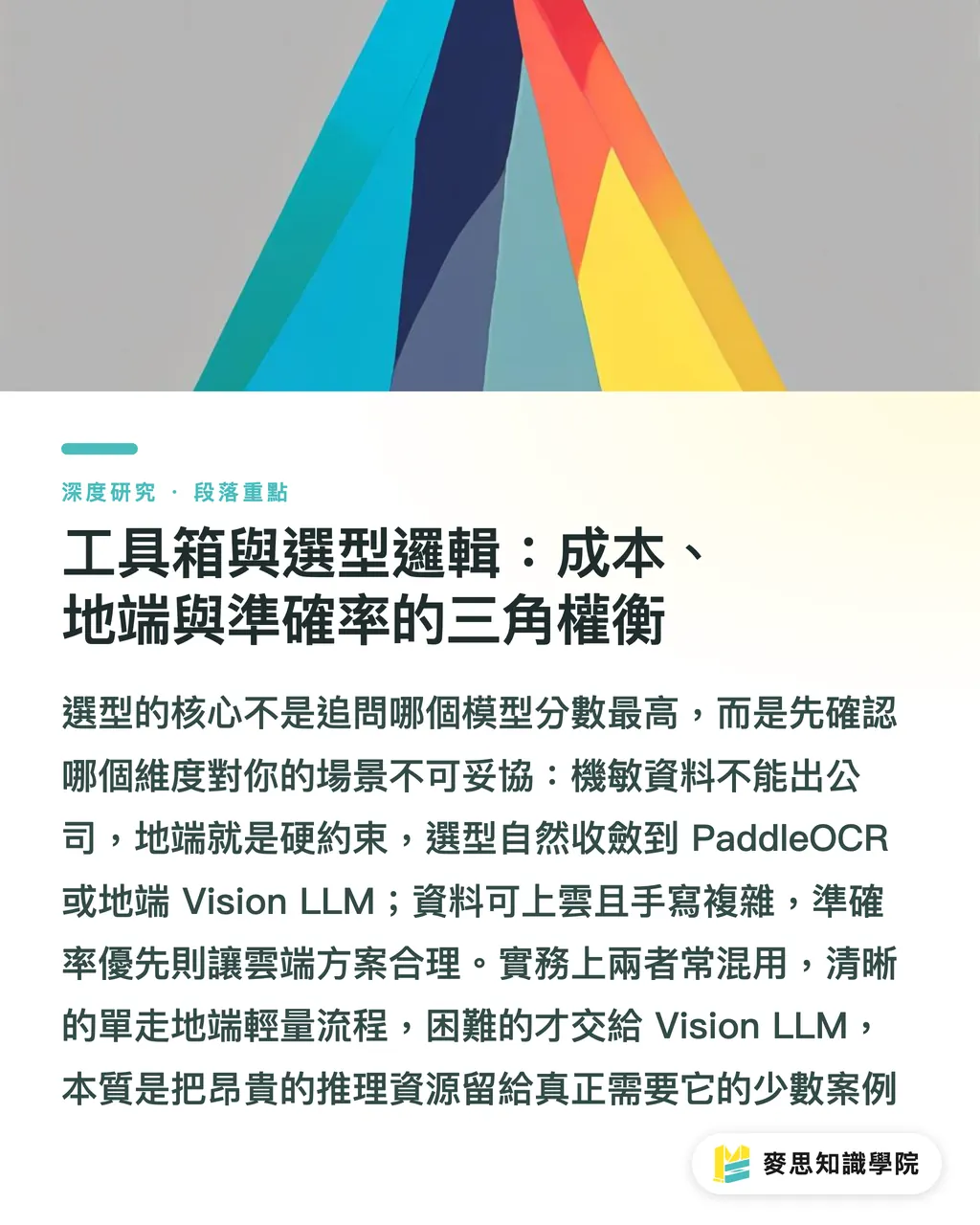
Translating the three generations into specific tools reveals a clear tradeoff triangle: cost, on-premises capability, and recognition accuracy rarely come all at once. Tool selection comes down to prioritizing these three dimensions for a given scenario
At the traditional OCR engine layer (the frontend for generations one and two), the field report details three setups tested in production [1]. Tesseract is the classic open-source engine: fully on-premises, free, and backed by extensive language packs. It is stable, works offline, and has a large community, but struggles with Traditional Chinese, handwriting, and complex layouts. Skewed, poor-quality field photos cause accuracy to drop noticeably, making it best as a simple baseline for clean, printed text [1]. PaddleOCR, open-sourced by Baidu, runs on-premises across various hardware backends like NVIDIA GPUs and Intel CPUs, with support for over 100 languages. Its primary strength is handling Chinese text and tables, outperforming Tesseract on mixed Traditional Chinese forms. It also extends the pipeline from raw PDF or image input all the way to structured JSON or Markdown with layout analysis included, making it the top baseline choice for Chinese documents requiring on-premises processing [1]. Google Cloud Vision and Document AI offer high recognition rates, mature layout parsing, straightforward APIs, and solid handling of handwriting and complex slips, giving them a smooth developer experience. Their major drawback is being cloud services where data must leave the premises, directly clashing with strict data privacy requirements [1]
At the on-premises Vision LLM layer (generation three), open-source communities have moved fast, with several notable models emerging between 2025 and 2026 [1]. Qwen2.5-VL (Alibaba) scales from 7B to 72B parameters, scores 95.7 on DocVQA, excels at parsing handwriting, tables, and multilingual documents, and boasts the most mature ecosystem, making it a primary candidate for general document and receipt processing [1]. PaddleOCR-VL (Baidu) features a lightweight version of roughly 0.9B parameters that hits over 96% on OmniDocBench v1.6, beating several larger frontier models on native OCR benchmarks across 109 languages, ideal for lightweight, accuracy-focused on-premises setups [1]. dots.ocr (rednote), at around 1.7B parameters, combines layout detection and content recognition into
・a single step, supports over 100 languages, and has official vLLM integration, standing as a SOTA pick among compact models [1]. MiniCPM-V 2.6 packs roughly 8B parameters into about 5.5GB, fitting easily on a single GPU or edge device while delivering strong OCR performance for resource-tight on-premises deployments [1]. olmOCR 2 (AllenAI), at around 7B parameters, uses RLVR training and is completely open source, covering both data and code [1]
This toolbox reveals a selection logic different from model-centric thinking: the question is not "which model has the highest score," but "which dimension is non-negotiable for your scenario." If sensitive data cannot leave internal servers, on-premises deployment is a hard constraint, narrowing choices down to PaddleOCR plus a text LLM or a local Vision LLM. If documents feature dense handwriting and scribbles while data can go to the cloud, accuracy takes priority, making cloud Vision LLMs a sensible pick [1]. Research on fine-tuned VLMs supports this view: models and datasets must align with target scenarios, as discussing model superiority in a vacuum offers little practical value [2][4]
A more practical answer is running a hybrid setup: routing clean slips through low-cost on-premises pipelines, and sending hard cases to Vision LLMs [1]. This hybrid routing acts as a cost-triage strategy, reserving expensive, heavy inference resources for the small pool of difficult documents that genuinely need them, rather than running heavy models indiscriminately on every page
Architecture Principles: Minimize Recognition, Maximize System Logic, and Route Uncertainty to Humans
The field deployment report distills its hard-won lessons into a single architectural rule: minimize recognition, maximize system logic, and route uncertainty to humans [1]. This rule breaks down into three system design layers that align with governance literature
The first layer is standardized preprocessing. Most receipt recognition failures do not happen inside the model; they happen at ingestion. Water-damaged, skewed, or carelessly shot photos often fail to capture key data points in the first place, and no model can invent missing information [1]. The first engineering step is standardizing inputs before recognition takes place: deskewing, cropping, contrast enhancement, and filtering out unreadable images. The design philosophy here is catching uncertainty early: rather than letting poor inputs pollute downstream pipelines, filter them out right at the front door. Research on mobile receipt datasets also underlines this: variations in input quality must be handled systematically instead of being dumped entirely onto the model [2]
The second layer is structured LLM extraction. This reflects the spirit of "minimizing recognition": rather than asking the model to handle all business logic at once, let it focus strictly on converting visual layout into structured data fields. Whether using generation-two text LLMs or generation-three Vision LLMs, the core task is mapping unstructured images or text into an explicit schema covering order numbers, item names, quantities, delivery dates, and sign-off status [1]. Structuring extraction around schemas brings two clear benefits:
・First, structured outputs can be fed directly into downstream databases and ERPs, cutting post-processing overhead
・Second, a well-defined schema acts as a verification anchor, letting the system validate whether fields were extracted reliably. AI coding agents help speed up development here by automating boilerplate integration code, allowing engineers to focus on designing schemas and validation rules [5][3]
The third layer is the human review gateway. This is the lynchpin of the architecture and the operational form of "routing uncertainty to humans." Model extractions should carry confidence scores or validation checks. When confidence falls below a set threshold, or when fields show logical contradictions (such as quantities and totals failing to calculate correctly), the system should halt auto-approval and route the slip to a human reviewer [1]. This design converts structural model uncertainty into a manageable human workflow. It reflects the core principle of managing AI wisely: systems should not pretend to be flawless, but instead establish clear accountability handoffs and fallback paths for uncertain cases [6]
Looking at all three layers together reveals a clear triage scenario. Imagine a print shop receiving 1,000 receipts daily. Roughly 80% are clean, printed slips that run quickly through low-cost on-premises OCR and text LLMs. About 15% are moderately difficult slips with handwriting or crossed-out corrections, which route to a Vision LLM. The remaining 5% are blurry, damaged, or conflicting slips that head straight to human review [1]. In this estimated setup, the pricier cloud Vision LLM handles only 15% of daily volume, while staff focus strictly on the hardest edge cases. This layered routing optimizes both accuracy and cost structure, ensuring marginal costs scale with document difficulty rather than total page count

Implications for Taiwan's Design and Print Industries
These architectural principles offer clear, actionable takeaways for different players across Taiwan's design and print sectors
For small and medium print shops, the primary takeaway is to treat receipt recognition not as a procurement task of "buying a model to solve everything," but as a workflow challenge of "building a triaged system." In practice, shops should start with PaddleOCR and a local text LLM as a baseline to automate standard, high-volume printed slips. This tier incurs virtually zero token costs and keeps data strictly on-premises, satisfying confidentiality concerns around client orders [1]. From there, shops can selectively route difficult handwritten slips to cloud Vision LLMs, while ensuring confidence thresholds and human review gateways are in place [1]. This phased rollout lets shops get a baseline running within weeks to clear 80% of daily volume, then gradually automate harder cases instead of chasing full automation on day one
For designers, digitizing receipts and job tickets ensures specifications on dimensions, paper stocks, and special finishes flow reliably from paper into digital systems, cutting down transcription errors. When recognition systems reliably extract structured fields, spec alignment between design desks and press floors becomes instantaneous, reducing the communication costs of proofs and revisions. In addition, designers who understand how recognition systems favor clean layouts can create job ticket templates with fixed fields and printed text, lowering the parsing barrier for downstream systems
For brand owners, digital receipts bring supply chain visibility and clear traceability. When sign-offs and delivery slips are logged in structured formats, brands can track order progress through the print supply chain and pull up verified records if disputes arise. This echoes the core insight of AI governance literature: the real value of these systems lies not just in automated speed, but in resetting boundaries of responsibility and trust between humans and software [6]. When deploying such systems, brands should check that review gateways maintain complete audit logs so that automation does not come at the expense of accountability
A common factor across all roles is balancing security with on-premises deployment. Taiwanese print shops handle high volumes of documents containing personal and proprietary data, such as billing statements, membership lists, and financial reports. Keeping data on-premises is often a strict requirement. This explains why the second-generation OCR plus text LLM route remains so important in Taiwan: it delivers acceptable accuracy while preserving data sovereignty through local deployment, something pure cloud Vision LLM setups struggle to match today [1]
Conclusion and Limitations
Using a deployment report from a Taiwanese print shop as its core case study, this article addresses the three questions raised in the introduction:
・First, receipt recognition has evolved through three generations: OCR plus regex, OCR plus text LLMs, and direct Vision LLM evaluation. Rather than replacing one another, these approaches coexist depending on workflow needs and data security constraints [1]
・Second, the latest model is not always the best choice. Technology selection rests on balancing cost, on-premises needs, and accuracy, rather than chasing a single benchmark score [1][2]
・Third, practical success hinges on coordinating three layers: standardized preprocessing, structured LLM extraction, and a human review gateway, guided by the rule to "minimize recognition, maximize system logic, and route uncertainty to humans" [1]. The central argument is that receipt OCR must shift from a model-centric mindset to a system and governance focus [6]
This study carries several limitations that deserve clear mention. First, the core case study comes from a single engineer's first-hand field report. While representative of Taiwanese print workflows, the quoted benchmark metrics (such as DocVQA 95.7 and OmniDocBench over 96%) rely on publicly claimed vendor numbers rather than independent testing in this specific production setting, so generalizations should be made carefully [1]. Second, the cited receipt OCR research evaluated Japanese mobile receipts, which differ in language and layout from Traditional Chinese print shop slips, meaning the portability of its conclusions requires further testing [2][4]
・Third, the 1,000-slip triage scenario discussed earlier is an estimate based on field principles for illustration purposes. Actual volume splits vary across shops and have not been measured empirically
Future research should explore three directions:
・First, building an annotated dataset of Traditional Chinese print receipts to establish local benchmarks instead of relying on external extrapolations, drawing on methodologies from the Japanese receipt study [2]
・Second, quantitatively evaluating the cost-benefit balance of the three-tier architecture in production, particularly around setting optimal confidence thresholds for human review gateways
・Third, translating AI governance frameworks into practical auditing and accountability guidelines for the printing industry, bridging the gap between technical deployment and organizational oversight [6][5]
Key Takeaways
The three generations of receipt recognition tech (OCR+Regex, OCR+Text LLM, Vision LLM) do not replace one another. They coexist based on workflow needs and data security constraints
Technology selection depends on balancing cost, on-premises needs, and accuracy rather than chasing benchmark scores. The latest model is not automatically the right choice
Deployment success relies on coordinating three layers: standardized preprocessing, structured extraction, and a human review gateway, rather than banking on the power of a single model
"Minimize recognition, maximize system logic, and route uncertainty to humans" serves as the core principle for turning structural model uncertainty into a manageable workflow
For sensitive document workflows in Taiwan, on-premises OCR+Text LLM pipelines remain essential for safeguarding data sovereignty, with Vision LLMs reserved selectively for difficult edge cases
Further Considerations
For print manufacturing, the real power in receipt OCR comes from system design rather than raw models. Clearing 80% of routine slips with low-cost on-premises pipelines and reserving cloud Vision LLMs and human review for the long tail of difficult cases ensures marginal costs scale with difficulty rather than volume. For design teams, this means structuring job tickets with fixed fields and printed text to reduce parsing hurdles downstream. For AI integrators and SaaS vendors, the opportunity lies in packaging the three-tier architecture, triage engine, and audit logging into ready-to-use products for print shops, rather than just selling model APIs. Three open challenges remain: the lack of localized benchmarks for Traditional Chinese print receipts, the absence of empirical data on optimal review thresholds, and balancing automation with accountability at the governance level
References
[2] Nathan S. (2025). Japanese-Mobile-Receipt-OCR-1.3K: A Comprehensive Dataset Analysis and Fine-tuned Vision-Language Model for Structured Receipt Data Extraction. DOI: 10.36227/techrxiv.175616889.90325672/v1
[3] Rodriguez J. (2025). myownrobs: AI Coding Agent for 'RStudio'. CRAN: Contributed Packages. DOI: 10.32614/cran.package.myownrobs
[4] Nathan S. (2025). Japanese-Mobile-Receipt-OCR-1.3K: A Comprehensive Dataset Analysis and Fine-tuned Vision-Language Model for Structured Receipt Data Extraction. DOI: 10.21203/rs.3.rs-7357197/v1
[5] Wienholt N. (2025). Using an AI Coding Agent. GitHub Copilot and AI Coding Tools in Practice. DOI: 10.1007/979-8-8688-1784-7_2
[6] Waardenburg L., Huysman M., Agterberg M. (2021). Introduction to managing AI wisely. Managing AI Wisely. DOI: 10.4337/9781800887671.00010
FAQ
- Do print shops have to use the latest Vision LLMs for receipt OCR?
- Not necessarily. While Vision LLMs can read handwriting and crossed-out notes, they run slower, cost more, and mostly operate in the cloud, making full on-premises deployment difficult. When handling sensitive slips that cannot leave the building, on-premises OCR paired with a text LLM is often a better fit. A common approach is running a hybrid setup that triages documents by difficulty
- Why is 100% accuracy impossible for receipt recognition?
- Water damage, skewed angles, and careless phone photos often fail to capture the required information in the first place, and no model can invent missing data. The right design absorbs this uncertainty using confidence thresholds and a human review gateway, rather than expecting the model to reach perfection on its own
- What is the three-tier architecture in receipt OCR?
- It refers to standardized preprocessing (deskewing, enhancement, filtering bad images), structured LLM extraction (mapping text to an explicit schema), and a human review gateway (routing low-confidence or conflicting slips to staff). Coordinating all three layers is what makes deployment succeed, rather than relying on a single model
- Where should small and medium Taiwanese print shops start with receipt recognition?
- Start by using PaddleOCR with an on-premises text LLM as a baseline to automate standard, high-volume printed slips. This setup keeps data local with virtually no token costs. From there, gradually route difficult handwritten slips to Vision LLMs with human review checkpoints
- Why does on-premises deployment matter for the printing industry?
- Print shops handle large volumes of documents containing personal and proprietary business data. Keeping data on-premises is often a non-negotiable rule. This makes mature local setups like OCR plus text LLMs especially valuable in Taiwan, where cloud-only Vision LLMs cannot easily guarantee data sovereignty
References
- 工廠回單 OCR 上線實錄:這些坑你不踩就是白費工,沉澱後的架構心法全公開 · ai-coding.wiselychen.com
- Japanese-Mobile-Receipt-OCR-1.3K: A Comprehensive Dataset Analysis and Fine-tuned Vision-Language Model for Structured R · doi.org
- myownrobs: AI Coding Agent for 'RStudio' · doi.org
- Japanese-Mobile-Receipt-OCR-1.3K: A Comprehensive Dataset Analysis and Fine-tuned Vision-Language Model for Structured R · doi.org
- Using an AI Coding Agent · doi.org
- Introduction to managing AI wisely · doi.org
Related articles




The Print × AI weekly
The print and AI know-how designers, brands and enterprises can use before they commit — one email, every week
MINDS Free Tools
AI background removal, brand stamping, and a LINE sticker maker — free design tools, right in your browser, no upload.
MINDS Group
Need actual printing or gifting services?
From premium printing to online ordering and festive gifts — the MINDS Group sister brands take it from here.