
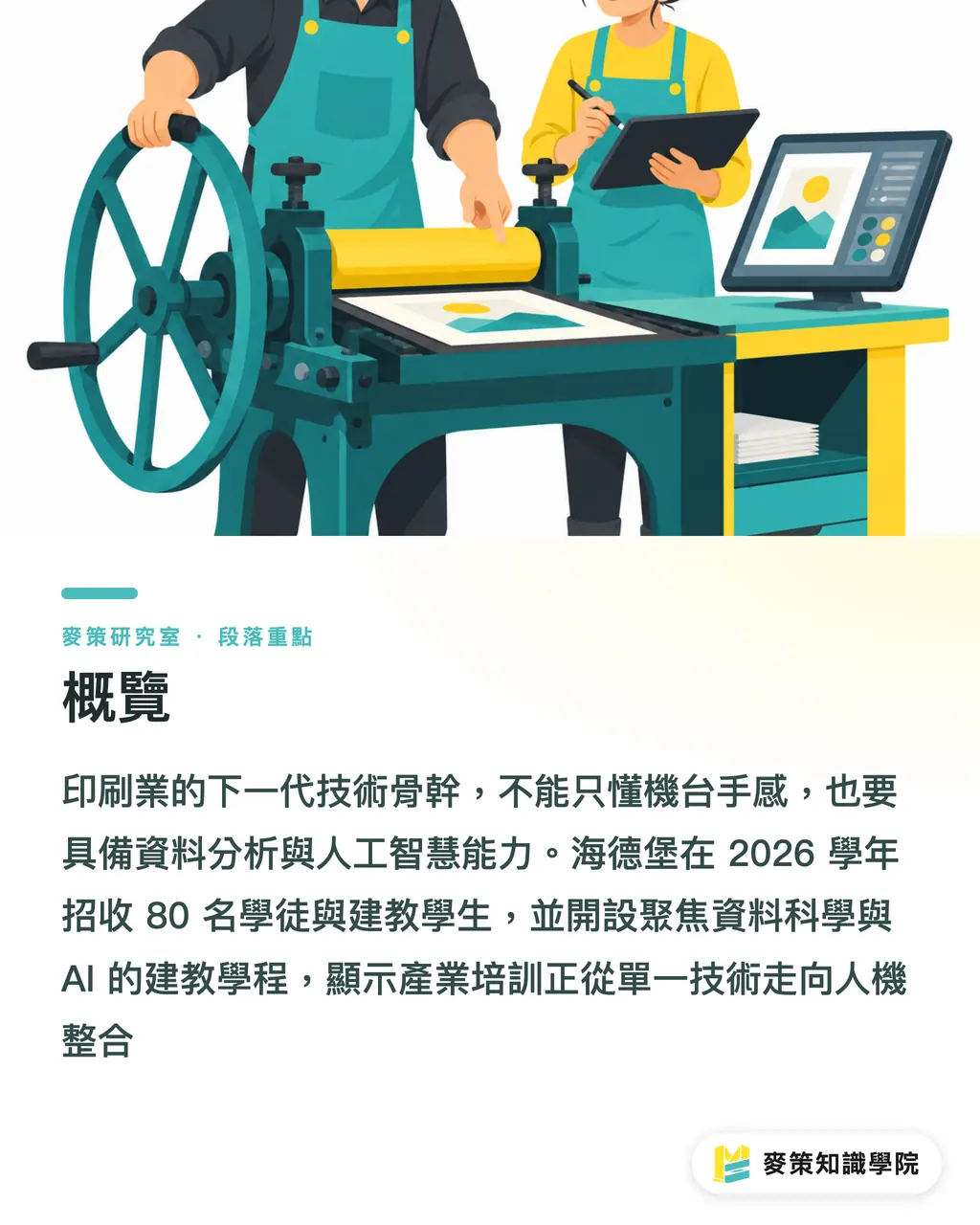
Overview
Picture a very real scene: your plant's most senior pressman is in his early fifties. He can judge color with uncanny accuracy, but he wants nothing to do with CIP4 data flows or machine utilization reports. The 25-year-old next to him is highly comfortable in Excel and knows how to use AI tools, but cannot feel when the ink is right at the press. What should the next generation of technical leaders look like?
Heidelberg offered a fairly concrete answer for the 2026 academic year: it is taking on 80 apprentices and work-study students across several sites in Germany, while also launching a work-study program focused on data science and artificial intelligence [1]. When a century-old printing press manufacturer puts AI into the apprentice curriculum, rather than only into the machine software, what signal should we take from that, and what should we change?
What exactly is Heidelberg doing, and why should Taiwanese plants care?
Heidelberg has moved AI from a 'product feature' to an 'entry-level capability.' For the 2026 academic year, its 80 new apprentices and work-study students are spread across several sites in Germany. The company is currently training more than 300 young people in Germany across 16 vocational training programs and 15 work-study programs. The newly launched data science and AI program is designed to strengthen skills in data analysis, digitalization, and AI applications, while supporting new business at Heidelberg Advanced Technologies [1]. The recruitment focus is not limited to packaging and digital printing. It also covers security printing and anti-counterfeiting, energy, electric mobility, and automation [1]
Put the three numbers together and the signal is clear: 16 vocational training programs + 15 work-study programs = 31 training pathways. The new one is data and AI. It has not replaced any traditional mechanical or printing technology pathway. It was added alongside them. This is an added course, not a replacement for existing courses
For Taiwan, the lesson is clear: Germany's dual-system programs have long been the industry's concrete bet on what kind of people it will need over the next three to five years. Heidelberg itself says its training programs are tailored to long-term staffing needs [1]. When an equipment maker bets on data and AI skills, it is telling the whole supply chain: machines will increasingly talk about themselves, but someone still has to understand what they are saying
Does putting AI on the curriculum mean traditional printing vocational skills will be replaced?
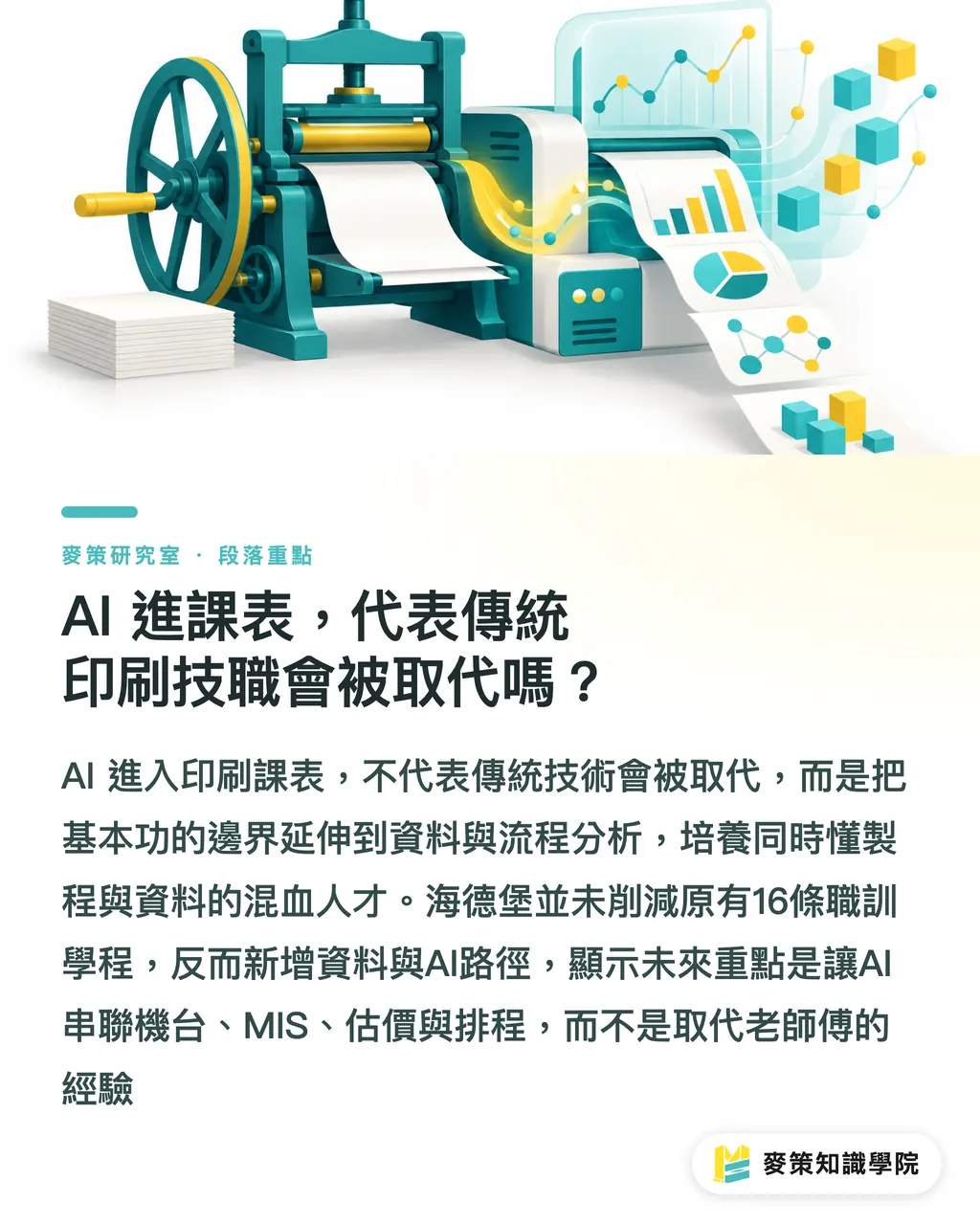
No. It means the boundaries of the 'basics' are being pushed outward. Heidelberg added a data and AI pathway rather than cutting any of its existing 16 vocational training programs [1]. That is the clearest evidence
More telling is the path taken by Patrick Höflein, one of the first students in the program: he first completed vocational training in information science at Heidelberg, specializing in data and process analysis, then continued into this program to deepen that training [1]. This is a deeper training path that moves from data analysis into AI applications. It is not a direct swap of printing technology for AI
My reading (analysis, not a statement from the sources): the place where AI really carries weight on a print production line is not replacing the feel required to judge color or set up a press. It is connecting the data currently scattered across presses, MIS, estimating, and scheduling. That calls for a hybrid skill set, someone who understands the language of production and can read data. People with that mix are almost nonexistent as off-the-shelf hires. You have to grow them in-house
From an organizational research perspective, the impact of AI adoption is concentrated in the reshaping of work content and roles, rather than simple headcount replacement [3]. Evidence from psychology also warns that employees do not experience AI and monitoring technology in the workplace neutrally [4]. That matters especially for Taiwan's family-run printing plants: if veteran operators read AI as a 'supervisor' rather than a tool, the rollout will stall
Why do most Taiwanese printing plants buy AI yet feel no benefit?
Because most plants change the tool without changing the job description. This is the bottleneck I have seen most often on the front lines over the past few years: the system goes live, but estimators and IT staff remain tied to their old firefighting duties. The time AI saves never gets reassigned to press utilization or quote quality, so the benefit never shows up in the books
Heidelberg's approach is worth copying because it changes how people are developed, not what gets purchased. Apprentices and work-study students receive regular development conversations and opportunities for internal advancement [1]. In other words, the new skills are built into the system, with a path and somewhere to go. This is not one-off training
For smaller Taiwanese printing plants, copying a 300-person training model is not realistic. Start with three concrete steps instead
Find one employee with the right background, rather than rolling out an entire system in one shot. Look for someone already on staff who is comfortable with numbers and has worked around a press. Give that person a clearly defined data responsibility, such as producing a weekly report with consistent definitions for utilization and rework rates
Put the new responsibility formally in the job description instead of assigning it verbally. A new responsibility that never makes it into the JD will be the first thing sacrificed when a rush order comes in
・Make the data trustworthy before talking about AI. When the press reports, job orders, and quotes do not use the same definitions, any model output only accelerates the errors
Where will data and AI skills take the printing industry?
Toward the intersection of printing, electronics, and data, and Heidelberg's recruitment areas already point in that direction. It is placing new apprentices in packaging printing, digital printing, security printing and anti-counterfeiting, energy, electric mobility, and automation [1]. Strictly speaking, the last three are already outside the traditional printing industry
This path is not an isolated case. The convergence of print processes and electronics already has a mature research and industrial base. Fraunhofer ILT has long worked on process development for printed electronics [5]. Fraunhofer ENAS continues to build expertise in microelectronics and nanosystems [6]. On the academic side, the dedicated journal Flexible and Printed Electronics carries research from the field [7]. As the substrate for 'printing' expands from paper to functional materials, the required skills naturally expand from color and registration to materials, measurement, and data
One thing worth watching is that the debate around AI entering professional workflows looks similar across fields: it speeds up output, but it also creates new questions about quality control and accountability. Discussion in academic publishing about AI's role in the manuscript production process has clearly identified these governance challenges [2]. In a printing plant, the corresponding questions are: Who is responsible when an AI scheduling recommendation causes a delay? Who has the authority to override the parameters for AI color correction? These are not technology questions. They are job design questions, and job design is exactly what Heidelberg starts addressing at the apprentice stage
So, what can you do tomorrow?
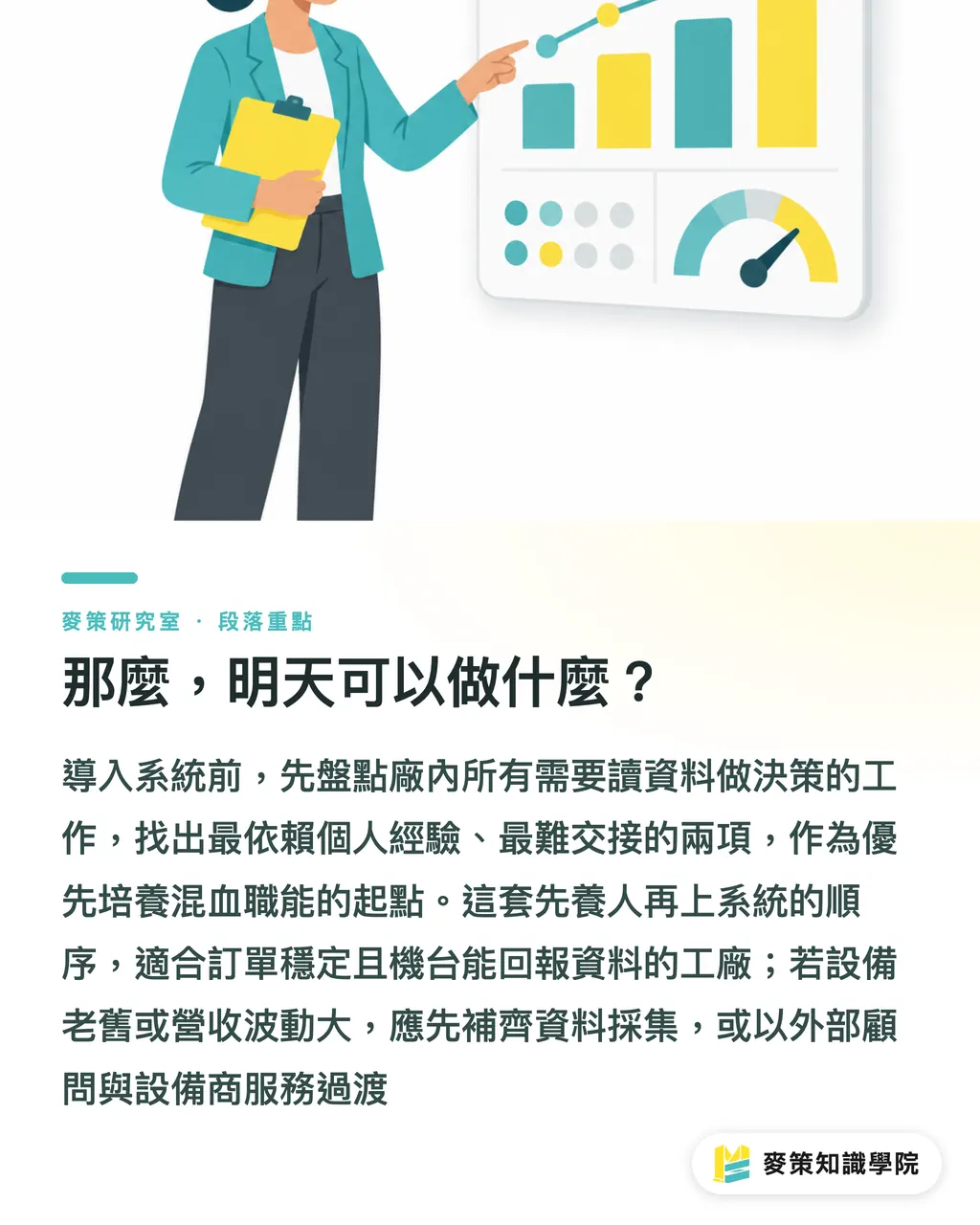
Take a skills inventory before talking about implementation. The sequence is simple: list every decision inside the plant that requires someone to 'read data before deciding,' such as scheduling, estimating, consumables, and rework decisions. Mark who currently makes each decision and what they base it on. Then identify the two decisions most dependent on personal experience and hardest to hand off. Those are the first places to develop a hybrid skill set
Be clear about the boundary conditions. In plants with stable orders and machines that can send back data, we recommend developing people first and introducing systems step by step. If most of your machines are more than ten years old and cannot output utilization or fault data, or if monthly revenue swings so much that you cannot support a full-time data role, reverse the priority. Fill the data-collection gaps first, or use an outside consultant or an equipment vendor's service package as a bridge. Talk about building the capability in-house once the data flow is stable. Force-fitting the Heidelberg model will only leave you with an analyst who has no data to analyze
Key Takeaways
For the 2026 academic year, Heidelberg is taking on 80 apprentices and work-study students and has added a work-study program in data science and AI. The company is training more than 300 young people in Germany across 16 vocational training programs and 15 work-study programs [1]
The AI program was added as an extra pathway. It did not replace existing technical programs. That means the core skill set of a printing worker is being extended, not replaced
The fields assigned to Heidelberg's new apprentices include packaging printing, digital printing, security printing and anti-counterfeiting, energy, electric mobility, and automation. That goes beyond the traditional printing industry [1]
The weak results many Taiwanese small and midsize plants see after adopting AI often come from failing to update job descriptions alongside the system, not from inadequate system capabilities (the author's practical observation)
A workable first step is to inventory the decisions that require people to read data, find the two most dependent on personal experience, and use them as the starting point for developing hybrid skills
Further Thoughts
For printing manufacturers, Heidelberg's move shows equipment makers pushing the value chain from hardware toward 'data and services.' Talent development is the hardest part of that path to outsource. Equipment can be bought, but people who can understand both production and data have to be developed in-house. For the design side, this means the print-production contact they deal with will be more accustomed to answering 'Can this run, what will it cost, and where is the risk?' with data. If designers can spell out file specifications and process assumptions earlier, communication will become much more efficient. For AI adoption, the best investment is not the model. It is consistency in data definitions and a fresh division of responsibilities. Without both, every tool simply accelerates the existing disorder. For SaaS vendors, the key is not building a more advanced scheduling algorithm. It is offering a complete package that includes skills training, so small and midsize businesses can use it without having to build a data team from scratch. Three questions remain open:
・1. How should responsibility for an AI decision error be written into the job description?
・2. Taiwan lacks the institutional foundation of the German dual system. How can small and midsize plants fill the gap through joint training or industry-academia partnerships?
・3. As printing substrates expand into functional electronics [5][7], how long will it take existing vocational curricula to catch up?
References
[2] Schirmacher P. (2025). Artificial intelligence and the process of publishing scientific manuscripts. Virchows Archiv. DOI: 10.1007/s00428-025-04331-y
[3] Niubo S. (None). Artificial intelligence impacts on organizations and work: a Delphi study with brazilian experts. DOI: 10.11606/t.12.2019.tde-22082019-153846
[4] 2023 Work in America Survey: Artificial intelligence, monitoring technology, and psychological well-being. PsycEXTRA Dataset. DOI: 10.1037/e504252023-001
[5] Fraunhofer ILT: Fraunhofer ILT Printed Electronics page. Fraunhofer ILT
[6] Fraunhofer ENAS: Fraunhofer ENAS official website. Fraunhofer ENAS
[7] Flexible and Printed Electronics (IOP): IOP Flexible and Printed Electronics journal homepage. Flexible and Printed Electronics (IOP)
FAQ
- What exactly does Heidelberg's AI work-study program teach?
- The program focuses on data science and artificial intelligence. Its aim is to strengthen skills in data analysis, digitalization, and AI applications, while supporting the development of new business at Heidelberg Advanced Technologies [1]. It is a new work-study program launched by Heidelberg for the 2026 academic year
- Will traditional printing vocational skills be phased out as AI enters printing apprenticeships?
- Not in the short term. Heidelberg added a data and AI pathway on top of its existing 16 vocational training programs and 15 work-study programs. This is expansion, not replacement [1]. On-site skills such as judging color and setting up a press remain foundational. They now need to be paired with the ability to understand machine data
- What should small and midsize Taiwanese printing plants do without Germany's dual system?
- Start at a smaller scale: choose an existing employee who understands both presses and numbers, give that person a clear data responsibility, and write the new responsibility into the job description instead of assigning it verbally. System procurement can come later. Standardizing data definitions has to come first
- Why do many printing plants see no benefit after adopting AI?
- A common reason is that the tools have changed while job design has not. Employees remain tied to their old firefighting duties, and the time AI saves is not reassigned to utilization or quote quality. On top of that, when the press, job order, and quoting data use different definitions, model output only magnifies existing errors (the author's practical observation)
- What is the connection between the printing industry and printed electronics?
- Print processes are expanding from paper to functional substrates. Fraunhofer ILT has long worked on printed electronics process development [5], and the field has its own academic journal, Flexible and Printed Electronics [7]. Heidelberg's new apprentices are being assigned to areas such as energy, electric mobility, and automation [1], which points in the same direction
Related articles


The Print × AI weekly
The print and AI know-how designers, brands and enterprises can use before they commit — one email, every week
MINDS Free Tools
AI background removal, brand stamping, and a LINE sticker maker — free design tools, right in your browser, no upload.
MINDS Group
Need actual printing or gifting services?
From premium printing to online ordering and festive gifts — the MINDS Group sister brands take it from here.