
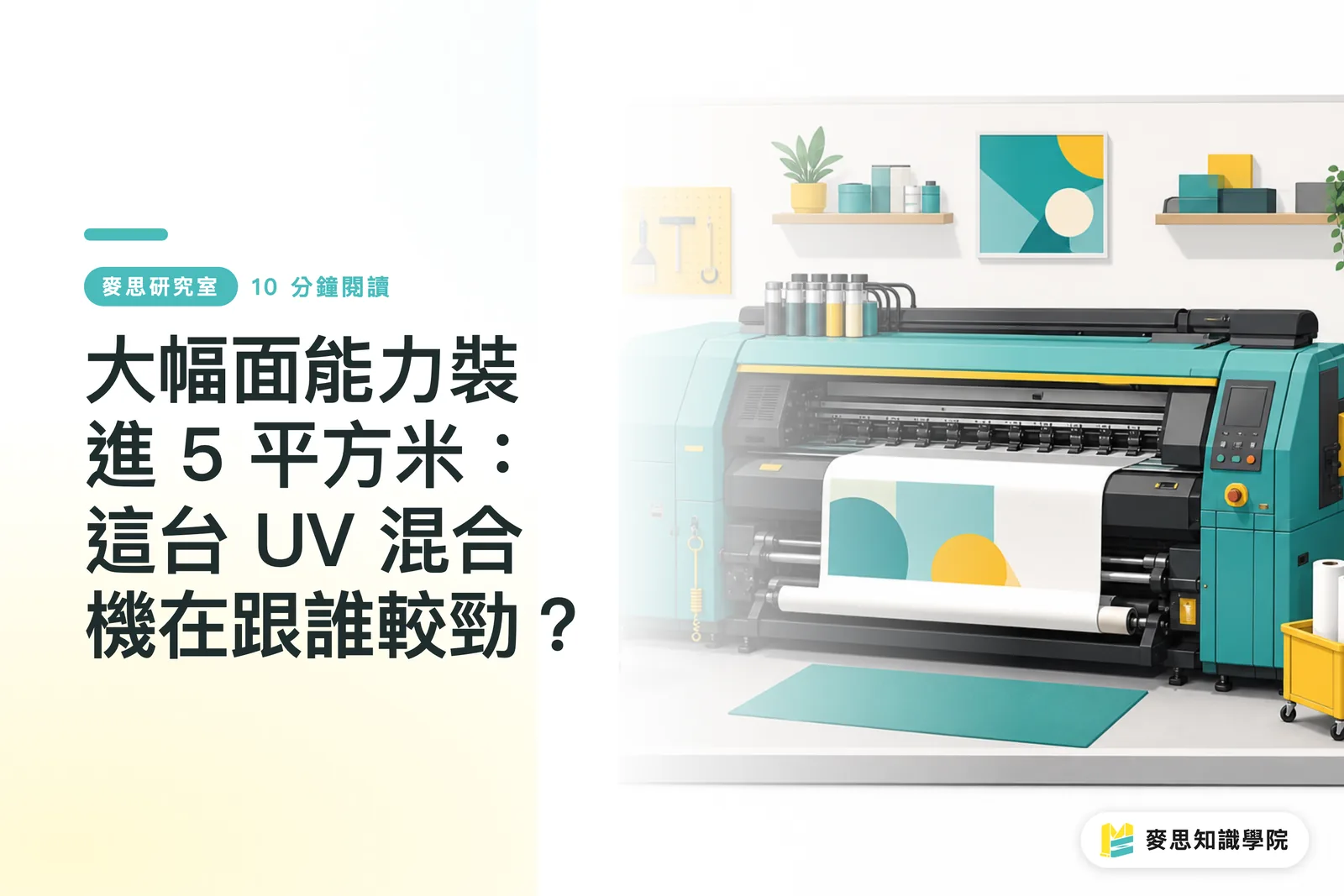
Overview
You have probably run into this dilemma. You have jobs lined up for display boards, PVC stands, wooden signage, and roll-to-roll banners. In theory, a single UV hybrid machine could handle it all. But after asking around for quotes, you find that capable machines take up half your shop floor, with rent and depreciation eating away your profit before you even start. For small and mid-sized print shops where every square meter counts, chasing capacity while saving space feels like an impossible trade-off
The GZ HB18UV-Pro aims to tackle this exact problem. Distributed by France-based Plateforme Imprimeur, it features a 1.85 m print width, CMYK plus white ink, support for rigid substrates up to 55 mm thick, and rolls up to 50 kg, all within a compact 5 m² footprint and priced at roughly one-third of competing models [1]. That might sound like marketing hype, but the details are worth breaking down step by step
How Does It Actually Fit Large-Format Capability into Such a Small Footprint?
The bottom line: it does not shrink by stripping away essential specs. Instead, it trims the footprint by cutting out excess and keeping only what matters
The hardware configuration is grounded and practical. A 1.85 m print width, four to eight Epson I3200-U1 PrecisionCore printheads, up to 2440 DPI, and speeds reaching 65 m²/h, paired with a vacuum transport belt and collapsible extension tables [1]. In other words, it avoids spec-stuffing to the ceiling. Instead, it strikes a balance between output speed, machine size, and operating cost. CEO Christophe Bader put it plainly: a UV hybrid should not take over an entire workshop. The core concept here is keeping only what is necessary, while costing three to four times less than other brands and occupying just 5 m² [1]
The clever trick lies in the collapsible extension tables. The rigid section handles Dibond, PVC, wood, glass, and signage media. When the tables fold down, the workspace opens up for flexible roll media. The built-in feed-and-take-up system handles rolls up to 50 kg, while a vacuum belt keeps vinyl, banners, and visual communication materials feeding smoothly [1]. Rigid boards and roll media share the exact same floor area at different times. That time-sharing setup is the real secret behind the 5 m² footprint
In my view, this shared workspace concept works nicely for single-line setups with diverse, small-batch orders. But if your shop runs rigid boards and rolls side by side for long stretches, constantly folding and unfolding tables will eat up the setup time you saved. That is something you have to factor in yourself
One-Third the Price: Real Savings or Hidden Costs Moved Elsewhere?
The biggest trap with budget hardware is simple: you save on the purchase price, only to bleed it right back into consumables and downtime
Plateforme Imprimeur clearly recognizes this concern, so their strategy goes beyond slashing the machine tag. They bundle pre-tuned media profiles, tested substrates, and Greenguard Gold certified inks [1]. In Bader's own words: an affordable machine should not make production more expensive. Their role is to fine-tune profiles, media, and inks to keep ink costs down without compromising print quality [1]
In plain terms, this brings hidden costs out into the open. For a print shop, the true cost of a machine is never just speed and resolution. It comes down to ink unit price, print consistency, and the calibration time spent switching media [1]. If a budget machine forces you to build profiles from scratch and scrap test sheets on every media change, those upfront savings vanish fast. Providing pre-validated materials and profiles means the vendor absorbs that trial-and-error burden upfront
There is another financial angle that is easy to miss: Plateforme Imprimeur offers direct financing with monthly SEPA direct debit payments at virtually zero financing fees, bypassing expensive bank leasing arrangements [1]. For cash-strapped small shops, this payment structure can matter even more than the sticker price. It marks the difference between being able to buy the machine and being able to comfortably keep it running
Of course, these are distributor claims rather than independently verified long-term numbers. Greenguard Gold certified ink is a plus for indoor bids and low-VOC requirements. Still, actual ink pricing and how well those profiles match everyday local materials can only be proven by running proofs on your own substrates

How Should Small and Mid-Sized Print Shops Calculate the ROI?
Do not let the one-third price tag cloud your judgment. Start with your own order profile
The UV hybrid market has grown steadily in recent years because these machines handle rigid and flexible substrates on a single system, cutting turnaround time between jobs [1]. For shops juggling signage, packaging mockups, and industrial printing across parallel jobs, that multi-purpose flexibility drives genuine ROI. But flexibility only turns into profit if your job mix is diverse enough to justify covering multiple media on one machine. If 80 percent of your work is the same roll material, a dedicated roll-to-roll printer is still the smarter buy
I suggest anchoring your calculations around three checkpoints:
・First, real-world speed: the rated 65 m²/h is a ceiling. What actually dictates your deadlines is the effective production speed on your everyday materials at acceptable quality [1]
・Second, the opportunity cost of floor space: saving down to 5 m² saves on rent, but it also determines whether you can fit an extra finishing machine into the same shop to complete your workflow
・Third, changeover frequency: switching between 55 mm rigid boards and 50 kg rolls [1] takes time. How many switches happen each day, and how many minutes does each take? Multiply that by your labor rate to find the real cost or benefit of this shared workspace
Plug these three factors into your monthly capacity model, match them against the monthly installments, and the answer becomes clear. This machine is not built to challenge top-tier flagships on extreme image resolution. It is built as a practical fix for shops trapped between tight space, mixed orders, and tight budgets. It does not sell top-end specs; it sells a practical way out of a specific bottleneck
Does This Mean the Barrier to UV Hybrid Printing Has Truly Dropped?
Looking at the broader industry context, this machine feels more like an industry signal than an isolated case
Price has long been the primary barrier to entry in the UV hybrid market [1]. When a printer offering a 1.85 m width, white ink, and hybrid rigid-to-roll handling hits the market at one-third the price, with a 5 m² footprint and low-cost financing [1], it shows that large-format UV power is shifting from large factory territory into reach for smaller operations. That shifts the competitive landscape downstream. Once the entry barrier falls, standing out is no longer about owning the machine. It is about what unique work you can produce with it
Once hardware access is leveled, the winning edge moves to downstream execution. Color management, specialty substrate applications, creative white ink layering, and finishing quality will determine who wins jobs far more than a model number. When anyone can buy a comparable hybrid, competing on raw hardware specs alone is over
Here is a practical takeaway to wrap up: if you are boxed in by wanting large-format capability without the floor space or budget, this machine belongs on your shortlist. Do not just place an order, though. Take two or three of your most common local substrates in for proofing. Use the actual production speed, ink consumption, and changeover time to build your own capacity and payment calculations. The spec sheet belongs to the manufacturer. The real numbers belong to your shop

Key Takeaways
・The GZ HB18UV-Pro focuses on large-format output in a compact footprint: a 1.85 m print width, 55 mm rigid boards, and 50 kg rolls within just 5 m², priced at roughly one-third of competing models [1]
・It uses collapsible extension tables to let rigid media and rolls share the same workspace across different production runs, rather than shrinking by cutting core specs [1]
・True operating cost goes beyond machine price. Ink unit cost, print consistency, and media setup time are what matter most. The supplier helps offset trial-and-error costs with verified profiles and certified inks [1]
・Monthly SEPA direct debit financing sidesteps bank leases. For cash-constrained shops, being able to afford day-to-day operations is often more important than the initial purchase price [1]
・As equipment barriers drop, competition moves away from simply owning the printer toward color management, specialty media, and finishing craftsmanship
Broader Implications
For print manufacturers, this machine signals that UV hybrid capability is trickling down to smaller shops. When barriers drop through lower pricing, smaller footprints, and direct financing, competitive advantage shifts from machine specs to color management, white ink execution, and finishing. For designers and brands, more local shops can now handle mixed-media, customized short runs, opening up a wider range of printable substrates. For AI and SaaS adoption, the real opportunity sits in the workflow gaps the hardware leaves behind: automated profiling, cross-substrate color prediction, job scheduling, and real-time ink usage tracking. These software layers turn affordable hardware into a profitable production line. The lingering question is how local print businesses can use data and service capabilities to turn standard hardware into lasting customer retention once equipment becomes a commodity
References
FAQ
- What are the print width and floor space requirements for the GZ HB18UV-Pro?
- It features a 1.85 m print width and takes up roughly 5 m² of floor space. It handles rigid substrates up to 55 mm thick and roll media up to 50 kg, priced at about one-third of comparable hybrid systems [1]
- What printheads does it use, and how fast can it print?
- It runs four to eight Epson I3200-U1 PrecisionCore printheads with resolutions up to 2440 DPI and speeds up to 65 m²/h, supporting CMYK plus white ink printing [1]
- Does a lower-priced machine lead to higher consumables costs?
- The distributor bundles pre-tuned media profiles, validated substrates, and Greenguard Gold certified inks to keep ink consumption in check and maintain consistency. Still, confirming actual unit costs requires testing with your own everyday substrates [1]
- What metrics should small and mid-sized shops look at when evaluating this machine?
- Look beyond rated top speeds. Calculate effective production speeds on your everyday media, factor in the floor space savings of a 5 m² footprint, and tally the daily labor time spent switching between rigid and roll modes, then match those figures against monthly installment costs [1]
- Why is the UV hybrid printer market continuing to grow?
- Because it handles both rigid and roll media on a single system while reducing job changeover times. This suits businesses managing mixed jobs across signage, packaging, and industrial items, where high entry prices have traditionally been the biggest barrier [1]
References
- UV 混合式噴印機 GZ HB18UV-Pro:大幅面能力裝進小機身,中小廠的新選項? · printindustry.news
- Figure 6 from: Grant T, Bolívar-García W (2021) A new species of Leucostethus (Anura, Dendrobatidae) from Gorgona Island · doi.org
- Hybrid sealant stands up to UV · doi.org
- Pre main sequence stars as UV sources for the World Space Observatory-UV mission · doi.org
Related articles



The Print × AI weekly
The print and AI know-how designers, brands and enterprises can use before they commit — one email, every week
MINDS Free Tools
Spine width and imposition calculators — skip the manual math, free in your browser.
MINDS Group
Need actual printing or gifting services?
From premium printing to online ordering and festive gifts — the MINDS Group sister brands take it from here.