
Overview
Assume you have a label press that has been running for seven years, and next year you have to decide whether to renew its service contract or replace it. One sales rep tells you that a certain brand has a major group behind it. Another says, "We're factory-direct." How do you judge which claim will still hold up five years from now?
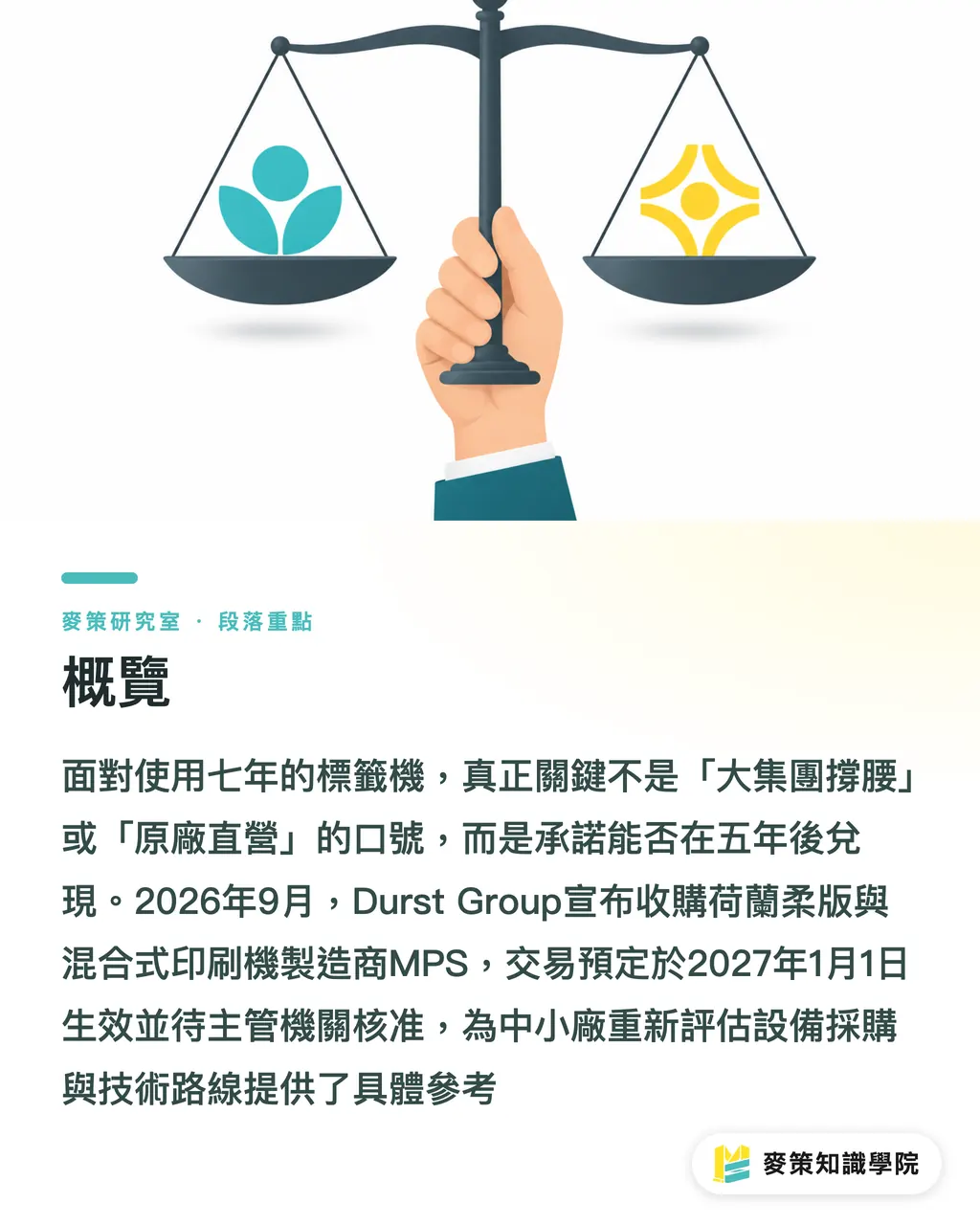
This kind of question has no standard answer, but this acquisition in September 2026 happens to lay out the reference points for making that call. Durst Group announced that it will acquire Dutch flexographic and hybrid press manufacturer MPS, with the transaction taking effect on January 1, 2027, subject to regulatory approval [1]. The core question here is this: when an international equipment maker "buys in" flexographic technology instead of "building it," how should small and midsize printers adjust their equipment purchasing and technology roadmap?
Why Is Durst Buying a Flexographic Press Manufacturer?
Durst already has digital inkjet capabilities. What it really lacks is flexographic engineering know-how and field experience
Durst is headquartered in Bressanone, Italy, has around 1,100 employees and annual revenue of more than €430 million, and has 4,000 installed systems in more than 40 countries [1]. In the label market, it already has the Tau series of digital presses and has partnered with Italy's OMET to develop KJet and XJet, which combine inkjet, flexography, and finishing [1]. In other words, Durst has been pursuing the hybrid route for years, but it has filled the flexographic side through a partner
MPS fills that gap. The company has around 35 employees and more than 850 presses installed in over 100 countries. Its product line includes flexographic presses and the EF Symjet, a hybrid platform combining flexography with Domino inkjet [1]. Durst CEO Christoph Gamper put it plainly: what MPS brings is "expertise, technology, and flexographic engineering capability" [1]
Thirty-five people and 850 installations. That ratio deserves a pause. A flexographic press business does not end when the machine is sold. The installed base itself is an asset. That also explains why a company with fewer than 3% of Durst's headcount would be acquired whole: the buyer is buying accumulated application engineering, not capacity
My read is this: major equipment makers are no longer assuming that digital will simply replace flexography. Flexography still has a clear place in the cost structure of labels and flexible packaging, and hybrid presses are the practical landing point. Academic interest in flexography points in the same direction. The relationship between flexographic print quality and process parameters remains an active subject in printing-engineering research [3][4]. A technology that was "about to be eliminated" would not still be the subject of PhD dissertations on parameter optimization
MPS Changed Hands Twice in One Year. What Risk Does That Signal?
It means that when you evaluate an equipment supplier, "the brand is still here" and "the company is still here" are two different things
Here is the full timeline worth looking at: MPS Printing was the successor organization formed after MPS Systems went bankrupt. It resumed operations in November 2025 through a management buyout led by Richard Miedema, Michiel Borst, Nick Tyrer, and MPS Systems co-founder Bert van den Brink [1]. After the relaunch, its strategy shifted toward service and recurring revenue, taking a more selective approach to new-machine sales while continuing to expand its installed base [1]. Less than ten months later, the company changed hands again [1]
The practical implications for Taiwanese buyers fall into three parts:
・Continuity of spare parts and service commitments matters more than brand recognition. Durst has explicitly said that existing contracts and service commitments remain valid after the change in ownership. MPS will retain its direct-sales channel in Europe, while Durst US will take over sales and service in the United States [1]. Note: the announcement did not explain the arrangement for Taiwan and Asia-Pacific
・Keeping the management team is a positive signal, not a guarantee. Michiel Borst will remain CEO [1], which reduces the risk of a short-term break in continuity, but no one's contract tells us what the organization will look like three years from now
・When partnerships and acquisitions coexist, the product line enters a gray period. Gamper said the partnership with OMET "remains strategically important and will continue," while KJet and XJet will continue to be developed and sold under their existing organizational structure [1]. With in-house flexography and partner-based flexography now both inside the group, the question of how the product line will converge in the medium term is one you should ask directly when purchasing
What Should Taiwan's Small and Midsize Printers Decide Now?
Downgrade "which equipment brand?" Move "can we get service?" up the list
Taiwan's small and midsize label printers rarely hurt because a machine's specifications are insufficient. The pain is how long it takes someone to show up when the machine stops, whether consumables and plates can be sourced steadily, and who will train the operators when staff change. That is the layer this acquisition changes: your future equipment supplier may not be the same company you signed with, but the physical parts of the service network, the local distributor, spare-parts warehouse, and engineers, usually change more slowly than ownership
Three things you can do now:
・Revisit the wording of your service contract. Identify the manufacturer by its legal name, not just the brand, and require a service-continuity clause for any change in ownership. The case above shows that continuity of existing contracts can be negotiated [1], but only if the contract already says so
・Do not retire flexographic capacity early just to go "all-digital." The economics of long runs in labels and flexible packaging still favor flexography, and the arrival of the EF Symjet hybrid platform shows that the market still needs both flexographic and digital technologies [1]
・Treat quality-parameter management as an asset you own. Regardless of whose equipment it is, the relationships among dot gain, pressure settings, ink transfer, and other flexographic print parameters can be studied and controlled systematically [3][4]. On the materials side, ASTM's paper and packaging standards provide a shared language for communicating specifications [2]. None of this becomes invalid because a supplier changes hands
Should You Consider a Hybrid Press?
For most small and midsize printers, the starting point for evaluating a hybrid press should be your order mix, not the novelty of the technology
The value of a hybrid platform lies in completing variable data and large solid-color areas in one pass. EF Symjet puts flexography and Domino inkjet on the same line, while KJet and XJet combine inkjet, flexography, and finishing [1]. All of these designs point to the same conclusion: the market needs one machine that can handle a mixed flow of long and short runs
But this is an analytical view, not a blanket recommendation. The threshold is simple: if short runs, under 1,000 meters, have stayed below 30% of your business, it will be hard for the hybrid press premium to pay back within the depreciation period. If the share of short runs keeps rising and plate costs have become a visible line item, it is time to put a hybrid press on the formal agenda
One more point: there is already substantial research behind how strongly flexographic print quality is affected by process parameters [3][4]. A hybrid press does not make parameter management on the flexographic side easier. It puts two sets of variation on the same production line. Before bringing one in, make sure your quality records are granular enough to trace an individual parameter
Next Steps, and When This Does Not Apply
Right now, the most important move is not replacing the machine. Contact your equipment distributor and ask three questions: What are the service terms when ownership changes? How much spare-parts inventory is held in Taiwan? And will the product line converge within the next five years? Those three answers will tell you more about how many hours you will be down next year than any acquisition headline
Let's be clear about the boundary of this advice: the analysis above is for small and midsize label and flexible-packaging plants with their own production capacity and equipment decision cycles longer than five years. If you are a trading-style printing business that mainly outsources production, a reshuffling of the equipment landscape affects you mainly at the quoting stage, not the purchasing stage. Your priorities should be entirely different. Also, the transaction still awaits regulatory approval [1]. Until closing, any long-term purchasing decision based on it should leave room for adjustment
Key Takeaways
Durst will acquire Dutch flexographic and hybrid press manufacturer MPS on January 1, 2027, subject to regulatory approval [1]
MPS has only about 35 employees but more than 850 installed presses across over 100 countries. The core value being acquired is flexographic engineering capability and the installed base, not production capacity [1]
MPS changed hands twice in less than a year, relaunching under a management buyout in November 2025 and being acquired by Durst in September 2026. When purchasing, put service-continuity clauses in the contract instead of relying only on brand trust [1]
Durst will have both in-house flexography, through MPS, and partner-based flexography, through KJet and XJet with OMET. Product-line convergence in the medium term is a risk you should ask about proactively when purchasing [1]
A major equipment maker choosing to buy a flexographic business rather than abandon the technology shows that digital technology has not fully replaced flexography. Hybrid platforms are the key direction for the label and flexible-packaging markets
Further Thoughts
For the manufacturing side of printing, the signal from this acquisition is that "application engineering is worth more than machine specifications." Durst is paying for the flexographic know-how carried by 35 people and the customer relationships behind 850 installed presses [1]. That offers a lesson Taiwan's small and midsize printers can replicate: systematizing process parameters, material cross-reference tables, and customer proofing histories is itself off-balance-sheet value. For designers, the spread of hybrid platforms means short-run variable data and flexographic large solid-color areas can coexist within the same batch of orders. The cost assumptions behind layout design need to be rewritten. For AI adoption and SaaS, the real opportunity is not another quoting system. It is to turn the cause-and-effect links between flexographic quality parameters and process variation, already backed by substantial academic research [3][4], into predictions and anomaly detection that people can use on the shop floor, with established materials standards such as ASTM serving as a shared vocabulary for the data [2]. Two questions remain:
・First, no public explanation has yet been provided for MPS's sales and service arrangements in Taiwan and Asia-Pacific [1], leaving local buyers without enough information to judge
・Second, there is still no public information from which to infer how the group's in-house and partner-based flexographic paths will coexist or converge in the medium term. The only way to get an answer is through an actual purchasing negotiation
References
[2] ASTM International: ASTM Paper and Packaging Industry Standards Page. ASTM International
[3] Journal of Graphic Engineering and Design: JGED Research Paper on Flexographic Print Quality. Journal of Graphic Engineering and Design
[4] DiVA Portal / Karlstad University: Doctoral Thesis on Flexographic Print Quality and Parameter Relationships (PDF). DiVA Portal / Karlstad University
FAQ
- When Will Durst's Acquisition of MPS Take Effect?
- The transaction in which Durst Group acquires MPS will take effect on January 1, 2027, subject to regulatory approval and customary closing conditions [1]. After the acquisition, MPS will be renamed "MPS, A Durst Group Company." Development, manufacturing, and marketing of the existing flexographic press product line will continue [1]
- Will Existing Customer Service Contracts Remain Valid After MPS Is Acquired?
- Durst says that existing contracts and service commitments will remain valid after the change in ownership [1]. MPS will retain its direct-sales channel in Europe, while Durst US will take over sales and service in the United States [1]. The announcement did not explain the arrangement for Taiwan and Asia-Pacific
- Will Durst's Acquisition of MPS End Its Partnership with OMET?
- No. Durst CEO Christoph Gamper said the partnership with OMET remains strategically important and will continue. KJet and XJet, which combine inkjet, flexography, and finishing, will continue to be developed and sold under their existing organizational structure [1]
- Will Digital Printing Replace Flexographic Printing?
- This acquisition does not point to replacement. An equipment maker built on digital inkjet chose to buy a flexographic manufacturer rather than exit the field [1]. The relationship between flexographic print quality and process parameters remains an active topic in printing-engineering research [3][4], while hybrid platforms such as EF Symjet, combining flexography with Domino inkjet, show that the market wants the two technologies to coexist [1]
- Do Taiwan's Small and Midsize Label Printers Need to Replace Their Equipment Now?
- No, this acquisition is not a reason to replace your equipment. The more practical move is to review your existing service contract, confirm the service-continuity terms for a change in ownership, check spare-parts inventory levels in Taiwan, and assess the risk of supplier product-line convergence. The accessibility of the service network matters far more than the stability of the equipment brand
Related articles
The Print × AI weekly
The print and AI know-how designers, brands and enterprises can use before they commit — one email, every week
MINDS Free Tools
Spine width and imposition calculators — skip the manual math, free in your browser.
MINDS Group
Need actual printing or gifting services?
From premium printing to online ordering and festive gifts — the MINDS Group sister brands take it from here.