
What Happened with Pulp and Paperboard in Q2?
The clearest takeaway from the Q2 pulp and paperboard market is that major mills put pricing actions on the table despite soft demand
Packaging Dive (a US packaging industry publication tracking packaging supply chains and paper company earnings) summarized Q2 signals from Clearwater Paper, Huhtamaki, Mondi, and Sylvamo on August 11, 2026. All four companies pointed to prices, costs, mill capacity, or supply adjustments
Using price actions to manage volume is how suppliers protect gross margins through price adjustments, quotas, and minimum order thresholds when costs climb or supplies tighten. Buyers will first feel this through shorter quote validity, tighter lead times, and more paper stock substitutions
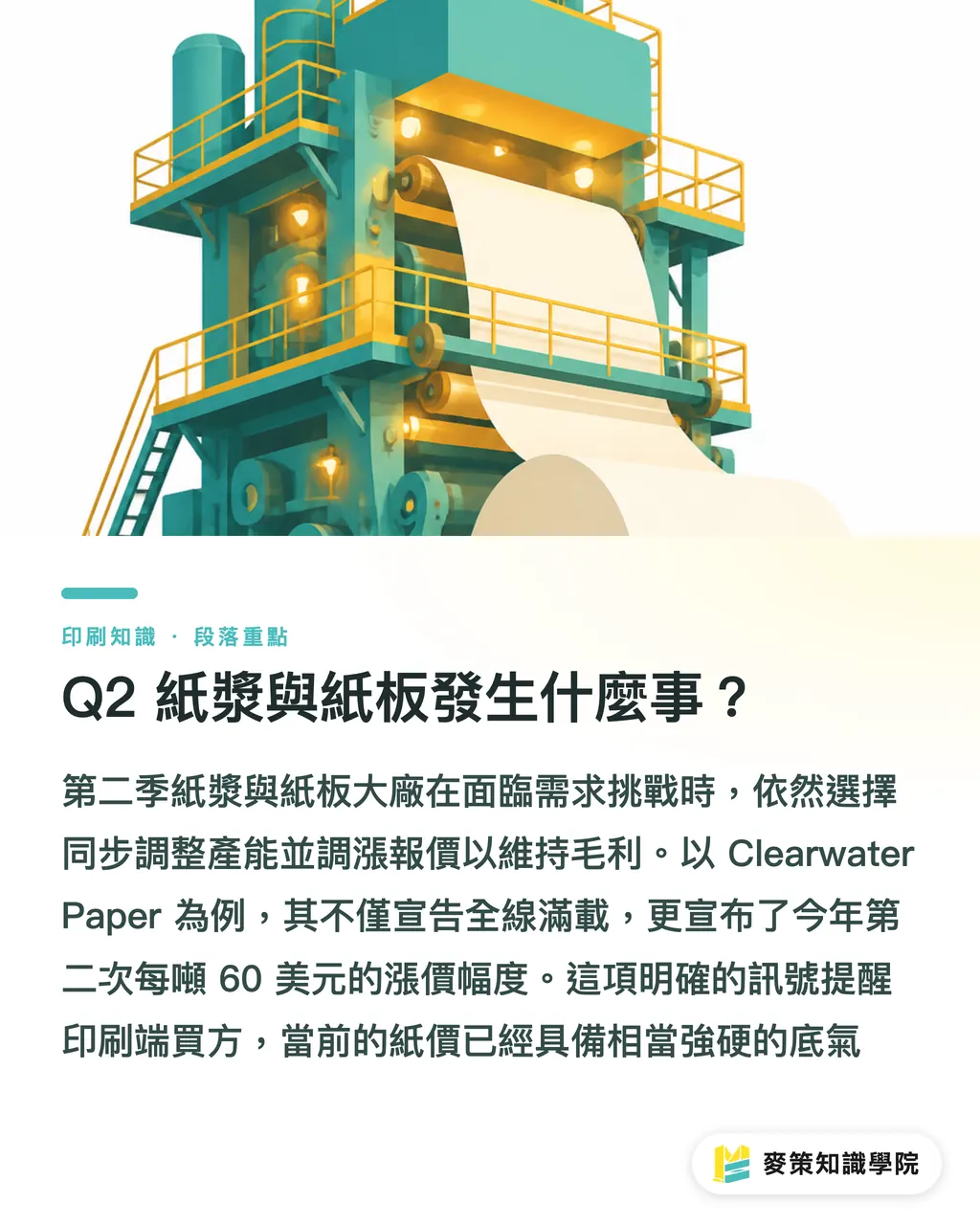
When I look at earnings calls like these, I never just look at price hike announcements. I look at whether they are adjusting capacity at the same time. Clearwater saw Q2 shipments grow 8% year-over-year, yet stated their entire mill network was sold out and announced their second $60 per ton increase of 2026. For printers, that is a clear reminder: paper prices now have solid ground underneath them
Why Are Price Increases Sticking?
Prices are going up because raw materials, energy, freight, and capacity cuts are squeezing mill margins all at once
Clearwater reported higher than expected freight costs, largely tied to the fallout from the Iran conflict. Huhtamaki also noted visible increases in energy and logistics costs, with North American net sales dropping nearly 10% year-over-year alongside 140 layoffs in North America over the past year
Fastmarkets RISI (a global pulp and paper price reporting service often referenced by mills and procurement teams as a pricing benchmark) can take several quarters to reflect price increases like Clearwater's. That means printers cannot wait for indices to catch up before adjusting their quotes
SBS (solid bleached sulfate, a bleached paperboard commonly used for bright white folding cartons, food packaging, and brand boxes) saw shipments rise 6% year-to-date, even as the industry took out 300,000 tons of SBS capacity. This is the exact scenario I worry about most on the ground: clients think they still have time to shop around, while paper mills have already tightened supply
Don't panic just yet
This does not mean every sheet of paper will jump in price tomorrow, but keeping long-lasting, rock-bottom quotes will become much harder to defend
Which Paper Grades Will Hit Print Quotes First?
The paper grades feeling the price squeeze first are folding boxboard, kraft paper, containerboard, and uncoated freesheet
・SBS: Commonly used for cosmetics boxes, food cartons, luxury tags, and high-brightness packaging. Clearwater noted SBS shipments rose 6% year-to-date, but industry capacity dropped by 300,000 tons. Procurement teams should prepare backup options using alternative virgin bleached board or recycled paperboard
・Kraft paper and containerboard: Commonly used for kraft bags, corrugated boxes, and e-commerce mailers. Mondi's containerboard sales volume rose about 12%, but underlying EBITDA dropped nearly 33%, which shows volume moved, yet rising costs ate away the profit
・UCFS (uncoated freesheet, an uncoated woodfree paper used for manuals, forms, book text pages, and office print): Sylvamo stated that after the IP Riverdale mill conversion, North American UCFS annual supply dropped by 7%. The 60,000-ton annual capacity added at Eastover cannot offset the 90,000 tons of lost contract supply
・Coated recycled paperboard: Clearwater launched Circa in July, targeting folding cartons and beverage carriers. Launches like this are not marketing gimmicks; they are mills rolling out substitute materials for buyers. Printers should run tests on ink holdout, scoring, and stiffness without delay
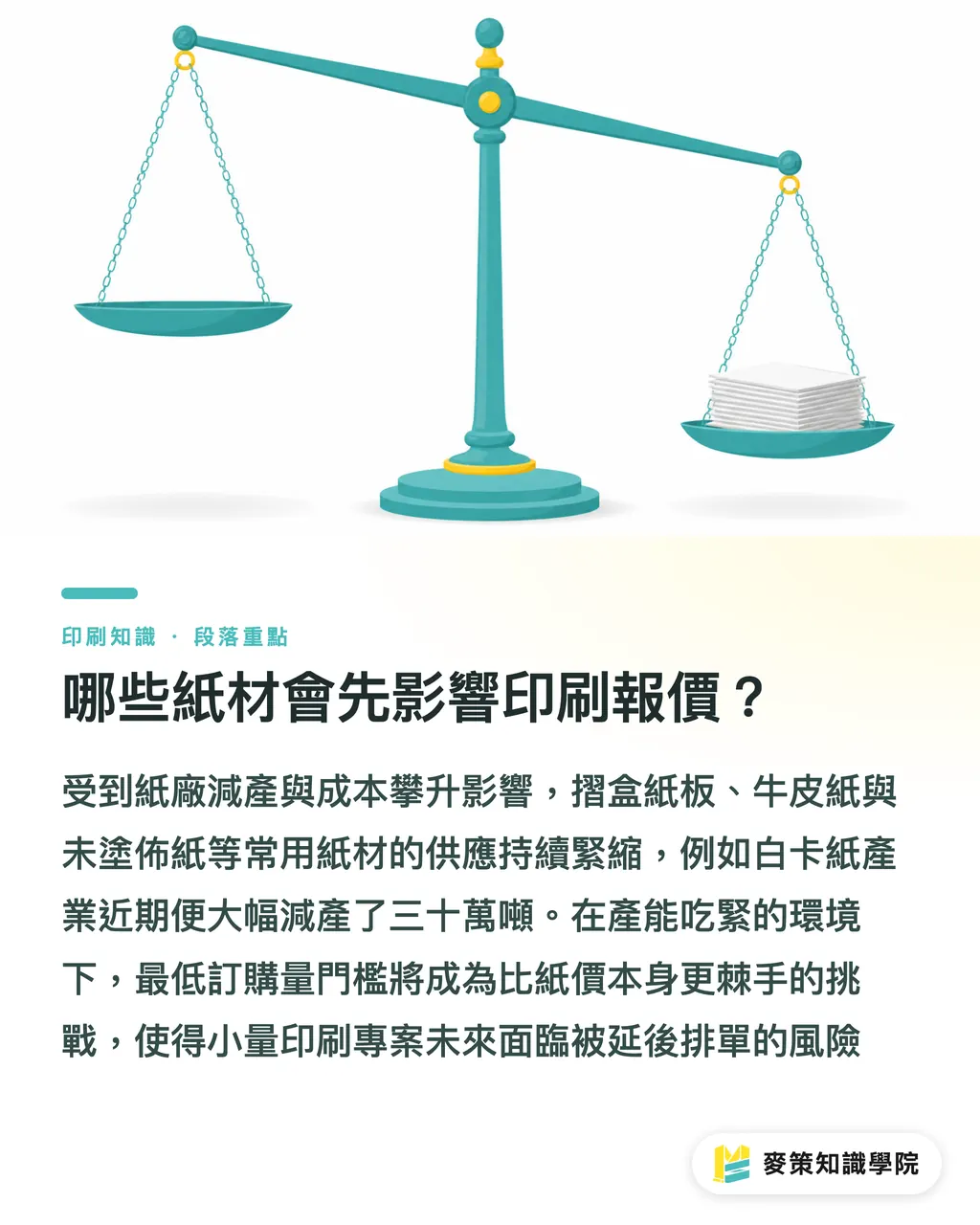
Minimum Lot Orders, or MLO (the smallest production run or shipment unit a supplier accepts, below which you face surcharges, order pooling, or stock changes), might become a bigger headache than unit paper prices, because small-batch jobs are the first to get pushed to the back of the queue
How Should Brand Clients Plan for the Next 6 Months?
Over the next 6 months, stop asking whether prices will rise. Start asking how long quotes will hold, whether materials can be swapped, and if reorders can be split into batches
The Mai Strategy 3-Step Print Check is my practical checklist for new buyers: define the function first, select the paper grade second, and lock in the quote validity window third. This keeps you from sending out design files only to find that paper prices, order minimums, or delivery timelines have shifted
・Step 1: Define the function first. Rigid outer boxes need crush resistance, hang tags need stiffness, and flyers need sharp color reproduction. Lock in performance needs before talking paper grades
・Step 2: List two paper options, one primary and one backup. This prevents the entire project from stalling if SBS or kraft paper runs out on short notice
・Step 3: Ask for the quote validity window up front. Break down paper costs, finishing fees, and freight separately rather than burying every risk inside a single lump sum
For variable-heavy projects like catalogs, packaging boxes, and luxury cards, working with MINDS early on to unbundle paper stocks and finishing costs saves far more back-and-forth than waiting until final artwork is ready
If you only need short-run business cards, stickers, flyers, or standard items, placing an order online through MINDS Print works best when you stick to stable, standard specifications rather than taking on extra risk with specialty stocks
What Should Go into a Price Protection Clause?
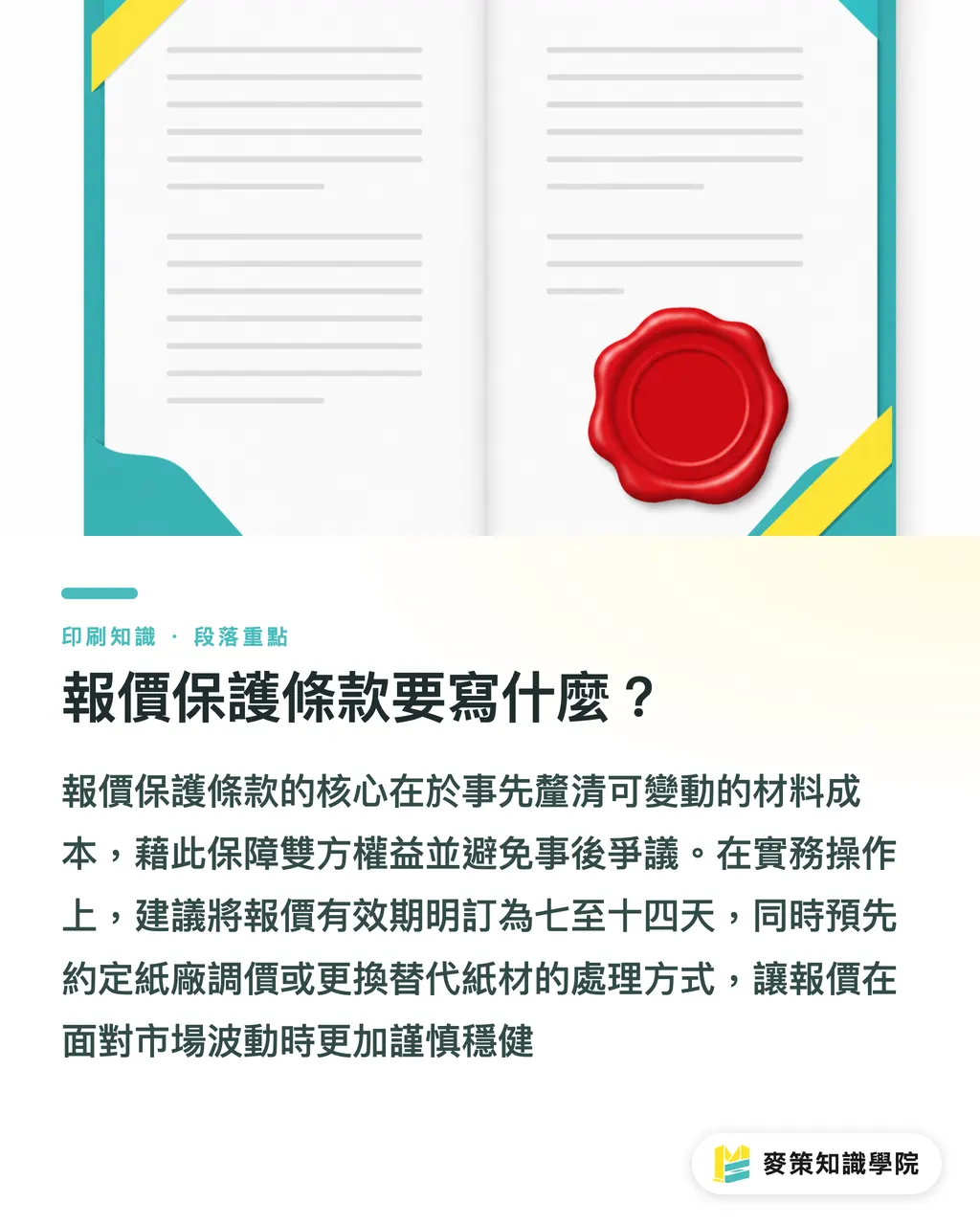
A price protection clause needs to spell out variable material costs clearly, showing clients which prices are locked in and which adjust upon mill notices
Sylvamo projects its second-half price and mix benefit to rise by $75 million to $85 million over the first half, while Mondi announced a series of price increases across key fiber grades. In print shop terms, this means long-term fixed pricing must be handled with much greater care
・Quote validity window: This quote is based on specified paper stocks and current supply conditions on the date of quotation. Recommended validity is 7 to 14 days, with specialty or imported papers confirmed separately
・Paper price adjustments: If the paper mill announces price increases, supply suspensions, or changes to minimum lot orders before the order is placed, the printer may offer equivalent paper substitutes or reconfirm raw material cost differences
・Lead time reservations: Until paper arrives at the warehouse, delivery dates are subject to supplier confirmation. If client proof approvals are delayed, paper pricing and production schedules must be reconfirmed
・Paper substitution clause: Paper substitutes must be evaluated for caliper, brightness, stiffness, ink performance, and finished application before proceeding to mass production upon client approval
These lines might sound rigid, but they protect both sides instead of acting as an excuse for printers to raise prices at will. I would rather be transparent from day one than haggle with clients over cost pressure right before delivery
Key Takeaways
・This wave of paper price increases is not an isolated move by a single mill, but a tightening of costs, mill capacity, and lead times across the board
・Price protection is not about locking in a rigid number. It is about separating variable paper costs from stable finishing fees
・New buyers should define application first, then select paper grades. Paper stocks can be swapped, but the product's function cannot be compromised
・Printers who communicate risks early keep trust far better than those who reissue higher quotes a week late
Further Thoughts
Printers need to build paper validity windows, MLOs, substitute stocks, and freight terms straight into their quotation workflows. Designers should specify paper priority lists before delivering final artwork rather than handing over only visual files. AI tools and SaaS quoting systems should make 'paper grade versions' and 'validity reminders' dedicated fields instead of expecting sales reps to catch them by memory. Put simply: when paper prices fluctuate, solid processes beat verbal promises every time
Further Reading
FAQ
- Will Q2 pulp and paperboard trends immediately drive up print prices in Taiwan?
- Not necessarily right away, but quote validity windows will shorten first. Clearwater has announced its second $60 per ton increase of 2026, and signals like this usually show up first in inquiries for imported stocks, specialty papers, and packaging paperboard
- What should brand clients ask their printer first right now?
- Ask three things first: How long can this paper price hold, what is the minimum order quantity, and are there equivalent backup stocks? Those three answers forecast your procurement risk over the next 6 months much better than unit price alone
- Why should we pay close attention to SBS paperboard?
- SBS is widely used for high-brightness folding cartons and brand packaging. Clearwater noted SBS shipments rose 6% year-to-date, but the industry has cut 300,000 tons of capacity. When rising demand meets capacity cuts, short runs and rush jobs feel the squeeze first
- How can print quotes avoid disputes down the road?
- Itemize paper costs, finishing fees, and freight separately. Spell out quote validity periods, mill price increase handling, and paper substitution approval processes. That way, clients know exactly what is locked in and what moves with the market
Related articles





The Print × AI weekly
The print and AI know-how designers, brands and enterprises can use before they commit — one email, every week
MINDS Free Tools
Spine width and imposition calculators — skip the manual math, free in your browser.
MINDS Group
Need actual printing or gifting services?
From premium printing to online ordering and festive gifts — the MINDS Group sister brands take it from here.