
Overview
PPWR governs final packaging placed on the EU market. Ink makers usually don't sign the PPWR DoC for their customers, but they do need to hand over product info solid enough to support the technical file. Before any export packaging job goes to press at MINDS (MS), we run it through the "MINDS (MS) Three-Gate Prepress Check" to sort out who's responsible for what
・① Who prepares the DoC: in principle the packaging manufacturer, not the ink supplier standing in
・② Who supplies the technical data: ink, coating, and related-product vendors have to put their product information on the table
・③ Who locks the limits into the spec: prepress, purchasing, and QA need to write the heavy-metals and PFAS conditions confirmable before 2026-08-12 into the work order
Where does PPWR actually reach?
PPWR defined: PPWR is EU Regulation (EU) 2025/40, covering packaging and packaging waste across every sector. It demands that final packaging demonstrate compliance with Articles 5-12 and similar via a technical file
Information on Printing Inks and Related Products: PPWR Obligation cites EuPIA noting that PPWR took effect on 2025-02-11 and applies from 2026-08-12. The misread I see most often on the shop floor is treating PPWR as a straight swap-paper, swap-film, swap-recycled-stock purchasing problem
PPWR looks at final packaging first, and inks and coatings end up in the technical file alongside everything else, because the regulator audits the finished pack that lands on the EU market. Substrate, plastic, ink film, varnish coating, and food-contact conditions all funnel back to the same compliance responsibility
PPWR DoC defined: the packaging maker's formal statement that the final packaging meets PPWR, backed by the Annex VII technical file and producible within 10 days when the authority asks
PPWR DoC and FCM Declaration of Compliance sound almost identical and do different jobs. The former is a conformity statement for final packaging; the latter is a compliance document for Food Contact Materials. They don't substitute for each other
Does the ink maker have to issue a DoC?
Ink makers don't sign the PPWR DoC for their customers' finished packs, unless the ink maker itself places a packaged product on the EU market and counts as the packaging manufacturer under the regulation
ThePackagingPortal, citing EuPIA, is unambiguous: under Article 39, the PPWR DoC is prepared by the packaging manufacturer and backed by the Annex VII technical file, covering Articles 5-12. The DoC isn't public and usually isn't handed to the customer proactively, but it has to be producible within 10 days when the regulator asks
What a printer should be asking ink and coating suppliers for isn't "sign a PPWR DoC for me" but product information that lets the packaging manufacturer complete the technical file
・substances-of-concern info
・restricted-substances info
・usable recyclability-assessment info
・compostability info, if the customer claims compostability
・food-contact compliance info, if the pack is used for food contact
・supporting documents where needed
The worst habit among Taiwan's small and mid printers is waiting for an email from the customer and then forwarding the request to the ink maker. The steadier move is writing "which ink, which coating, what end use, food contact yes or no" into the RFQ before estimating or sampling
What to check before 2026-08-12
Many delegated acts will still land before 2026-08-12, but EuPIA's note keeps the near-term work practical: tackle the heavy metals carried over from the previous directive and PFAS in food-contact applications first
・Heavy metals: Article 5(4) updates limits for lead, cadmium, mercury, and hexavalent chromium. The four combined must not exceed 100 mg/kg in overall packaging
・PFAS: Article 5(5) requires food-contact packaging on the EU market to meet PFAS concentration limits
・Delegated acts: recyclability and substances-of-concern details feeding into the DoC will be spelled out in later regulatory documents, the source notes
FCM defined: FCM stands for Food Contact Materials, covering materials and articles that touch food directly or indirectly. If packaging ink goes on food packaging, it falls back into the FCM compliance frame
EuPIA's note flags that PFAS aren't intentionally added to printing inks, so accidentally hitting or crossing the Article 5(5) limit is unlikely. Printers can't use that line as a free pass; the PFAS customer information note or supplier statement still has to be on file
Why do inks and coatings affect recyclability?
Recyclability assessment looks at the whole pack structure. Inks and coatings may not be used in large volumes, but they show up right where problems tend to start. I've seen plenty of jobs where the paper or film story sounded great and then stalled on varnish, barrier coating, or ink residue the printer couldn't explain to the customer
ThePackagingPortal, citing EuPIA's information request, explicitly puts recyclability, compostability, reuse, and food contact inside the scope an ink supplier may need to support. An SDS isn't enough. The PPWR technical file also has to back the compliance call on the final pack
・Paperboard and corrugated: water-based varnish, UV varnish, or specialty coatings can sway how recyclers sort the stream. Confirm with the supplier before sampling whether recyclability support info is on hand
・Flexible packaging: NC-free inks, barrier coatings, and laminate structures have to be reviewed together. Ink and substrate can't be treated as two separate, unrelated purchase orders
・Compostability claims: if the brand wants compostability on-pack, the ink and coating need to back compostability documentation too, not just the base substrate name
On mid-to-high-end fully custom commercial print and packaging work at MINDS (MS), I recommend putting ink, coating, and finishing conditions on the same spec-confirmation sheet. For ordinary domestic jobs like flyers, business cards, and stickers, MYS online ordering fits better. Don't dump PPWR document costs onto jobs that have nothing to do with it
How should a small or mid printer fold this responsibility into the workflow?
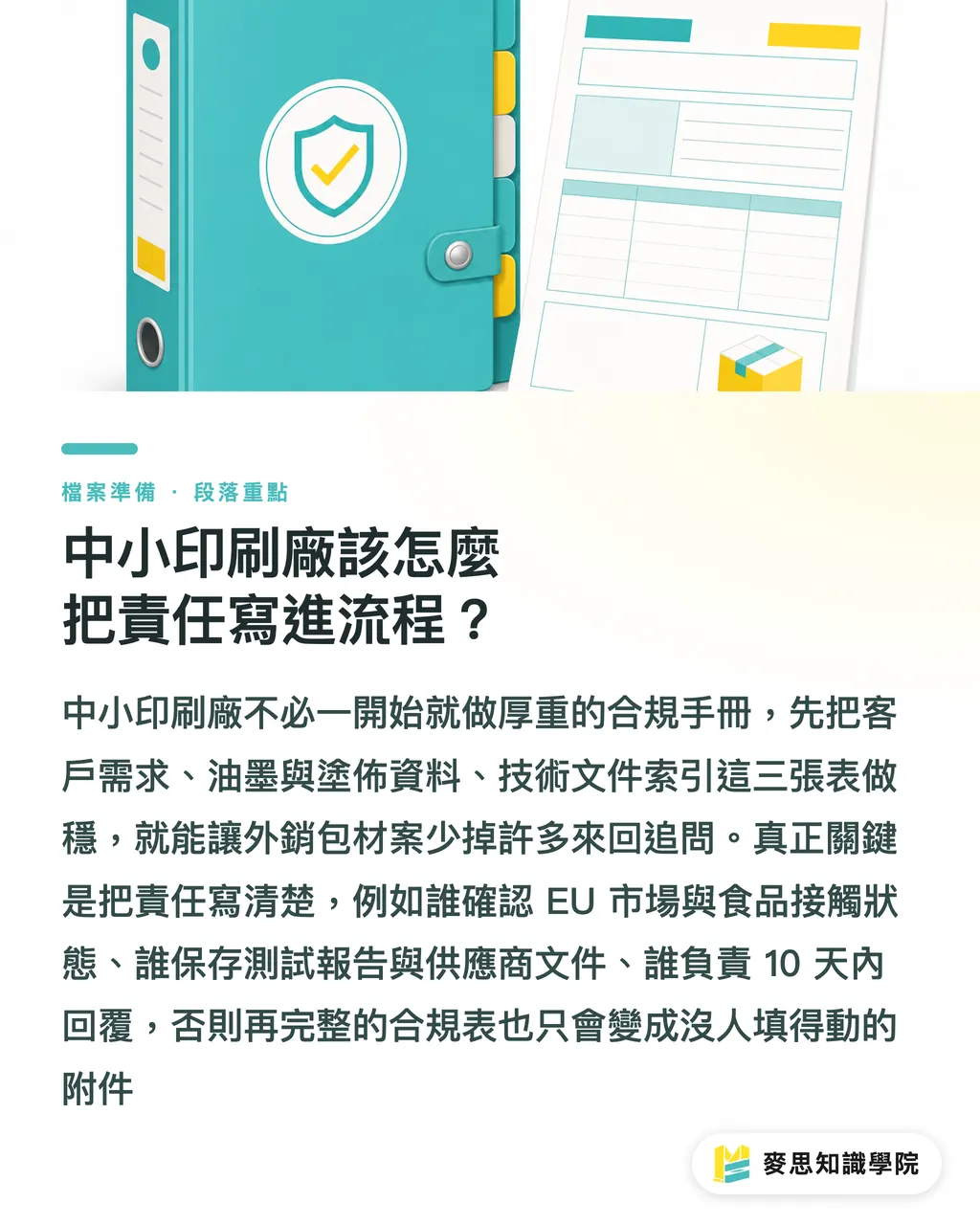
Small and mid printers don't need a thick compliance manual on day one. Get three sheets stable and most export jobs lose a lot of back-and-forth email
・Customer requirements sheet: confirm whether the pack enters the EU market, qualifies as packaging, involves food contact, claims reuse or compostability, and needs to support post-2026-08-12 PPWR application
・Ink and coating data sheet: list ink codes, coating codes, heavy-metals statement, PFAS statement, recyclability support info, compostability support info
・Technical-file index sheet: BOM, print specs, supplier documents, test reports, design judgments, DoC owner, 10-day-response owner all in one traceable place
Brand customers have to draw the line clearly too. "Must comply with PPWR" on a PO is not enough. Better wording: state the final-packaging end use, the sales market, the food-contact status, the documents the supplier must return, and who owns document updates
When the Mai Strategy Knowledge Academy consulting team looks at an export packaging job, we usually start with one small thing: whether the supplier can actually fill the form back in. A compliance sheet nobody can complete just becomes another attachment in the inbox, and nobody on the line still knows which ink to swap
Key takeaways
・PPWR chases the final pack. Ink data is just one link in the evidence chain
・Ink makers usually don't sign the PPWR DoC for customers, but they have to deliver product info that supports the DoC
・Before 2026-08-12, get heavy metals and food-contact PFAS into the press specs
・Four heavy metals combined cap at 100 mg/kg in overall packaging. That's not something a verbal promise covers
・Don't wait until after sampling to ask about coatings. A lot of recyclability risk shows up in varnish, barrier, and drying conditions
Further thinking
The path to the floor is simple. The print side pulls the BOM, ink codes, and coating conditions together first. The design side flags EU market, FCM, and compostability on the die and substrate proposals. The AI and SaaS crew builds DoC owner, 10-day-response owner, heavy-metals, and PFAS fields into the work order instead of stopping at a file-upload cabinet. PPWR pressure on Taiwan's small and mid printers won't just land on the legal team. It'll land on the quote sheet, the proof sheet, the ink inquiry, and the shipping documents
Further reading
FAQ
- Under PPWR, does an ink maker have to issue a Declaration of Conformity for the printer?
- Usually no. The PPWR DoC is in principle prepared by the packaging manufacturer. What the ink maker has to provide is supporting info on substances, restricted substances, recyclability, compostability, and food contact
- Is the PPWR DoC the same as the food-contact-material Declaration of Compliance?
- No. The PPWR DoC is the formal statement that final packaging meets PPWR. The FCM Declaration of Compliance is the food-contact-material compliance document. The two don't substitute for each other
- What should printers ask ink makers for first, before 2026-08-12?
- Start with heavy-metals and food-contact PFAS information. PPWR Article 5(4) sets a combined 100 mg/kg limit across lead, cadmium, mercury, and hexavalent chromium in overall packaging
- Do inks and coatings really affect PPWR recyclability assessment?
- Yes. The PPWR technical file may need to back recyclability, compostability, reuse, and food-contact judgments. Ink film, varnish coating, and barrier coating can all feed into the final-packaging assessment
- Is a brand's blanket "must comply with PPWR" request to the printer enough?
- No. Brand customers should spell out the sales market, packaging end use, food-contact status, reuse or compostability claims, and the documents the ink and coating suppliers are expected to return
Related articles
The Print × AI weekly
The print and AI know-how designers, brands and enterprises can use before they commit — one email, every week
MINDS Free Tools
Spine width and imposition calculators — skip the manual math, free in your browser.
MINDS Group
Need actual printing or gifting services?
From premium printing to online ordering and festive gifts — the MINDS Group sister brands take it from here.