

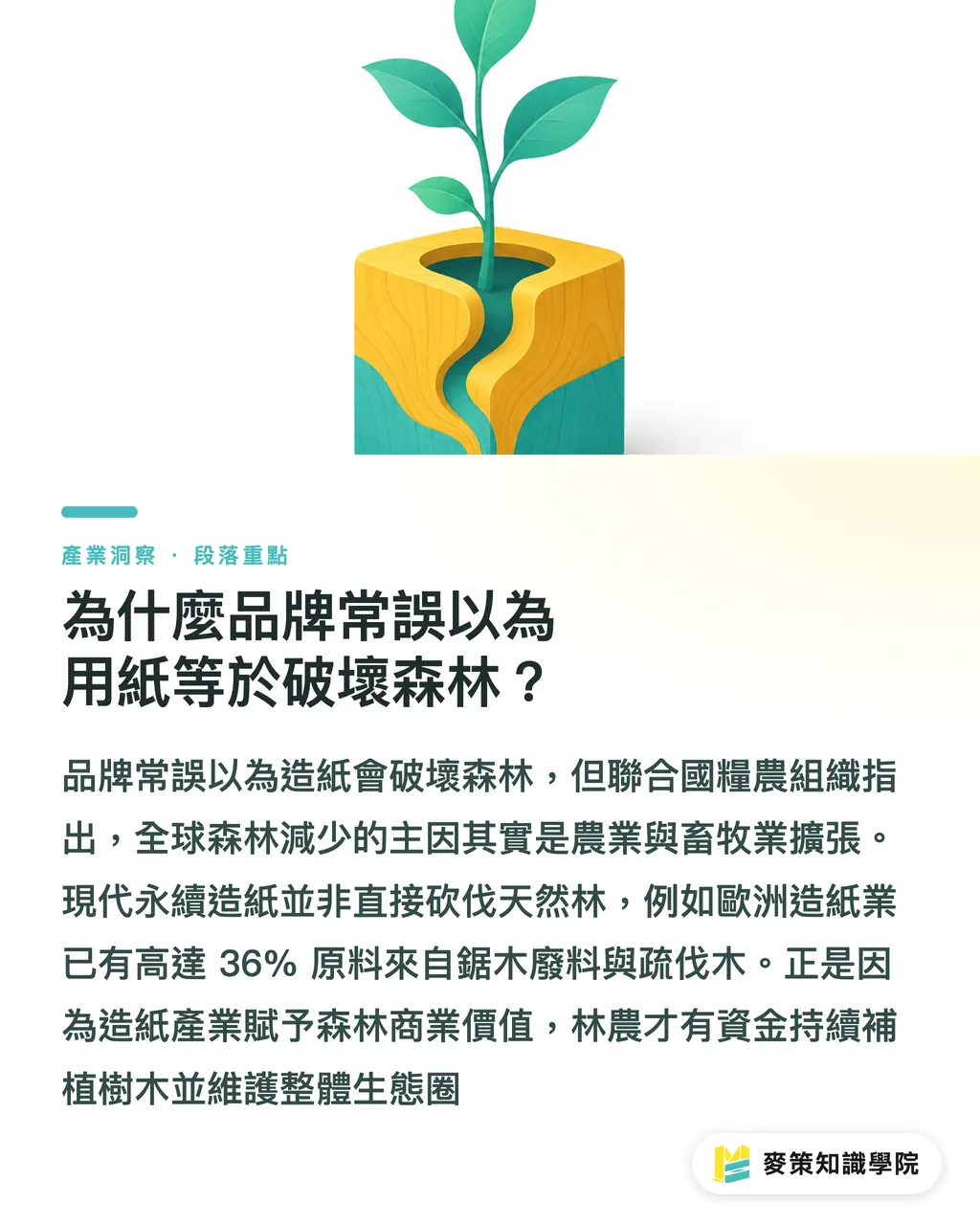
Why Do Brands Often Mistake Paper Use for Forest Destruction?
Brands commonly equate logging with deforestation, but research from the UN Food and Agriculture Organization, FAO, clearly shows that the main drivers of global forest loss are agricultural expansion and livestock development, not harvesting for papermaking
When I meet with corporate clients, I often hear marketing leads say that printing catalogs destroys forests. In reality, this is a dated stereotype left over from the paperless office slogans of the 1990s. At the time, heavy media coverage of old-growth forest clearing in the Amazon and Southeast Asia led many people to believe that using less paper would save trees. But the way sustainable papermaking works in Europe and North America is completely different
Modern pulp feedstock does not come from directly cutting down natural forests. According to CEPI's Key Statistics 2022, sawmill chips accounted for 24.6% of virgin fiber input in the European paper industry in 2021. In other words, one out of every four portions of virgin fiber came from wood chips and shavings left over from lumber processing. Another share comes from forest thinning, where weaker trees are selectively removed to help main trunks grow and to prevent pests and disease
FSC forest certification: an international standard certification system created by the Forest Stewardship Council. It requires wood and paper raw materials to come from responsibly managed forests that are environmentally sound, socially beneficial, and economically viable. It helps ensure harvesting does not damage biodiversity and establishes a full chain-of-custody tracking system from production to sale
If forests have no commercial economic value, landowners are actually more likely to convert forestland into farmland or construction land. It is precisely the income from the paper and timber industries that gives forest owners the funds to keep replanting and maintaining forest ecosystems
Is Digital Communication Really Lower-Carbon and Greener Than Paper Printing?
Digital marketing is not carbon-free. The electricity consumed by data centers and servers running around the clock keeps adding to an invisible carbon footprint, while paper has natural carbon storage properties and a high recycling rate
Many people assume that sending emails or posting on IG is the ultimate green choice because no paper is used. Don't rush to that conclusion. The transmission and storage of digital information depend on massive data centers. These server clusters consume staggering amounts of electricity every year, and the related carbon emissions are often overlooked in corporate ESG assessments
By contrast, paper is one of the few materials with a mature circular economy chain. According to CEPI statistics, Europe's paper recycling rate has already exceeded 79%. After recycled fibers are washed, repulped, and de-inked, they can be put back into production. The carbon absorbed as trees grow also remains stored in paper-based printed materials
Let's compare the two by the same standard:
・Digital marketing: network hardware and servers continuously consume electricity, databases emit carbon around the clock, information disappears quickly, and the threshold for consumer trust is higher
・Paper printing: the carbon footprint of a single print run can be calculated, natural wood fiber can store carbon, Europe's recycling rate exceeds 79%, and physical touch creates longer retention and a stronger sense of authority
It's simple. When companies assess carbon footprints, they cannot look only at front-end production. They also need to look at back-end operation and real life cycle consumption
What Marketing Value Does Physical Print Still Have in the Digital Age?
With its distinctive tactile experience and physical presence, print can build brand trust and deep memory retention that algorithms cannot copy
From my years of observation on production lines and in marketing settings, digital ads can be accurately targeted, but they also face extreme attention fragmentation and ad-blocking limits. Consumers can swipe past a screen in fractions of a second, making it hard for information to settle into a brand impression
Printed materials create a multisensory physical interaction. Paper weight, texture, ink scent, and special finishing all build deeper sensory memory in the brain. This is exactly why premium brands still insist on producing physical catalogs when launching important products
When planning marketing materials, companies should use the Mai Strategy Three-Point Print Submission Check to choose the right media:
① Verify the raw material source: prioritize eco-friendly paper with FSC or PEFC international certification to ensure wood fiber comes from sustainably managed forests or industrial by-products
② Assess communication lifespan: use digital channels for high-frequency updates and short-term promotions. Use physical print for contracts and brand publications that need long-term retention and trust
③ Optimize print production: through the mid- to high-end fully custom commercial printing services provided by MINDS, calculate print volume and layout precisely to reduce waste at the source
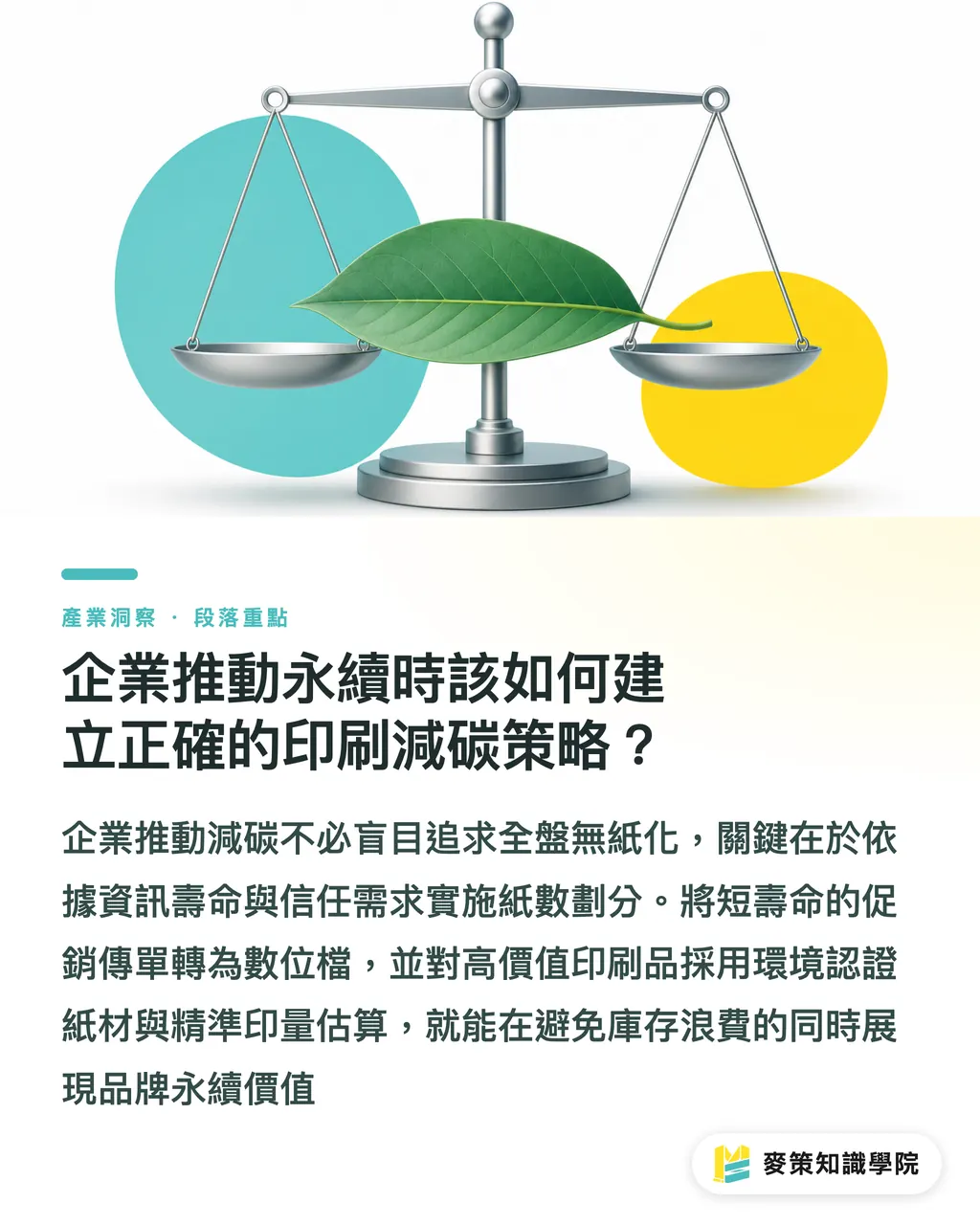
How Should Companies Build the Right Print Carbon-Reduction Strategy When Pursuing Sustainability?
Companies pursuing sustainability should not fall into the extreme myth of going fully paperless. Instead, they should divide paper and digital work based on information lifespan and trust needs
That's enough. Brands do not need to treat printing as a sin when reducing carbon. The key is precise printing and circular recovery. Here are steps corporate procurement and design teams can take right away:
1. Audit the company's internal printed materials, and move internal notices and short-term promotional flyers with a lifespan of less than one week to digital files
2. For high-value brand catalogs and packaging, work with the Mai Strategy Knowledge Academy consulting team to assess paper carbon footprints and select paper with a high recycling rate or environmental certification
3. Adopt precise digital printing and reasonable print-volume estimates to avoid the old habit of printing in bulk just to lower unit cost, which often leads to excess inventory and disposal
4. Mark FSC certification and recycling symbols on physical printed materials, using transparent and verifiable data to communicate the brand's sustainability value to consumers
Key Takeaways
・Paper-driven deforestation is a historical misunderstanding. The UN FAO has confirmed that the main cause of global deforestation is agricultural expansion, not papermaking
・Sawmill chips accounted for 24.6% of virgin fiber input in the European paper industry (CEPI, 2021), and Europe's paper recycling rate reached 75.1% (EPRC, 2024)
・The data centers behind digital communication consume massive amounts of electricity, and companies must not ignore digital's hidden carbon footprint
・Use the Mai Strategy Three-Point Print Submission Check to select media, letting high-trust printed materials and high-frequency digital communication complement each other
・Choosing FSC-certified eco-friendly paper can support forest owners in maintaining sustainable forests through commercial mechanisms
Further Thinking
For print manufacturers and brand clients, green transformation is definitely not about passively giving up print. It is about using scientific data to reposition how printed materials communicate. Designers should factor in paper sources and post-processing waste from the early planning stage, while print factories should strengthen their ability to deliver fully custom, precise print production. When a brand uses responsible paper to carry deeper value, physical print becomes the brand asset with the most human warmth in the ESG era
Further Reading
FAQ
- Does printing paper really cause natural forests to disappear?
- No. The UN Food and Agriculture Organization, FAO, states that the main causes of deforestation are agricultural and livestock expansion. European papermaking mainly uses sustainably managed forests and sawmill by-products, while harvesting is paired with ongoing replanting and forest ecosystem maintenance
- Are newsletters and digital ads really greener than printed materials?
- Not necessarily. Digital communication depends on data centers running 24 hours a day, which creates a substantial hidden carbon footprint over time. Paper, by contrast, has natural carbon storage properties and a circular recycling rate of up to 79%
- How can companies prove their physical printed materials meet ESG sustainability standards?
- Companies can choose paper with FSC or PEFC international certification, control print volume and waste through [MINDS](https://www.mindscmyk.com/) precision printing processes, and print traceable certification marks to show consumers verifiable proof
Related articles




The Print × AI weekly
The print and AI know-how designers, brands and enterprises can use before they commit — one email, every week
MINDS Free Tools
AI background removal, a LINE sticker maker, spine & imposition calculators — all free, right in your browser, no upload.
MINDS Group
Need actual printing or gifting services?
From premium printing to online ordering and festive gifts — the MINDS Group sister brands take it from here.