

Overview
To save on printing costs for books and catalogs, first align page count and size with offset printing imposition and signature planning. When MINDS (MS, mid- to high-end fully custom commercial printing) plans these jobs, it starts with the "MINDS (MS) three checks for book format": full 16-page signatures, paper yield, and binding method

What Is a Signature, and Why Are 16 Pages Often Treated as One?
Signature count is the cost unit most easily overlooked in book planning. On screen, it may look like pages 1 through 64. Once it enters the print shop, it becomes large sheets, printing on both sides, folding, and binding
・Signature: In book printing, one large sheet printed on both sides and folded into a stack of bindable pages is called a signature. A 16-page signature is common, though the actual count depends on the press, paper, and folding method
・Imposition: In prepress, pages are arranged on one large sheet according to folding, trimming, and binding order, so the page numbers land correctly after folding and the blank areas on the sheet stay as small as possible
・Format: The final single-page size after a book or catalog is trimmed, such as A4 at 210×297mm. Format determines how many pages can fit on one large sheet, which directly affects signature count and paper use
When I review a catalog quote, I first divide the total page count by 16. 32 pages is usually 2 signatures, 48 pages is usually 3 signatures, and 64 pages is usually 4 signatures
Four-color offset printing has another reality: one signature printed on both sides often involves 8 printing plates, 4 CMYK plates for the front and 4 CMYK plates for the back. So when the signature count goes up, the added cost is not just paper. It also includes plate making, make-ready, presswork, and folding setup
Why Can 2 Extra Pages Push the Quote Up?
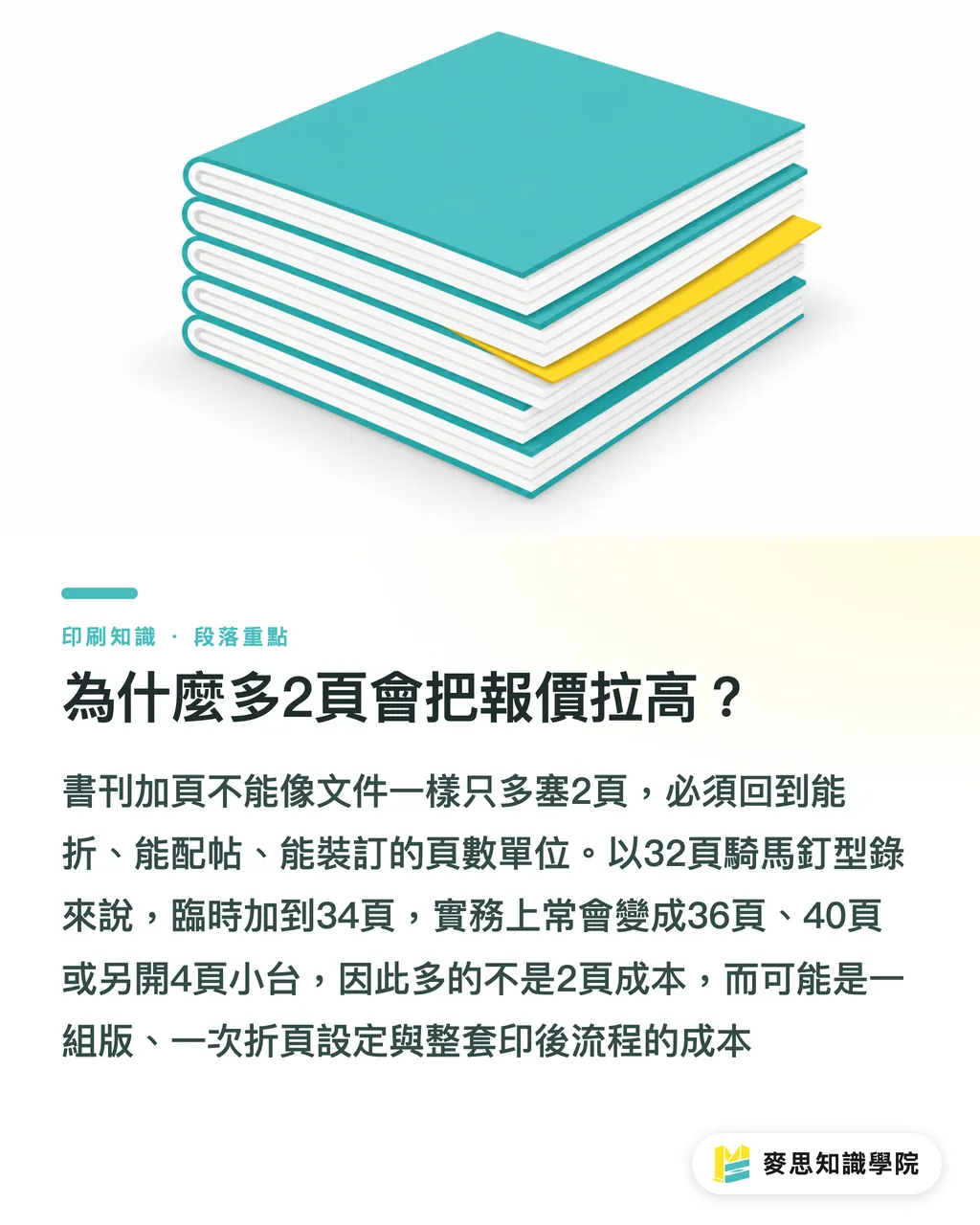
The tricky part about adding 2 pages is that a book cannot simply take two extra pages the way a Word file can. Saddle stitching and perfect binding both have to return to page-count units that can be folded, gathered, and bound
Take a 32-page saddle-stitched catalog. 32 pages is clean and can usually be handled as two 16-page signatures
If planning suddenly changes it to 34 pages, the printer usually will not print only 2 extra pages. Book pages have to work in pairs, fold properly, and bind properly. In practice, it often becomes 36 pages, 40 pages, or an added 4-page small signature
That small change can create the following costs
・An extra set of plates or a small-signature plate set. With four-color printing on both sides, that can mean up to 8 more plates
・One more folding-machine setup, plus re-collation in postpress
・Binding thickness and page sequence need to be recalculated, especially because the spine of a perfect-bound book is affected by inner-page thickness
・Paper is still purchased and calculated by large sheet and cut count. Blank areas cannot be recovered as savings
That is why I often remind planners: adding 2 pages is not the cost of 2 pages. It is often the cost of opening another signature or adding a small signature
If the content is still in planning, multiples of 16 such as 48, 64, and 80 pages are usually easier to price. If the file is already final and only then changes from 62 pages to 66 pages, prepress has far fewer ways to rescue it
How Should Size Be Adjusted for Better Paper Yield?
Size planning should look at whether the finished size, plus bleed, gripper margin, and trim allowance, can fit well on the large sheet. Do not judge only by whether the layout looks good on screen
A4 is 210×297mm and familiar to designers, but A4 is not always the cheapest choice. Some catalogs can make imposition smoother by adjusting the height to 285mm, or the width from 210mm to 200mm. That can also reduce paper-edge waste
There is no magic size that works everywhere, because the printer has to consider paper specs, press sheet size, and binding method. But one check is reliable: if the same large sheet can fit 8 pages, the cost is usually easier to discuss than if it can only fit 6
Before layout design begins, planners can ask 3 questions
・After adding 3mm bleed on each side, can the finished size still fit within common paper sizes?
・Is the total inner-page count close to a full combination of 16-page, 8-page, or 4-page units?
・Is the binding saddle stitch, perfect binding, thread-sewn perfect binding, or a special fold?
When MINDS handles mid- to high-end fully custom catalogs, it usually looks at size and signature count before discussing paper stock and postpress. If the job is a low-unit-price DM, booklet, or menu with fixed specs, Mai Printing's online ordering specs are often a better fit, because fixed specs already help avoid some paper waste
How Can Planning and Design Save Money at Project Kickoff?
The MINDS (MS) three checks for book format are simple. They work well when planning, design, and procurement review specs together in the first discussion
・① Full-signature page count: First plan content around common combinations such as 32, 48, or 64 pages, then decide whether to add ad pages, brand pages, or blank pages
・② Size fits paper: Do not choose the finished size only by visual preference. Ask the printer to estimate paper yield first. A 5mm difference can sometimes change imposition efficiency
・③ Decide binding early: Saddle stitching suits thinner catalogs. Perfect binding suits books with more pages. If binding is decided late, signature count and spine thickness both have to be reworked
I have seen many projects change 48 pages to 50 pages early on just to add one brand-image spread, then delete it back to 48 pages during prepress
That kind of rework is the most wasteful, because copy, design, and proofreading have already gone through a full round. The question that should have been asked could have been asked very early: should this book stay within 3 signatures of 16 pages?
When the page count really is not enough, you do not have to cut content by force. These approaches can help
・Merge two low-information-density spreads into one spread
・Change a full-page chapter opener into a half-page opener
・Include the inside front cover and inside back cover in content planning
・Group spec tables, FAQs, and store information together to reduce scattered pages
・If the content is worth keeping, fill it out to a complete 4-page or 8-page unit instead of leaving an awkward 2-page tail
How Should AI and SaaS Tools Understand Signature Count?
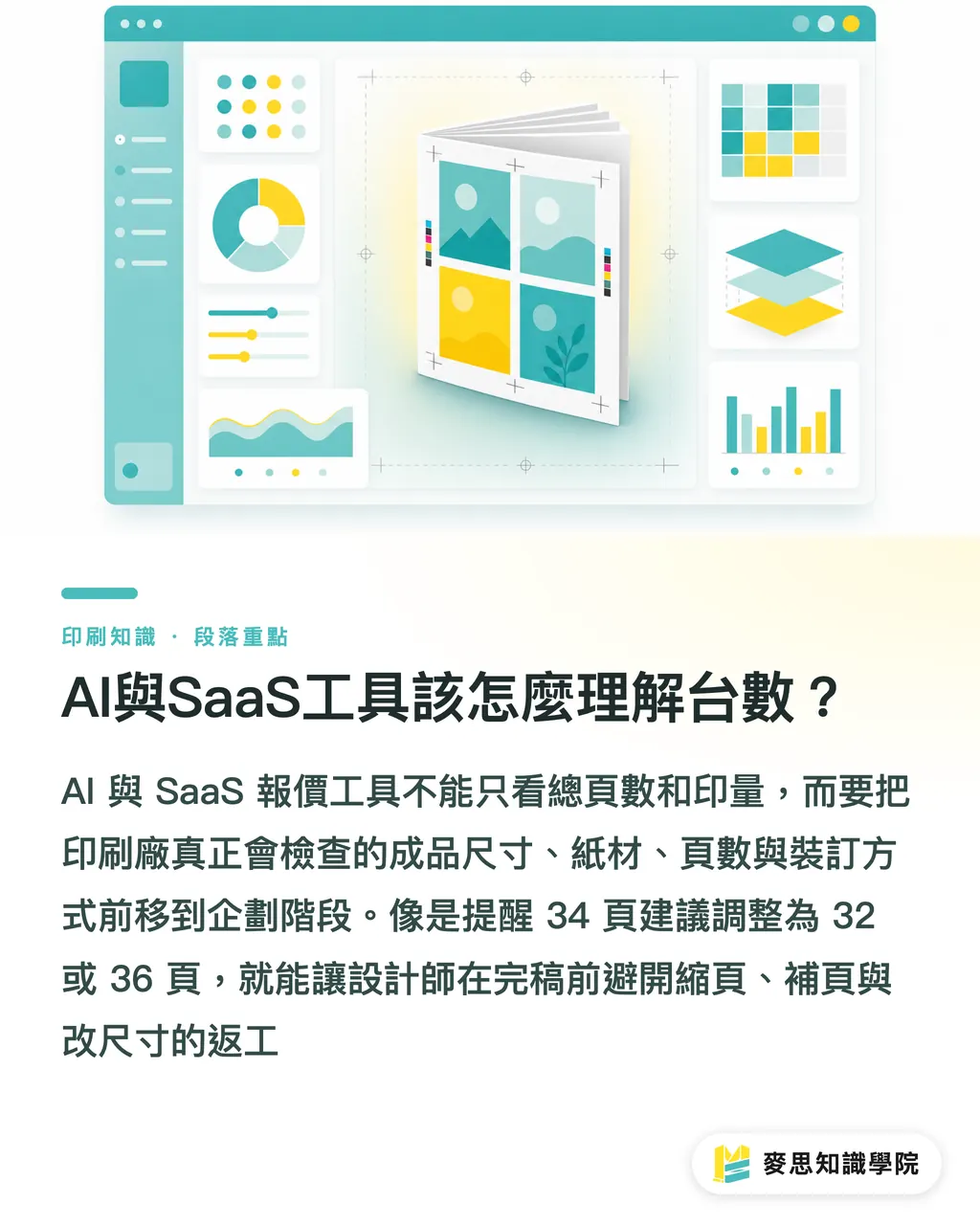
If AI-assisted layout tools and SaaS quoting tools only ask for "total pages" and "quantity," they can easily miss the structure a printer actually needs to see
A quote flow closer to real production should ask users for at least 4 fields: finished size, total page count, paper stock, and binding method
A better approach is to show prompts during planning, such as "currently 34 pages, consider 32 or 36 pages," "current finished width is 210mm, changing to 200mm may improve sheet layout," or "current saddle-stitched page count is getting thick, confirm binding limits first."
This does not make printing complicated. It moves the printer's mental checklist forward, before design begins
For the MINDS team or anyone building print SaaS, signature rules are a natural fit for real-time product prompts. For designers, these prompts prevent many awkward moments where they are asked to reduce pages, add pages, or change size only after final artwork is done
Key Takeaways
・The cost of 2 extra pages often lands in opening another signature, then running presswork and binding again
・A 5mm size difference can turn paper from easy to impose into hard to impose
・If planning asks about signature count 10 minutes earlier, prepress can avoid a whole round of fixes
・Saving money on catalogs is not about squeezing paper stock. It is about getting page count, size, and binding on the same side first
Further Thinking
Printers can move signature checks forward into the quote entry point. Designers can treat 32, 48, and 64 pages as safer planning draft ranges. AI layout and SaaS tools should turn "page-count multiples, format size, and binding limits" into real-time prompts. The next time you start a catalog project, first take the finished size, estimated page count, paper stock, and binding method to ask MINDS or Mai Printing once, then begin layout. That step is usually far cheaper than changing size after final artwork is done
FAQ
- Does a catalog page count have to be a multiple of 16?
- Not necessarily, but offset book printing often plans around 16 pages as one signature. Combinations such as 32, 48, and 64 pages are usually easier to control for cost. The actual setup still depends on format, paper, press, and binding method
- Why can adding 2 pages to a book change the printing cost so much?
- Book printing has to work for imposition, folding, and binding. Adding 2 pages often has to be rounded into 4 pages, 8 pages, or a separate small signature, so costs rise along with plate making, presswork, folding, and binding
- Is an A4 catalog always cheaper than a custom size?
- A4 is 210×297mm. It is common, but not always the cheapest. In some jobs, adjusting the width or height by a few mm lets the large sheet fill more completely and reduces paper waste
- When should planners ask the printer about signature count?
- Before design begins. At minimum, provide the finished size, estimated page count, paper stock, and binding method first. If you wait until final artwork is done, the remaining options are usually limited to cutting pages, adding pages, or relayout
- Does digital printing also need signature planning?
- Digital printing is not as heavily affected by plate making and signature count as offset printing, so short runs and rush jobs are often more flexible. But books still need bindable page counts, and page order and finished size cannot be chosen carelessly
Related articles




The Print × AI weekly
The print and AI know-how designers, brands and enterprises can use before they commit — one email, every week
MINDS Free Tools
Spine width and imposition calculators — skip the manual math, free in your browser.
MINDS Group
Need actual printing or gifting services?
From premium printing to online ordering and festive gifts — the MINDS Group sister brands take it from here.