
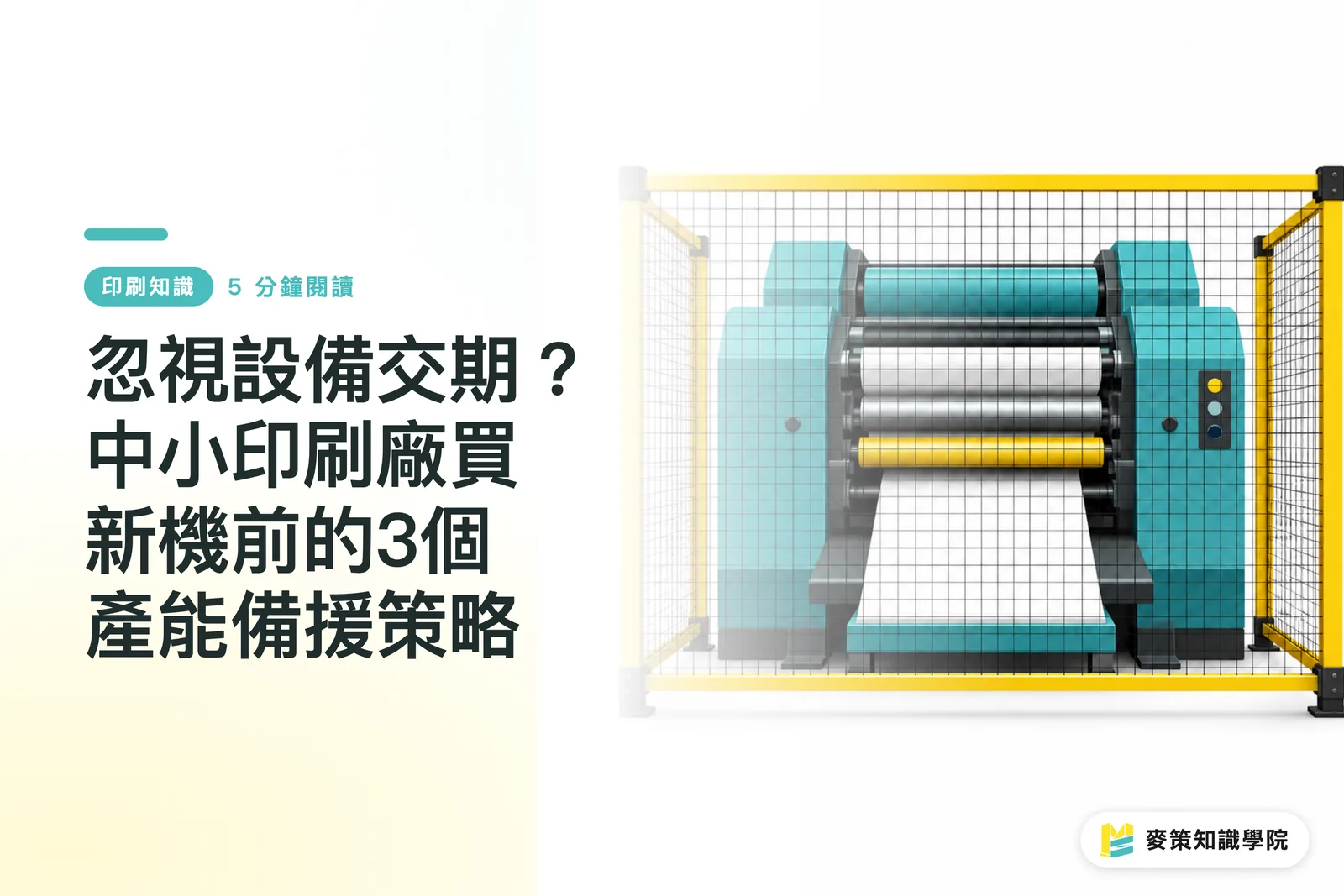
Why Are Packaging Equipment Lead Times Still So Long?
Visiting clients over the past few months, the complaint I heard most was not the labor shortage, but "When on earth is our machine actually arriving?"
Packaging Digest recently launched a survey on packaging equipment lead time (the entire span from placing an order, manufacturing, and shipping to on-site installation and testing), reflecting the industry's widespread anxiety over delayed deliveries. Back in 2022, Rich Hollander, former Vice President of Sterile Injectable Technology at Pfizer, bluntly stated that excessive lead times severely wreck production schedules and business plans, making brands hesitate to invest in new technology
Take medical-grade packaging, which I have seen a lot of recently. With automated dispensing systems spreading across pharmacies, demand for small, traceable, serialized print jobs has surged. Many Taiwanese print shops saw the opportunity and wanted to buy new machines to break into the market, only to get stuck with lead times of six months to over a year on imported equipment, watching incoming orders slip away. This drives home a brutal reality: in the current climate, equipment lead time is a massive investment risk on its own. Without physical machines on your shop floor, even the best business blueprint is just talk
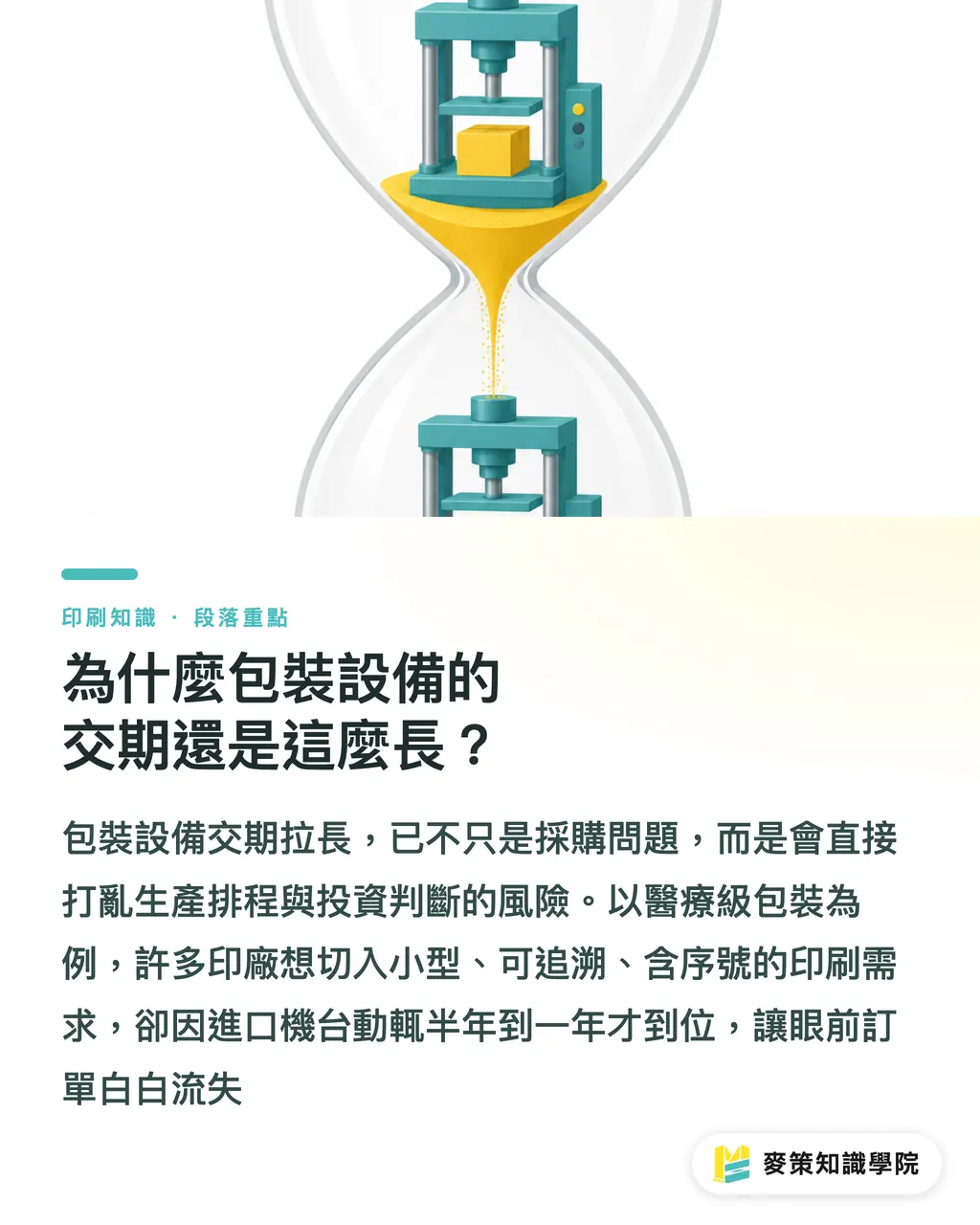
What If the New Machine Is Delayed? How Small and Mid-Sized Shops Should Respond
Print buyers dread getting that call from vendors saying "it might be two days late." What print shop owners dread even more is the equipment vendor throwing up their hands and saying, "We have a chip shortage, your delivery is pushed back."
When this happens, small and mid-sized shops cannot rely on luck. You need a real backup plan. If a new machine fails to arrive on time, the production bottleneck usually hits a specific finishing stage on the packaging line, like foil stamping, spot UV coating, or folder-gluing. I usually advise clients to tackle this from three practical angles:
・Extend old machine service with deep maintenance: Do not rush to sell or scrap your old press. Before the new machine is confirmed to be up and running reliably, schedule a deep overhaul for the old equipment. Stock up on wear-and-tear parts like rollers and belts so it can carry base capacity during the gap
・Build an outsourcing backup roster: Keep good relationships with two to three peer trade printers during normal times. Packaging outsourcing bottlenecks usually flare up in procurement or inventory. Once delivery slips, trigger your outsourcing immediately. This tests how well you know your peers' process capabilities
・Phase in automation step by step: Squeezed between labor shortages and rising wages, small and mid-sized printers often assume automation requires an unattainable fortune. Upgrading does not need to happen all at once. Pick the right bottlenecks and introduce automation in phases, such as adding automated feeders or stacker modules first, gaining extra capacity at minimal cost
How to Evaluate Capacity Backups Before Buying New Equipment
Before investing in a new press, you can run through a "three-gate check" to assess your risk of contract breach
Buying equipment is a big deal, especially if you have already taken on new orders planning to run them on the incoming machine. That is when your risk is highest. Instead of nagging equipment dealers every day, work out your baseline first. Here is the scenario planning exercise I often run with plant managers on site:
1. Stress-test worst-case lead times: Add three full months to the dealer's promised delivery date. Use this worst-case scenario to see if your promised shipping dates to clients will fall through
2. Calculate the exact capacity deficit: Work out the capacity deficit during those extra three months of waiting. Calculate this to the dollar, including potential liquidated damages to clients or emergency airfreight costs
3. Budget your backup costs: Factor in the outsourcing subcontractor fees and legacy machine repairs mentioned earlier. This money must be counted as part of your total capital expenditure for the new machine
If you find that the projected backup costs are too steep and your shop cannot absorb them internally, you might want to look for an established print partner. Offloading high-risk specialty finishing through services like MINDS, which provides mid-to-high-end fully custom commercial printing, is a viable way to keep risk under control
Why Lead Time Data Actually Helps
When facing uncertain delivery dates, expediting orders purely on gut feeling is the least reliable approach
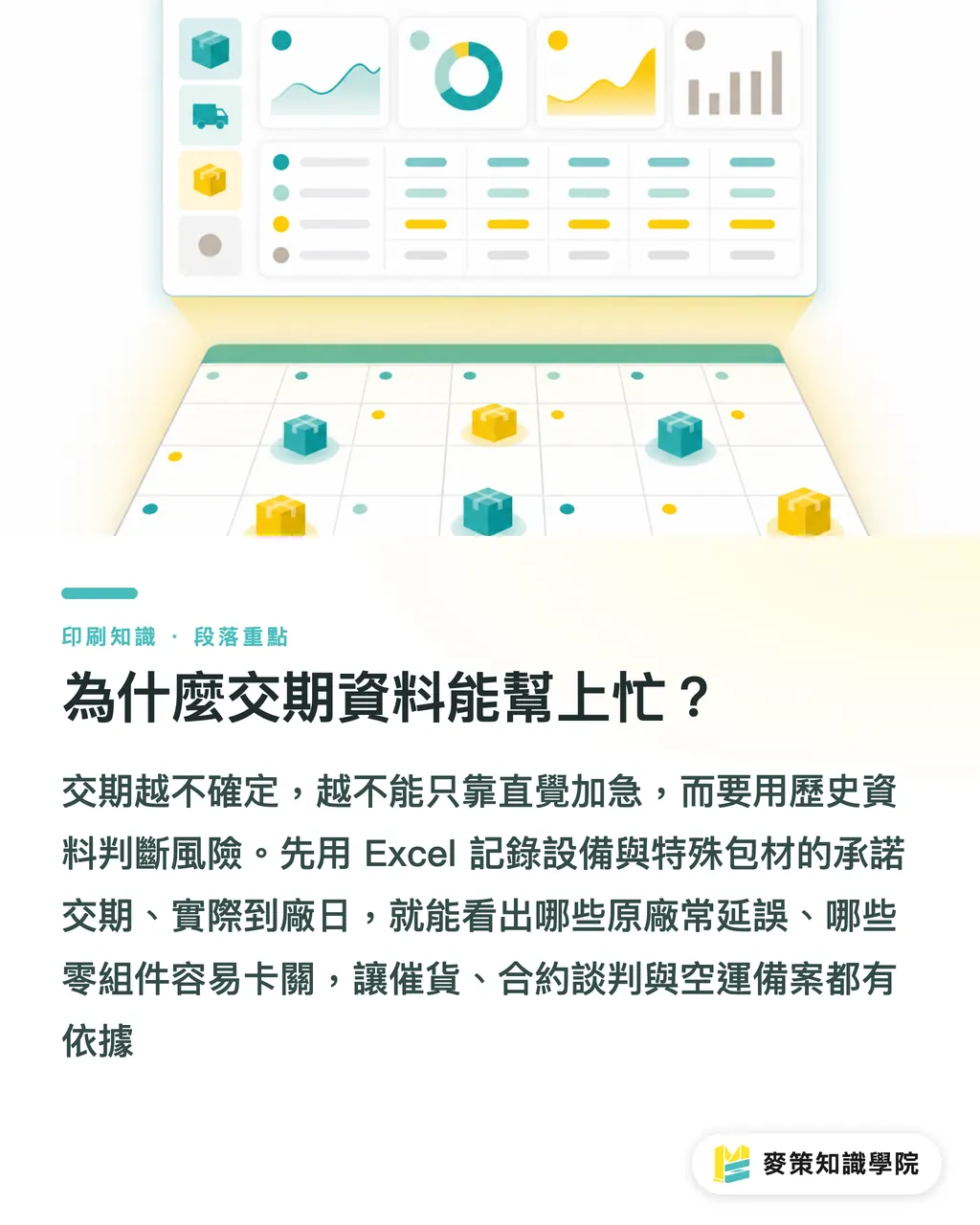
Many veteran plant managers still rely on gut instinct to guess when machines or materials will arrive, but that no longer works in current supply chains. Building a historical lead time log turns your expediting decisions from guesswork into evidence-backed choices
You do not need to buy an expensive system right away. Start with a basic Excel sheet to track promised delivery dates against actual arrival dates for every machine and batch of specialty packaging material. As this data builds up, you will see exactly which manufacturers' promises need a discount and which specific components get held up most often. Backed by hard facts, you can hold your ground in contract negotiations or decide whether to pull the trigger on costly air freight backups. That alone is enough
Key Takeaways
・Long equipment lead times are the biggest hidden investment risk for small and mid-sized printers expanding capacity
・Buying new equipment requires looking beyond specs to factor in backup costs for legacy press extensions and trade outsourcing
・Automation does not have to happen all at once. Phasing in upgrades to existing machine modules is a more practical risk-hedging strategy
・Track historical lead times to build an early warning list, backing purchasing decisions and contract negotiations with real data
Food for Thought
Given how volatile supply chains are right now, print shop owners and managers need a mindset shift. Buying a machine is no longer just purchasing hardware, it is buying a "capacity guarantee window." For designers and print buyers, this also means not putting all your eggs in one basket. When confirming a vendor's capacity, asking one extra question, "What is your backup plan if this machine runs into issues?", can save your project
Further Reading
FAQ
- What stages are usually included in packaging equipment lead time?
- Lead time goes far beyond transit time. It covers the entire timeline from paying the initial deposit, factory scheduling and manufacturing, factory inspection, ocean or air freight, and on-site delivery to final installation, test runs, and formal handover
- What if the new machine is delayed and the old machine breaks down at the same time?
- You must maintain an active outsourcing backup roster during regular operations. Partner regularly with two to three trade printers who match your quality standards so you can immediately transfer files and plates during emergencies and keep your delivery promises to clients
- How can budget-constrained small and mid-sized shops phase in automation to handle lead time issues?
- You do not need to rebuild the entire plant from scratch. Start with the most labor-heavy bottleneck, like mounting an automatic labeling head on an existing packaging line or adding a robotic arm at the delivery end. Targeted modular upgrades free up capacity without breaking the bank
Related articles



The Print × AI weekly
The print and AI know-how designers, brands and enterprises can use before they commit — one email, every week
MINDS Free Tools
AI background removal, brand stamping, and a LINE sticker maker — free design tools, right in your browser, no upload.
MINDS Group
Need actual printing or gifting services?
From premium printing to online ordering and festive gifts — the MINDS Group sister brands take it from here.