
Overview
As EPR starts moving through the courts, the direct meaning for packaging projects in Taiwan is this: quotes can no longer look only at paper, ink, finishing, and quantity. Material proof, recycling responsibility, and state-by-state compliance risk also have to enter early design decisions. When MINDS (MS) reviews a packaging project, it first uses the "three prepress gates" to check ① whether the material can be clearly identified ② whether the structure affects recyclability ③ whether the client can retain reportable data
EPR Is in Court. What Should Taiwanese Brands Understand First?
Packaging EPR in the U.S. has reached the courtroom, which means the cost conversation around packaging has entered a new stage. According to Packaging Dive's Packaging EPR Goes to Trial, Maine was the first state to pass a packaging EPR law in 2021, Oregon became the first to implement one in 2025, and the National Association of Wholesaler-Distributors' challenge to Oregon's system is expected to enter a five-day trial in Portland from July 13 to 17, 2026
The way I see it, the point is not how U.S. lawyers fight the case. It is how purchase orders get rewritten. In the past, a brand might ask a print shop, "How much is this color box?" Now it will also ask, "Who is responsible for reporting this material, which states can we sell it in, and can we produce the recycling data?"
Packaging Dive notes that the court may issue a ruling before the end of 2026, and the result could affect later system design in states such as California, Colorado, and Minnesota. For Taiwanese brands whose goods enter U.S. retail channels, packaging specifications can no longer be treated as paperwork added after design. They need to be on the meeting agenda from the early design stage
What print production teams fear most is not that the rules are complicated. It is the client asking one week before shipping, "Can this film material be reported?" By then, dies, plates, proofs, and purchasing have all moved ahead. Changing one structure can shake the whole production schedule
What Is Packaging EPR, and How Does It Work?
EPR, Extended Producer Responsibility, is a system that requires brands or producers to bear responsibility for post-sale recycling, treatment, and related costs. Once packaging enters EPR, material choices directly affect compliance costs
The Oregon case has two legal terms at its center. Print and design teams do not need to become lawyers, but they do need to understand how these terms affect who pays and who submits data
・Due Process Clause: NAW questions whether Oregon's arrangement, which gives authority to the producer responsibility organization, or PRO, Circular Action Alliance, is reasonable
・Commerce Clause: NAW questions whether Oregon's system affects out-of-state businesses in a way that touches constitutional limits on interstate commerce
・In February 2026, the court had already granted a preliminary injunction to some NAW members, showing that the dispute has entered the level of actual enforcement
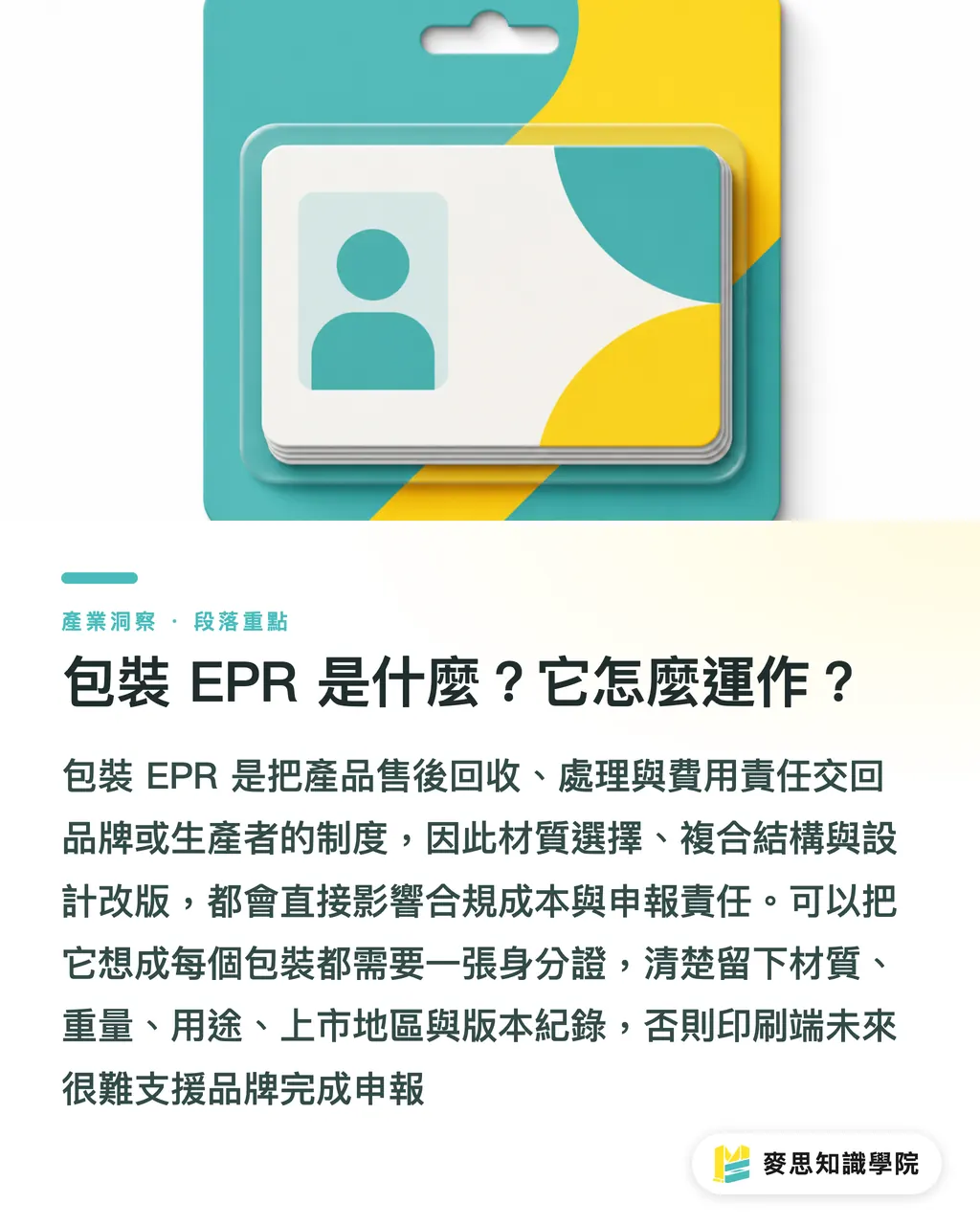
EPR can be understood as a "packaging ID card." Every box, bag, label, and cushioning material needs to explain its material, weight, use, market area, and responsibility for recycling and treatment. If a print shop only keeps finished product photos and quotes, it will be hard to support a brand's reporting later
MINDS (MS)'s three prepress gates are very practical here: the first gate checks whether material names are precise enough to trace, the second checks whether composite structures affect recycling determination, and the third checks whether version records remain after design revisions
Why Are Packaging Design Costs Shifting from Material Costs to Responsibility Costs?
Packaging design decisions used to be driven by "unit price." After EPR, they have to be judged by "life-cycle responsibility." For the same outer box, paper type, lamination, foil stamping, spot gloss, lining, and plastic hang tabs can each change later reporting and recycling responsibility
Take a skincare color box for export to the U.S. as an example. If the designer adds a matte film layer, the visual texture may improve. The purchasing side sees an increase in finishing cost. Once EPR enters the picture, the brand also has to ask whether that film layer will complicate recycling classification, whether upstream material proof can be obtained, and whether responsibility fees vary across states
This is the change I have clearly felt on the client side recently: at packaging meetings, regulation, purchasing, design, and print vendors are starting to sit at the same table. There is less room for simple price comparison, and suppliers that cannot explain early-stage data clearly will lose points first
Taiwanese small and midsize print shops can start by breaking quotes into 4 fields, so clients can see that EPR-related costs are not last-minute add-ons
・Material costs: paper, film materials, ink, adhesives, and special finishing
・Process costs: proofing, plate making, dies, post-press finishing, inspection, and packing
・Documentation costs: material proof, supplier declarations, version records, and client reporting data
・Risk costs: state-by-state regulatory differences, rework after revisions, and delays caused by missing data
For mid- to high-end fully custom commercial printing projects, MINDS (MS) recommends that brands discuss material proof and structural options before proofing. If a design file only changes material after entering prepress, it often takes 2 more rounds of communication than it would have at the design stage
How Should Small and Midsize Print Shops Respond Now?
Taiwanese small and midsize print shops do not need to wait for the ruling at the end of 2026 before taking action. Oregon already began implementing packaging EPR in 2025, and Packaging Dive also wrote that this trial will affect later regulations and litigation. The supply chain should start filling in its data now
I would suggest print shops start with 5 tasks. Once these are done, there is no need for slogans. Sales teams will naturally have firmer ground when quoting
・Build a packaging material BOM: for every SKU, at minimum keep records for paper, film materials, ink, adhesives, lining, and outer packaging
・Complete supplier documents: paper sources, film specifications, recycling-related declarations, and version dates must be traceable
・Keep revision trails: for the same color box from V1 to V3, it should be possible to look back and see which material and which finishing process changed
・Add responsibility boundaries to quotes: state what data the print shop provides and what reporting the brand handles. Do not only write "produced according to client files"
・Manage U.S. clients by state: California, Colorado, Minnesota, and Oregon may develop different details in their EPR systems. Export projects cannot rely on one generic packaging answer
Designers also need to change their habits. Packaging design proposals should not show only visuals. They should include at least one page of "material and finishing assumptions," clearly stating paper, surface treatment, special finishing, and alternatives
If a brand client is already revising or rebuilding packaging for export, MINDS (MS) can help lay out paper, finishing, and structural options before proofing, avoiding choices that become hard to change, hard to report, or hard to explain later
How Can AI and SaaS Help?
The role of AI and SaaS in EPR packaging management is very practical: organizing data scattered across quotes, design files, supplier PDFs, and client emails into a packaging material database that can be searched, updated, and handed over
For the MINDS team and SaaS builders, EPR is not finished once a good-looking dashboard exists. A truly useful system has to match the version flow on the print production floor. For example, 1 SKU may include an inner box, outer carton, sticker, cushioning material, and instruction leaflet. A material change in any one item affects the data
I would expect the tool to handle at least 4 capabilities
・Data field standardization: split material, weight, supplier, version, and market area into fixed fields
・Document linking: allow each packaging material item to attach source proof, supplier declarations, and update dates
・Version comparison: when a client changes the design, the system can point out which materials or finishing processes differ from the previous version
・Export and delivery: when a brand needs to hand data to retailers, legal teams, or consultants, it can directly export a clean packaging material list
When the consulting team at Mai Strategy Knowledge Academy looks at this kind of implementation, it first asks a plain but accurate question: when a client asks what material a package uses, can you find the answer in 5 minutes, or do you have to search 5 folders and ask 5 people?

Key Takeaways
・After EPR enters the courtroom, packaging cost moves from a unit-price issue to an issue of material, responsibility, and data completeness
・If a print shop does not have a packaging material BOM, supplier documents, and version records, U.S. export projects will become harder and harder to quote
・When a designer chooses one film layer or one special finishing process, that choice may change visuals, production, and recycling responsibility at the same time
・Brands should bring EPR into the early design stage now, instead of waiting until proofing is done to fill in compliance data
・The value of AI and SaaS lies in organizing packaging material data flows, not in making legal judgments for brands
Further Thinking
For print manufacturers, the next step is to upgrade the quote into a "product data entry point." Every export packaging project should retain at least material, finishing, supplier, version, and market area data. For designers, proposals need one more page of material assumptions, so aesthetics and compliance can be discussed on the same drawing. For AI and SaaS teams, please first understand the real pace of prepress, proofing, revisions, and mass production before designing data fields. Otherwise, no matter how polished the system looks, it will get stuck at the veteran press operator's line: "This batch uses different material from the last one."
Further Reading
FAQ
- Will EPR make packaging printing more expensive?
- EPR may add costs for document organization, material verification, version management, and state-by-state compliance checks. Material costs alone may not rise right away, but quote items will become more detailed
- If a Taiwanese print shop has no U.S. office, does it still need to care about Oregon EPR?
- If the brand products served by a Taiwanese print shop enter the U.S. market, clients are likely to trace packaging material data and recycling responsibility upstream. Oregon is simply one of the first states to implement this in 2025
- When designing packaging, what should designers pay attention to first?
- Designers should clearly state paper, film materials, surface finishing, and alternatives at the proposal stage, because EPR makes material choices affect reporting data and later responsibility
- Where should EPR compliance data organization begin?
- Start with the packaging material BOM for each SKU. At minimum, organize material, weight, supplier, version date, and market area, then gradually add supporting documents
- Can AI or SaaS directly solve EPR compliance?
- AI and SaaS can help organize packaging material data, compare versions, and export lists, but EPR legal judgments still need confirmation from the brand, legal team, and professional consultants
Related articles

The Print × AI weekly
The print and AI know-how designers, brands and enterprises can use before they commit — one email, every week
MINDS Free Tools
AI background removal, brand stamping, and a LINE sticker maker — free design tools, right in your browser, no upload.
MINDS Group
Need actual printing or gifting services?
From premium printing to online ordering and festive gifts — the MINDS Group sister brands take it from here.