

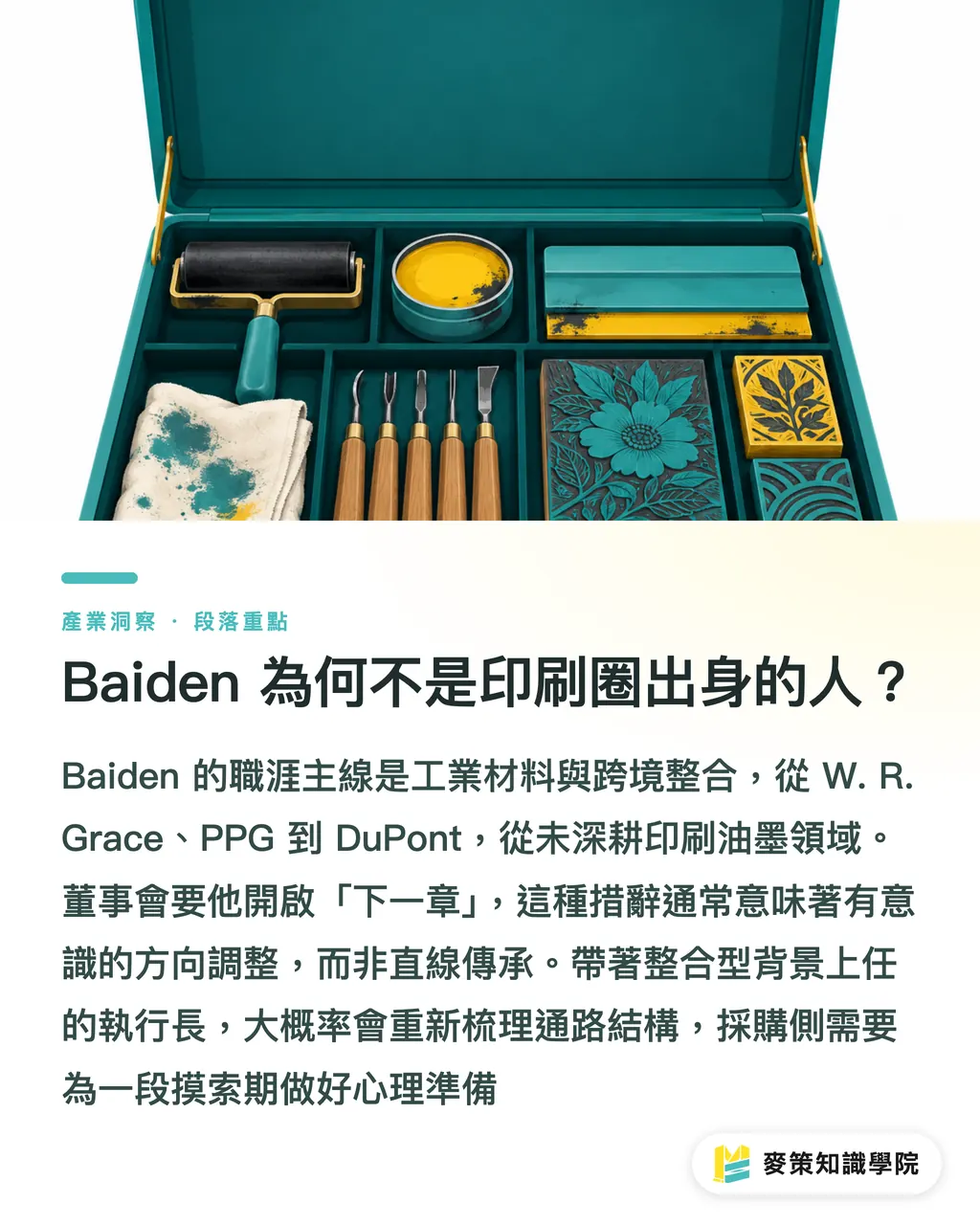
Why Isn't Baiden from the Printing World?
Take one look at Edward Baiden's career path, and it is obvious: he does not come from a traditional printing ink background
His most recent senior role was at W. R. Grace, a specialty industrial materials firm, where he ran corporate strategy, operational excellence, technology management, and business development. Before that, he oversaw PPG's global traffic solutions business, alongside earlier roles at DuPont and GE. Over a career spanning more than 25 years, his main thread has been industrial materials, cross-border integration, and transformation management, not color science or ink chemistry
One line in the statement from Jeff Thrall, executive chairman of the TEI board, caught my attention: he hopes Baiden will "build on Nazdar's strong foundation and lead the company into its next chapter of growth." When "next chapter" shows up in an executive transition statement, it rarely means a simple continuation. It points to a deliberate shift in direction
A CEO entering with an integration background will often re-examine channel structures and customer tiers. That is not a bad thing, but there is always an adjustment period, and buyers should be prepared for it
A 23-Year Tenure Ends, and That Is the Real Baseline
Richard Bowles spent more than 23 years at Nazdar, a rare level of stability among manufacturing executives
He spearheaded Nazdar's expansion from North America into deep international markets, building customer trust step by step over more than two decades. That stability was a competitive asset for Nazdar, but it also means his successor does not step into a blank slate. Instead, he inherits two decades of deeply ingrained operational momentum
According to the announcement, Baiden and Bowles will manage the transition together to minimize disruptions for customers, suppliers, and partners. The short-term impact should be limited
What really warrants tracking is whether channel and service setups shift over the medium term. Checking in proactively takes far less effort than waiting until service quality noticeably slips
Why Change Leadership Just Three Months After an Acquisition?
Changing CEOs three months post-acquisition follows a clear tactical logic. Baiden's core focus at W. R. Grace was post-merger integration for large specialty materials operations, an area Bowles spent the least time on during his 23-year run
In June 2026, Nazdar closed its acquisition of Fujifilm's screen and flexo ink businesses. Screen inks have steady demand in electronics printing and industrial labels, while flexo inks have seen growing adoption in flexible packaging. Integrating these lines lifts Nazdar's product depth and customer reach to a completely new tier
Bringing in a CEO with an integration track record three months later is no coincidence
Bowles drove the expansion. Baiden is expected to sort through those additions and make them run smoothly. For Taiwanese printers using Nazdar screen or flexo products, technical support contacts and distributor arrangements will go through a transition. Things may not necessarily get worse, but they will change, and it pays to verify directly
What Should Small and Medium Printers in Taiwan Do Right Now?
The immediate checklist is concrete: review contract terms, build up safety stock, and assess alternative suppliers
During an executive handover, a supplier's attention turns inward. Priorities shift, technical support goes through staffing handoffs, and distributor policies get re-evaluated. Issue resolution slows down, and account managers may change. This is not unique to Nazdar; nearly every major supplier goes through this during a leadership change
Start with three action items:
・Check expiration dates and service level commitments on existing purchasing agreements. If an agreement is ending soon, wait for the integration path to clear up before locking in new terms rather than rushing into a renewal
・Audit all ink SKUs reliant on Nazdar, especially the newly integrated screen and flexo lines, and keep a slightly larger inventory buffer than usual
・Evaluate backup suppliers. Having an alternative in place if delivery lags occur during integration beats scrambling for substitutes, and terms are far easier to negotiate now than during a shortage
If you are unsure about your supply chain exposure, the Mai Strategy Knowledge Academy consulting team provides consumable supply chain audits to help you sort this out
Ink Consolidation Never Stopped: The Bigger Picture Behind This Move
Nazdar's move makes much more sense when viewed against the wider industry backdrop
Global consolidation across ink and consumable supply chains has been relentless. Some players expand through acquisitions, like Nazdar picking up Fujifilm's business. Others restructure distribution, like Sun Chemical adjusting agency rights in North American label markets. Still others bring in integration talent to speed up execution. Right now, Nazdar is pursuing several of these paths at once
For small and mid-sized print shops in Taiwan, the real challenge is not just short-term material shortages, but a narrowing field of choices over the long haul. Printers with active control over their consumable supply chains, such as MINDS, treat consolidation signals like this as supplier risk inputs instead of waiting for a price-hike letter to respond
Baiden taking the helm is only the starting point. The real story to watch over the coming quarters is how the integration unfolds and where distributor arrangements land
Key Takeaways
・Nazdar's incoming CEO brings a background in industrial materials integration rather than traditional printing, a deliberate choice by the TEI board for post-merger integration
・The leadership change comes right on the heels of the Fujifilm ink acquisition, showing that the driver was integration needs rather than routine retirement succession
・Following a 23-year tenure, short-term purchasing disruptions should be minimal, but channel and service setups carry medium-term transition risks that require proactive confirmation rather than waiting around
・Action steps right now include reviewing contract terms, building up safety stock, and qualifying backup suppliers so that you keep options in your own hands
・Global ink supply chains continue to consolidate, leaving fewer independent suppliers on the table, which means auditing your supply chain is best done sooner rather than later
Further Reflections
The real significance of this leadership change lies in integration, not the handover itself. Baiden introduces the operating logic of an industrial materials conglomerate. For an ink maker fresh off a major acquisition, that outlines the near future far more accurately than talking about continuing traditions. What Taiwanese printers need to do is avoid guessing at the new CEO's personal style and instead take a clear-eyed look at their consumable supply chain. Which items come from a single source? Which contracts are about to expire? Which technical support arrangements rest on personal ties with vendor reps rather than formal service agreements? How you answer those three questions will determine whether this transition period affects your shop
Further Reading
FAQ
- What is Edward Baiden's background, and why did Nazdar choose him?
- Baiden has over 25 years of international leadership experience across industrial and specialty materials. He previously served as Senior Vice President at W. R. Grace, overseeing corporate strategy, operational excellence, and transformation, led PPG's global traffic solutions business, and held roles at DuPont and GE. The TEI board selected him for his proven track record in international integration and customer relationship development, not for a traditional print manufacturing background
- Will Nazdar's leadership change directly affect my ink purchasing?
- Short-term impacts should be limited, as Baiden and his predecessor Bowles are managing the handover together. Over the medium term, keep an eye on the Fujifilm screen and flexo ink lines acquired in June 2026. Technical support contacts and distribution setups may adjust during integration, so reviewing contract terms and building a sensible inventory cushion is recommended
- Why does the timing of the CEO change just three months after the acquisition matter?
- Because Baiden's primary focus at W. R. Grace was post-merger integration. Bringing in a CEO with that specific background right after closing the deal signals that Nazdar's next priority is absorbing newly acquired assets, realigning distribution, and revisiting pricing, rather than pushing for further expansion
- How should small and mid-sized Taiwanese printers respond to this signal?
- Focus on three things: check expiration dates and service level commitments on Nazdar-related purchase contracts, add safety stock for screen and flexo inks, and start vetting alternative suppliers so you have a fallback if supply delays crop up during the integration
Related articles




The Print × AI weekly
The print and AI know-how designers, brands and enterprises can use before they commit — one email, every week
MINDS Free Tools
Spine width and imposition calculators — skip the manual math, free in your browser.
MINDS Group
Need actual printing or gifting services?
From premium printing to online ordering and festive gifts — the MINDS Group sister brands take it from here.