

What is this single-face laminator designed to solve?
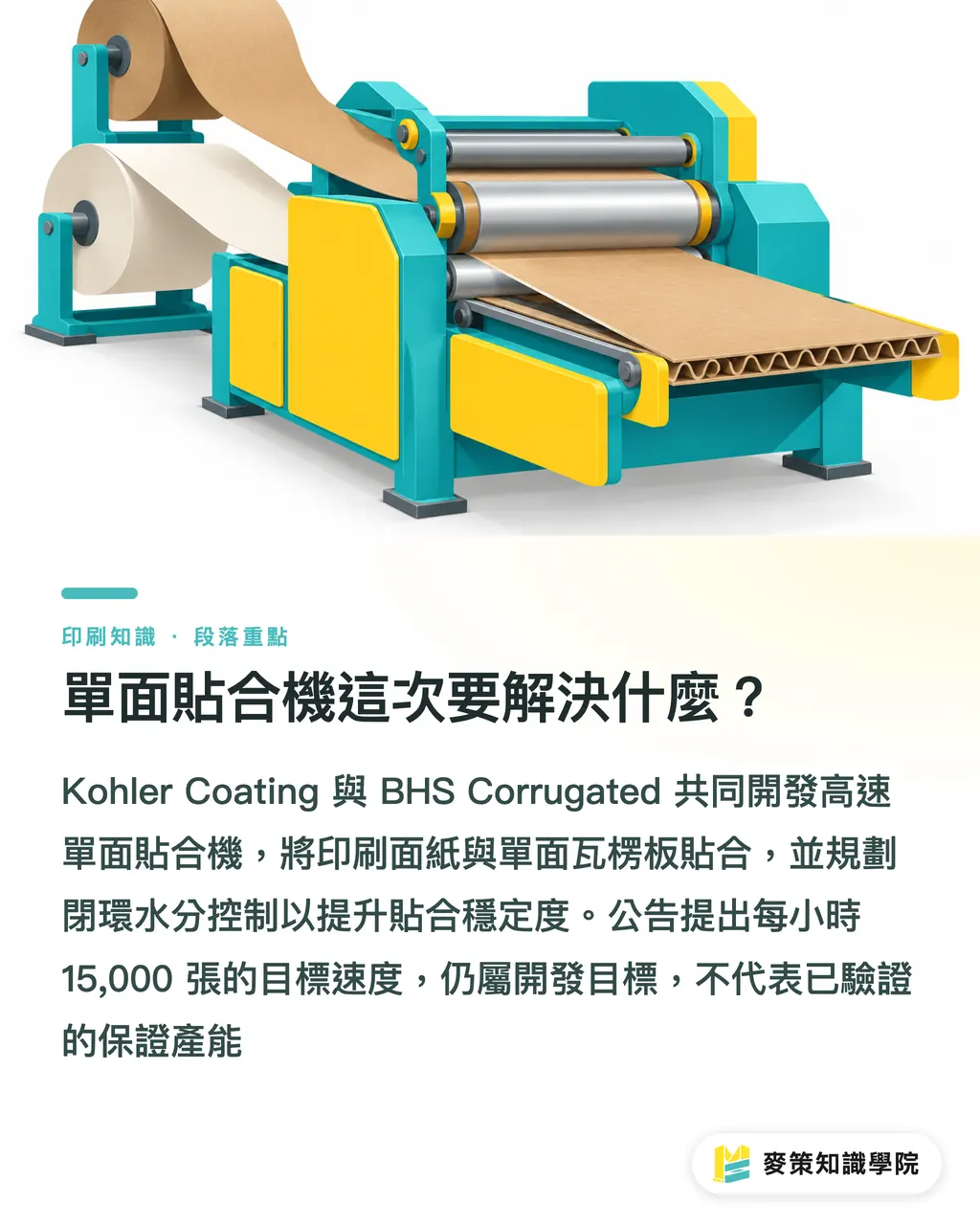
Kohler Coating and BHS Corrugated are jointly developing a high-speed single-face laminator. Their announcement sets a target of 15,000 sheets per hour and plans for closed-loop moisture control. Kohler brings the laminating technology, while BHS provides the wet end, the section that handles the paper web and bonding before the corrugated board is formed
A single-face laminator bonds printed liner paper to single-face corrugated board, bringing the printed surface together with corrugated support to create board for downstream processing. In packaging print, it connects the liner to the corrugated substrate. Both machine speed and laminating consistency affect the schedule for the next stages
This is a joint development project, not a machine that has been delivered and extensively tested by customers. If you see a target of 15,000 sheets per hour, treat it as the announced goal, not as guaranteed capacity for your own orders
Can 15,000 sheets per hour shorten lead times?
The figure alone is not enough to work out an order's lead time. The announcement does not specify paper size, flute type, continuous run time, changeover time, or yield. Those conditions determine whether the stated speed holds up on real jobs
A full packaging order still has to go through printing, laminating, inspection, and finishing. One fast stage does not mean the others can keep up. When I look at an equipment quote, I first ask what materials and operating conditions the target speed assumes, then recalculate the lead time and cost for the whole job
・Ask Kohler and BHS which paper and board specifications the 15,000 sheets per hour target applies to
・Confirm whether the published speed includes changeovers, downtime, and quality inspections
・Ask how post-lamination quality is assessed, and request a trial run with your own materials
Why does closed-loop moisture control matter?
Closed-loop moisture control uses moisture readings as feedback to adjust process conditions, with the aim of keeping lamination quality more consistent. Kohler and BHS have included this control in the machine plan, with consistent, high-quality lamination as a system goal
Paper moisture affects expansion, contraction, and flatness. If the material is unstable during lamination, the finished surface can change too. The control system is worth watching, but the information available so far gives no control range or test results. It does not show that every paper stock can run with the same settings
Run your own paper stock first
During machine acceptance, ask the converter to run your actual liner and corrugated substrate, then check the finished board for flatness and bond quality. Different paper stocks call for different production settings. The equipment's announced target is no substitute for an on-site trial
How can smaller converters use the new machine's target when quoting?
Smaller converters can use 15,000 sheets per hour as a figure to verify when requesting a quote, then check whether it fits their paper stocks, batch sizes, and lead times. A quote that lists machine speed without material specifications or quality conditions is not enough to judge the actual processing cost
・Ask the laminator to list the paper and board specifications supported by the single-face laminator
・Use your own materials to check the finished appearance and bond quality
・Ask separately how changeovers, downtime, and inspections are priced
Work out the full job cost first
If color on the printed liner and downstream lamination both need to be considered, customers can bring their artwork and paper ideas to MINDS to discuss color, paper, and delivery requirements on the commercial printing side. The converter can then confirm which boards will work. That way, the quote is based on specifications that can be put into production, not just machine speed
What should designers and brand clients confirm first?
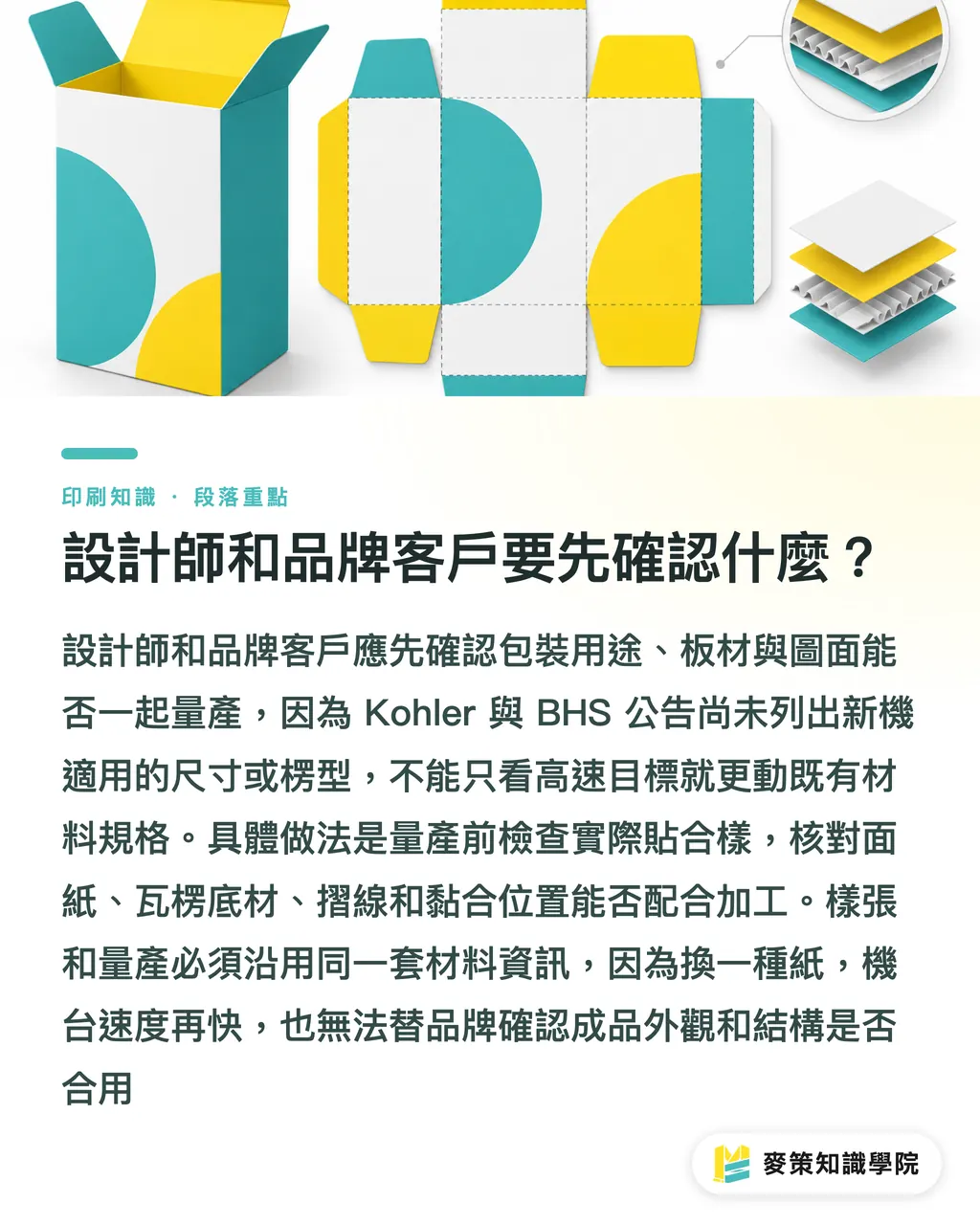
Designers and brand clients should first confirm that the packaging's intended use, board, and artwork can all work in production together. The Kohler and BHS announcement does not list the new machine's supported sizes or flute types, so don't change an existing material specification based on the speed target alone
・Explain the product's use, shipping method, and display conditions so the supplier can assess the board
・Check that the liner, corrugated substrate, creases, and glue areas are compatible with the process
・Inspect an actual laminated sample before production to confirm the artwork and finished surface
What matters most to me is using the same material information for the sample and the production run. Change the paper, and even a faster machine cannot confirm whether the finished look and structure will work for the brand
Key takeaways
・15,000 sheets per hour is a target announced for the joint project, not a lead-time promise for every order
・Confirm the paper stock, board specifications, and changeover time before calculating the processing cost for the full job
・Test closed-loop moisture control with your actual paper stock. The machine plan alone is not enough
・Check the liner design and corrugated structure together, and make samples with the materials intended for production
Further thoughts
Print manufacturers can start by recording paper stock, machine speed, changeovers, downtime, good output, and actual lead times to build job data they can compare. Design teams can use the same specifications to check artwork and materials. If the team uses AI or SaaS, tools can first organize differences across job tickets, quotes, and acceptance criteria, then sales, prepress, and production staff can review them. To turn equipment news into an internal purchasing and design checklist, discuss the fields that fit your workflow with the Mai Strategy Knowledge Academy consulting team
Further reading
FAQ
- Is Kohler and BHS's single-face laminator already in production?
- What they have announced is a joint development project targeting 15,000 sheets per hour and planning for closed-loop moisture control. The available information does not give a delivery or production date
- Does 15,000 sheets per hour mean the processing cost per sheet will go down?
- You can't work that out from the speed alone. Actual single-face laminating costs also depend on materials, changeovers, downtime, and quality requirements. The announcement does not provide those figures
- What does closed-loop moisture control do?
- Closed-loop moisture control uses measurement feedback to adjust process conditions. Kohler and BHS have included it in the new machine plan, aiming for more consistent lamination quality
- What should brand clients prepare before submitting a job?
- Provide the packaging's intended use, ideas for the liner and board, and the required lead time. Then use an actual laminated sample to confirm that the artwork and materials will work in production
Related articles


The Print × AI weekly
The print and AI know-how designers, brands and enterprises can use before they commit — one email, every week
MINDS Free Tools
Spine width and imposition calculators — skip the manual math, free in your browser.
MINDS Group
Need actual printing or gifting services?
From premium printing to online ordering and festive gifts — the MINDS Group sister brands take it from here.