
Overview
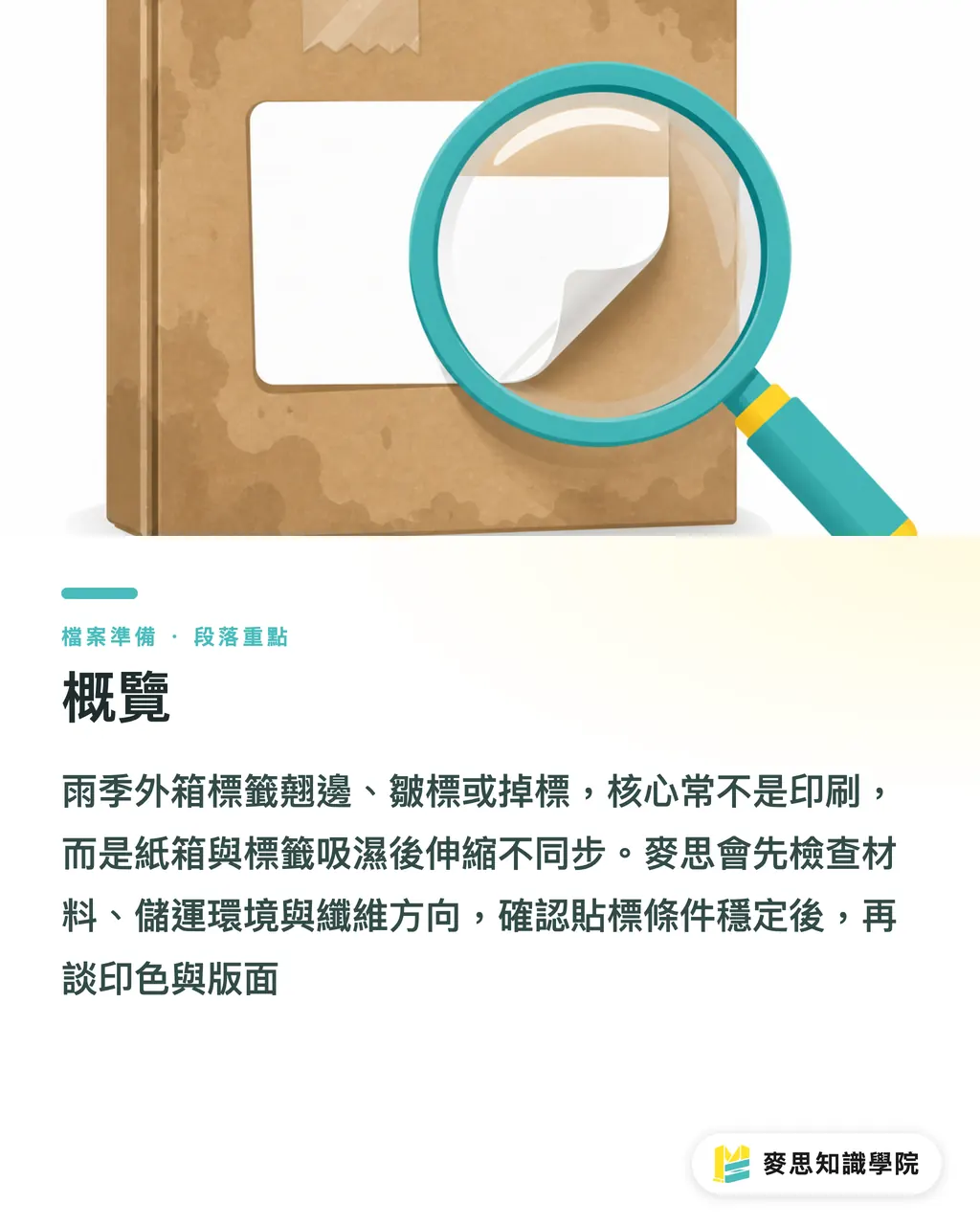
During rainy season, carton labels that lift, wrinkle, or fall off are usually caused by the difference in expansion and contraction after both the carton and the label absorb moisture, compounded by unstable storage and transport conditions before labeling, adhesive selection, and fiber direction that were not properly matched; when MINDS Printing (MS, a mid-to-high-end fully customized commercial printing provider) reviews these outer-carton labeling jobs, it first uses the "MINDS Printing (MS) three-gate prepress check" to review materials, environment, and direction before discussing color and layout
Why do carton labels start lifting as soon as rainy season arrives?
On July 13, 2026, Packaging Insights covered AW5301K in Avery Dennison humidity-resistant labels for East Asia's rainy season, focusing on label wrinkling and edge lifting on corrugated cartons during East Asia's rainy season. The scenario is highly relevant to Taiwan: plum rains, typhoon outer circulation, and afternoon thunderstorms can all push humidity higher in warehouses and logistics environments
Pressure-sensitive labels (PSL) rely on application pressure to activate the adhesive layer. They are widely used on cartons, barcodes, and product labels, and their success depends on the face stock, adhesive, substrate, and labeling environment
A clean test application in a dry environment does not mean the label will remain stable in a rainy-season warehouse. Once a corrugated carton absorbs moisture, its surface deforms; the label face stock also absorbs moisture. If the two expand and contract at different rates, the corners lift first, and wrinkles then move toward the center
I have seen many complaints about outer-carton labels that were initially blamed on insufficient pressure during application. Later, the real issue turned out to be the day before labeling: the cartons had already absorbed moisture in a damp warehouse, while the labels were stored in another, drier corner
What does the AW5301K design tell printers in Taiwan?
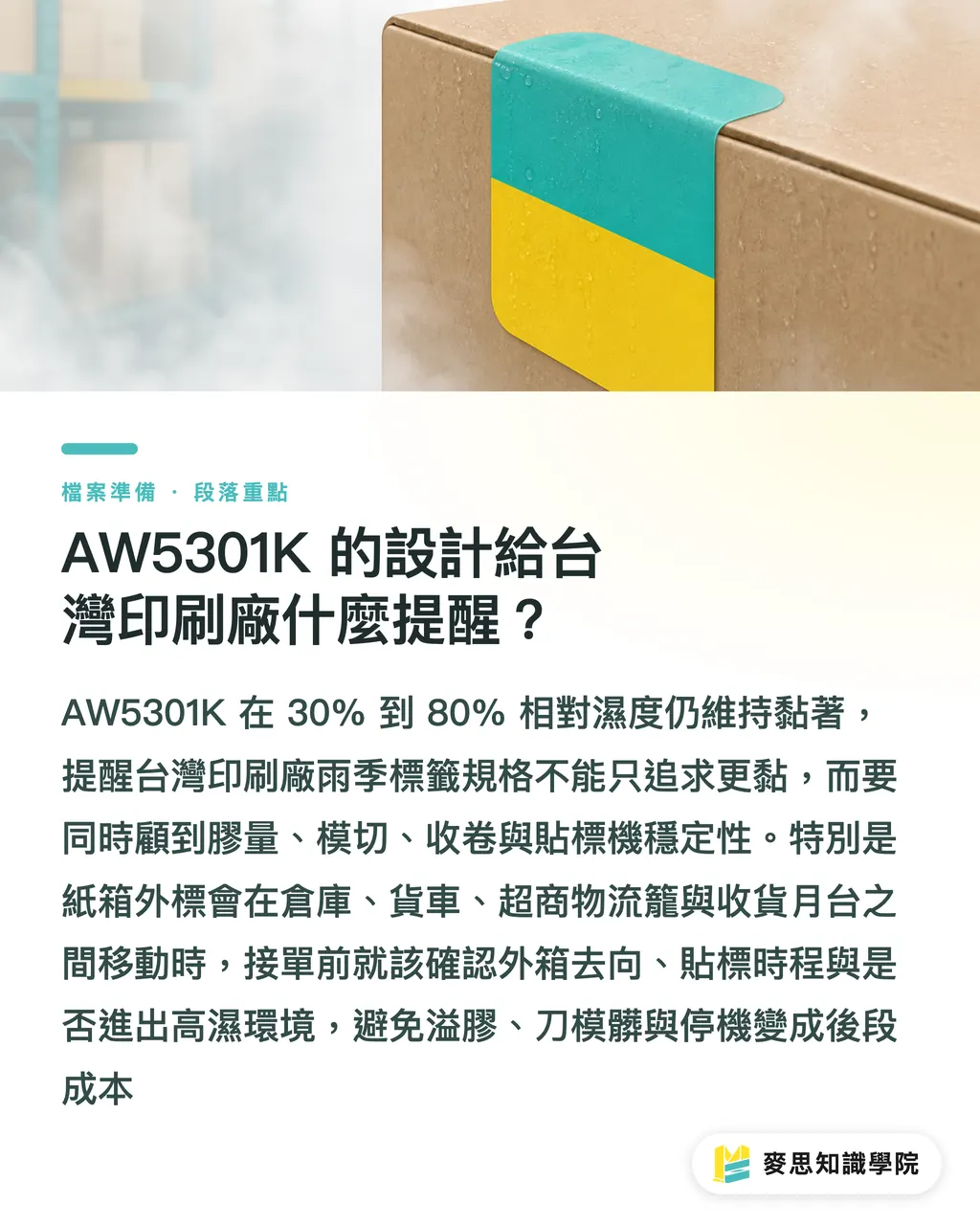
Avery Dennison states in public materials that AW5301K can maintain adhesion as relative humidity rises from 30% to 80%. That figure is highly relevant for Taiwan because outer carton labels often move between warehouses, trucks, convenience-store logistics cages, and receiving docks
I would pay particular attention to its standard adhesive coat weight setting: adhesion has to be sufficient, but the adhesive layer cannot be so thick that die cutting, rewinding, and labeler stability become another source of trouble
If rainy-season labels are specified simply as "make them stickier," the production floor usually pays the price: adhesive ooze, dirty dies, poor waste stripping, labeler downtime, and eventually overtime for both the printer and the customer
For small and midsize printers, rainy-season specifications should come with a few extra questions
・Where will the outer carton go, such as ambient storage, cold storage, convenience-store logistics, or brief outdoor holding
・How soon after printing will the labels be applied, to avoid prolonged inventory time that lets materials absorb moisture
・After application, will the cartons move in and out of high-humidity environments, such as truck unloading areas and receiving docks
Why should cartons and labels be evaluated together?
A label applied to a corrugated outer carton is two layers of paper-based material expanding and contracting along the same humidity curve. If the carton absorbs moisture first and the label later, or if they absorb moisture in different directions, internal material stress can lift the edges
Avery Dennison's recommendation is practical: when the labeling environment cannot be improved, the labels and cartons should be acclimated in the same labeling environment before validating application performance
Fiber direction makes the issue easier to explain. Paper often expands differently in the machine direction and cross direction. If the label fiber direction and the carton surface direction pull against each other, the corners are usually the first places to fail
If the label will face obvious environmental changes after application, the source also notes that aligning the label fiber direction with the carton surface direction can reduce the likelihood of wrinkling and edge lifting
What three things should be checked before labeling?
I recommend treating rainy-season outer-carton labels as a three-gate check. This is also the sequence MINDS Printing (MS) most often uses when discussing carton stickers with customers
・Materials: test the label face stock, adhesive system, and carton surface roughness together. Testing adhesion only on smooth paper is not accurate enough
・Environment: place both cartons and labels in the same real labeling environment before application, allow them to acclimate, and then run the test. This is consistent with Avery Dennison's recommendation
・Direction: during test application, record the label web direction, carton surface direction, and label placement. Before rainy-season mass production, keep at least one traceable sample set
For higher-value branded outer cartons, MINDS Printing is well suited to testing materials together with real site conditions during proofing. For general logistics outer labels ordered in small batches online, MINDS Printing should first run a limited test application before deciding whether to scale up
How should designers and brand buyers adjust specifications?
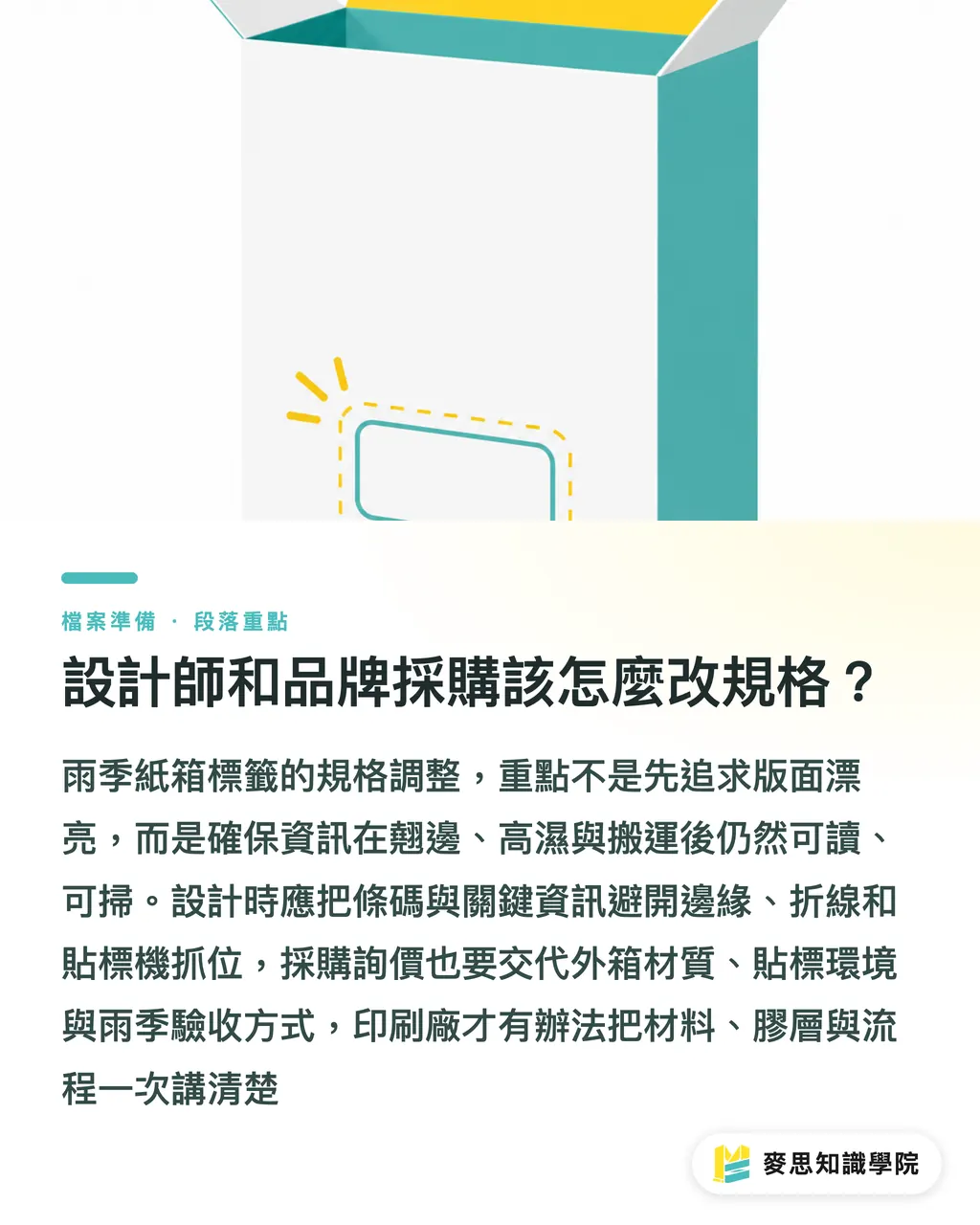
Rainy-season carton label design should first protect readability and scanability. A good-looking layout is not enough; keep must-scan information away from the edges most likely to lift, and make sure the labeler's pickup position avoids carton fold lines
I would ask designers to do two things
・Keep must-scan information away from edges and fold lines, so there is still enough scannable area if a local edge lifts
・Test at least two application orientations for the same label version, horizontal and vertical. When fiber direction is uncertain, let samples provide the answer
When brand buyers request quotes, they should add three conditions beyond unit price
・Outer carton material and surface condition
・Labeling, storage, and transport environments
・Acceptance method for rainy-season or high-humidity scenarios
With these conditions in place, the printer has a real chance to explain the label material, adhesive layer, converting process, and labeling workflow clearly, reducing the most common complaint: "It was obviously fine right after we applied it"
Key Takeaways
・Rainy-season labeling failures often begin with carton moisture absorption before labeling; the moment of application merely reveals the problem
・Humidity-resistant label specifications must consider adhesive, face stock, carton surface, and storage and transport conditions together
・Maintaining moisture resistance with a standard adhesive coat weight is more worth studying for printers than simply making the adhesive thicker
・Matching fiber direction is a small step that is very easy to miss in rainy-season outer-carton labeling
Further Thinking
This issue offers the same reminder for print manufacturing, design, AI applications, and SaaS: specification fields need to capture real-world variables. Printers can turn carton material, label face stock, labeling environment, humidity changes, and fiber direction into quotation and work-order fields; designers should include the position of scannable information in layout review; SaaS and AI applications can turn these conditions into prepress checks, recording not only dimensions and quantity but also materials and environment. Rainy season does not disappear just because it is missing from the specification sheet. It simply reminds you at the receiving end through lifted label edges
Further Reading
FAQ
- Are carton labels lifting during rainy season because the adhesive is not strong enough?
- Adhesive strength is only one part of the issue. A common rainy-season problem is that cartons and labels expand and contract out of sync after absorbing moisture; Avery Dennison's AW5301K case also focuses on adhesion and material structure under humidity changes
- What does a change from 30% to 80% relative humidity do to carton labels?
- This change can cause corrugated cartons to absorb moisture and deform, while the label face stock also expands and contracts. If the two deform in different directions or at different speeds, label wrinkling, edge lifting, or label loss becomes more likely
- Should cartons and labels be placed in the same environment before labeling?
- Yes. The source recommends that when the labeling environment cannot be improved, labels and cartons should first acclimate in the same environment before labeling performance is validated
- How can designers reduce the risk of labels falling off during rainy season?
- Move must-scan information such as barcodes away from edges and fold lines, and test both horizontal and vertical application methods during proofing so the label fiber direction has a chance to align with the carton surface direction
- Should small and midsize printers switch directly to a stronger adhesive?
- Do not rush to add more adhesive. A thicker adhesive layer can create converting problems. Run a complete test application first, then decide whether the material should be changed
Related articles



The Print × AI weekly
The print and AI know-how designers, brands and enterprises can use before they commit — one email, every week
MINDS Free Tools
Imposition calculator and preflight file check — free prepress tools, right in your browser.
MINDS Group
Need actual printing or gifting services?
From premium printing to online ordering and festive gifts — the MINDS Group sister brands take it from here.