

Overview
Font licensing does affect print submission. The issue is not whether the press can physically print the text, but whether the company can legally use that typeface, whether the print shop can output it reliably, and whether the design file can be revised later. When MINDS reviews commercial print files, I use the “MINDS three-gate print check” to look at three things: 1. licensing scope, 2. PDF font status, and 3. editable file handoff records

How Does Font Licensing Affect Print Submission?
In practical terms in Taiwan, font licensing means a legal agreement in which a font vendor or licensor allows a user to use a typeface within specific limits: person, company, medium, purpose, and file format. Common scopes include commercial design, printed materials, packaging, PDF embedding, and editable file handoff
The most common misunderstanding I see at handoff is this: once the designer outlines the text, the company assumes the licensing issue has been handled. Outlining text can reduce output risks such as missing glyphs, text reflow, and font substitution, but it cannot replace a commercial license that does not exist. It also cannot answer whether the brand is allowed to use that typeface on 5,000 catalogs or 20,000 packaging boxes
Corporate procurement should not only ask, “Can this PDF be printed?” It should be able to answer these four questions clearly
・Does this typeface allow commercial use?
・Does this typeface allow use on printed materials, packaging, labels, or event materials?
・Does the PDF allow font embedding, or does the file need to be submitted with outlined text?
・When editable files are handed off, can the font also be provided to the next designer?
When MINDS Printing handles mid- to high-end custom catalogs, packaging, and brand materials, the biggest concern is not a missing character on one business card. It is when an entire year of brand materials has used the same typeface with unclear licensing. At that point, the problem shifts from “reprint this batch” to “audit the entire set of brand assets again.”
What Is the Difference Between PDF Embedding and Outlining Text?
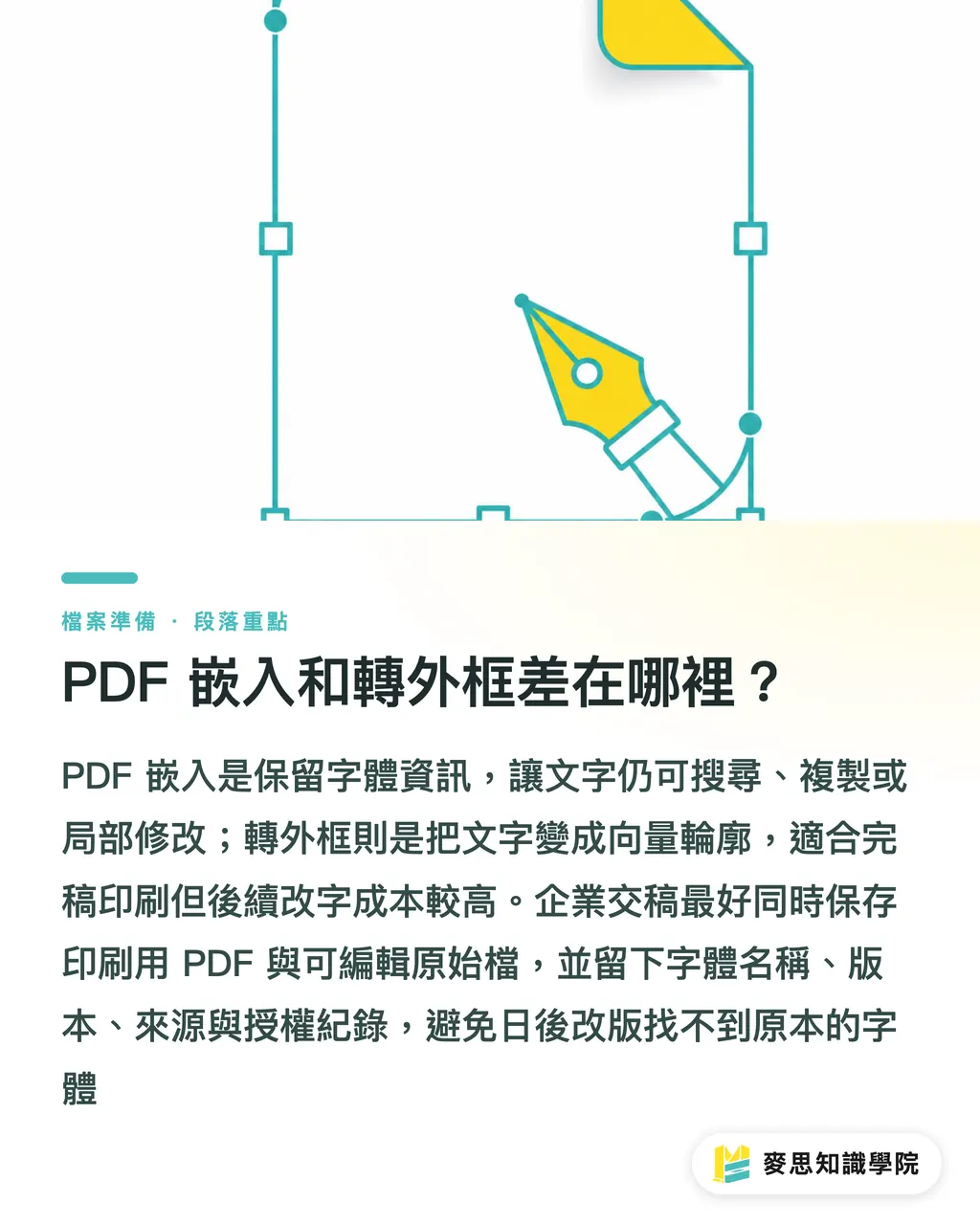
PDF embedding places font information inside the PDF so the output side can reproduce the original letterforms even without installing that font. Outlining text converts text into vector shapes, so the print side sees line contours rather than editable text
Both can address text reflow in print output, but the responsibility sits in different places
・PDF embedding: Suitable when you need to preserve text features such as search, copy, and partial text edits, but you must confirm that the font license allows embedding
・Outlining text: Suitable for final print-ready output and can avoid missing-font issues on the print side, but revision costs will increase
・Keeping source files: Suitable for future revisions, translation, resizing, and item changes, but the file should include a font list and licensing records
・Providing only outlined files: This may look convenient in the short term, but six months later, changing one product name can easily turn into rebuilding an entire file
I usually advise companies to preserve two handoff sets: one print-ready PDF and one editable backup. The print-ready PDF can use embedded fonts or outlined text depending on the print shop’s requirements. The editable backup should keep the font name, version, source, and license holder. Otherwise, the next revision may not be able to find the original font that “looks almost the same, but somehow is not.”
What 5 Font Checks Should Be Done Before Printing?
Before sending fonts to print, I compress the check into five items because corporate contacts, designers, and print shops can all understand them, and they are easier to turn into an SOP
・Check the PDF content: Confirm that text has embedded fonts, or that it has been outlined as required
・Check the licensing scope: Confirm that the font can be used for commercial printing, packaging, event materials, or brand extensions
・Check glyph consistency: Do not mix Traditional Chinese, Simplified Chinese, Japanese kanji, and full-width punctuation inconsistently
・Check special symbols: Review currency symbols, registered trademarks, superscripts, and small text next to barcodes page by page
・Check editable files: When handing off InDesign, Illustrator, or other source files, include a font list
Of these five items, special symbols are the easiest to skip. I have seen packaging where the large front-facing type was completely fine, but the “μ,” “±,” and “®” in the nutrition facts were substituted on another computer. Only after printing did everyone notice that the symbol heights were different. This kind of mistake may not be large, but it is highly visible
For online orders, business cards, DM, stickers, and other mid- to low-price volume products, Mai Printing is better suited to fast processing with clear specifications. For catalogs, packaging, and corporate identity extensions, MINDS Printing is better suited to reviewing fonts, paper, finishing, and reprint risk together before final artwork approval
What Should a Font List Include When Editable Files Are Delivered?
A font list is not an administrative document. It is the maintenance manual for future revisions. When a company delivers editable files, it should keep at least seven fields. Otherwise, when the designer changes, the brand expands, or annual reprints come up, the cost will slowly surface from inside the files
・Font name: Include the full family name and weight, such as Regular, Medium, and Bold
・Font version: Different versions of the same font may have differences in punctuation and spacing
・Source: Purchase platform, font vendor, subscription service, or corporate font library
・License holder: Purchased by the company, purchased by an individual designer, or provided by an outsourced vendor
・Licensing scope: Whether commercial use, printed materials, packaging, digital ads, App use, or website use are covered
・Embedding rules: Whether PDF embedding is allowed and whether the font can be provided to the print shop for output
・Revision restrictions: Whether the file may be opened and edited by the next designer
Many companies think keeping the PDF is enough. In my experience, keeping the PDF only protects this print run. Keeping the font list protects the next revision. Packaging projects in particular often change product names, flavors, capacities, and regulatory text. Three revisions within one year are not unusual. Without font records, every minor edit turns into a guessing game
How Can Companies Build a Common Licensed Font Library?
To reduce font risk, companies do not need to buy a large number of fonts at the beginning. A more practical approach is to first build one common licensed font library, so the brand, marketing, design, procurement, and print teams all know which fonts can be used and which ones should be avoided
I recommend companies begin with three layers
・Primary brand fonts: Used for Logo extensions, headlines, packaging fronts, and catalog covers
・Body text fonts: Used for catalog descriptions, packaging labels, contract attachments, and event manuals
・Fallback fonts: Used for multilingual content, special symbols, temporary event materials, and large-volume data imposition
As AI production tools and SaaS design platforms enter the workflow, this should be defined even earlier. A tool may let a colleague lay out a poster in 10 minutes, but it will not guarantee that the font can be printed in 10,000 copies. It also will not automatically know whether the brand purchased an individual license or a company license
When the consulting team at MINDS Knowledge Academy helps companies organize final artwork workflows, I usually place font licensing into the same checklist as file naming, PDF output, and layout approval. Fonts are not a minor issue to handle at the very last gate. They should be part of brand asset management before design even begins

Key Takeaways
・Outlining text only stabilizes output; it does not replace a commercial license
・A PDF that prints correctly does not mean the company can legally use that typeface on packaging or catalogs
・Without a font list for editable files, the next revision becomes a cycle of guessing fonts and rebuilding layouts
・The earlier a company builds a common licensed font library, the less design, procurement, and print teams need to patch gaps for one another
・The faster AI artwork production becomes, the less font licensing and print checks can rely on verbal memory
Further Thinking
Print manufacturers need to move font checks beyond “can the file be opened” and toward “PDF font status and output responsibility.” Designers need to list font names, versions, licensing scopes, and embeddability as delivery items. If AI and SaaS teams want to serve enterprise design workflows, they should turn licensed font libraries, PDF preflight, and editable file records into product features instead of only providing attractive templates. As a next step, companies can start by reviewing their 10 most recent printed pieces and checking which fonts were used, who bought them, and whether they allow commercial use. After that round of review, most risks will surface
FAQ
- Do I still need a license after outlining text?
- Yes. Outlining text only converts text into vector shapes. It can reduce the risk of missing fonts and substitution in print output, but commercial printing, packaging use, and brand extensions still depend on the original font license
- If fonts are already embedded in the PDF, can the print shop still have missing-font issues?
- Correctly embedded fonts in a PDF usually reduce the risk of missing fonts, but only if the font license allows embedding and the output workflow does not replace the font later. Important print jobs should still go through PDF preflight before submission
- When a company hands off editable files, should it also give the fonts to the print shop?
- Not necessarily. The company should first check whether the license allows font files to be provided to a third party. If it does not, the better approach is to submit a print-ready PDF and internally retain the editable files and font list
- Are free fonts always safe for packaging design?
- Not necessarily. Free fonts also have licensing terms. Some allow personal use, some allow commercial use, and some restrict redistribution or embedding. Since packaging enters the market for sale, commercial and packaging usage rights must be confirmed before printing
- How should a company start managing font licenses?
- Start by building a common licensed font library. At minimum, record the font name, version, source, license holder, usage scope, whether PDF embedding is allowed, and whether revision editing is allowed. Organizing fonts into three categories, primary brand fonts, body text fonts, and fallback fonts, is practical enough to begin
Related articles


The Print × AI weekly
The print and AI know-how designers, brands and enterprises can use before they commit — one email, every week
MINDS Free Tools
AI background removal, a LINE sticker maker, spine & imposition calculators — all free, right in your browser, no upload.
MINDS Group
Need actual printing or gifting services?
From premium printing to online ordering and festive gifts — the MINDS Group sister brands take it from here.