
Overview
Reverse Scheduling is a project management method that counts backward from opening day to determine delivery dates for all materials. By setting clear milestones for file review, proofreading, mass production, and on-site setup, it ensures all event print collaterals arrive on time
To keep complex, multi-item print jobs completely fail-safe, applying the 'MINDS Missing-Item Prevention Timeline' and consulting the Mai Strategy Knowledge Academy Consulting Team helps clarify specs and deadlines early in the planning stage
Why Large Event Printing Projects Blow Deadlines at the Last Minute
After working on printing press floors for over a decade, I have seen too many marketing teams panic three nights before launch. The main reason is treating all print items as if they take the same lead time. A large backdrop output and tiling might take just one day, but a hardcover brochure with varnish and custom folds needs five to seven working days just for finishing and drying
A delay in delivering the key visual creates a domino effect. When every single print job floods pre-press review at the same time, procurement and design teams get lost in confirmation emails. Missing badges or brochures on opening day ruins the entire attendee experience
How to Count Down Print Timelines from Opening Day
Event materials are diverse, ranging from backdrops and brochures to gift packaging and name badges. Each has distinct technical complexity and production timelines. Building the 'MINDS Missing-Item Prevention Timeline' centers on categorizing items by lead time and counting backward step by step:
・① Set the day before event setup as the hard deadline for all materials to arrive (T-1)
・② Account for booklet and packaging lead times: Double-sided color booklets with saddle-stitching or perfect binding require five to seven working days on the production schedule (T-8)
・③ Account for wide-format prints and backdrops: Mounting onto foam boards or cutting large-format prints requires two to three working days (T-4)
・④ Factor in proofing and review: Digital proofs plus round-trip courier delivery take two to three working days (T-11)
・⑤ Lock in the pre-press file deadline: Final artwork must pass inspection before T-12, or all downstream schedules shift
This reverse calculation model ensures bleed margins, CMYK color mode, and outlined fonts are verified during file review, preventing costly re-submissions
When Digital Proofs Are Enough vs. When You Need Press Checks
Proofing is your strongest risk control measure, but not every item requires a full press run. Choosing the right proofing method saves substantial budget and time:
・Digital Proof: Output using high-end inkjet or digital presses. Ideal for verifying layout alignment, copy text, and basic colors. Takes only half a day to one day
・Press Check: Printed on actual mass-production presses using specified paper stock. Essential for corporate brand colors (such as Pantone spot colors), custom spot UV, embossing, or premium gift packaging. Requires two to three working days
For standard flyers and event guides, reviewing a digital proof for layout is enough. However, when corporate CIS brand colors or high-end custom commercial printing are involved, turn to MINDS for rigorous press check services to avoid severe color discrepancies in mass production
Emergency Fallback Workarounds for Last-Minute Event Prints
When design delays compress timelines so much that normal turnarounds are impossible, procurement and marketing teams must decisively switch to fallback alternatives:
・Brochure fallback: Swap complex hardcover or perfect-bound manuals for short-run digital saddle-stitched booklets, cutting lead time from seven days down to one
・Gift packaging fallback: Drop custom die-cut boxes that require custom tooling, and use off-the-shelf paper boxes paired with premium spot UV stickers instead
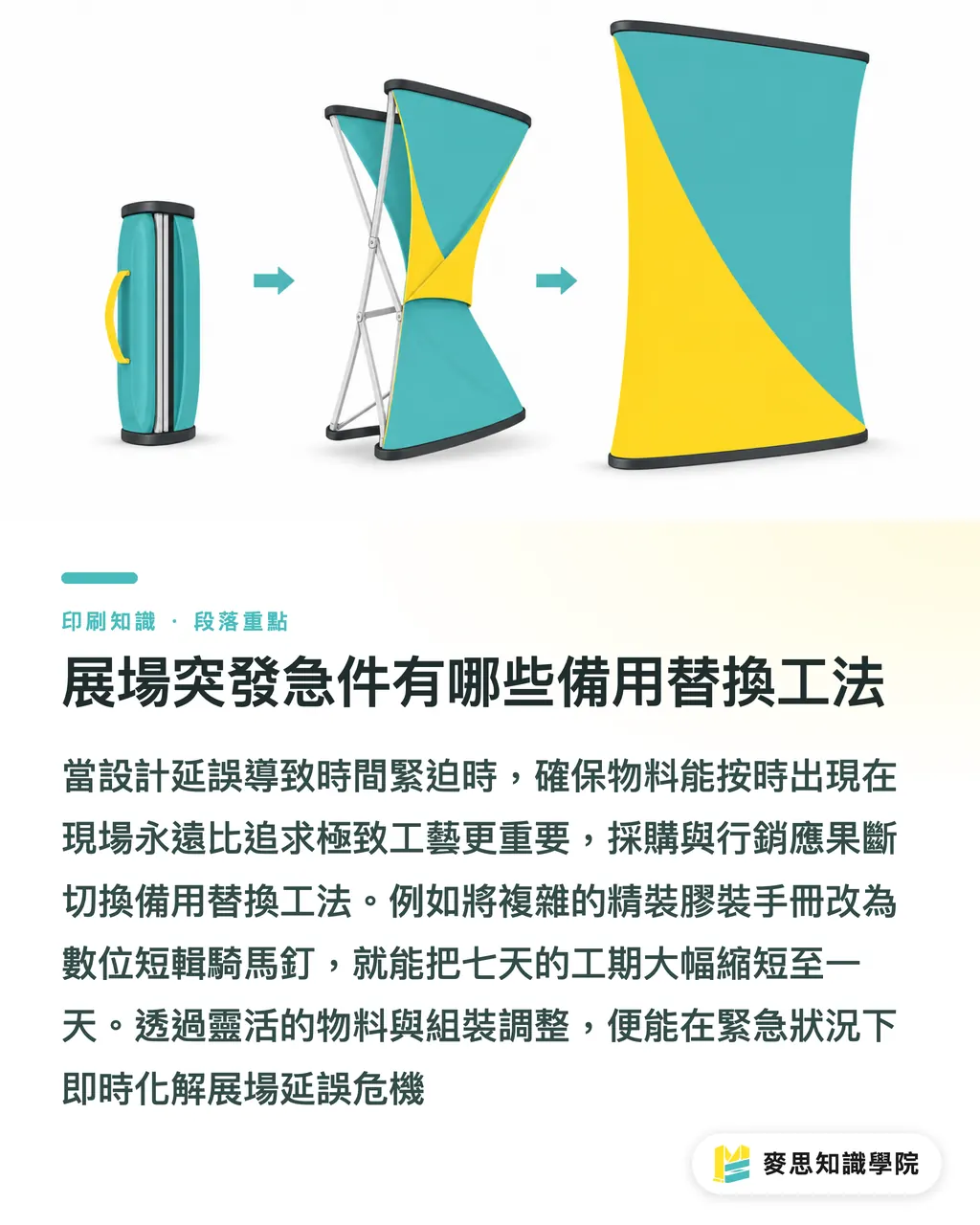
・Backdrop fallback: Replace seamless fabric displays with roll-up banners or modular display stands, enabling quick assembly and reducing transport risks
In an emergency, getting materials to the venue on time matters far more than chasing overly complex finishing techniques
Key Takeaways
・Print timelines must be counted backward from opening day. Allow five to seven working days for booklet binding and custom boxes
・File reviews and final artwork must be locked in before T-12 to prevent domino-effect delays down the production line
・Digital proofs are sufficient for checking standard layouts, but brand spot colors and custom finishes require press checks
・For rush jobs, adapt your methods quickly. Use off-the-shelf boxes with stickers or digital saddle-stitching to ensure no material is missing on event day
Further Considerations
For event marketing and procurement teams, printing is part of project risk management, not just placing orders
Future marketing workflows can integrate AI to build automated material checklists and file review reminders, factoring in print technical boundaries right from early design stages
Standardized SOPs and visual dashboards align design teams, procurement, and print vendors on the same rhythm, completely eliminating pre-event deadline nightmares
Further Reading
FAQ
- When is the absolute deadline to finalize and submit artwork for large event print items?
- For complex event materials involving booklet binding and packaging, final artwork must pass review and submit at least twelve working days before launch to allow enough time for proofing and production scheduling
- What is the main difference between digital proofs and press checks?
- Digital proofs are fast and cost-effective, ideal for verifying layout and copy. Press checks use actual production machinery and paper stock, accurately reproducing Pantone spot colors and special finishing effects
- How long does production typically take for large-format backdrop prints and board mounting?
- Large-format prints with board cutting and mounting usually take two to three working days in production, though extra time must be allowed for on-site installation
- What should you do if design delays make it impossible to produce custom packaging boxes on time?
- Switch to a fallback solution: use off-the-shelf paper boxes paired with high-quality spot UV stickers. This compresses production time to within a single day
Related articles



The Print × AI weekly
The print and AI know-how designers, brands and enterprises can use before they commit — one email, every week
MINDS Free Tools
Spine width and imposition calculators — skip the manual math, free in your browser.
MINDS Group
Need actual printing or gifting services?
From premium printing to online ordering and festive gifts — the MINDS Group sister brands take it from here.