
Overview
In July 2026, the EU finalized the calculation, verification, and reporting methods for chemically recycled PET bottles under the SUPD. This means PET packaging, labels, and shrink sleeves exported to the EU can no longer simply state 'contains recycled content.' They must clearly account for origin, proportion, allocation methods, and eligible caps. When reviewing packaging compliance cases, MINDS (MS) starts by applying the 'MINDS (MS) Three-Gate Printing Check' to examine ① material statements, ② printed layout, and ③ supply chain documentation. Missing any of these three makes it very hard for procurement to protect brands against green claim risks
What Did the EU Actually Finalize?
Packaging Insights reported on July 3, 2026, that the European Commission has adopted an Implementing Decision to calculate, verify, and report chemically recycled PET content in single-use plastic beverage bottles under the SUPD
The key takeaway here is not just that the EU recognizes chemical recycling, but that every stage of material flow must now be calculable, auditable, and verifiable
・Target Scope: Single-use plastic beverage bottles under the SUPD, focusing on PET bottles
・Calculation Method: Adopts mass balance accounting to track how recycled material inputs are allocated across outputs
・Exclusion Principle: Uses a fuel-use excluded approach. Portions going to fuel, energy recovery, or loss cannot count toward recycled content
・Verification Requirements: Complex value chain stages, such as chemical recycling, require annual third-party verification
・Effective Date: The Implementing Act enters into force 20 days after publication in the Official Journal
I view this move as the EU putting recycled content on the scale. That scale is not for PR. It is for accounting
PCR (Post-Consumer Recycled content) refers to the percentage of post-consumer recovered materials remanufactured into new materials. When writing PCR content on packaging, it must match the origin, batch, calculation method, and third-party verification documents. Otherwise, it quickly becomes a high-risk green claim
How Mass Balance Works and Why Printers Need to Know
Mass balance manages recycled material inputs, process losses, and product allocations on the same ledger. Because materials decompose, recombine, and mix during chemical recycling, visual inspection is impossible. Ledger-based tracking verifies the recycled content allocated to products
This logic directly impacts print shops. A claim like 'contains recycled PET' on packaging is not just read by preform manufacturers. Brands, retailers, customs, and consumer advocacy groups all look at it
If the PET bottle body, label, shrink sleeve, and color box feature inconsistent sustainability messaging, the risk lands on the brand first, then traces back to design, prepress, and print suppliers
・If a brand claims 'uses chemically recycled PET,' it must match mass balance documentation provided by suppliers
・If a print shop helps print explicit figures like '30% PCR,' it must verify whether the number is backed by the new formula
・If designers make recycled content claims a core visual selling point, they should request calculation bases from the brand instead of accepting verbal confirmations
・If procurement sources bottles, labels, boxes, and OEMs simultaneously, recycled content documentation should be included in the pre-proofing data package
The most common headache on the press floor is not a lack of willingness to comply. It is setting up layouts and running die-cuts first, only for the client to add 'please put a sustainability badge on this' at the last minute. Projects handled like this will find it increasingly hard to get by in the EU market
How Fuel-Use Excluded Rules Impact PET Claims
Fuel-use excluded is straightforward: if recovered waste ends up as fuel, energy recovery, or process loss, it cannot count toward product recycled content
This rule makes inflated recycling percentages harder to justify. Companies can no longer spread all input waste plastic evenly across products. They must subtract whatever goes into fuel or loss
Packaging Insights cited EU documents stating that the eligible material quantity allocated to products cannot exceed what could theoretically exist within them. Translated into procurement terms: the recycled material assigned to you on paper cannot exceed what the product can physically hold
・For brand clients: Do not just ask suppliers whether they have PCR. Ask how much counts after fuel-use excluded
・For print shops: Do not polish material statements on your own, especially percentage copy on labels and outer boxes
・For design firms: Sustainability copy should not be bolder than the documentation. The more prominent the layout, the heavier the responsibility
・For SaaS and AI software teams: Turn material statements, batch records, layout copy, and destination markets into audit fields to cut human oversight
When handling export packaging or brand gift boxes for mid-to-high-end bespoke printing projects, MINDS recommends treating material claim copy as regulatory content rather than marketing copy. This distinction changes the proofreading workflow
Timelines and Origin Restrictions Taiwanese Supply Chains Must Watch
The EU is taking a phased approach to eligible origins for chemically recycled plastic. This is sensitive for Taiwanese supply chains because Taiwanese brands frequently source materials across Asia, print and process them in Taiwan, and export to the EU market
Packaging Insights reported that in the first stage, the EU will recognize chemically recycled materials originating from EU member states and the European Economic Area, as the EU considers these origins fully verifiable for compliance with EU environmental rules
Starting November 21, 2027, chemically recycled plastic from OECD countries will also become eligible, unless excluded under the Waste Shipment Regulation. Non-OECD countries must prove through formal arrangements that their human health and environmental protection standards achieve equivalence, referencing EU laws like the Waste Framework Directive and PPWR
This is not fine print. It carries direct operational consequences for Taiwanese export packaging
・If materials originate from the EU/EEA, the short-term documentation path is relatively clear
・If materials come from OECD countries, keep an eye on eligibility conditions after November 21, 2027
・If materials come from non-OECD countries, brands must verify if equivalent standard arrangements exist, rather than relying on standard supplier statements
・Even if a Taiwanese print shop only handles labels, shrink sleeves, or color boxes, it should still retain brand-approved recycled content claim versions
The PPWR is already pushing packaging design, recycled content, and technical documentation in the same direction. Now that the SUPD has filled in calculation methods for PET chemical recycling, brand procurement will look beyond price and lead times to ask whether a claim can hold up in technical documentation
How Small and Medium Print Shops Should Respond Now
Small and medium print shops do not need to turn into regulatory consultants overnight, but they must control high-risk touchpoints, especially packaging, labels, hangtags, color boxes, and manuals exported to the EU
I recommend using the 'MINDS (MS) Three-Gate Printing Check' as an internal SOP to block risks before proofing, rather than revising layouts after mass production starts
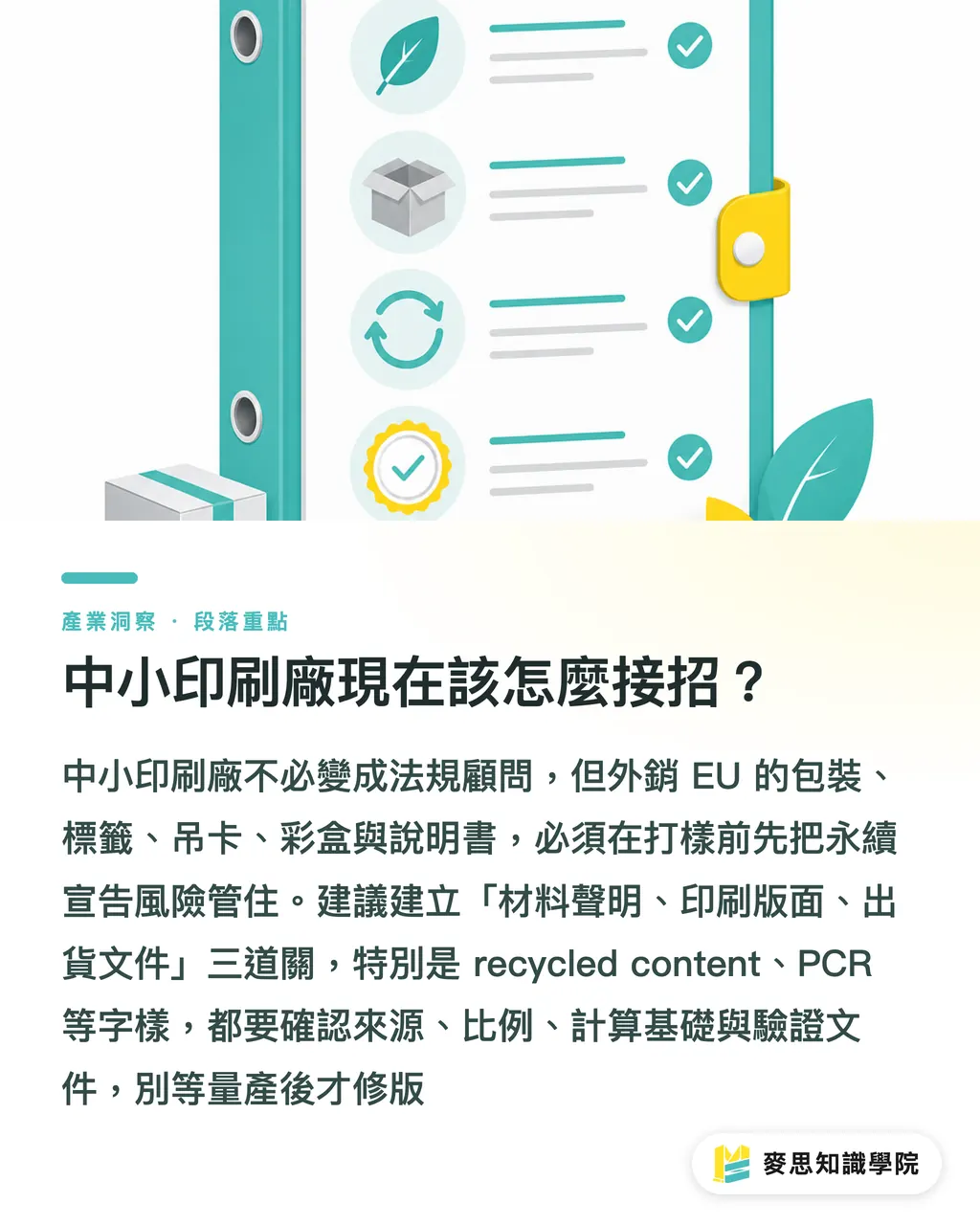
・① Material Statement Gate: Whenever terms like recycled content, PCR, chemical recycling, or PET recycled content appear, request origin, ratio, calculation basis, and verification documents from the brand or material supplier first
・② Print Layout Gate: Check sustainability claims word for word across labels, shrink sleeves, color boxes, stickers, and manuals. Percentages, material names, and target markets should never be left to print staff guesswork
・③ Shipping Documentation Gate: Package final layout text, client approval records, material batch data, and supplier declarations together for customs inspections or retail audits
If brand clients are redesigning packaging for EU export, the Mai Strategy Knowledge Academy consulting team can help review claim wording and prepress documentation separately. If proofing has already begun, MINDS can step in to manage risks across prepress proofing, material selection, and document retention
This compliance shift goes beyond filling out another form. It changes how questions are asked before quoting. Instead of asking 'how many colors, how many sheets, and what is the delivery date,' you now ask 'who signed off on this sustainability claim.'
Key Takeaways
・EU PET chemical recycling rules turn recycled content from a slogan into a formula, requiring export packaging claims to be auditable
・Mass balance allocates chemically recycled content, but fuel-use excluded rules deduct fuel, energy recovery, and process losses
・November 21, 2027, marks a key date for OECD-sourced material eligibility, so Taiwanese supply chains must verify material origins early
・Printers do not need to endorse material ratios for brands, but they must refuse unbacked layout claims
・The safest approach is grouping material documents, layout copy, and client sign-offs into a single prepress package
Further Considerations
For print manufacturing, these EU SUPD PET rules show that sustainable packaging competition is shifting from good marketing to audit-ready documentation on the shop floor. Designers must treat recycled content as compliance data. AI and SaaS teams can integrate layout copy, material batches, supplier declarations, and market regulations into verification workflows, creating a clear audit trail for every print run. The next step is practical: audit all PCR and recycled content copy on existing EU-bound packaging, verifying whether each percentage reflects mass balance calculations, fuel-use excluded deductions, and third-party verification
Further Reading
FAQ
- Will new EU PET chemical recycling rules affect Taiwanese print shops?
- Yes. For labels, shrink sleeves, color boxes, and packaging copy exported to the EU, print shops should request traceable documentation from brands before printing any recycled content, PCR, or chemically recycled PET claims
- What is mass balance?
- Mass balance is a method using ledger tracking to monitor recycled material inputs and product allocations. It fits chemical recycling processes where materials decompose, mix, and recombine. The EU now requires chemically recycled PET content to be calculated and verified using mass balance
- What does fuel-use excluded mean?
- Fuel-use excluded means that if recovered waste becomes fuel, energy recovery, or process loss, it cannot count toward product recycled content. This impacts the actual recycled percentage brands can claim on PET packaging
- What should brand clients inspect first right now?
- Brands should inspect all PCR and recycled content copy on EU-bound packaging, making sure every percentage is backed by material origins, calculation bases, supplier declarations, and required third-party verification
- How can print shops mitigate green claim risks?
- Print shops can build a pre-printing check by bundling material statements, layout text, client approvals, and batch documents into a single package. Sustainability claims lacking documentation should not go directly to press
Related articles



The Print × AI weekly
The print and AI know-how designers, brands and enterprises can use before they commit — one email, every week
MINDS Free Tools
AI background removal, a LINE sticker maker, spine & imposition calculators — all free, right in your browser, no upload.
MINDS Group
Need actual printing or gifting services?
From premium printing to online ordering and festive gifts — the MINDS Group sister brands take it from here.