

When Should You Decide on the Folding Style?
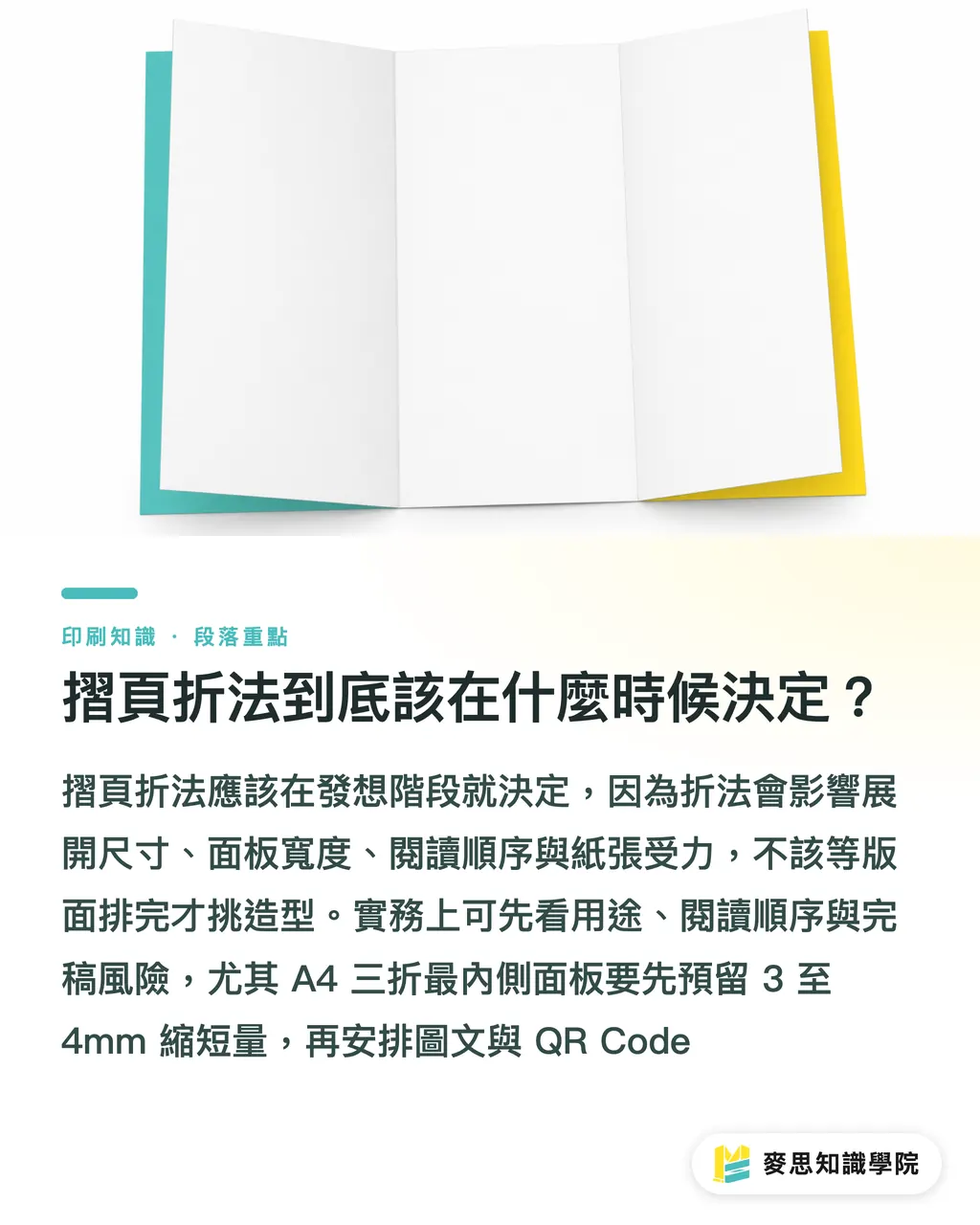
Decide on the folding style during the initial brainstorming phase, not after the layout is finished. When reviewing brochure files, MINDS uses the MINDS Three-Step Folding Decision Guide to evaluate intended use, reading sequence, and prepress risks first before deciding between half fold, tri-fold, accordion fold, Z-fold, French fold, or parallel fold
Standard definition of a folded print product: taking a single printed sheet and folding it along designated lines into multiple reading panels. The folding method alters the flat size, panel widths, page-turning sequence, and physical stress on the paper
I have seen countless rejected files, and the issue always comes down to the same mistake: treating every panel as an equal-width artboard in the design file without confirming which panel folds inward or which line accounts for paper thickness. This is especially common with A4 tri-folds
・① Intended use: Exhibition flyers need a quick 3-second scan to deliver the main message. A half fold or Z-fold is much easier to digest than a long parallel fold
・② Reading sequence: Product brochures unfold layer by layer, making a tri-fold or parallel fold easier for organizing chapters
・③ Prepress risks: Whenever a tri-fold is involved, shorten the innermost panel by 3-4mm first before placing artwork, text, and QR codes
How to Choose Between Half Fold, Tri-Fold, Accordion Fold, and Z-Fold?
Half Fold is the simplest folding style. A single sheet is folded into 4 panels. An A4 sheet folded in half is close to A5, making it ideal for menus, invitation cards, brief catalogs, and draft testing when content volume is still uncertain
・Half Fold: 4 panels with an intuitive reading path, best for single topics and short-form content
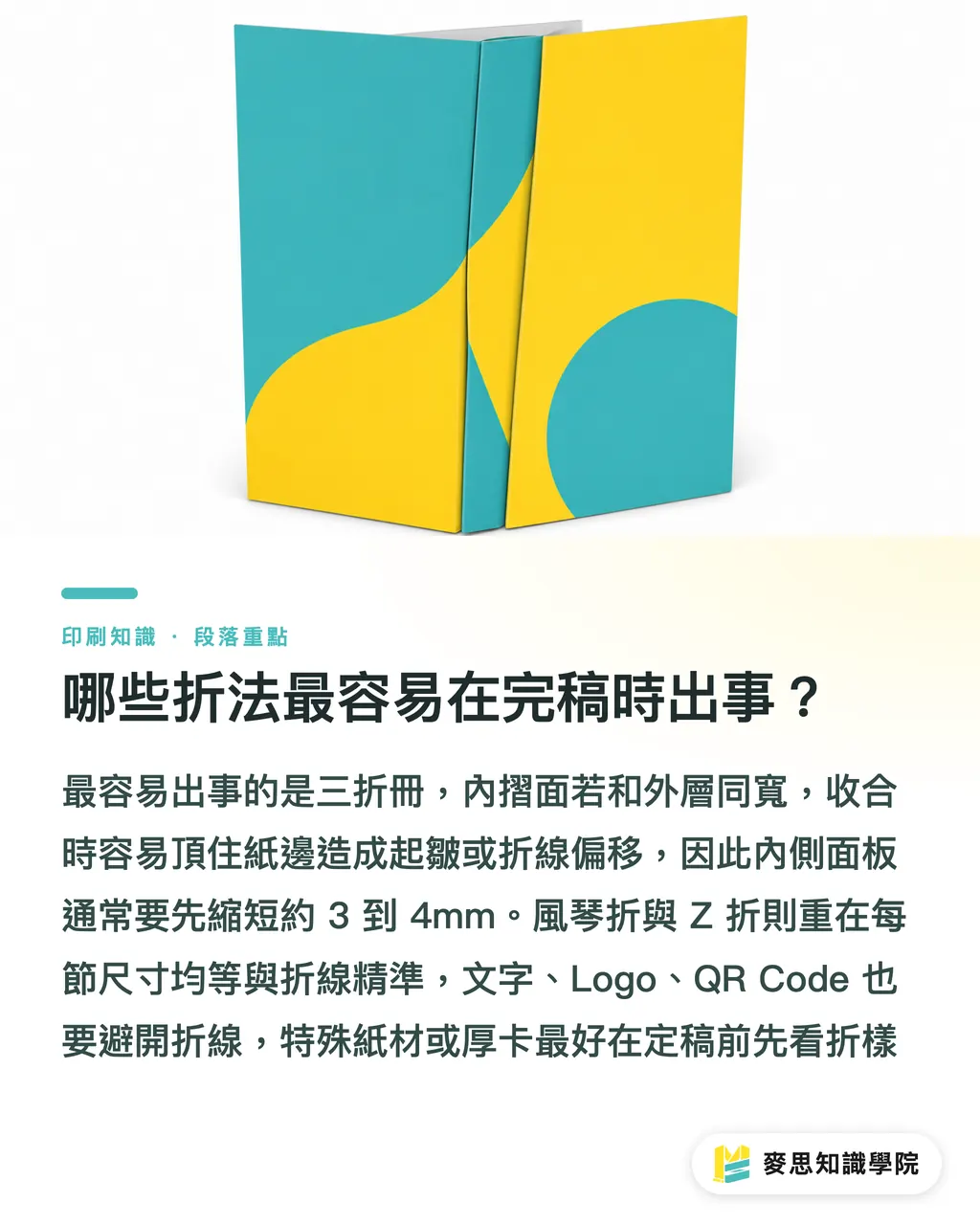
・Tri-fold: Typically 6 panels, with one panel folding inside. The inside panel must be shortened by roughly 3-4mm. Best for exhibition flyers, service overviews, and store brochures
・Accordion Fold / Z Fold: Typically 6 panels with alternating left-right folds. Each panel width must be equal. Ideal for workflows, timelines, and maps
・French Fold: Usually folded horizontally first then vertically, creating a 4-layer thickness. Perfect for luxury invitations, brand cards, and visuals that benefit from a sense of reveal
・Parallel Fold: Folded multiple times in the same direction, suitable for long catalogs, instruction manuals, and map-based info. The longer the content, the earlier you need to map out panel order
When a client verbally asks for a tri-fold, I usually ask them to take a piece of scrap paper and fold it for me. Both tri-fold and accordion fold are casually called tri-fold, but one requires an inner panel compensation while the other demands equal width. Their prepress rules are completely different
Which Folding Methods Cause the Most Prepress Issues?
Tri-fold brochures cause issues most often. If the inner panel is the same width as the outer panels, it hits the outer edge when folded in, causing wrinkling at best or offset fold lines at worst. I usually shorten the inner panel by about 3-4mm first, then adjust based on paper thickness and post-press finishing
Accordion folds carry the exact opposite risk. Each section must be identical in width. If any panel width shifts, the outer edges will not align when closed. Alternating folds like Z-folds and accordion folds offer a great visual layout rhythm, provided the fold positions are precise
・Fold lines: The PDF must clearly mark every fold line and indicate whether it folds inward or outward
・Panel dimensions: Shorten the inner panel for tri-folds, while keeping each section equal for accordion and Z-folds
・Paper grain direction: For heavy paper or stock prone to cracking, check whether fold lines run parallel to paper fibers before deciding on creasing
・Bleed and safe margin: Avoid placing text, logos, or QR codes too close to fold lines so they do not get swallowed by creases when folded
If your brochure involves specialty paper, matte lamination, spot UV, or heavy cardstock, the Mai Strategy Knowledge Academy consulting team usually recommends reviewing a folded sample before finalizing visual designs. Once paper goes into the creasing machine, many pretty white spaces on screen turn into practical creasing issues on site
Which Folding Style Fits Which Distribution Scenario?
Brochures must match the distribution setting. Pickup habits vary across trade shows, service counters, dining tables, and mail envelopes. For the same 6-panel brochure, trade show flyers need speed, product booklets need clarity, and menus need durability
・Exhibition flyers: People hold them briefly. Main headlines, QR codes, and contact info must sit on the outermost face visible at first glance. Half fold, Z-fold, and tri-fold are all commonly used
・Product brochures: A 6-panel tri-fold allows pain points, features, specs, case studies, and contact info to sit on dedicated panels. The reading sequence must be confirmed before visual flair
・Menus and price lists: High flip frequency on site. Half folds or parallel folds store easily. When listing many items, make a 1:1 black-and-white folded mock-up first to test how fast customers find dishes
・Luxury invitations and brand gifts: French folds create a 4-layer thickness with a strong sense of unboxing. Test paper stock and creasing beforehand to prevent thick paper from cracking along white edges
Mid-to-high-end custom commercial printing often encounters projects stuck on dimensions, paper stock, and finishing combined. If MINDS can get flat dimensions, fold diagrams, and usage scenarios before quoting, subsequent proofing runs much smoother
How to Make Accurate Hand Dummy Samples?
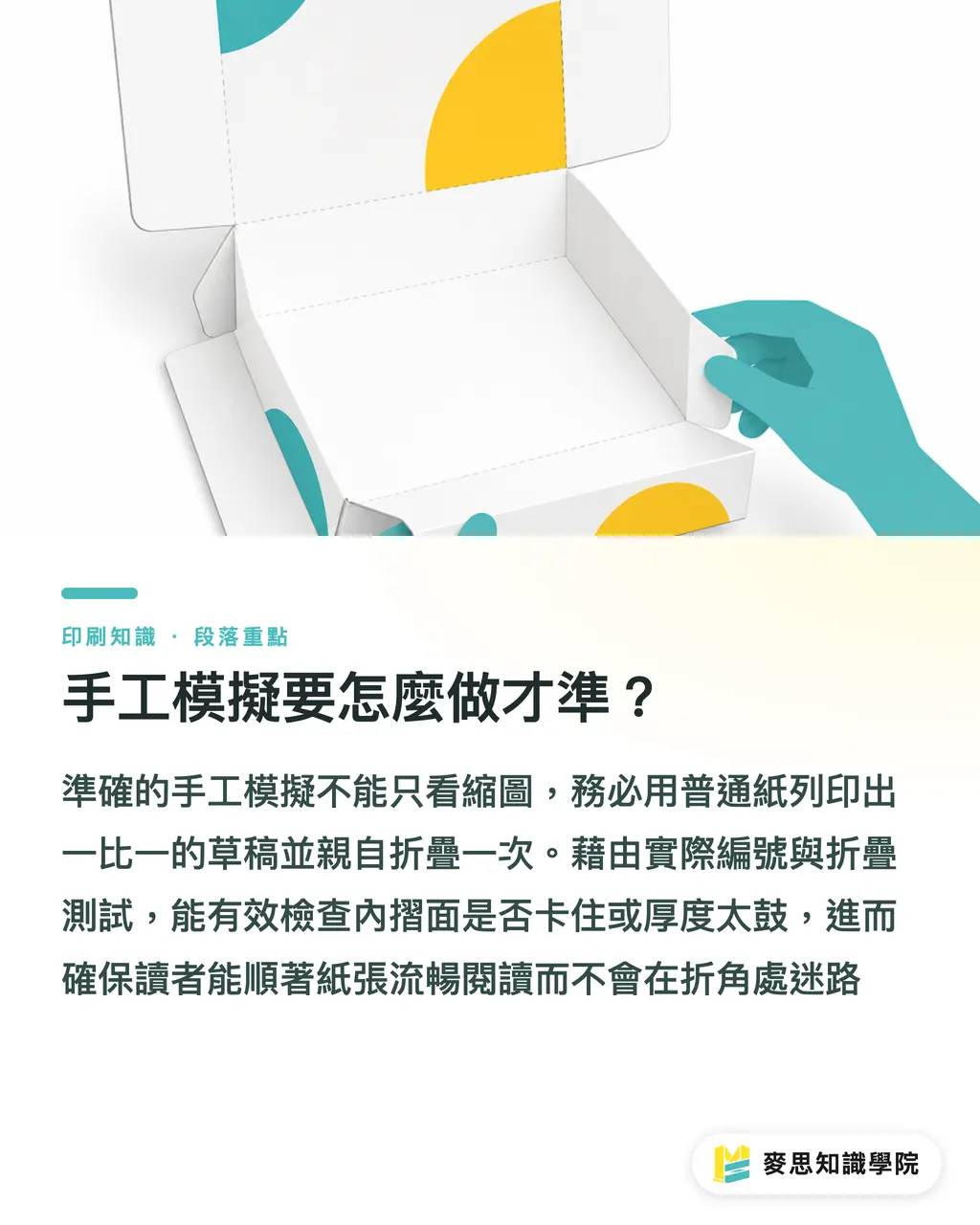
Do not rely solely on digital thumbnails for mock-ups. Make at least one 1:1 folded sample. My personal routine is low-tech: before even talking paper stock, I grab a sheet of A4 scrap paper and fold it in front of the client. Many arguments resolve the moment they unfold it the second time
・Print a 1:1 draft: Regular plain paper works fine. Check the flat size and panel order first
・Number by fold lines: Write 1, 2, 3 on the front cover, inside pages, and final flap to avoid flipping front and back incorrectly
・Fold it for real: Check if the inner panel jams on a tri-fold, if panels align evenly on an accordion fold, or if 4 layers bulge too much on a French fold
・View it from the distribution setting: Pickup habits differ between trade shows, counters, tables, and mail envelopes, and your folding choice should adapt accordingly
・Mark final PDF files: Clearly state Half Fold, Tri-fold, Accordion, French Fold, Z Fold, or Parallel Fold in the file name or notes
When a brochure is done right, readers follow the paper naturally through all content without getting lost at the first fold line. It sounds old-school, but print shops prove it true every day
Key Takeaways
・Decide on the reading sequence before laying out content, and your rejection rate will drop significantly
・When a client asks for a tri-fold, ask immediately if they mean an inner tri-fold or a Z/accordion fold. That single question often saves a full round of re-layout
・Shorten the inner panel of a tri-fold brochure by 3-4mm so the paper does not buckle against the outer layer when folded
・Accordion folds use equal section widths while tri-folds shorten the innermost panel. Never mix these two sets of rules
・Fold lines, paper grain, creasing, and reading sequence: get all four right before sending to press, and the finished product will turn out as expected
Further Thoughts
For print manufacturing, design, AI applications, and SaaS teams, folding is an ideal prepress checkpoint to standardize into automated workflows. AI can first help structure content hierarchy and panel summaries, while SaaS platforms should integrate reminders for 5 common folding styles, 3-4mm inner panel compensation, fold directions, paper grain, and creasing into preflight checks. That way, designers spot potential bottlenecks before uploading files, and print shops cut down on back-and-forth phone confirmations
FAQ
- Can all panels of a tri-fold brochure be equal in width?
- Equal panel width is not recommended for inner tri-folds. The innermost panel should typically be shortened by about 3-4mm so the paper does not press against the outer layer when folded. Equal section widths are reserved mainly for accordion folds or Z-folds
- Are accordion fold and Z-fold the same thing?
- In practice, both fall under the concept of 6-panel brochures with alternating fold directions, where equal section size is key. If your print shop or client uses different terminology, confirm the exact style with a folded dummy before final prepress
- Do brochure PDFs need fold line markings?
- Yes. PDFs with folds must indicate fold positions and directions so the print shop can verify imposition, creasing, and inner folding panels. Providing flat visual artwork alone easily leads to misinterpreting the folding order
- Does heavy paper always require creasing before folding?
- Heavy paper, specialty stock, or laminated finishes often require evaluating paper grain direction and scoring first to reduce cracking, white edges, and fold line shifting. Final decisions should always be based on actual testing with the paper stock and folding method
- Which folding style is best for trade show flyers?
- Half folds, tri-folds, and Z-folds are popular for trade show flyers because 4 to 6 panels balance main messaging, service details, and contact info effectively. If content gets too long, a parallel fold feels more like a catalog and makes quick on-site scanning difficult
Related articles





The Print × AI weekly
The print and AI know-how designers, brands and enterprises can use before they commit — one email, every week
MINDS Free Tools
Imposition calculator and preflight file check — free prepress tools, right in your browser.
MINDS Group
Need actual printing or gifting services?
From premium printing to online ordering and festive gifts — the MINDS Group sister brands take it from here.