
What data does BOBST Connect provide?
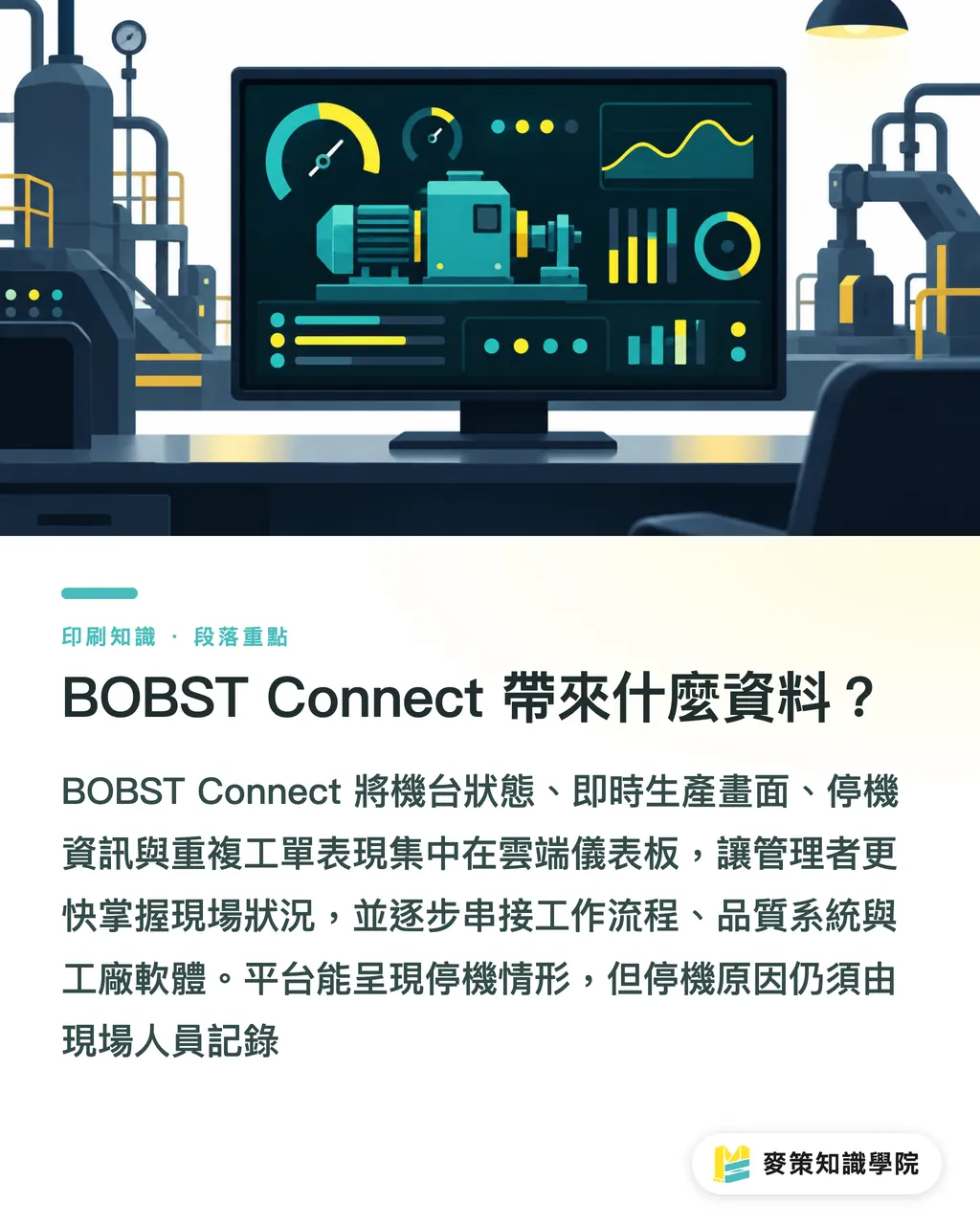
BOBST Connect is BOBST's cloud platform for equipment and production data. Managers can use different devices to view machine status, live production, downtime information, and repeat-job performance. Launched in 2022, the platform has since expanded to connect machines, workflows, quality systems, and factory software, according to BOBST's October 2026 review. Read BOBST Connect: Progress, Performance and Potential
This addresses a familiar information gap in factories: production data is copied down by hand, and connecting systems often means developing a custom interface for each case. When a machine has a problem, managers may not know about it right away. Connect puts the data on a dashboard, shortening the time between an issue on the floor and a manager seeing it. The cause of downtime still has to be recorded by the team on site. The platform won't tell a plant what went wrong
How does equipment data inform decisions?
For equipment data to support decisions, downtime, output, and quality need to be reviewed together. OEE (Overall Equipment Effectiveness) combines equipment availability, actual operating speed, and the proportion of good parts to measure how much effective output a machine produces. It can show where efficiency is falling short, but it can't explain the cause on its own
I review the data in this order:
・1. Check when downtime happened and how long it lasted, then confirm which process handoff was involved
・2. Compare repeat jobs to see whether the difference came from settings, materials, or operation
・3. Connect the cause to maintenance, scheduling, or training, then check the next production run to see whether the improvement holds
Start with downtime. Then ask why
Quality needs to be part of the picture too. If you track machine speed alone, you may miss rework and waste. Whether orders go out on time is the result a factory needs to measure
What do Stora Enso's numbers tell us?
The Stora Enso Packaging case shows how equipment data can be considered alongside improvements on the shop floor. It isn't a result every factory can expect to reproduce. After adopting BOBST Connect at two converting plants, the Swedish packaging company reported a 4.4% increase in capacity, a 3.3% increase in production efficiency, equipment availability of 98.5%, and reductions in downtime and waste
These figures come from one company's experience. They aren't a general guarantee for the platform. The maintenance manager interviewed also said the company arranged BOBST training as needed and used the Maintenance Plus service. My view: equipment data only affects the next shift's plans when it feeds into maintenance, training, and a review of improvements. Otherwise, however clear the dashboard is, the team still has to guess at the cause
What should small and midsize print shops ask before adopting it?
Before adopting a platform, a small or midsize print shop should start with a machine that often stops or holds up delivery, then ask whether its data can answer questions from the shop floor. Looking back at the platform's early days, BOBST noted that many factories still collected data by hand, machine connections often required custom interfaces, and simple, standard ways to integrate systems were lacking
・1. What real-time and historical data can this machine provide, and how often is it updated?
・2. How are downtime and quality issues defined, and who records the cause on site?
・3. What does each service cover for connectivity, training, and maintenance, and who follows up on improvements?
Without records of the causes, even a clear view of downtime only tells you that the machine stopped. It won't tell you whether to change the schedule, provide more training, or arrange maintenance. The Stora Enso case also mentions training and maintenance services, a reminder for smaller plants to include shop-floor users and ongoing support when evaluating a platform
How can brand clients use this information?
Brand clients can start by asking how a supplier manages production issues. They don't need to assume they'll be able to log in to the equipment platform themselves. BOBST says DS Smith has adopted Connect across its EMEA locations to bring machine data and digital services together. That creates an opportunity to view data across plants in one place, though the partners still need to confirm how each plant defines its data
When requesting a quote for the first time, spell out the finished product's purpose, paper stock, color tolerances, quantity, and delivery date. Then ask the print shop how it records downtime, quality issues, and rework. For custom commercial printing, confirm the product requirements and process conditions with MINDS so both sides have a shared specification to check against
Key takeaways
・BOBST Connect lets managers view machine status, downtime, and repeat-job performance remotely
・OEE can show gaps in effective equipment output, but downtime causes still need to be recorded on site
・The improvements reported by Stora Enso are results from one case, not a guarantee for every adopter
・Before adopting a platform, confirm its data fields, who records the causes, and what training and maintenance support is included
Further thoughts
In print manufacturing, start with one machine and one common downtime issue. Decide who records the cause and who reviews the improvement. On the design side, include paper stock, color tolerances, and finishing requirements in the proofing specifications. Assess AI applications once data definitions are consistent and records are complete. SaaS teams should explain how equipment connections, data permissions, and issue handling fit into work on the shop floor. The next step is to use one piece of equipment data to change one real decision
Further reading
FAQ
- What equipment data can I view in BOBST Connect?
- Managers can use BOBST Connect to view machine status, live production, downtime information, and repeat-job performance remotely. BOBST also says the platform has expanded to connect workflows, quality systems, and factory software
- Can OEE tell a print shop exactly why a machine stopped?
- OEE measures effective output using equipment availability, actual speed, and the proportion of good parts. It can show where efficiency is falling short, but it can't identify the cause of downtime on its own. The plant still needs to record when an issue happened and what the team observed on site
- What should a small or midsize print shop confirm before adopting an equipment data platform?
- First, confirm what data the machine can provide, how downtime and quality issues are defined, and who records the causes on site. Also ask what's included in connectivity, training, and maintenance services
- Can every print shop expect the results reported for BOBST Connect?
- No. After adopting the platform at two converting plants, Stora Enso Packaging reported a 4.4% increase in capacity, a 3.3% increase in production efficiency, and equipment availability of 98.5%. These are results from that company's case
Related articles

The Print × AI weekly
The print and AI know-how designers, brands and enterprises can use before they commit — one email, every week
MINDS Free Tools
Spine width and imposition calculators — skip the manual math, free in your browser.
MINDS Group
Need actual printing or gifting services?
From premium printing to online ordering and festive gifts — the MINDS Group sister brands take it from here.