
What Is Balcan's 50-Foot Line Actually Doing?
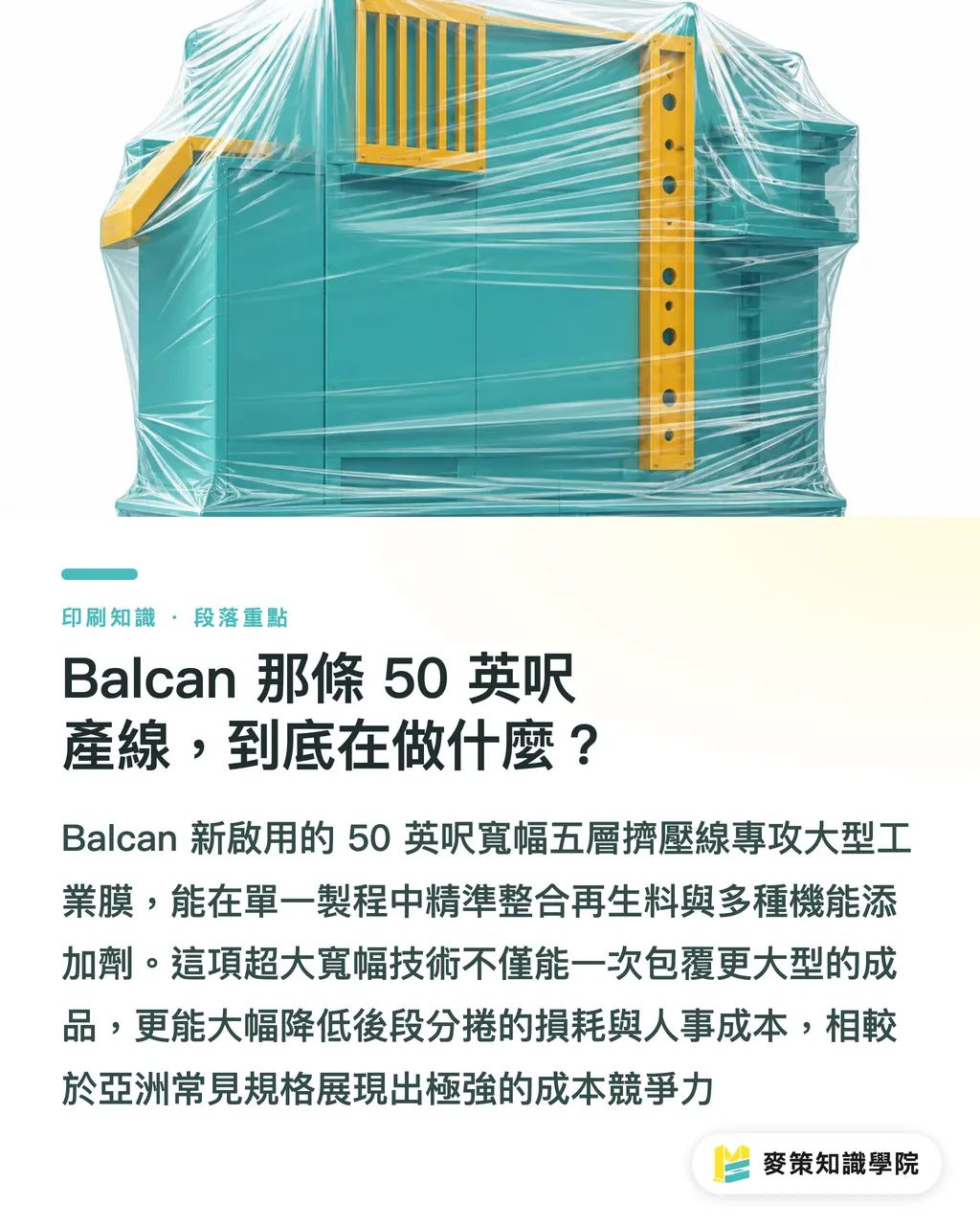
Simply put, it is an extrusion line built specifically for large-scale industrial films
In late July, Balcan Innovations fired up a new Bandera AgriFuture 5-layer wide extrusion line at its Pleasant Prairie, Wisconsin facility. Capable of reaching widths up to 50 feet (roughly 15 meters), it mainly produces heavy-duty shrink films and tarps for agriculture, construction, and marine applications. The real takeaway isn't just raw width. It integrates 5-layer co-extrusion, flame retardants, UV stabilizers, and post-consumer recycled (PCR) resin into a single process, all while keeping tight control over tension and gauge tolerances
For manufacturers in Taiwan, the key number to watch is that 50-foot width. Wider web widths mean each roll covers significantly more surface area, wrapping larger products in one pass at the customer's end. Translated into unit costs, it beats the 2-to-4-meter widths common across Asian export converters. Anyone who has run a flexible packaging line gets this immediately: every step up in width drops downstream slitting scrap and labor costs dramatically
Why Is North America Building Its Own Lines Instead of Buying from Asia?
Because policy, freight rates, and brand customers are all pushing in the same direction
Flexible packaging reshoring to North America didn't start this year, but Balcan's new line amplifies the signal
・Policy: Deadlines for Extended Producer Responsibility (EPR) regulations like California's SB 54 are closing in. Film packaging must plug into local recycling and reporting systems. Relying on imported Asian films makes recycling chains and carbon footprints difficult to verify
・Freight: Industrial film rolls are bulky with low unit values, making trans-Pacific shipping a huge chunk of total landed cost. When freight rates fluctuate, margins vanish overnight
・Customers: Regulations like the EU's Packaging and Packaging Waste Regulation (PPWR) demand Design for Recycling. Brand buyers in construction, agriculture, and marine sectors increasingly prefer local supply with local recycling loops. That squeezes Asian suppliers into high-value, small-batch orders
All three trends point to one clear outcome: bulky, low-margin, hard-to-recycle industrial films are moving away from export-driven factories in Asia
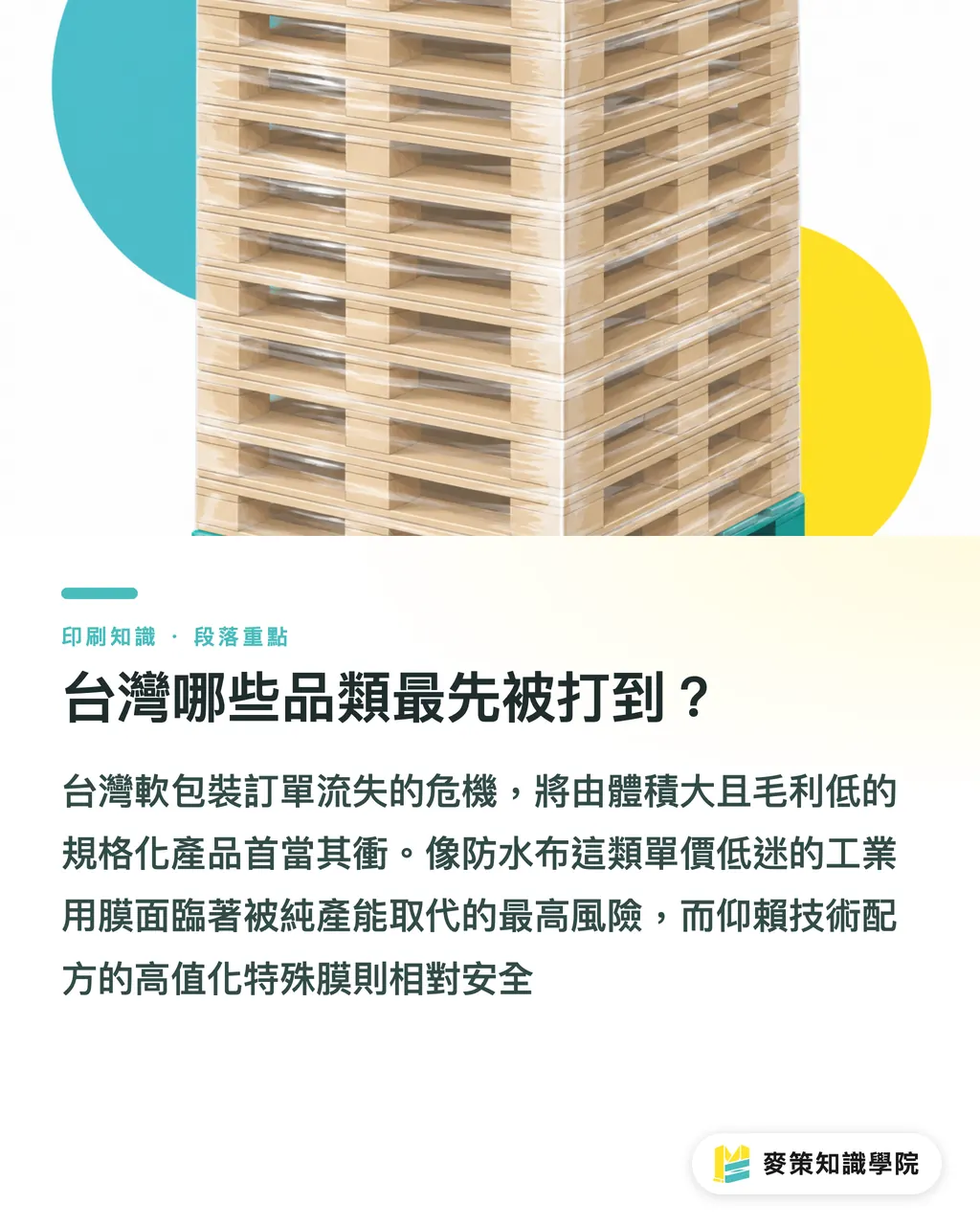
Which Product Categories in Taiwan Get Hit First?
The biggest risk isn't food packaging. It's industrial films
Here is how the risk breaks down across three tiers so you can see where your products stand
・Highest risk (Industrial films): Tarps, marine covers, agricultural greenhouse films, and pallet shrink hoods. These are low-margin, bulky, and standardized products that Balcan's line is practically custom-built to produce
・Moderate risk (Commodity consumer films): Trash bags, basic food bags, and bin liners. New capacity across Southeast Asia and the Middle East has already pushed margins on these products to the edge
・Relatively safe (High-value films): High-barrier food pouches, medical and pharmaceutical packaging, recyclable mono-material structures, and custom short-run specialty films. These rely on technical formulations that raw capacity alone cannot replace
You can see the pattern: lost orders start at the bulky, low-margin end of the spectrum. This is not a guess. It comes from watching tectonic shifts across the flexible packaging sector over the past decade
3 Ways for Taiwanese Converters to Pivot
Skipping the slogans, here are actionable moves you can start making next month
・Pivot 1: High-barrier and functional formulations
・Invest in multi-layer structures using EVOH or PVDC coatings, targeting sauce sachets, coffee packaging, and meat vacuum pouches
・Lock in proprietary specifications with brand R&D teams to raise the barrier to entry for competitors
・Pivot 2: Recyclable mono-materials
・Switch existing multi-material laminates (like PET/PE or NY/PE) to PE/PE or PP/PP mono-material structures, aligning with EU PPWR Design for Recycling rules
・This transition requires adjusting resin recipes, switching inks, and re-validating interlayer adhesion. It will take 6 to 12 months, but without it, winning European orders will be impossible
・Pivot 3: Short-run custom jobs and brand co-creation
・Shift your operation from high-volume commodities to high-mix, low-volume production with rapid prototyping, connecting directly with design agencies and brand owners
・If you lack in-house design and prototyping capabilities, team up with external print and packaging integration partners. For example, tap MINDS (MS) for mid-to-high-end fully custom commercial printing, or MYS Printing (MYS) for on-demand short-run web-to-print ordering. Handling front-end design through back-end packaging under one roof shortens the runway from sample to mass production
3 Things Small and Mid-Sized Taiwanese Converters Can Do Next Month
Do not wait until orders dry up to take action. Start by auditing these three areas
・Audit your product portfolio: Group shipments from the past year across three metrics: volume, unit price, and recyclability. Flag high-volume, low-margin items as high risk immediately
・Run a mono-material trial: Reach out to resin suppliers (like SABIC or Braskem) or domestic distributors for 50 to 100 kg of mono-material PE trial resin. Run a short trial batch and keep the process data on file
・Schedule client interviews: Call your top three brand clients directly and ask about their compliance timeline for PPWR or SB 54 in Western markets. Once they confirm their needs, you have a clear business case to pivot
None of these steps require major capital, but within 90 days, you will have a definitive answer on where your business stands
Key Takeaways
・The 50-foot wide extrusion line in North America is not just an isolated equipment purchase. It is the result of policy, freight costs, and brand demands converging
・Bulky, low-margin industrial films are the first category that export converters in Asia will lose to local production
・High-barrier formulations, recyclable mono-materials, and short-run custom runs offer three practical paths forward for Taiwanese converters
・Every step up in web width cuts slitting scrap and labor costs significantly, giving wide extrusion lines a serious cost advantage
・Running client interviews and small-scale mono-material trials within 90 days is the lowest-cost hedge for small and mid-sized shops
Looking Ahead
After more than a decade working across factory floors and client boardrooms, one reality stands out: flexible packaging converters rarely lose out to a single new machine. They get sidelined when policy and cost structures redraw the entire supply chain. Balcan's 50-foot line is just the tip of the iceberg, backed by North America's push for localized production and circular film recycling. For Taiwanese converters, the most dangerous mindset is believing you are safe in a niche market. If your products are standardized, bulky, and low-margin, you will feel the impact sooner or later. Conversely, converters investing in mono-material formulations and high-barrier technology today will hold qualified vendor certifications from Western brands in two years, and that is an asset competitors cannot easily copy. Next, build local supply and closed-loop recycling capabilities directly into your client pitches. Show brand owners that you are ahead of the curve instead of waiting for them to ask
Further Reading
FAQ
- Will Balcan's 50-foot extrusion line really affect Taiwanese flexible packaging converters?
- Yes, but the impact falls mostly on bulky, low-margin, hard-to-recycle commodities like industrial films and basic consumer films. High-barrier packaging and custom short-run jobs are relatively insulated because they compete on technical formulations rather than sheer production volume
- What is 5-layer co-extrusion, and why does web width matter so much?
- Five-layer co-extrusion combines five different functional resin layers in a single pass to produce film with tailored barrier properties, heat resistance, and mechanical strength. A wider web increases the usable surface area per roll and reduces slitting scrap downstream, giving industrial film producers an overwhelming cost advantage
- What is a recyclable mono-material structure, and why do European clients care so much about it?
- It refers to packaging made entirely from a single polymer family (such as PE laminated to PE, or PP to PP) so it can be easily recycled. The EU's PPWR mandates Design for Recycling, making mono-material structures a core requirement for regulatory clearance
- Is it too late for small and mid-sized Taiwanese converters to switch to mono-materials?
- Not at all. The market is just entering its compliance-driven phase. Investing 6 to 12 months now to validate recipes and processing parameters is far more cost-effective than scrambling after 2027 when clients start dropping uncertified suppliers
- Can the same production line run both industrial shrink film and food-grade packaging film?
- Technically yes, but food-grade production requires cleanroom certifications and strict hygiene standards that carry substantial changeover costs. It is smarter to define distinct target markets for dedicated lines rather than trying to force an industrial line into food-grade service
Related articles

The Print × AI weekly
The print and AI know-how designers, brands and enterprises can use before they commit — one email, every week
MINDS Free Tools
AI background removal, a LINE sticker maker, spine & imposition calculators — all free, right in your browser, no upload.
MINDS Group
Need actual printing or gifting services?
From premium printing to online ordering and festive gifts — the MINDS Group sister brands take it from here.