

Why can't AI tool evaluation stop at the image?
AI tool evaluation cannot stop at the image, because a preference score only proves that one output is more appealing. It does not prove the tool can fit into quoting, final artwork, proofing, and mass production
A Reddit discussion on world models and preference tests mentioned that Black Forest Labs, a generative image and video model company, used its own preference test for FLUX 3 to describe performance. The figures were against Runway Gen- 4.5 preferred by 77%, and against Luma Ray 3.2 preferred by 93%, but the post questioned the lack of methodology, sample size, evaluator pool, and prompt set
preference test: showing A/B outputs to evaluators and asking which version they prefer. It is useful for reading aesthetic tendency, but not for inferring physical understanding, print stability, or commercial risk
I have seen plenty of beautiful samples on the print floor. The scary ones are the samples that only work inside a pitch deck. Once bleed, Chinese text, brand colors, and finishing limits enter the job, the problems all land back on the prepress desk
Slow down first

What does a world model have to do with print procurement?
The link between a world model and print procurement is simple: the bigger the marketing term around an AI tool, the more the buyer has to break it down into acceptance tests that can be rerun
world model: a system that can represent how objects change, interact, and respond to conditions. In the ideal case, it should be able to predict scene outcomes. That is not the same thing as generating an attractive image
The Reddit comments spelled out the gap plainly. Evaluations should disclose the prompt, seed, model build, sample selection rule, and failure rubric. They should also test whether an object still exists after being occluded, whether collision outcomes stay consistent, and whether object relationships still make sense after the angle changes
seed: a parameter that fixes the random starting point during generation, often used to reduce variation across repeated outputs from the same prompt
If the same promotional key visual is generated 20 times and produces 20 conflicting product images, the print shop ends up paying the repair cost for changed SKUs, logos, and packaging materials
If your team is putting generative images into the prepress workflow, you can ask the Mai Strategy Knowledge Academy consulting team to design an evaluation sheet around your current SOP first
Which 5 checks should a print shop use before buying an AI tool?
When a print shop buys an AI tool, I would use 5 checks to filter out products that only make demo images before deciding whether they belong in the order-taking workflow
First apply MINDS Printing's (MS) three print-submission checks: 1. whether the use case is valid, 2. whether the file can be made plate-ready, and 3. whether the repair cost makes sense. Then move on to the 5 checks
・Aesthetics: the image has to pass the human eye first, but a 5-second A/B preference result is only the entrance. It is not a purchasing conclusion
・Controllability: the same product, brand color, and packaging structure must be repeatable. Logos and Chinese text cannot drift
・Stability: after fixing the prompt and seed, rerun the job. If the composition changes every time for the same request, layout staff will be patching holes during final artwork
・Color and platemaking: the ICC profile, meaning the International Color Consortium color profile used to let screens, software, and output devices communicate through the same color-conversion rules, must be explainable. Resolution, bleed, and color space also have to pass inspection
・Licensing and integration: commercial licensing, client reuse, file retention, API links to quoting or customer support. If any one of these is missing, it turns into operating cost
ISO 12647, the International Organization for Standardization print process control standard used to check dot gain, color, and proofing consistency, reminds us of one thing: print is judged by an acceptable process, not by the most pleasing image on screen

How should the evaluation sheet connect to orders, production, and customer support?
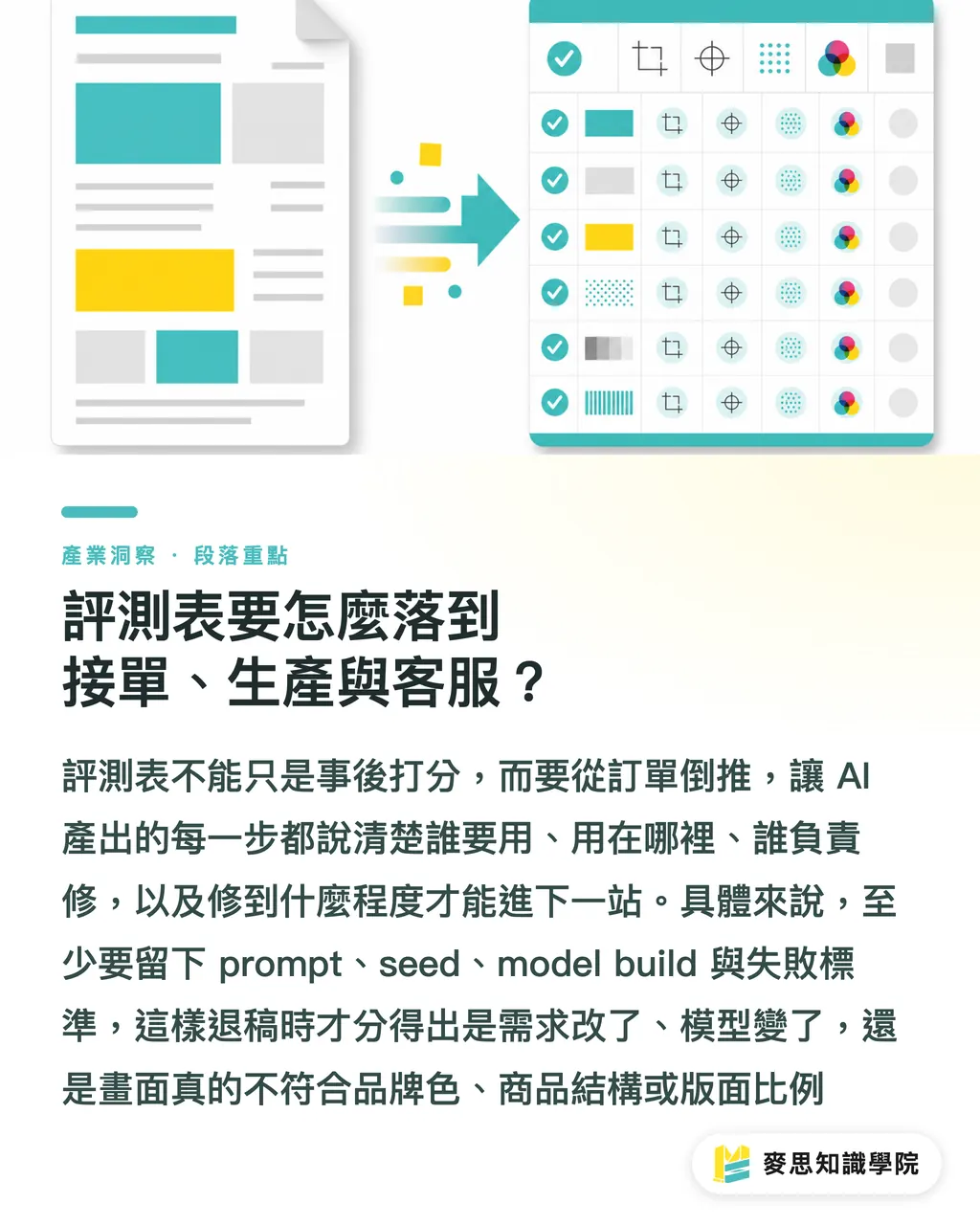
The evaluation sheet should work backward from the order, so every AI output can answer who will use it, where it will be used, who is responsible for fixing it, and how far it must be fixed before moving to the next stage
・prompt: record the customer's requirements and constraints, so designers or customer support can rerun the same job type
・seed: fix the generation starting point, so when a file is rejected you can tell whether the requirement changed or the output drifted
・model build: keep the version used, so the same prompt does not produce a different image 3 months later
・sample selection rule: state clearly why this image was chosen. Do not just pick the one the boss likes
・failure rubric: count typos, brand-color shifts, wrong product structure, and wrong layout proportions as failures. Even a pretty sample loses points
Connect this sheet to quoting and customer support, and sales can know before taking the job whether an AI image needs an added final-artwork fee. Prepress can also stop high-risk files before proofing
For mid- to high-end fully custom commercial printing, you can confirm final-artwork and proofing risks with MINDS Printing first, instead of leaving the problem until the press is ready to run
Key Takeaways
・When evaluating an AI tool, ask whether it can be rerun before asking whether the image looks good
・Preference scores are useful for first impressions. They cannot replace prepress acceptance checks
・Buying an AI tool means separating aesthetics, controllability, stability, licensing, and workflow integration
・If repeated outputs from the same prompt cannot keep the product and brand consistent, repair costs will eat up the time saved
Further Thinking
When a print shop adopts an AI tool, the next step is not buying the hottest subscription. It is testing it with a real work order, so sales, design, prepress, and customer support can judge where rejections will happen. The design side needs to keep the prompt and seed. The SaaS side needs to provide version records and failure tags. The print side needs to feed evaluation results back into quoting and delivery promises. Less myth, more rejected-file data
Further Reading
FAQ
- What should AI tool evaluation look at first?
- AI tool evaluation should first look at use case, platemaking, and repair cost. MINDS Printing's (MS) three print-submission checks can first rule out outputs that work for proposals but are not fit for print
- Can a preference test be used as a purchasing basis?
- A preference test can only serve as an initial filter, because it measures evaluator preference, not whether a file can move reliably through final artwork, proofing, and mass production
- What records should a print shop keep when adopting generative AI?
- A print shop should keep at least the prompt, seed, model build, sample selection rule, and failure rubric, so rejected files can be traced later
- If an AI image looks beautiful, why can it still fail at print submission?
- A beautiful image can still have problems such as insufficient resolution, brand-color shifts, incorrect Chinese text, insufficient bleed, unclear licensing, and inconsistent structure. All of these turn into repair costs in prepress
Related articles





The Print × AI weekly
The print and AI know-how designers, brands and enterprises can use before they commit — one email, every week
MINDS Free Tools
AI background removal, brand stamping, and a LINE sticker maker — free design tools, right in your browser, no upload.
MINDS Group
Need actual printing or gifting services?
From premium printing to online ordering and festive gifts — the MINDS Group sister brands take it from here.