
Why are the big players joining forces to go after narrow web labels?
Because demand for customized packaging with short lead times and high added value has already made narrow web printing a core profit center
Narrow web printing (Narrow Web) generally refers to roll-fed presses with web widths under 40 centimeters. They can change jobs extremely quickly and are now the workhorses for printing beverage labels, household-product stickers, and short runs of flexible packaging
Over the past month or two, I've noticed a clear shift: customers no longer just want labels that are legible. They want texture, spot raised-gloss finishes, even cold foil stamping. Sun Chemical's partnership with Cyngient, announced at LOUPE Americas 2026, goes straight at that shop-floor pain point. Sun Chemical brings a broad base of ink technology, while Cyngient specializes in specialty coatings and high-performance adhesives. Together, the two companies aim to let printers produce a range of eye-catching finishing effects on their existing presses without making the production process unnecessarily complicated. This follows their earlier decision to hand North American distribution rights to Mark Andy. Ink manufacturers are actively linking hardware with the specialty-finishing supply chain to capture the high-margin custom market
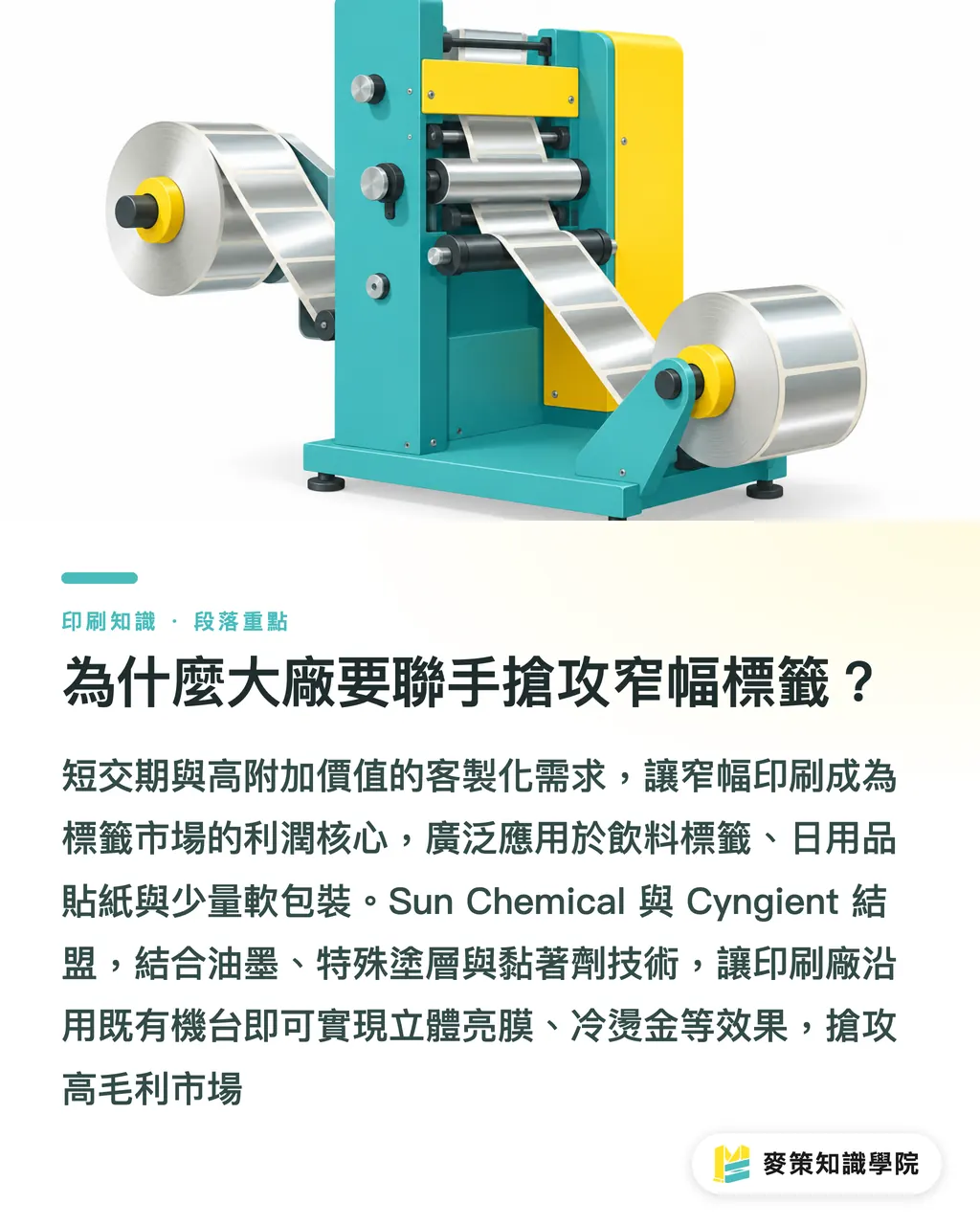
What bottlenecks are traditional coating and bonding processes running into?
Because old multi-station finishing workflows consume too much time and material, they can no longer keep up with brands' need to launch products quickly
From what I've seen over years on production lines and with clients, making a waterproof label with a special tactile finish might once have meant printing four colors, stopping the press, switching to a special-coating station, and sometimes running the job through another machine to apply adhesive to the back. The registration errors and waste this creates can be staggering. Cyngient's strength is its ability to provide high-efficiency coating and bonding solutions that run directly on existing narrow web presses. The co-branded product line it has introduced with Sun Chemical is designed to eliminate those unnecessary stoppages and waits. If color, special visual effects, and the adhesive layer can all be handled in a single pass, that gives converters a direct weapon for cutting their quotes. Alliances like this will show up directly in the print quotes we receive
What do plastic additives have to do with printing?
The visual and functional performance of packaging increasingly depends on the physical properties of the substrate itself, not just the layer of ink on its surface
Sun Chemical followed up by showcasing a combination of DIC.PPS™ and Masterbatch at Fakuma 2026. Masterbatch is a highly concentrated plastic colorant that is blended into plastic during packaging production to keep color uniform and improve material stability
We used to think of color management as a prepress department issue: ink was ink, and the plastic substrate was the substrate. But after working on several flexible-packaging projects recently, I've seen brands set increasingly strict requirements for single-material eco-friendly substrates and heat resistance. When the substrate changes, the first things to go off the rails are ink adhesion and color accuracy. Sun Chemical's move into plastic additives is an attempt to settle the fight between materials and inks at the source. If your product needs a specialized plastic container, this means color and quality control will start from the moment the plastic is injection-molded
How should small and midsize printers and brand clients respond?
The most practical move is to take a fresh inventory of your current consumables suppliers and start testing new integrated coating systems early
With multinational giants concentrating their resources, most small and midsize businesses simply don't have the bandwidth to track every new formula overseas manufacturers roll out. If you're a designer or brand-side professional new to packaging, rather than hunting around for a specialty-coating solution yourself, let a hands-on team like MINDS vet it for you. When we review proofs and place jobs with vendors for clients, we usually watch a few practical details closely:
・Compatibility testing: Whenever you switch to a new substrate or coating, be sure to run a tape-peel test to make sure the ink won't lift off
・Simplify the coating process: Ask the press technician to assess whether a new integrated coating process can replace the multiple film-coating passes used in the past and save on plate costs
・Supply-chain backup plan: Specialty adhesives and inks often have short shelf lives, so you can't rely on a single imported source
Things have been moving fast on the production line lately. Upgrading technology is definitely a good thing, but don't rush into changing materials just to follow the trend. Make sure your end customers are truly willing to pay for that special visual effect, and find a proofing partner who understands material properties. That's the shortest route to avoiding supply shortages and returns
Key Takeaways
・Narrow web label printing has become the main battleground for specialty coatings and high-end adhesives
・Color management and print quality control are gradually moving upstream, into the plastic-substrate additive stage
・Major consumables manufacturers are actively consolidating technologies. Companies that can connect everything from pigments through coating will hold the pricing power
Further Thoughts
For people working in AI applications and SaaS, the alliances among major consumables manufacturers send a clear signal. Future print-quoting and job-ordering systems will need to do more than count colors and identify paper types. They will also need to model substrate properties, specialty-coating steps, and compatibility. The systems that can accurately forecast the costs and lead times of these composite materials will come out on top in the next wave
Further Reading
FAQ
- What is narrow web printing (Narrow Web)?
- It refers to a roll-fed printing method that typically uses web widths under 40 centimeters. The presses are compact and change jobs quickly, making them the mainstream equipment for producing beverage labels, household-product stickers, and short-run flexible packaging today
- Why do printers need to switch to new specialty coatings?
- Today's brand clients often ask for labels with a raised tactile finish or scuff resistance, which conventional inks struggle to deliver on their own. New coatings can create these effects directly on the production line without sending the job out for extra post-processing
- What impact does switching to eco-friendly plastic substrates have on printing?
- Many sustainable materials have different surface tensions, which can keep ink from adhering or make the color rub off easily. That's why ink manufacturers are moving into plastic-additive R&D, trying to solve adhesion problems at the source
Related articles




The Print × AI weekly
The print and AI know-how designers, brands and enterprises can use before they commit — one email, every week
MINDS Free Tools
Spine width and imposition calculators — skip the manual math, free in your browser.
MINDS Group
Need actual printing or gifting services?
From premium printing to online ordering and festive gifts — the MINDS Group sister brands take it from here.