

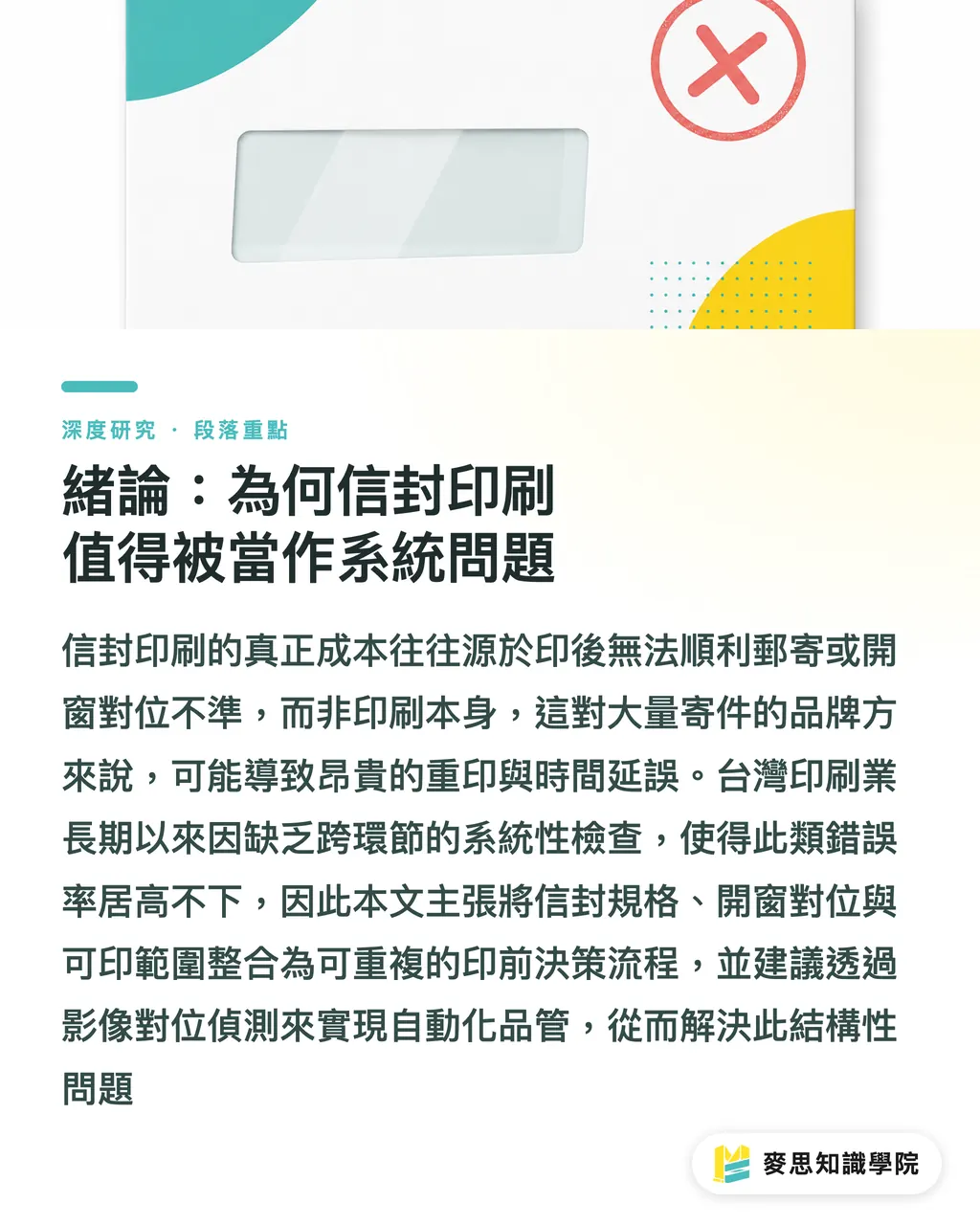
Introduction: Why Envelope Printing Should Be Treated as a Systemic Issue
The cost of errors in envelope printing usually lies not in the printing itself, but in the downstream consequences of items that 'cannot be mailed' or have 'misaligned windows.' For brand owners who send large volumes of direct mail, invoices, or commercial documents, a single misjudgment in specifications can lead to entire batch reprints and delayed mail schedules. The core questions this article seeks to answer are: How can commercial envelope specifications, window positioning, and printable areas be integrated into a repeatable, auditable prepress decision-making process that simultaneously satisfies mailing compliance?
This issue is of practical importance to the Taiwanese industry. Small and medium-sized printing companies in Taiwan have long operated via 'single-process optimization,' where layout, window die-cutting, and postal regulations are managed by different personnel, lacking cross-process consistency checks. This analysis argues that such division of labor is a structural source of high error rates in envelope products, and thus deserves to be redefined from a systems perspective
The contributions of this article include Three:
・First, reconstructing window positioning as a coupled problem constrained by the flap and glue zones
・Second, introducing a research perspective on image alignment detection, illustrating how quality control for mass overprinting can be automated
・Third, proposing actionable suggestions for different tiers (printers, designers, and brand owners)
Literature and Current State Review: The 'Window/Envelope' Discourse Fragmented Across Three Domains
A notable phenomenon in existing searchable academic discourse is that rigorous research related to 'window' and 'envelope' is rarely directly aimed at mailing envelopes; rather, it is scattered across the fields of building envelopes, image processing, and signal analysis. This section reviews these three threads before positioning the research gap addressed by this article
The first thread is the discourse of 'window-to-envelope' in architectural and design history. Related research treats 'window' and 'envelope' as metaphors for interface and enclosure, discussing their visual, structural, and cultural transitions [1][2]. Other studies have used the window-to-wall ratio as a parameter to quantify the impact of window proportions on the overall performance of the building shell [3]. The common stance of this literature is that the window is not an isolated element, but is mutually constrained with the overall envelope. This analysis suggests that this 'proportion and total system coupling' approach can be analogously transferred to envelope window design: the position and area of the window must be determined in conjunction with the envelope's printable area and flap structure, rather than cutting a hole after the fact
The second thread is image alignment detection. Research has used an improved Hough transform to perform window location detection on envelope images [4], with the goal of automatically identifying the window position on the envelope. The value of this methodology lies in transforming the problem of 'whether the window is aligned accurately'—which traditionally relies on human sampling, into a quantifiable, automated image detection task
The third thread is window functions and envelope estimation in signal processing. Related research explores non-parametric envelope estimation under matched window reassignment [5]. Although this belongs to the field of signal analysis, its logic of 'defining the valid region by a window, and then estimating the envelope boundary' is abstractly consistent with the prepress concept of defining printable areas
Synthesizing these three threads reveals both consensus and divergence. All agree that the 'window' and the 'envelope' have a mutually constrained relationship; they diverge because their objects and scales are completely different. More importantly, the gap is that no single thread directly handles the concrete scenario of 'prepress workflows for postal envelopes,' specifically how specifications, windows, printable areas, and postal regulations can be coordinated within the same final artwork. This is the entry point for this article
Core Analysis I: Specifications as the Starting Point for All Decisions
This section argues that the selection of envelope specifications is not merely a formatting issue, but a source decision that simultaneously determines folding methods, feasible window areas, and postal categorization
Common specifications for commercial envelopes in Taiwan are listed below:
・Chinese No. 12: Vertical envelope, commonly used for official documents and invoices
・Western DL: Horizontal long type, most commonly paired with A4 tri-folds, a mainstay for commercial DM and invoices
・12K/20K: Locally common sizing systems, frequently seen for larger documents or catalog mailings
This analysis maintains that specification decisions should follow the order of 'reverse-engineering from the contents': first, determine the folding method and dimensions of the contents, then select the envelope specification, and finally address windows and printing. The reason is that the contents determine the fold lines, and the fold lines determine whether the window can align with the recipient information on the inner page; if the envelope is decided first and the contents are forced inside, window misalignment is highly likely to occur
This sequence is consistent with the stance in architectural envelope research that 'proportions obey the whole' [3]. If the window ratio is set independently of the overall dimensional relationship, the overall performance, in the context of envelopes, the alignment accuracy and postal compliance, will be compromised

Core Analysis II: The Coupled Constraints of Window Positioning and Printable Area
This section argues that window positioning and printable area should not be treated separately, but as a coupled problem mutually constrained by the flap and glue zones
The core challenge of a window envelope is to let the inner page accurately expose the recipient's address through the window. There are at least three layers of constraints:
・The window position must be aligned with the recipient's address area on the inner page, allowing for tolerance for slight shifting of the inner page within the envelope
・The area around the window must avoid the flap and side glue zones; otherwise, wrinkling and contamination are likely during film application or gluing
・Full-bleed or dark printing extending into the glue zone will reduce bond strength, causing the envelope to burst during transit
When these three layers of constraints are considered together, the printable area is effectively the remaining region 'after deducting the flap, glue zones, and window safety margins.' This analysis argues that this is the same logical structure as 'defining the valid range by a window and then estimating the envelope' in signal processing [5]: define the off-limits 'forbidden zones' first, and only what remains is the effective area where the design can be freely applied
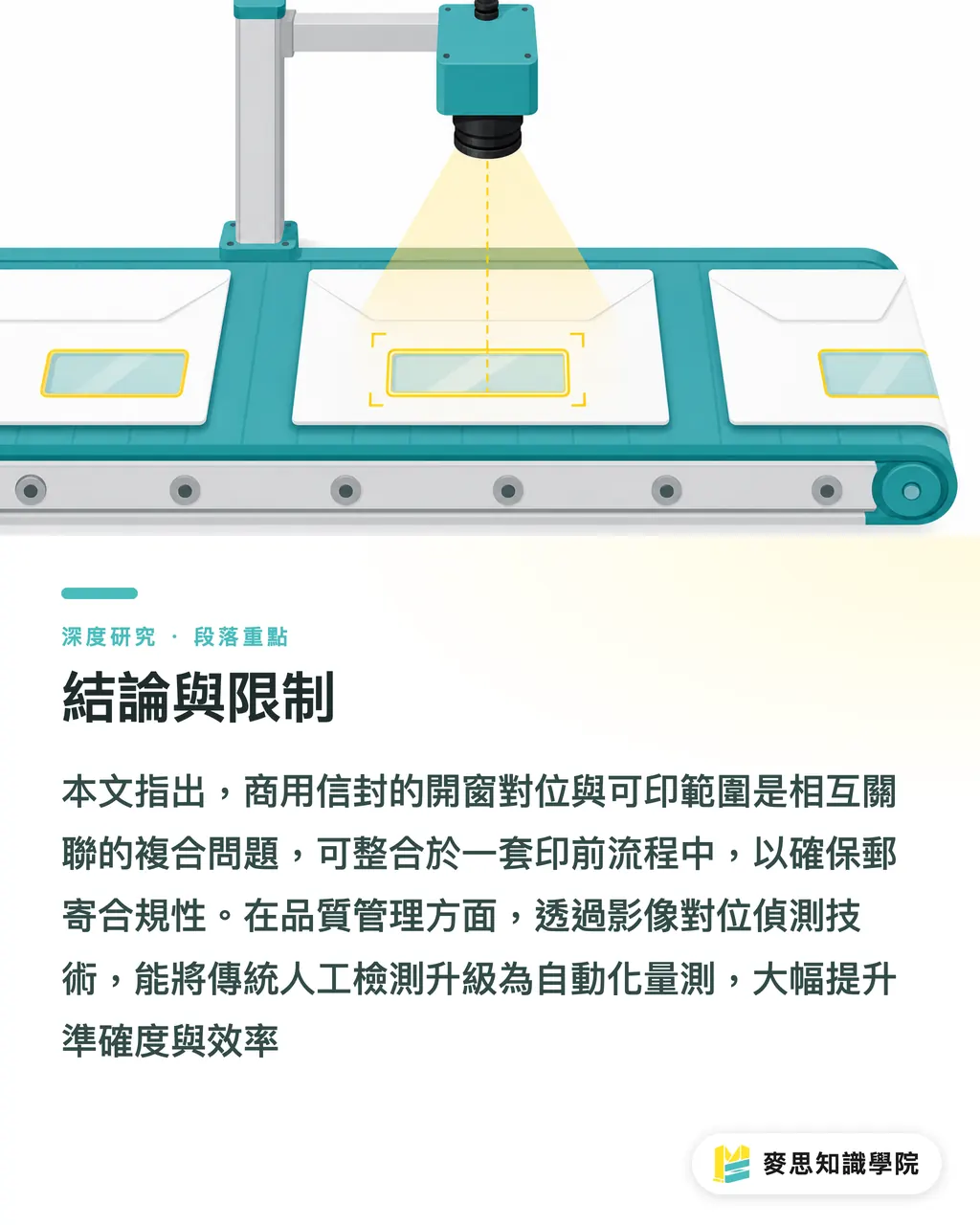
At the quality control level, verification of window alignment can be aided by image detection. The method of detecting window location on finished envelopes using an improved Hough transform [4] provides a technical path to upgrade human eye sampling to automated measurement. For mass mailing, this means relative positions of the window and the inner-page address can be sampled on the production line using image comparison, rather than relying solely on the approval of the first piece
Also, paper weight and stiffness are often underestimated coupling variables. This analysis suggests that because window film weakens the local structure, window envelopes require higher paper stiffness than non-window envelopes; insufficient weight will cause the area around the window edge to collapse, actually amplifying the visual perception of alignment errors
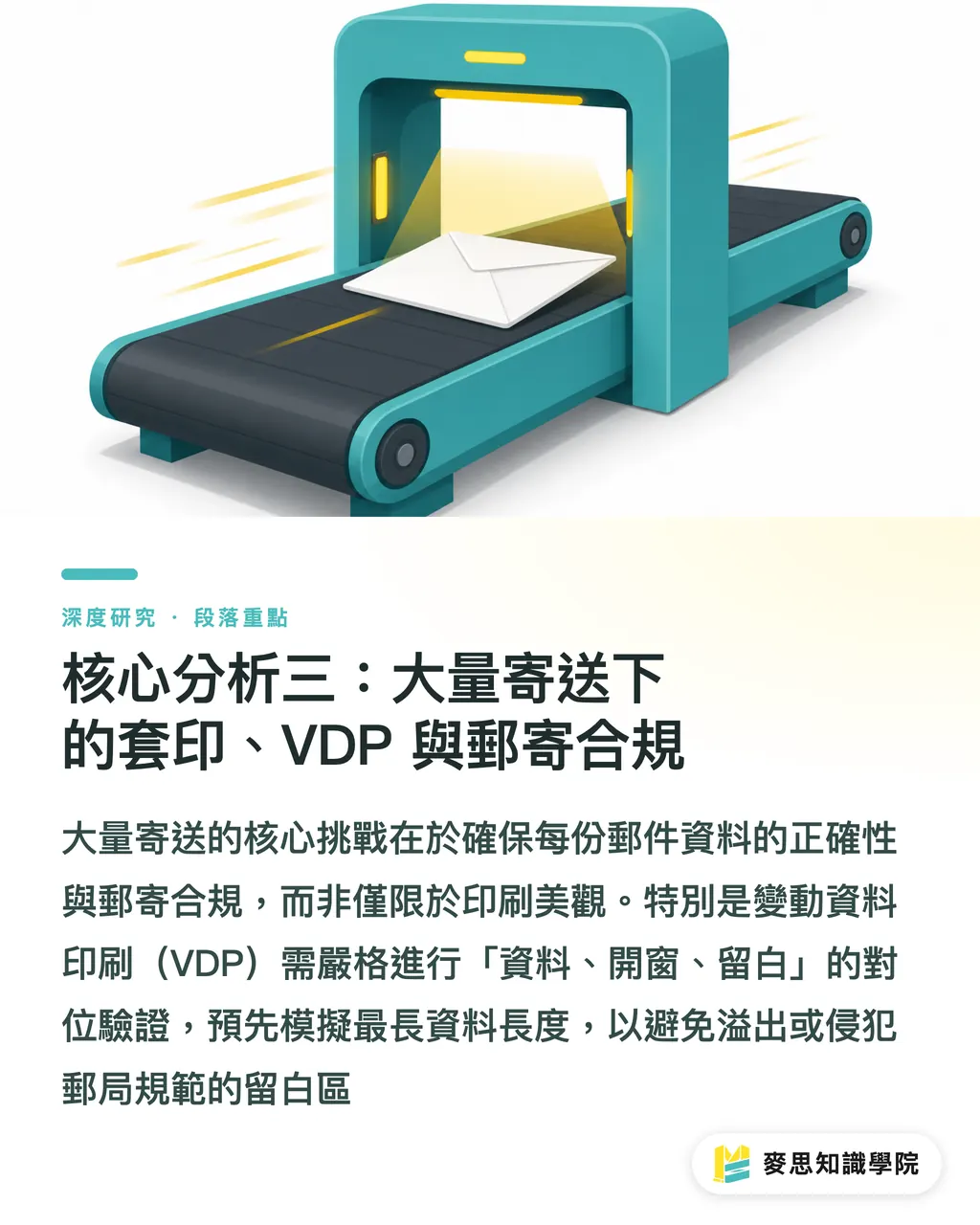
Core Analysis III: Overprinting, VDP, and Mailing Compliance in Mass Mailing
This section argues that when mailing volume reaches a certain scale, the key issue in envelope printing shifts from 'printing beautifully' to 'data accuracy and compliance for every single piece.'
Mass mailing typically involves overprinting and Variable Data Printing (VDP), meaning fixed layouts are printed steadily while recipient names, addresses, and barcodes change for every piece. This analysis argues that the biggest risk of VDP is not print quality, but data alignment: variable fields must be stably positioned within the window's visible area and must not intrude upon the clear zones required by the post office for labeling and barcodes
Mailing compliance can be broken down into several actionable check items:
・Dimensions and weight must fall within the postal office's categorization range for that class of mail; otherwise, it affects postage rates and eligibility for machine sorting
・Sufficient clear space must be reserved for the recipient address area and barcode area to avoid interference with automatic sorting readers
・The reflectivity and transparency of the window film material must meet machine-readable requirements; dark inner pages visible through the window may reduce readability rates
Combining VDP with mailing compliance, this analysis suggests establishing a verification workflow for 'data, window, and clear space': the maximum possible length of a data field (such as the longest address) must be simulated in advance to confirm that it does not overflow the window or intrude into clear zones under any data record. If this step is omitted, errors often only emerge after the entire batch has been printed, or even after the mail has been returned
On the material side, water-based adhesive is a common option for mass mailing. This analysis argues that water-based glue is sensitive to ink absorption and friction during full-bleed printing. If sufficient glue-margin clearance is not left in dark full-bleed areas, the risk of decreased adhesion and back-printing smudge increases simultaneously, making the definition of 'printable area' not just a visual issue, but a material engineering one
Implications for the Taiwanese Design and Printing Industry
This section applies the preceding analysis to specific practices for three types of stakeholders, arguing that cross-process alignment verification should be institutionalized rather than relying on the experience of individual craftsmen
For SMEs, there are three actionable changes: First, establish an integrated checklist covering specifications, window dies, and postal regulations, requiring all three to be cross-verified on the same first-piece approval form. Second, introduce image sampling for window alignment on production lines for mass overprinting, echoing the methodological path of automatic window location detection [4], to simultaneously increase the frequency and objectivity of sampling. Third, for dark full-bleed designs, set default glue-margin rules to lower after-sales costs associated with bursting and back-printing
For designers, the key is to treat windows and clear zones as 'pre-defined forbidden zones' rather than post-production fixes. The specific approach is to place layers for the window frame, glue zones, and postal clear spaces before beginning the layout, and then compose within the remaining area; this is consistent with the research stance that 'proportions obey the whole envelope' [3]. At the same time, designers should check VDP fields using the longest data scenario, rather than previewing with short, illustrative addresses
For brand owners, the implication is to view the envelope as part of a mailing system rather than just a printed product. This analysis suggests that when issuing a project, brand owners should simultaneously provide the folding method of the contents, estimated mailing volume, and mailing method, allowing the printer to reverse-engineer specifications from the contents; projects issued without this information are often the root cause of subsequent reprints. In terms of cost and schedule, the time spent on specification confirmation at the beginning is usually far less than the cost of entire-batch reprints and mail schedule delays
Conclusions and Limitations
Returning to the research questions: Envelope specifications, window alignment, and printable areas can indeed be integrated into a prepress workflow centered on 'reverse-engineering from contents, pre-defining forbidden zones, and verifying data alignment,' while simultaneously meeting mailing compliance. The main finding is that window alignment and printable area are a coupled problem constrained by the flap and glue zones, rather than separate, independent processes; and quality control can use image alignment detection, upgrading from human eye sampling to quantifiable automatic measurement [4]
The limitations of this article must be honestly disclosed. First, the rigorous literature available is mostly concentrated in architectural envelopes, image processing, and signal analysis [1][2][3][5], which are not the same objects as postal envelope printing; therefore, the arguments in this article regarding specific printing processes are largely author analysis based on industry practice rather than empirical results directly ready for citation. Second, postal dimensions and weight regulations change with policy adjustments; this article only provides a structured check logic, and actual values should be based on official announcements at the time of print. Subsequent research can extend in two directions: first, deploying window location detection [4] on local envelope production lines and evaluating error rates; and second, establishing simulation tools for VDP field overflow to quantify the probability of alignment failure under the 'longest data scenario'
Key Takeaways
・Envelope specifications should be determined by reverse-engineering from content folding methods, rather than choosing an envelope and then cramming contents into it, to avoid window misalignment
・Window alignment and printable area are a coupled problem constrained by flaps and glue zones; the printable area is the remaining region after deducting forbidden zones
・Window alignment quality control can draw from the window location detection of improved Hough transforms, upgrading human eye sampling to automatic measurement [4]
・The biggest risk for VDP mass mailing is data alignment; fields must be verified using the longest address scenario to ensure they do not overflow windows or intrude into clear zones
・Glue-margin clearance for dark, full-bleed printing is a material engineering issue that impacts adhesion and the risk of bursting during transit
Reflections for Future Development
For printing and manufacturing, the competitiveness of envelope products is shifting from 'printed well' to 'aligned and compliant in every piece,' which requires the factory to integrate specifications, windows, and postal clear spaces into a single auditable check workflow. On the design side, the habit of defining forbidden zones before composing can significantly reduce return costs. The adoption of AI and image detection is the most worthy direction for investment: window alignment detection [4] already has a methodological foundation and can serve as the starting point for automated production line sampling. For SaaS, the problem to be solved is to build a cloud-based proofing tool that can simulate the longest VDP data scenarios and automatically flag conflicts between windows and clear zones, distilling the judgment currently scattered in the experience of master craftsmen into a repeatable rule engine
References
[1] In the Kiosk Window. The Black Envelope. DOI: 10.12987/9780300188622-001
[2] Höweler E. (2025). From Window to Envelope. Design for Construction. DOI: 10.4324/9781003434559-7
[3] Altun A. (2022). Determination of Optimum Building Envelope Parameters of a Room concerning Window-to-Wall Ratio, Orientation, Insulation Thickness and Window Type. Buildings. DOI: 10.3390/buildings12030383
[4] Zenghui N. (2010). Window Location for Envelope Image Based on Improved Hough Transform. 2010 International Forum on Information Technology and Applications. DOI: 10.1109/ifita.2010.36
[5] Reinhold I., Sandsten M. (2021). Non-parametric Envelope Estimation for the Matched Window Reassignment. 2021 29th European Signal Processing Conference (EUSIPCO). DOI: 10.23919/eusipco54536.2021.9616053
FAQ
- How can the window position of a window envelope be aligned with the inner-page address?
- The address area position should first be determined by the folding method of the contents, then the window should be set accordingly, incorporating tolerance for inner-page shifting within the envelope; for mass printing, image detection can be used to sample the relative position of the window and the address
- Does the printable area of an envelope include the flap and glue zones?
- No, it does not. The printable area is the remaining region after deducting the flap, glue zones, and window safety margins. Extending artwork into glue zones will reduce adhesion and cause back-printing smudge
- What compliance issues should be noted for mass-mailed envelope printing?
- It is necessary to confirm that dimensions and weight fall within postal classification ranges, reserve clear space for addresses and barcodes, and ensure that the transparency of the window film meets machine-reading requirements
- What is VDP, and why is it needed for envelope mailing?
- VDP (Variable Data Printing) refers to a printing method where the fixed layout remains unchanged while recipient information changes piece by piece. It is suitable for large-scale personalized mailing, with the focus being that variable fields must stably fall within the window's visible area and clear zones
- What problems are dark, full-bleed envelopes prone to?
- If dark, full-bleed printing extends into glue zones, it weakens bond strength and increases the risk of bursting. It is also more prone to friction-induced back-printing, so sufficient glue-margin clearance must be reserved
References
- In the Kiosk Window · doi.org
- From Window to Envelope · doi.org
- Determination of Optimum Building Envelope Parameters of a Room concerning Window-to-Wall Ratio, Orientation, Insulation · doi.org
- Window Location for Envelope Image Based on Improved Hough Transform · doi.org
- Non-parametric Envelope Estimation for the Matched Window Reassignment · doi.org
Related articles


The Print × AI weekly
The print and AI know-how designers, brands and enterprises can use before they commit — one email, every week
MINDS Free Tools
Spine width and imposition calculators — skip the manual math, free in your browser.
MINDS Group
Need actual printing or gifting services?
From premium printing to online ordering and festive gifts — the MINDS Group sister brands take it from here.