

Overview
When foil stamping plus embossing goes out of register, it is usually not because one single process has spun out of control. The foil stamping die and embossing die are two separate sets of tooling, each with its own possible shift, and the paper can also deform under pressure. Before production, MINDS (MS, mid- to high-end fully custom commercial printing) checks three things: separated black artwork layers, fine lines and small type, and safe registration tolerance. Only then does it decide whether to run the processes separately or switch to a combined foil-and-embossing die

Why Are Foil Stamping and Embossing So Easy to Misalign?
Registration tolerance means the acceptable margin of error between color plates, foil stamping dies, embossing dies, and other printing or finishing plates. On production floors in Taiwan, this usually has to be confirmed based on paper thickness, artwork size, machine setup, and process order. You cannot judge it only by the perfect overlap you see on screen
I have seen plenty of luxury box files where the logo overlaps 100% on screen, only for the production line to reveal that the foil edge and raised contour are off by half a hairline. Consumers may not be able to name that distance, but once they hold the package, it feels just a little crooked
Foil stamping and embossing need to be treated separately because they are not the same action
・Foil stamping: heat and pressure transfer metallic foil onto the paper surface. Pressure, temperature, and foil adhesion all affect how clean the edges look
・Embossing: male and female dies press the paper into a raised form. Once the fibers are compressed, they stretch, and the edges deform slightly
・Registered foil embossing: the foil artwork and raised artwork sit in the same position. It gives the most refined look, but has the lowest tolerance for error
When MINDS reviews this kind of file, it first treats the "foil stamping die" and "embossing die" as two independent finishing processes. It does not assume they will automatically land flush. The finer the artwork, the earlier this judgment needs to be made. That saves money later
How Does the Finishing Sequence Affect the Final Product?
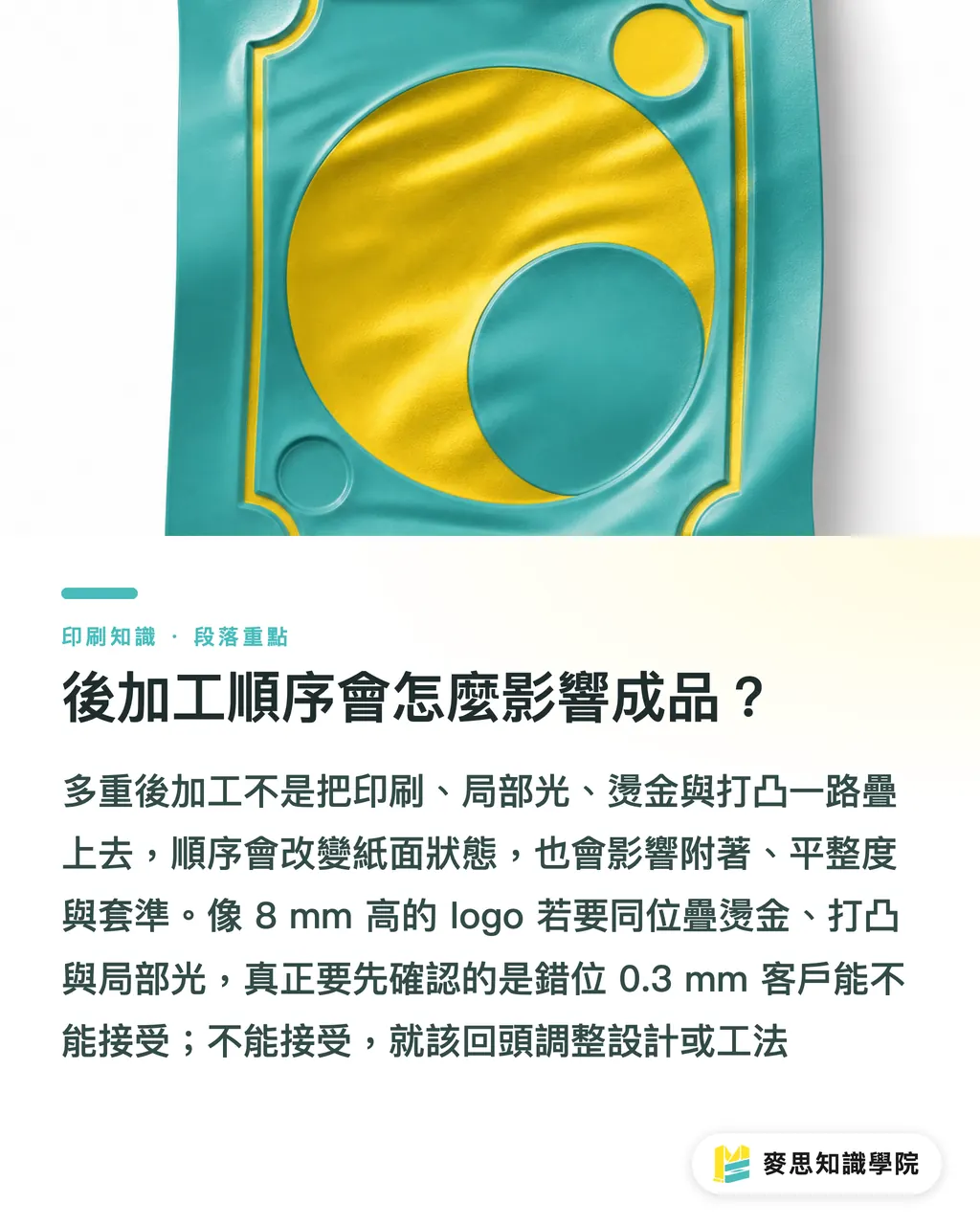
Multi-step finishing is not just a matter of stacking effects on top of each other. The sequence changes the state of the paper surface. Luxury packaging commonly involves at least four steps: printing, coating or spot gloss, foil stamping, and embossing. Each one can affect adhesion, flatness, and registration in the next step
A practical way to judge it is this
・Foil stamping before embossing: the metallic foil is positioned first, then the raised effect is pressed in. The result looks crisp, but embossing pressure can pull at the foil edges
・Embossing before foil stamping: the paper surface is already uneven, so it is harder for later foil stamping pressure to stay even. Fine lines and small type are more likely to look dirty
・Spot gloss with foil stamping: spot gloss changes surface adhesion conditions, so the foil area should avoid the built-up edges of thick gloss varnish
・Foil stamping, embossing, and spot gloss all in the same area: the visual impact is rich, but registration and adhesion risks rise together. This usually needs proofing to confirm
My own judgment is very direct: if a brand logo is only 8 mm tall and you still want registered foil stamping, embossing, and spot gloss stacked in the same place, it is not impossible. But you first need to ask, "Will the client accept it if it is off by 0.3 mm?" If not, change the design or the production method
When Should You Use a Combined Foil-and-Embossing Die?
A combined foil-and-embossing die handles foil stamping and the raised effect in the same press impression. In Taiwan packaging production, it is often used for logos, emblems, wordmarks, and other artwork that requires tight registration. The goal is to reduce the registration gap caused by running the job in two separate passes
When a printer recommends a combined foil-and-embossing die, it is usually not trying to make the specification sound complicated. It has likely seen that the file has entered the zone where two separate passes will make edge flaws easy to spot. This is especially true for front-facing logos on luxury boxes, emblems on wine packaging, and foil-stamped type on fragrance packaging. Clients inspect these areas closely, and tiny errors get magnified
A more practical judgment looks like this
・Good fit for a combined foil-and-embossing die: concentrated logo area, high registration requirements, and foil and raised contours that nearly overlap
・Good fit for separate processing: foil stamping and embossing are on the same page but in different areas, with enough distance between them, and the visual effect does not depend on perfect overlap
・Not recommended for forced stacking: ultra-fine English type, decorative lines smaller than normal readable size, or dense patterns that still demand perfect registration
A combined foil-and-embossing die is not a cure-all. It involves die cost, artwork limitations, pressure control, and how much the paper can tolerate. When MINDS evaluates this kind of project, it usually splits the artwork into two black layers first: one for the foil surface and one for the embossing height, then checks whether the two truly must register exactly
How Should Designers Allow for Safe Tolerance?
Black artwork refers to the single-color file used for finishing plate making. It usually uses 100% black to mark the areas for foil stamping, embossing, spot gloss, or other special finishing. When submitting files in Taiwan, black artwork should be separated into independent layers and named clearly to prevent misreading during plate making
The MINDS three-step prepress check can be added directly to the design workflow, especially for high-risk files involving foil stamping plus embossing
・① Clear black artwork layers: foil stamping, embossing, and spot gloss should each have their own independent layer. Do not mix them into the CMYK print artwork
・② Enlarged inspection of fine lines and small type: check logos, English text, and borders at actual size. If an element is so fine that you need to zoom in to see it clearly, it will usually be even harder to keep stable after plate making
・③ Safe registration distance planned early: registered effects need an agreed tolerance. Different finishing areas should also keep enough distance so they do not interfere with each other
I ask designers to make one "finishing relationship map" at the draft stage, using three colors to mark foil stamping, embossing, and spot gloss. This map may not be something you show the client, but the printer will know at a glance that you are designing luxury packaging, not gambling on luck
If the budget allows, a physical proof is worth more than on-screen proofing. This is especially true for dark paper, thick card, textured paper, and foil stamping after matte lamination. It is hard to judge foil adhesion and raised texture from a screen, so at least one proof should be made for the key area
How Should Buyers Estimate Waste Costs for Multi-Step Finishing?
Yield assessment is not just about asking for the unit price. It means asking three things: how much registration risk each extra finishing step adds, how much inspection time it adds, and how much waste is acceptable
When comparing quotes, buyers often see only "how much for foil stamping, how much for embossing, how much for spot gloss." But the cost of multi-step finishing is not just the sum of three unit prices. What really affects schedule and budget is where the job gets scrapped halfway through
・Foil stamping fails after printing: the waste includes printed sheets and earlier production time
・Embossing goes out of register after foil stamping: the waste is a semi-finished piece that already includes printing and foil stamping, so the cost is higher
・Poor foil adhesion is discovered after spot gloss is complete: there is usually very little room for rework, so the job may need to be redone
・A shifted front logo is discovered only after box assembly: inspection and rework costs grow much larger
Buyers can ask the printer to list four fields before quoting: process sequence, key risks, whether proofing is recommended, and whether extra waste should be reserved. The table does not need to look fancy, but it makes the line of responsibility much clearer
If the brand is aiming for a high-end look, the consulting team at Mai Strategy Knowledge Academy usually recommends doing a "process feasibility check" before moving into volume pricing. Spending one round of time to clarify the die, paper, foil, and sequence is cheaper than having a whole batch of finished products rejected later

Key Takeaways
・The biggest risk in registered foil stamping and embossing is not that the process cannot be done. It is that the design file treats tolerance as if it does not exist
・Multi-step finishing needs the sequence planned first, because every step changes the paper surface and the stability of the next step
・A combined foil-and-embossing die works well for tightly registered logos, but paper, artwork detail, and die cost still need to make sense
・Before designers submit files, they should run the MINDS three-step prepress check. Missing any one of black artwork layering, detail size, or registration distance can cause trouble
・When buyers evaluate luxury packaging, they need to ask about yield and waste, not just the unit price of each finishing process
Further Thinking
On the manufacturing side, printers can turn foil stamping, embossing, and spot gloss into a standard process risk table. On the design side, AI-assisted image generation or SaaS online proofing can add a "finishing layer check" field. On the buying side, proofing, waste, and inspection need to be written into quote discussions. The next step is simple: before plates are made for any luxury packaging project, use one finishing relationship map to confirm three things: which process goes first, which two processes must register, and how much deviation will trigger a return
FAQ
- Will foil stamping plus embossing always go out of register?
- Not always, but the foil stamping die and embossing die are two finishing tools that can each shift on their own. The smaller the artwork and the tighter the registration requirement, the more obvious the misregistration risk becomes. For luxury packaging, it is best to allow safe tolerance during the design stage and confirm it through proofing
- Which should come first, foil stamping or embossing?
- The common approach is to decide based on paper, foil, artwork size, and registration requirements. There is no single fixed answer. Foil stamping before embossing is often used when the metallic foil position needs to stand out, but you still have to check whether embossing pressure will affect the foil edges
- When is it better to switch to a combined foil-and-embossing die?
- Artwork such as logos, emblems, and wordmarks, where the foil and raised contours nearly overlap, can usually be evaluated for a combined foil-and-embossing die. It can reduce the registration gap caused by two separate passes, but die cost, paper pressure tolerance, and artwork detail must also be confirmed
- What should designers watch for when preparing foil stamping and embossing files?
- The black artwork for foil stamping, embossing, and spot gloss must be clearly separated into layers, and fine lines and small type should be checked at actual size. The MINDS three-step prepress check looks at black artwork layering, detail size, and safe registration distance. These three basics help reduce misregistration risk
- How should buyers estimate waste for multi-step finishing?
- Buyers should ask the printer to list the process sequence, key risks, whether proofing is needed, and whether extra waste should be reserved. The cost of multi-step finishing is not just the unit price. It also includes scrapped semi-finished pieces, inspection time, and rework risk
Related articles





The Print × AI weekly
The print and AI know-how designers, brands and enterprises can use before they commit — one email, every week
MINDS Free Tools
Spine width and imposition calculators — skip the manual math, free in your browser.
MINDS Group
Need actual printing or gifting services?
From premium printing to online ordering and festive gifts — the MINDS Group sister brands take it from here.